How much do Facebook ads cost in 2026?


Creative fatigue eats roughly 31% of the average Facebook ad budget — more than iOS attribution loss, more than CPM inflation, more than any bid mistake. A better-targeting fix won't close that gap; more ads, faster will. So when someone asks how much do Facebook ads cost in 2026, an honest answer starts with a confession: every benchmark report you've read models the media half of the bill and ignores the creative half. Top-spending brands ship 12–19 new creatives a week. Mid-tier ships 6–7. If your 2026 math still prices one ad at $200, you're losing before the auction starts.
How much do Facebook ads cost: the short answer
Total Facebook ad cost in 2026 = media spend + creative production + tools + iOS/DST surcharges. Media runs $0.44–$1.92 per click and $7–$16 per 1,000 impressions depending on industry and objective. Creative production adds $50–$10,000 per asset if you hire it out. Tools and tracking add $100–$500 per month. iOS boosts add 30%, EU/UK location fees add 2–5%.
One sentence, four line items — and it's the piece every competing guide skips. Media alone answers maybe half of the question. Creative, tools, and platform surcharges answer the rest, and the creative line is the only number a small advertiser actually controls.
What Facebook ads cost actually includes
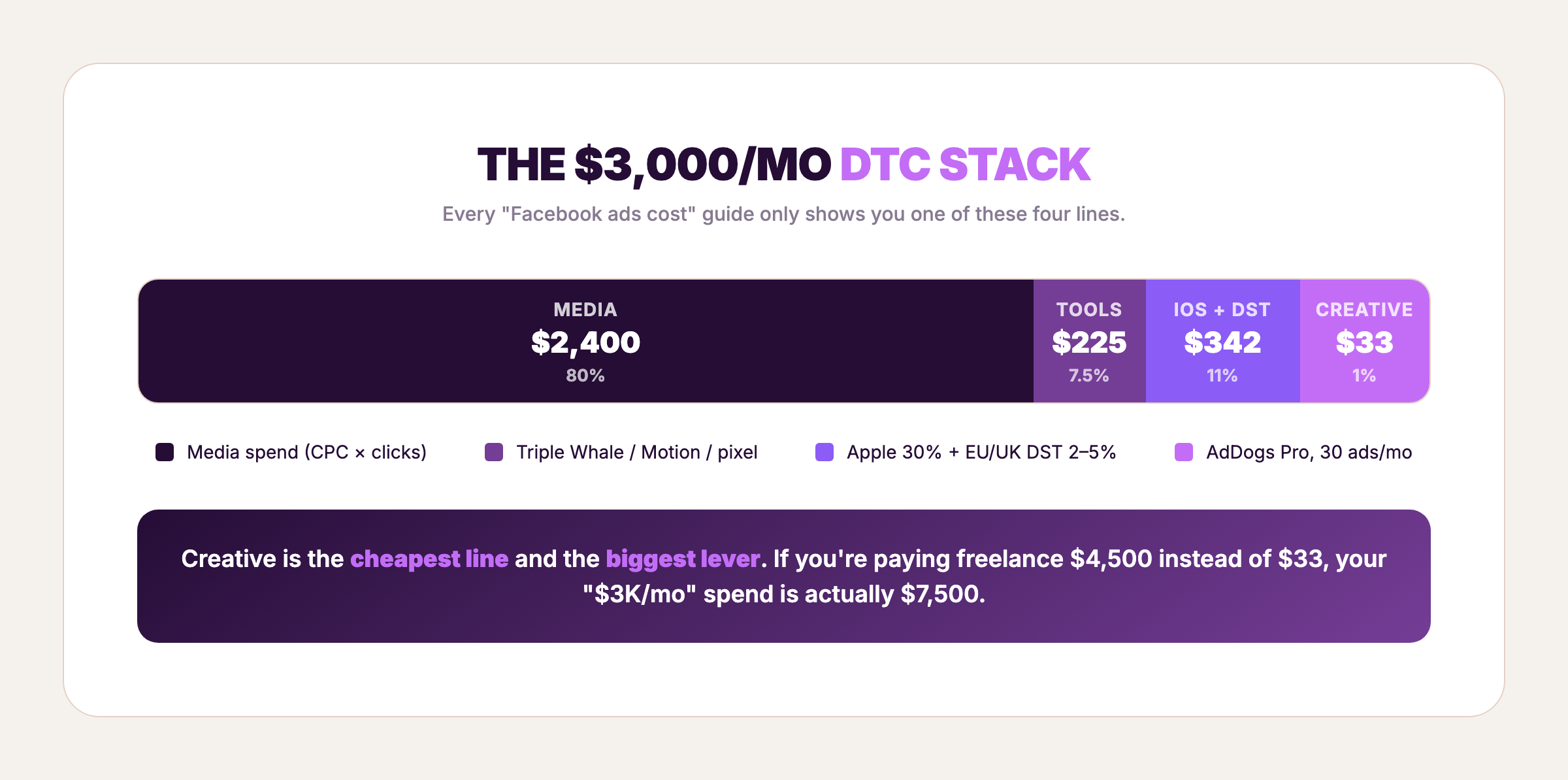
Four line items stack into what the credit card statement shows at the end of the month. Most guides cover one of them.
Media spend (the only line every guide covers)
Media is what Meta charges for impressions and clicks in the auction. CPC, CPM, CPA, CPL — every benchmark in every listicle measures this line. It's real, it's the largest single line item for most accounts, and it's also the line you have the least control over. You can shift objective, shift geo, shift placement. You cannot shift the auction floor once competitors show up.
Creative production (the line they skip)
Creative is what it costs to produce the ad you're paying media to distribute. A static image from a Fiverr freelancer: $50–$300. A short-form UGC video: $150–$300 per asset, with premium creators running $300–$500 and beyond. Professional short-form video: $300–$2,000+. Usage rights and whitelisting can add 30–50% on top of the base rate.
Most "Facebook ad cost" guides skip creative pricing entirely. Feedbird lists a dollar range but treats freelance as inevitable. WordStream mentions testing variations with no numbers attached. Shopify doesn't touch it. For a DTC brand running 50 creatives a month, creative is the largest controllable line in the account — and the one every benchmark pretends doesn't exist.
Tools and tracking
Triple Whale, Motion, Northbeam, Hyros, pixel infrastructure, server-side tracking, conversion APIs. A small-budget account can skip most of this. A serious account runs $100–$500/month at minimum. Meta reports 4 million+ advertisers now use its generative AI tools, up from 1 million six months earlier, and many of those live inside third-party ad-ops stacks that bill a separate monthly fee.
Hidden surcharges (iOS 30%, DST 2–5%)
Two platform fees didn't exist three years ago. Apple applies a 30% App Store fee when you boost a post through the iOS Facebook or Instagram app — a policy that rolled global in July 2024 and Meta hasn't reversed it. Buying from the web avoids it entirely; most small advertisers don't know. Meta's new Location Fees layer a 2–5% Digital Services Tax pass-through on top of ads delivered into the UK, France, Italy, Spain, Austria, and Turkey, with full billing effective July 1, 2026.
Sum those four lines for any given month and you get the actual Facebook advertising cost. Ignore the last three and you're working with the same incomplete picture every "2026 benchmark report" gives you.
Facebook ads cost per click (CPC) in 2026
CPC benchmarks are the easiest number to find and the hardest to trust. Published figures disagree by 4x across reputable sources, and each source pulls from a different customer base.
Why sources disagree
Four of the biggest "Facebook ads cost per click" numbers in circulation right now, plotted on one line:
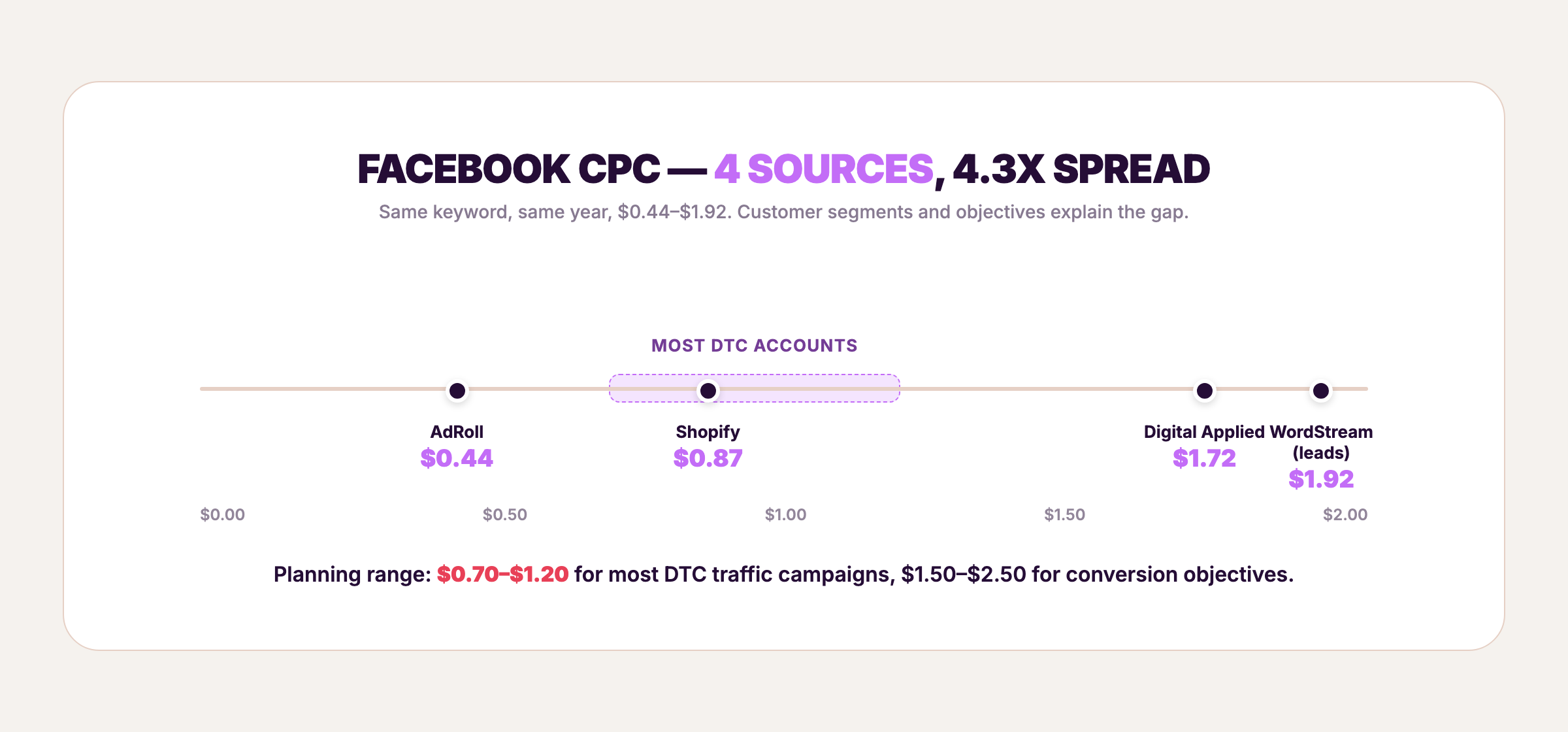
A 4.3x spread on the same keyword in the same year. Customer segments explain most of it: AdRoll's set skews smaller and retargeting-heavy, WordStream skews local-service lead-gen, Digital Applied aggregates Q1 2026 industry datasets, Shopify cites Revealbot. None of those sources are wrong; they measure different slices of Meta's auction.
CPC by industry
Verticals diverge further than totals suggest. WordStream's 2025 set shows dentists around $9.78 CPC, legal around $4.10, restaurants $0.74, employment $0.86. Beauty and personal care — the vertical most DTC readers live in — runs about $3.06 CPC on WordStream's set, roughly 2x the cross-industry average. If you sell sub-$40 physical goods to a broad consumer audience, AdRoll's $0.44 probably feels closer to lived reality.
CPC by campaign objective
Objective matters more than vertical. Digital Applied's 2026 benchmarks break it out cleanly: traffic campaigns average around $0.70 CPC, lead-gen around $1.92, and conversion-optimized campaigns higher still. Meta charges more for clicks it believes are likelier to convert.
Facebook ads cost per 1,000 impressions (CPM) in 2026
Meta ads cost per thousand impressions — CPM — is where 2026's inflation story lives. Every vertical moved up. No vertical held flat.
Current CPM
| Metric | Value | YoY Change | Source |
|---|---|---|---|
| Global median Meta CPM | $14.19 | +20.03% | Triple Whale, Apr 2026 |
| US-specific Meta CPM | $20.48–$23.00 | +18% | Affect Group / AdAmigo, Q1 2026 |
| Meta CPA (global median) | $38.19 | +1.04% | Triple Whale, Apr 2026 |
| Meta CTR (global median) | 2.19% | +13.5% | Triple Whale, Apr 2026 |
Triple Whale's dataset — 35,000 DTC brands — is the tightest read on DTC-specific Meta costs. Every industry saw CPM increases year over year. No vertical was spared.
CPM by vertical
Vertical spread matters because your true cost depends on which auction you're actually in.
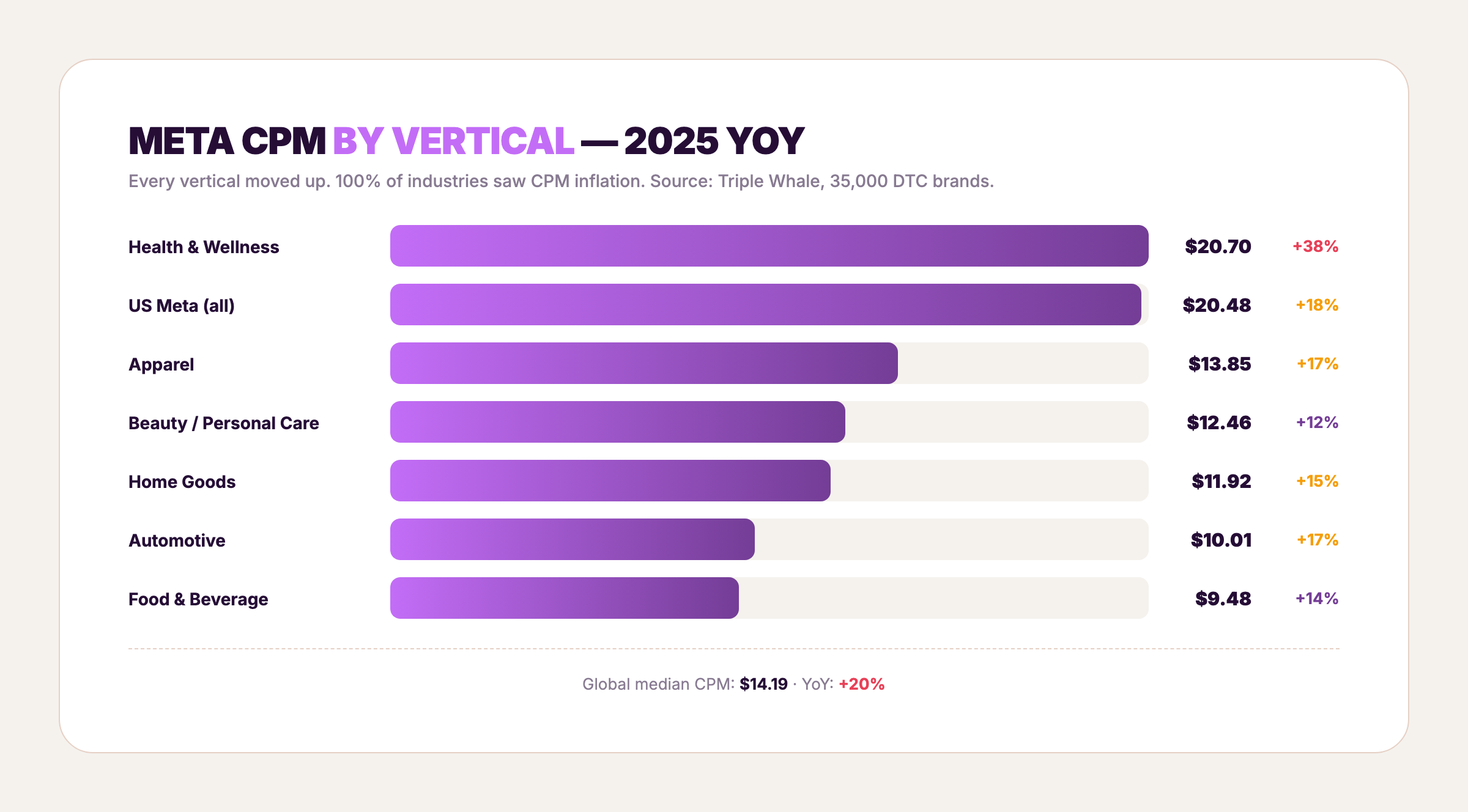
Source data: Triple Whale, Apr 2026 (35,000 DTC brands) for vertical medians; Affect Group, Q1 2026 for US all-vertical benchmark.
Health and Wellness pulling +38% is the standout. Supplements, skincare, and wellness SaaS advertisers are crowding the same auction with identical offers, which means higher bids and higher floors. Automotive, by contrast, carries a lower absolute CPM because the auction is thinner.
Why CPM is up 20% YoY
Three forces stack. First, auction compression — more advertisers using AI means more bids per impression. Second, iOS attribution loss still pushes campaigns toward broader, more expensive audiences. Third, economic and regulatory pressure — fees that used to be invisible are now line items Meta passes straight through. Expect continued upward pressure in 2026 and 2027 absent a real recession.
Cost per lead and cost per acquisition
CPL and CPA are downstream metrics. Both depend entirely on conversion rate, which depends on creative, which depends on the line item most guides ignore. Still, planning ranges help.
CPL benchmarks
Lead-gen CPLs in 2026 range from $3 (restaurants, per WordStream) to $76 (dental), with most professional-services verticals sitting around $15–$35. DTC and ecommerce founders mostly won't care — they're optimizing for purchase, not lead.
Advantage+ CPA claim and the n=31 problem
Meta's most-cited Advantage+ Shopping statistic is a +32% ROAS lift and a −17% cost-per-purchase reduction vs manual setups. Every agency pitch deck uses it. Almost none disclose the sample size: 31 advertisers in Meta's own internal test, circa 2023, not publicly archived. Treat the 32% figure as directional, not definitive — a 31-advertiser result repeated thousands of times without triangulation. Run Advantage+ if your account is below $100K/month. Don't build your financial model on the delta.
Creative cost: the Facebook advertising cost line nobody adds
Creative is the line every competing guide skips. For a brand running 30 ads a month, creative is often the largest controllable line in the account. It's also the line that decides whether you beat the 31% fatigue tax or absorb it.
Freelance baselines
Published 2026 rates from Fiverr, Upwork, and the agency pricing surveys break down this way:
| Asset Type | Low | Mid | High | Source |
|---|---|---|---|---|
| Static ad (single image) | $50 | $150 | $300 | PixelPanda / Feedbird, Mar 2026 |
| Short-form UGC video | $150 | $300 | $500+ | PixelPanda, Mar 2026 |
| Professional short-form video | $300 | $1,000 | $2,000+ | Superscale, 2025 |
| Premium pro video / studio | $2,000 | $5,000 | $10,000+ | Feedbird, Mar 2026 |
| Usage rights surcharge | +30% | — | +50% | PixelPanda, Mar 2026 |
A dropshipper testing 30 new static ads a month through Fiverr pays roughly $150 per asset — $4,500 a month in creative alone. Media to serve those ads at a reasonable frequency cap lands in the same range. Creative is half the budget, and it's the half nobody models. For when each format earns its production cost, see static vs video ad cost tradeoffs.
AI creative pricing matrix
Published pricing for every AI ad tool an ecommerce founder might consider:
| Tool | Monthly Price | Ads Per Month | Cost Per Ad | Logo Support | Source |
|---|---|---|---|---|---|
| AdDogs Basic | $12 | 30 | $0.40 | Pro+ plans | AdDogs pricing, Apr 2026 |
| AdCreative.ai | $39 | 10 credits | $3.90 | Yes | AdCreative.ai pricing, Apr 2026 |
| Canva Pro | $13 | Unlimited (manual) | — (time-bound) | Yes | Canva pricing, Apr 2026 |
| Pencil | $49 | Varies by seat | Varies | Yes | Pencil pricing, Apr 2026 |
| Fiverr freelancer | Project-based | 1 per project | $100–$500 | Yes | Fiverr marketplace, Apr 2026 |
AdCreative.ai charges $39 a month for 10 credits — $3.90 per ad. Pencil runs $49 a month on per-seat pricing. Canva Pro costs $13 a month but still requires manual layout, export, and resize work — cheap tool, expensive time. Fiverr sits at $100–$500 per static ad, project-based, before usage rights. For a head-to-head between specific tools, see AdDogs vs AdCreative.ai or which AI model makes the best ads. For the layouts these tools actually produce, ad examples by industry catalogs winners you can clone directly.
Doing the math — 30 ads/mo, freelance vs AI
Top-performing brands in Motion's 2026 Creative Benchmarks study — drawn from 550,000+ Meta ads and 6,000+ advertisers across $1.3B in spend — ship 12–19 new creatives per week. That's 48–76 ads a month. Mid-tier accounts ship 6–7 a week, or roughly 24–28 a month. 30 ads a month is the minimum viable production volume to stay ahead of creative fatigue at a real spend level. The lever is volume, not hit rate: top-quartile accounts ship 1.7 to 2.9 times the tier median and land two to three times the winners while hit rate barely moves, and the state of AI in advertising 2026 report puts those benchmarks next to what AI-made creative cost the brands that got caught.
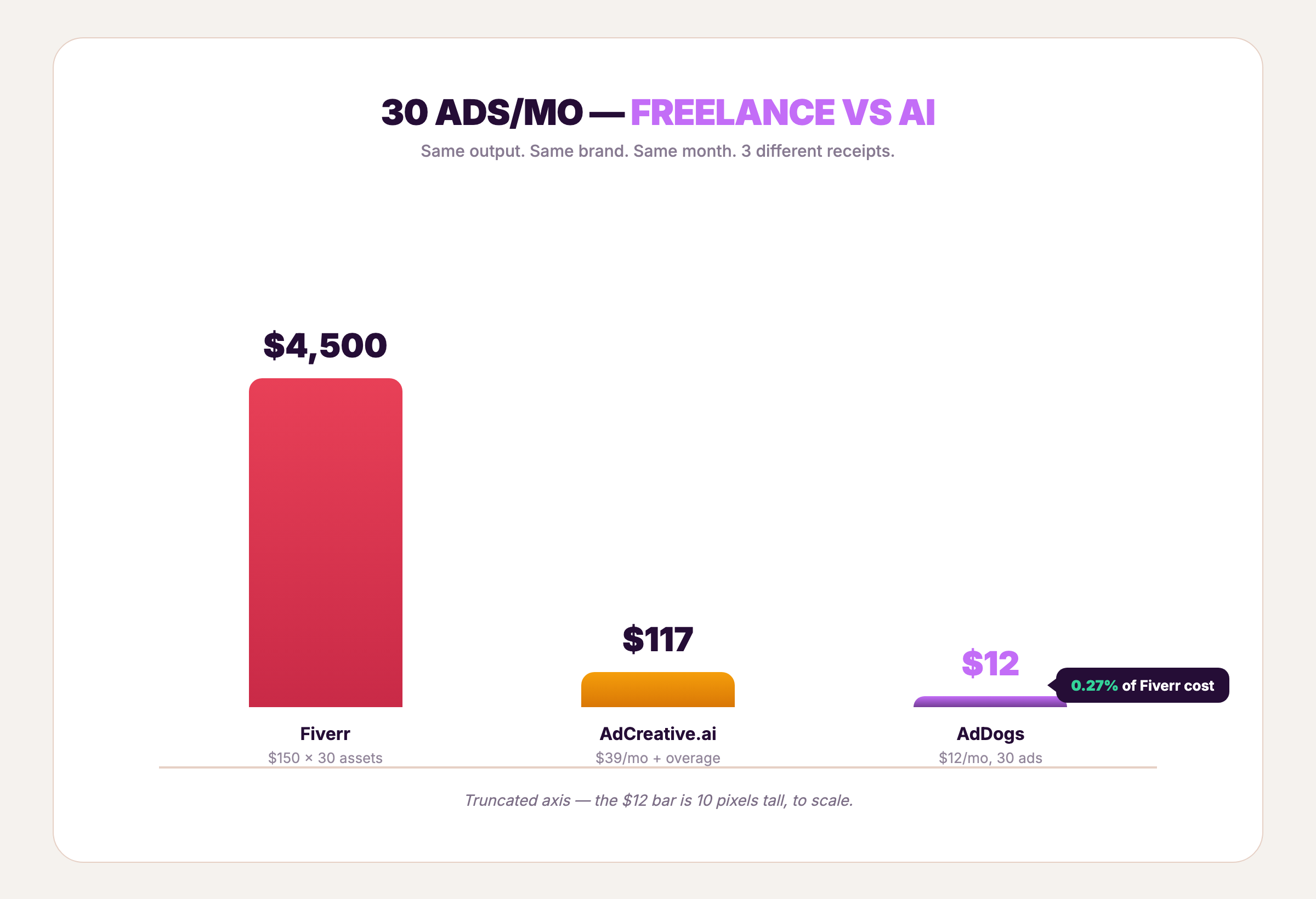
AdDogs ships 30 static ads for $12 — $0.40 per ad. Full stop.
A delta between $4,500 and $12 isn't a rounding error. It decides whether the rest of the budget survives the auction. AdCreative.ai's $3.90/ad sits between — cheaper than freelance, still ~10x the low end, with output capped by their template engine. The cost delta is the argument on its own.

Create your own static product ads
Create your ad
How much to spend on Facebook ads (3 budget personas)
How much to spend on Facebook ads depends on which tier you're building for. Three budget personas cover most founder situations. Each persona below splits the full stack — media, creative, tools — at a reasonable ratio for that tier.
Dropshipper testing — $500/mo
| Line Item | Monthly | Notes |
|---|---|---|
| Media spend | $400 | $13/day across 1–2 ad sets |
| Creative production | $12 | AdDogs Basic, 30 static variants |
| Tools (Shopify analytics, pixel) | $0–$50 | Native tools only |
| Total | ~$450–$500 | — |
At this tier the entire strategy is volume. One ad a week won't exit learning phase in most auctions. Thirty static variants a month is the minimum to find a winner before fatigue kills the account. See how to test Facebook ad creative without burning budget for the testing cadence that matches this tier.
Scaling DTC brand — $3,000/mo
| Line Item | Monthly | Notes |
|---|---|---|
| Media spend | $2,400 | $80/day, 3–4 ad sets |
| Creative production | $12–$33 | AdDogs Basic or Pro, 30–100 variants |
| Tools (Triple Whale, Northbeam) | $150–$300 | Attribution stack |
| Total | ~$2,600–$2,800 | — |
At $3K/month the creative math is still the lowest line item if you're using AI. Real room opens up on the media side: $80/day per ad set gets most verticals out of learning phase in 7–10 days if the CPA target is realistic. Creative cadence should push to 50–75 new assets a month to keep fatigue below the 31% tax floor.
Established DTC — $10,000/mo
| Line Item | Monthly | Notes |
|---|---|---|
| Media spend | $8,500 | $283/day across 5–8 campaigns |
| Creative production | $33–$500+ | AI for bulk variants, UGC for hero campaigns |
| Tools (attribution, creative ops) | $300–$800 | Motion, Triple Whale, server-side |
| iOS / DST exposure (if EU/UK) | $0–$500 | 2–5% of applicable spend |
| Total | ~$9,000–$10,000 | — |
At this tier, creative becomes a portfolio decision, not a line-item decision. AI handles the bulk of static variants (100+/month). UGC gets commissioned selectively for hero campaigns. Attribution stack earns its cost because downstream CAC math moves with it. At $10K, the iOS boost trap and DST exposure start producing real dollars — a $10K account sending 40% of impressions into UK and France pays an extra ~$120/month that's pure platform skim unless you exclude those geographies from specific campaigns.
Facebook ads minimum budget and the learning-phase trap
"What's the Facebook ads minimum budget?" is the most common question from first-time advertisers. Meta's UI accepts $1/day. That is not the real floor.
Meta's 50-event rule
Meta's Business Help Center documents the learning phase at ~50 optimization events in 7 days per ad set to exit and stabilize. Below that threshold, ad sets sit in "Learning Limited" and the algorithm doesn't accumulate enough conversion signal to optimize against. Meta has lowered the floor to 10 events on select Purchase-optimized and Mobile App Install placements, but 50 remains the default for most objectives.
Why $5/day never exits learning phase
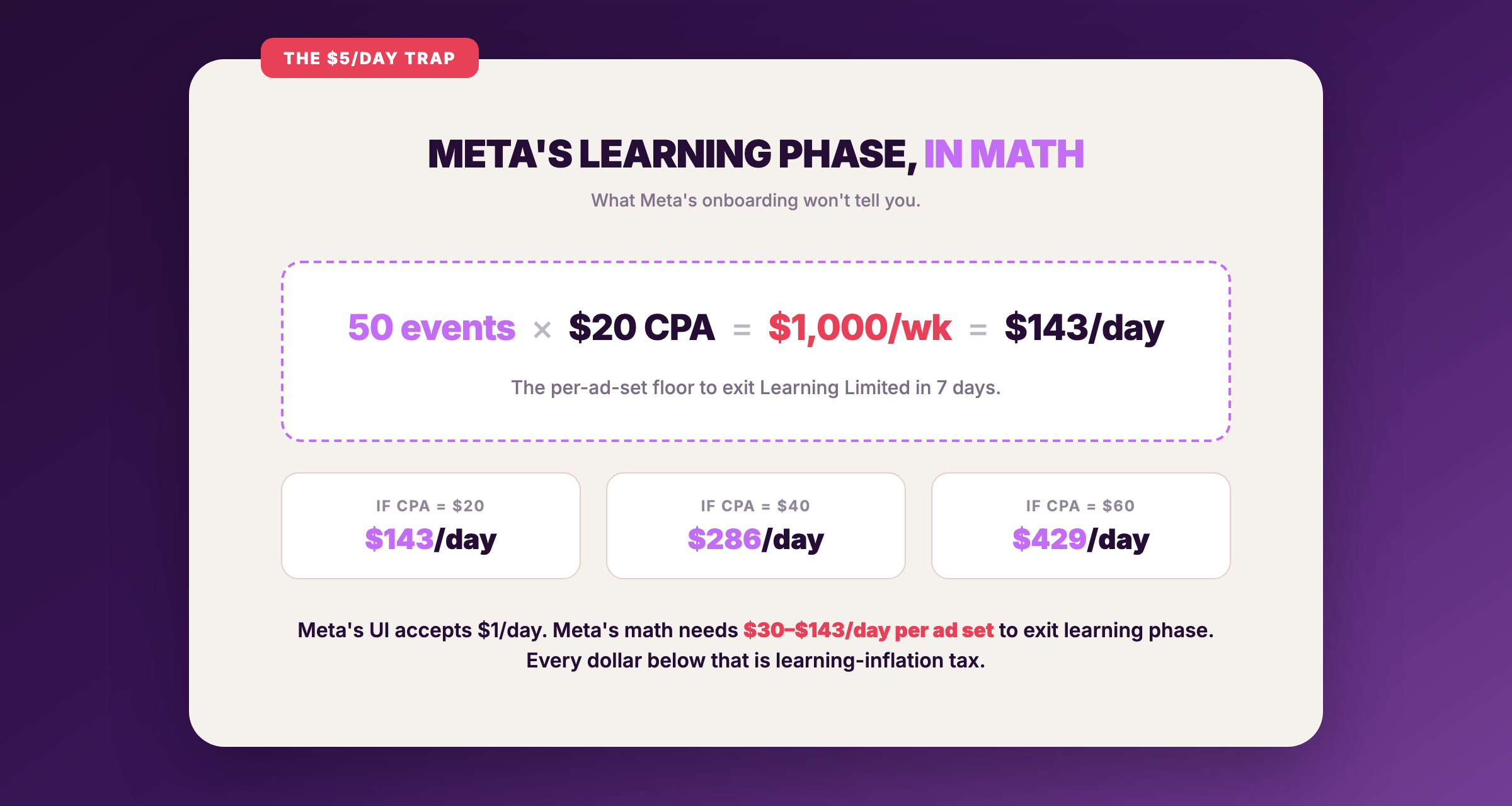
Run the arithmetic. If your target CPA is $20 and you need 50 events a week, the math floor is 50 × $20 = $1,000 weekly spend, or roughly $143/day per ad set. If your target CPA is $40, the floor doubles to $286/day. At $5/day, you generate fewer than 10 events per week and never stabilize. Campaigns run indefinitely in Learning Limited, which practitioner aggregators estimate inflates effective CPA by 20–50% versus stabilized campaigns. That number is practitioner-math, not a cited study — but the underlying arithmetic (events × CPA = required spend) is exact.
Real floor — $30–$50/day per ad set
Community consensus on Reddit and agency Slack puts the practical minimum at $30–$50/day per ad set for most DTC CPAs under $30. Meta's UI still says $1/day is fine. Meta's own math says otherwise. If you can't clear $30/day per ad set, consolidate rather than spread a small budget across many.
Why Facebook ads got more expensive in 2026
Three structural reasons total cost keeps climbing, each one largely invisible in older benchmark guides.
iOS App Store 30% surcharge (trivially avoidable)
Apple charges Meta a 30% fee on any ad purchased through an in-app "Boost" button on iOS Facebook or Instagram. Meta passes the fee through directly. Workaround takes 30 seconds: buy ads from Ads Manager on the web instead of tapping Boost. Policy has been globally in force since July 2024. Any advertiser still boosting from the iOS app pays a 30% convenience tax most users don't know exists.
EU/UK Digital Services Tax (July 1, 2026)
Meta's new Location Fees go into full billing on July 1, 2026. Rates by country: UK 2%, France 3%, Italy 3%, Spain 3%, Austria 5%, Turkey 5%. Meta bills fees as a separate line item by delivery country, with no opt-out short of excluding those countries from your targeting. eMarketer's coverage and Bloomberg's both align with the rates in Meta's Help Center. More countries are expected to enact DSTs in 2027; the fee list grows, it does not shrink.
CPM inflation and auction compression
More advertisers using AI means more creatives per week means more bids per impression. Triple Whale's 35K-brand dataset shows 100% of industries moved up on CPM in 2025. Auction gets denser, not sparser. Absent a recession, 2026 ends higher than it started.
How to lower your Facebook ad costs
Five levers, ordered by impact. Creative cost is first because it's the biggest line most advertisers haven't touched.
Collapse creative cost with AI (highest lever)
If you're paying a freelancer $150 per static ad and you need 30 a month, you're spending $4,500 to distribute ads Meta charges $2,000 to deliver. Flip those numbers. Generate 30 static ads for $12, and $4,488 that used to be creative cost becomes incremental media budget or incremental margin. Same account. Different math.
Refresh creative weekly to beat the 31% fatigue tax
Ad frequency above 3–4 pushes CPCs up 15–25% and CTRs down 25–40% inside two or three weeks. Rotation is the fix, not optimization. Motion's benchmark data puts top-tier accounts at 12–19 new creatives per week. Mid-tier at 6–7. Hit rate (the percentage of creatives that outperform account average) scales with volume, not production value.
Buy ads from the web, never the iOS app
Thirty seconds of behavior change saves 30% of spend on ads you'd otherwise boost from the iOS Facebook or Instagram app. Log into Ads Manager on desktop or mobile web. Create the ad there. Done.
Exclude high-DST countries if ROAS is borderline
If your ROAS in Austria or Turkey is already breakeven, +5% DST pushes it negative. (Not sure where breakeven sits for your product? Dropship's free break-even ROAS calculator works it out from selling price and product cost.) Exclude the geography from that specific campaign rather than trying to outbid the fee. UK, France, Italy, and Spain at +2–3% are easier to absorb; Austria and Turkey at +5% are the ones that flip unit economics.
Consolidate ad sets to exit learning phase
Three ad sets at $15/day each burn budget in Learning Limited forever. One ad set at $45/day exits learning in a week and starts optimizing. If the account is under $3K/month total, consolidate aggressively. Signal Meta's algorithm needs is event density, not ad-set count.
Your Monday morning 3-step plan
Three actions that shift the math immediately:
- Kill the iOS 30% tax. Log into Ads Manager on desktop or mobile web. Buy ads from there. Stop tapping Boost.
- Consolidate under $3K/mo. Three ad sets at $15/day burn in Learning Limited forever. One ad set at $45/day exits in a week.
- Ship 30 variants this week. Generate them in AdDogs for $12. That's the creative line most dropshippers are paying $4,500 for.
FAQ
Is $5 a day enough for Facebook ads in 2026?
No. Meta's learning phase requires roughly 50 optimization events in 7 days per ad set to exit. At $5/day — $35 a week — most verticals generate far fewer than 50 events, so ad sets sit in Learning Limited indefinitely. If your target CPA is $20, you need roughly $143/day per ad set to hit the event floor. At $40 CPA, $286/day. $5/day can test thumbnails and hooks at the very top of the funnel, but it will not drive reliable conversion performance.
Is $20 a day enough for Facebook ads?
For most DTC CPAs under $25, $20/day is still below the learning-phase floor for a single ad set. It's enough to keep a campaign live, not enough to stabilize it. Reddit consensus and agency practitioners put the practical minimum at $30–$50/day per ad set. At $20/day, consolidate to one ad set rather than splitting across multiple, or save the budget for a larger weekly test window.
Is $500 a month enough for Facebook ads?
Yes, if creative is handled cheaply and the campaign runs one ad set. $500/month is roughly $16.50/day — below the ideal floor but workable for testing creative variants and validating a product. Allocate $400 to media across a single ad set, use AdDogs Basic at $12/month for 30 creative variants, and keep tooling native. Expect to run in Learning Limited; measure creative winners by CTR and cost-per-click, not CPA.
How much does it cost to have one ad on Facebook?
No fixed cost exists to publish an ad. Meta charges by auction for each impression or click an ad earns. A cheap ad can cost under $0.50 in a thin auction; a competitive one can cost $10+ per click in a competitive vertical. Using 2026 benchmarks: one ad at median CPM ($14.19) serving 10,000 impressions costs about $142 in media. Add creative production — $0.40 per ad in AdDogs, or $150 from a Fiverr freelancer — and you have the all-in cost for one ad running once.
Is it worth paying for Facebook ads in 2026?
For most DTC brands, yes — with caveats. Median CPM is up 20% year over year, and creative fatigue alone wastes ~31% of the typical account's budget. Accounts where the math still works are refreshing creative weekly, buying from the web not the iOS app, and running a consolidated ad-set structure that exits learning phase. Meta's auction is more expensive than it was, but creative cost has collapsed faster than media has inflated — which means full-stack math works better in 2026 than it did in 2024 for advertisers who use both levers.