Static vs video ads: when to use each (with real data)


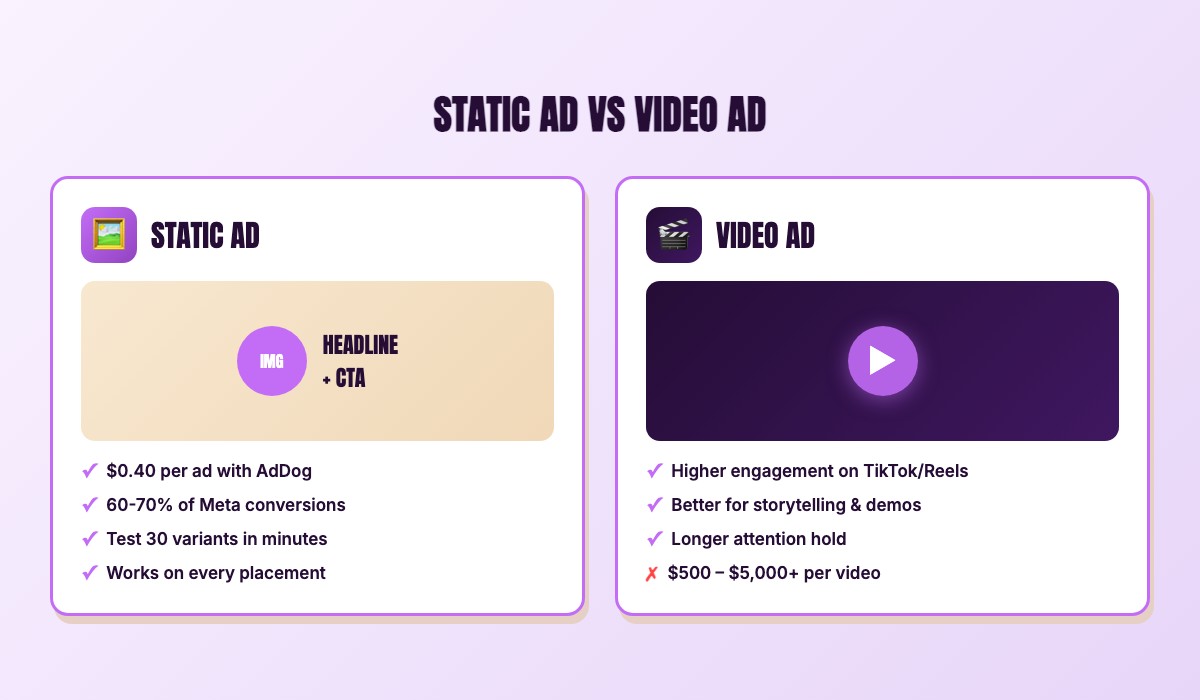
Video ads get 480% more clicks than static images. Static ads drive 60-70% of all conversions on Meta. Both of those stats are real. Both are from reputable sources. And if you stopped reading at either one, you'd make the wrong decision.
The static vs video ads debate is the wrong question. The right question: which format wins for your product, your platform, your budget, and your funnel stage? The answer changes depending on all four.
This post pulls benchmarks from Meta, Instagram, TikTok, Google, and YouTube — plus production cost data, conversion rates, and CPM comparisons — to build the decision framework that every other comparison article is missing.
When do video ads outperform static?
Short-form video ads are a $115 billion market in 2025, projected to hit $220 billion by 2030 (Statista). Meta's algorithm prioritizes Reels. TikTok is video-native by design. 91% of businesses now use video in their marketing (Wyzowl, 2026).
Earned hype. But hype that needs context.
Brand awareness and cold traffic
Cold audiences need convincing. Video does that better than any other format:
- 80% better brand recall than static ads (Ads Rater, 2025)
- 135% greater organic reach on Facebook (Ads Rater, 2025)
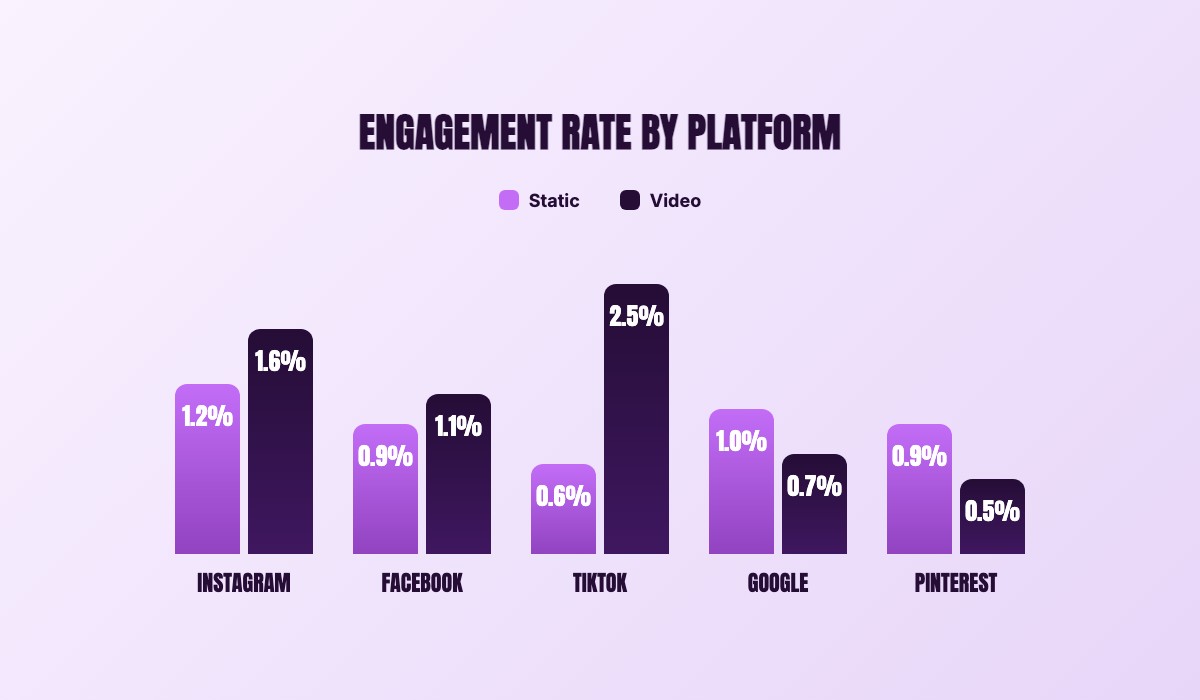
- Instagram video engagement: 3.8% vs 1.8% for static (SQ Magazine, 2025)
- Instagram video CTR: 1.87% vs 1.11% for static images (SQ Magazine, 2025)
Video stops the scroll. Movement catches the eye faster than a still image, and in a feed where thumbs move fast, that edge matters.
On Meta, vertical video with audio gets 35% higher CTR and 12% higher conversions per dollar spent — based on Meta's own analysis of 12 million ad sets. Not a blog post stat. Platform data at scale.
Platform by platform
Not every platform treats video equally.
TikTok is video-first. Static image ads exist on the platform, but they're second-class citizens. Average TikTok CTR sits between 0.5-1.5%, with a $0.66 CPC and $8.30 CPM. The algorithm rewards native-feeling video. If you're advertising on TikTok, you're making video.
Instagram Reels reach 700 million users monthly — and Meta's algorithm loves them. Reels get 27% higher engagement than static feed posts, and short-form video under 15 seconds hits an 82% completion rate. The algorithm surfaces 50% of feed content through AI recommendations, with a heavy bias toward Reels. If your audience lives on Instagram, video isn't optional.
YouTube is all video. Average CPV runs $0.02-$0.05, CPMs sit between $3.50-$10, and in-stream ads average a 0.51% CTR. The question here isn't static vs video — it's what kind of video.
Facebook is where the debate gets interesting. Biteable's widely-cited A/B test showed video generating 480% more clicks and 280% cheaper cost-per-lead. Impressive — until you check the methodology. That was a single test, $225 per variant, targeting social media professionals who are predisposed to engage with video content. At scale with real e-commerce budgets, the data tells a different story.
Where video falls apart
Here's what the "video is king" articles leave out.
73% of e-commerce video ads fail in the first 3 seconds (Motion App, 2025). They look like ads. The viewer scrolls. Your CPM burned for nothing.
Production cost is the silent killer. A quality 60-second video ad costs $1,000-$16,000 through an agency, averaging $3,185 (Advids, 2025). A Fiverr motion graphics freelancer charges $200-$900. That's for one video. Need 10 variations to test hooks, angles, and CTAs? Multiply accordingly — creative is often the biggest line in your full Facebook ad cost breakdown, not media.
Turnaround time kills iteration speed. Standard video production takes 3-5 days. High-production video takes 3-8 weeks. By the time your video ad is live, a competitor testing static variations has already killed 15 losers and scaled 3 winners.
Video CPMs run higher. Instagram video CPM averages $10.55 vs $8.91 for static. Facebook Reels carry a 20-25% CPM premium over image ads. You're paying more per thousand impressions before you even know if the creative works.
52% of viewers skip videos longer than 60 seconds — even when the topic interests them. You're not just competing with other ads. You're competing with the viewer's thumb.
Why do static ads drive more conversions?
Static ads are boring. Nobody writes breathless LinkedIn posts about static images. They don't trend on TikTok. They don't get featured in marketing keynotes.
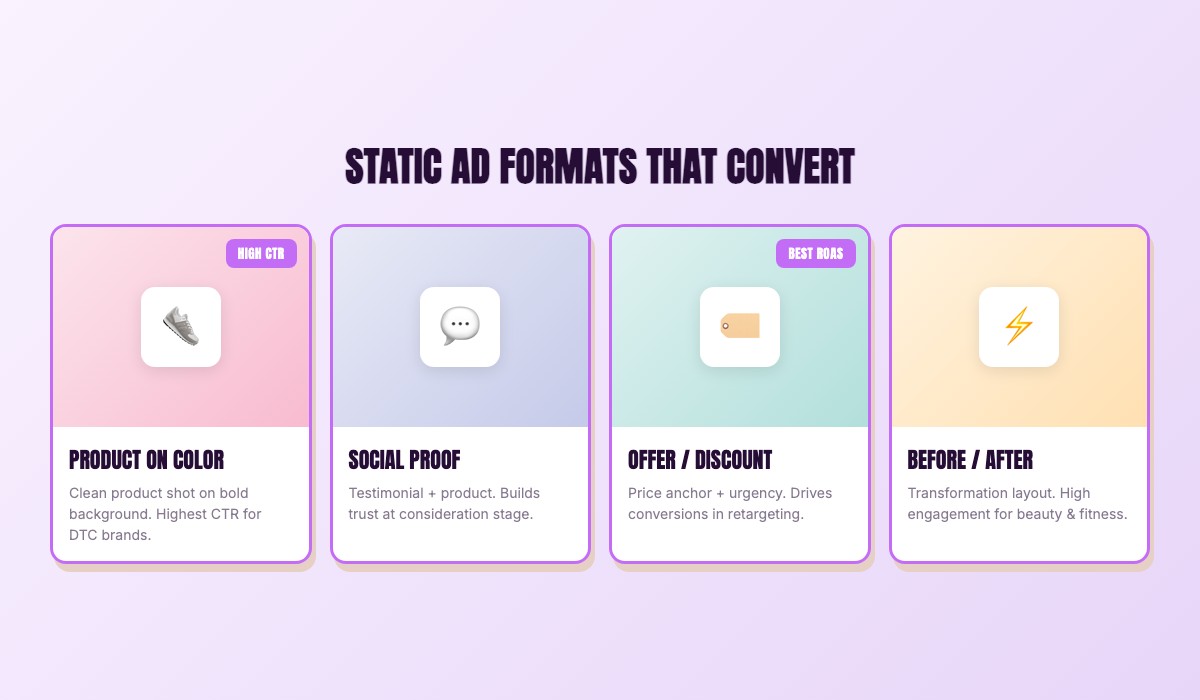
They also drive 60-70% of all conversions on Meta. In an era where everyone's telling you video is the future, static images are doing the majority of the conversion work on the world's largest ad platform. (Need the exact specs for each platform? See our social media ad sizes guide.)
The conversion data
Numbers don't match the narrative:
- 60-70% of Meta conversions come from static image ads (Meta data via industry sources, 2025)
- 40% higher conversion rate in retargeting for static vs video (Ads Rater, 2025)
- 20% higher CTR for e-commerce product ads using static images (industry data, 2025)
- Carousel ads (a static format) have the lowest customer acquisition cost on Meta — roughly $15, compared to $28 for single-image ads (BestEver.ai, 2025)
Why? Static ads deliver the message instantly. No waiting for a hook. No 3-second rule to survive.
The product, the price, and the CTA land in a single glance. For retargeting — where the viewer already knows your brand — that directness converts.
Production economics
Here's where the math gets brutal for video.
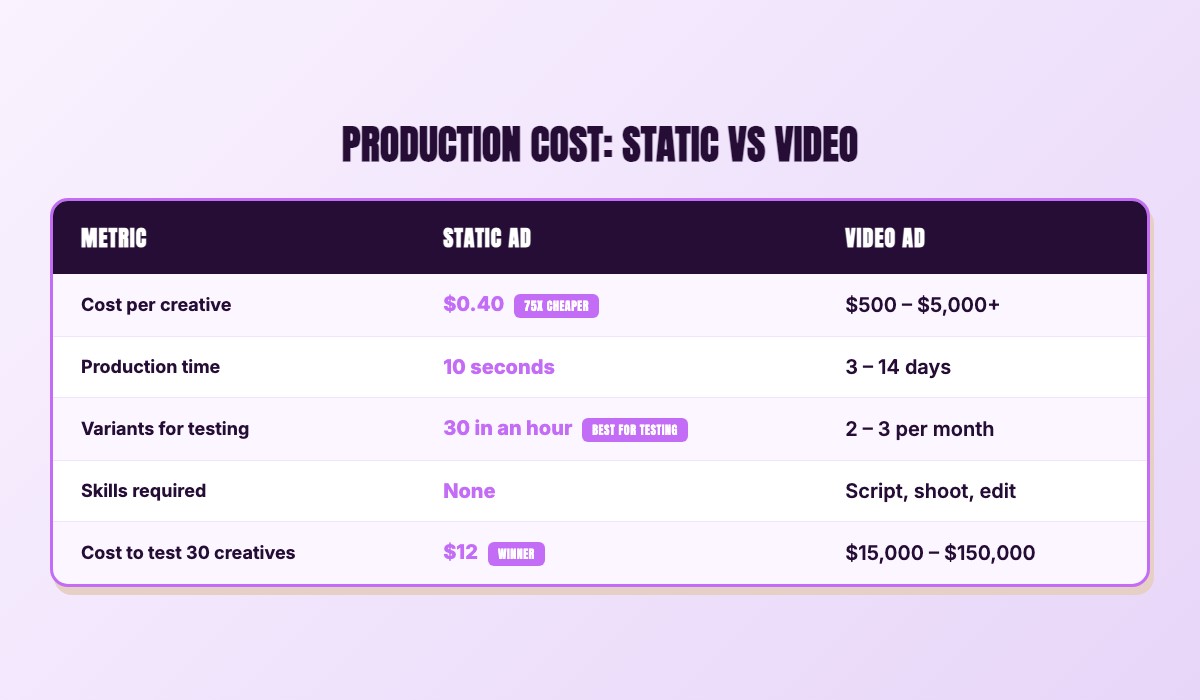
| Static Ad | Video Ad (60s) | |
|---|---|---|
| AdDogs | seconds, $0.33/ad | N/A (static generator) |
| AdCreative.ai | $3.90/ad | N/A (static generator) |
| Fiverr freelancer | $200-$800 | $200-$900 (motion graphics) |
| Agency | $100-$5,000 | $1,000-$16,000 |
| Turnaround | seconds (AdDogs) / 1-2 days | 3-5 days / 3-8 weeks |
| Cost to test 20 variations | $6.60 with AdDogs | $4,000-$18,000 (freelancer) |
Static ads cost 70-80% less to produce than video (Zeely, 2025). That gap widens further with AI tools. AdCreative.ai charges $39/month for 10 credits — that's $3.90 per ad. AdDogs' Pro plan is $33/month for 100 credits — that's $0.33 per ad. Both are a fraction of video production costs, but one is 12x cheaper than the other.
A dropshipper testing 20 products a week with 3 ad variations each needs 60 creatives. With video at $200+ per Fiverr variation, that's $12,000/month in production alone. With AdDogs Pro, it's $33/month and a Tuesday afternoon — 100 credits covers the full workload with room to spare.
The testing velocity advantage
Every other "static vs video" article misses this point.
Winning ad strategy isn't about picking the "better" format. It's about finding winning creative faster. Static ads let you test at a pace video can't touch.
With static, you can test:
- 5 different headlines
- 4 color schemes
- 3 product angles
- Multiple layout variations
That's 60+ combinations. Each one takes seconds to generate with AdDogs' static ad generator — pick a reference ad from the 14,000+ ad examples library, upload your product photo, and the AI rebuilds the layout with your brand colors applied automatically. Basic includes 3 dimensions (square, portrait, landscape); Pro and Ultimate unlock all 14. One credit per ad. Total cost at $0.33/ad on Pro: under $20 for all 60 variations.
With video, you're testing 2-3 variations. Maybe. After a week of production. See our full ad creative testing framework for the complete system — clone, test, kill, scale.
Smart e-commerce operators — including brands like Obvi, skincare advertisers, and DTC operators running Facebook ad campaigns at scale — don't choose between static and video. They use static to find winning concepts fast, then invest in video production for the proven winners. Test the hook, the angle, and the offer with static. Once you know what converts, then spend $3,000 on a polished video version.
The decision framework
Stop asking "which is better?" Start asking these four questions.
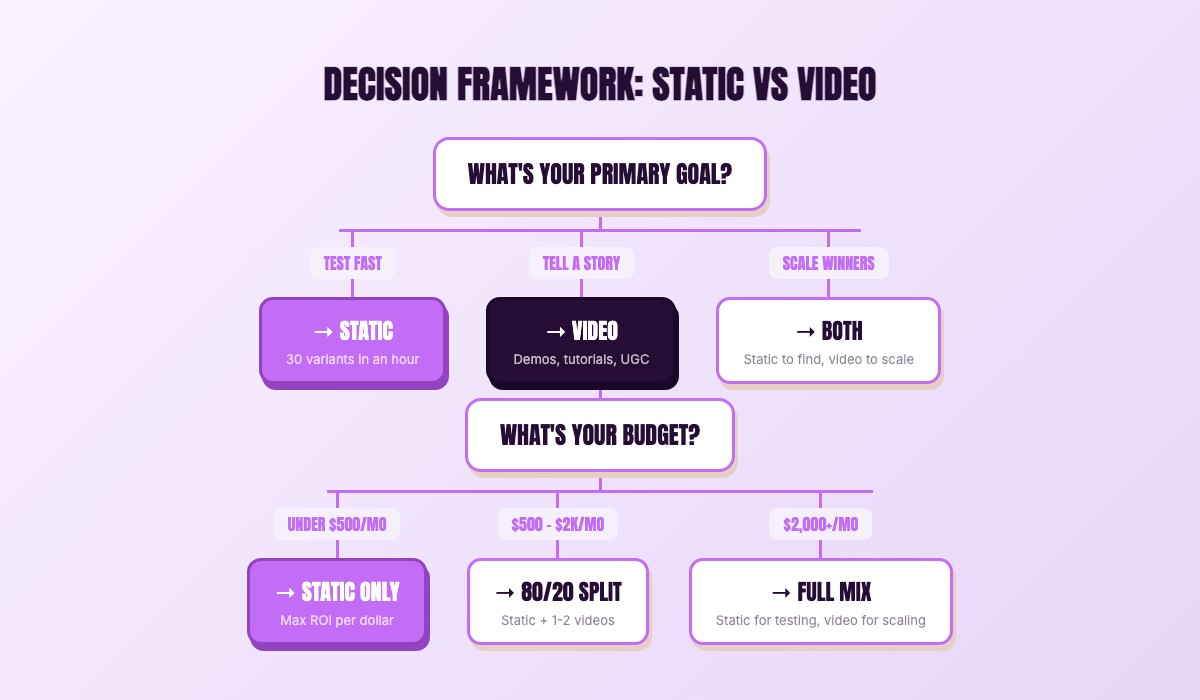
1. What's your funnel stage?
| Funnel Stage | Recommended Format | Why |
|---|---|---|
| Cold traffic / Awareness | Video (70%) + Static (30%) | Video builds recall 80% better. Use static for quick product showcases alongside. |
| Warm traffic / Consideration | 50/50 split | Test both. Neither format has a consistent edge here. |
| Retargeting / Conversion | Static (70%) + Video (30%) | Static converts 40% better in retargeting. The viewer already knows you — get to the CTA. |
2. What platform are you running on?
| Platform | Static Sweet Spot | Video Sweet Spot |
|---|---|---|
| Facebook Feed | Retargeting, conversions, product showcases | Prospecting, brand awareness, engagement |
| Instagram Feed | Product photography, carousel storytelling | Brand story, lifestyle content |
| Instagram Reels/Stories | Limited (video format) | Always — Reels get 27% more engagement |
| TikTok | Minimal (video-first platform) | Always — platform is built for video |
| Google Display | Always — static dominates display | Rarely — limited video inventory |
| Product pins, shopping ads | Idea pins, tutorials | |
| YouTube | N/A | Always — it's a video platform |
3. What's your monthly ad budget?
| Budget | Recommendation |
|---|---|
| Under $2,000/mo | 80% static, 20% video. You need maximum tests per dollar. Burn your budget on creative testing, not production. |
| $2,000-$10,000/mo | 60% static, 40% video. Use static for rapid testing. Invest in video for proven concepts. |
| Over $10,000/mo | 50/50 or format-by-platform. Enough budget to test both simultaneously across channels. |
Here's the math nobody does: at $500/month ad spend, a single agency video ad costs 6x your entire monthly budget. AdDogs' Basic plan is $12/month for 30 credits — you test 30 variations and still have your full ad budget intact. Need more volume? Pro is $33/month for 100 credits. AdCreative.ai charges $39 for 10. Canva is free but you're spending 30-60 minutes per ad designing manually. The production cost gap is the real variable in the static vs video equation — not the CPM.
4. What's your creative production capacity?
- Solo founder / small team: Lean into static. Use AI tools for speed. Save video for proven winners only.
- In-house creative team: Mix both, with static leading the testing phase.
- Agency support: Full video + static strategy, with proper allocation by funnel stage and platform.

Create your own product product ads
Create your ad
The "test static first" workflow
Here's the approach that combines the best of both formats:
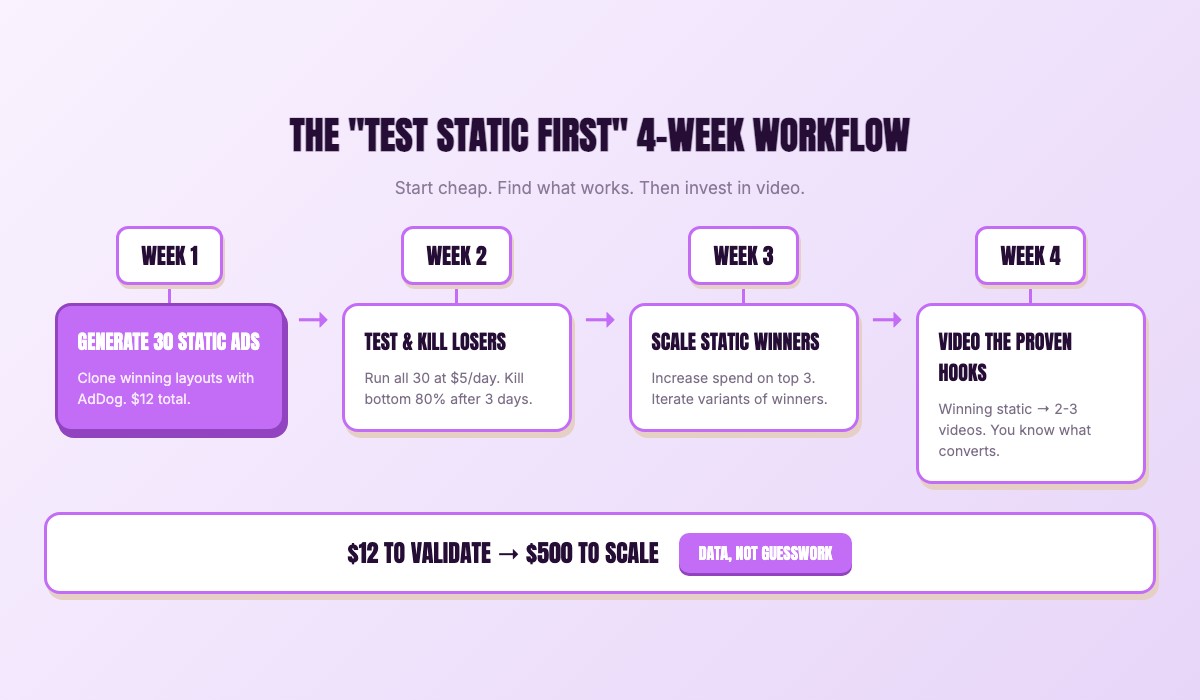
Week 1: Static testing blitz. Generate 15-20 static ad variations testing different hooks, product angles, color schemes, and CTAs. Clone proven ad layouts from AdDogs' product ad examples and swap in your product — seconds per variation, $0.33 each on the Pro plan.
Week 2: Kill and scale. Turn off the losers. Scale the 3-5 static ads with the best CTR, CPA, or ROAS. You've now identified your winning hooks and angles for less than $10 in production costs.
Week 3: Video for winners. Take your top-performing static concepts and produce video versions. You already know the hook works. You already know the angle converts. The video just amplifies a proven concept instead of gambling on an untested one.
Week 4+: Run both. Static variations for ongoing testing and retargeting. Video for awareness campaigns and scaling proven winners. Refresh static creatives every 2-3 weeks to combat fatigue (they're cheap to produce). Refresh video monthly.
This isn't a theory. Obvi, a DTC supplements brand that scaled to $40 million in 40 months, built their ad strategy on exactly this approach — using static to validate creative concepts before investing in video production (Motion App, 2025).
The bottom line
Video wins attention. Static wins conversions. Neither wins everything.
The operators scaling fastest right now aren't the ones arguing about format on LinkedIn. They're generating 20 static variations in AdDogs on Monday morning, killing the losers by Wednesday, scaling the winners by Friday, and producing video versions of the proven concepts the following week. That cycle costs $33/month on the Pro plan and seconds per ad.
AdCreative.ai charges $39/month for 10 ad credits. Pencil charges $49/month. A Fiverr video freelancer charges $200-$900 per deliverable. AdDogs starts at $12/month for 30 credits (Basic) or $33/month for 100 credits (Pro) — $0.33 per ad on Pro, finished in seconds, 14 aspect ratios available on Pro and Ultimate.
Static vs video matters. But production cost matters more.
FAQ
Do static ads still work in 2026?
They drive 60-70% of all conversions on Meta. Carousel ads — a static format — have the lowest customer acquisition cost on the platform at roughly $15. Static isn't dying. It's quietly doing the conversion work while video gets the LinkedIn posts.
Which ad format is cheaper to produce?
Static. By a lot. AdDogs generates a static ad in seconds for $0.33. A Fiverr video freelancer charges $200-$900 for one deliverable. Agencies charge $1,000-$16,000 for a 60-second video ad. The production cost gap is 70-80%.
Should I use video ads on Facebook?
For cold traffic, yes — video gets 80% better brand recall and 35% higher CTR with vertical + audio. For retargeting and conversions, static wins with 40% higher conversion rates. Run both, allocated by funnel stage. Don't let anyone tell you it's all-video or nothing.
How many ad variations should I test?
Meta recommends 2-5 per ad set. The real constraint is production speed. With AdDogs, testing 15-20 static variations per week is trivial — seconds each. With video, you're limited to 2-3 per production cycle unless you have an in-house team.
What's the best ad format for dropshippers?
Static, generated from proven templates. Dropshippers testing dozens of products monthly need volume and speed over polish. Clone 30 winning ad layouts with AdDogs for $12, find the 3 that convert, then invest in video for the winners. AdCreative.ai charges $39 for 10 credits to do the same thing.
Sources
- Meta: Vertical Video with Audio Performance — 35% higher CTR, 12% higher conversions (12M ad sets analyzed)
- Wyzowl Video Marketing Statistics 2026 — 91% of businesses use video
- Statista: Digital Video Advertising — $115B short-form video market
- WordStream: Facebook Ads Benchmarks 2025 — CTR and CPC averages
- BestEver.ai: Facebook Ads Benchmarks by Format — carousel CAC, format CTR comparison
- Ads Rater: Static vs Video 2025 — 80% brand recall, 40% retargeting conversion lift
- SQ Magazine: Instagram Ads Statistics 2025 — engagement rates, CTR by format
- Motion App: Static Ads Playbook — Obvi case study, 73% e-commerce video fail rate
- Advids: Video Ad Production Cost 2026 — agency pricing benchmarks
- AdAmigo: Meta Ads CPM Benchmarks 2026 — Reels CPM premium
- Zeely: Static Ads vs Video Ads — 70-80% production cost difference
- Biteable: Video vs Image Experiment — 480% more clicks (N=1 test, $225 budget)