Social media ad sizes and specs for every platform (2026)


Every guide on social media ad sizes gives you the same thing: a 4,000-word wall of dimensions you'll never memorize. You bookmark it, forget about it, and Google it again next week.
Here's what none of them tell you: three aspect ratios cover over 90% of ad placements across every major platform. Learn those three, and you can stop Googling.
The only 3 ad sizes you actually need
Before we dump the full spec sheets, here's the shortcut.
| Size | Dimensions | Where it works |
|---|---|---|
| Square | 1080 x 1080 px (1:1) | Facebook Feed, Instagram Feed, Instagram Explore, X/Twitter, LinkedIn, Google Display, YouTube in-feed |
| Vertical | 1080 x 1350 px (4:5) | Facebook Feed (mobile), Instagram Feed (best performer), LinkedIn Feed, Pinterest |
| Full-screen vertical | 1080 x 1920 px (9:16) | Instagram Stories, Instagram Reels, Facebook Stories, Facebook Reels, TikTok, YouTube Shorts, Snapchat |
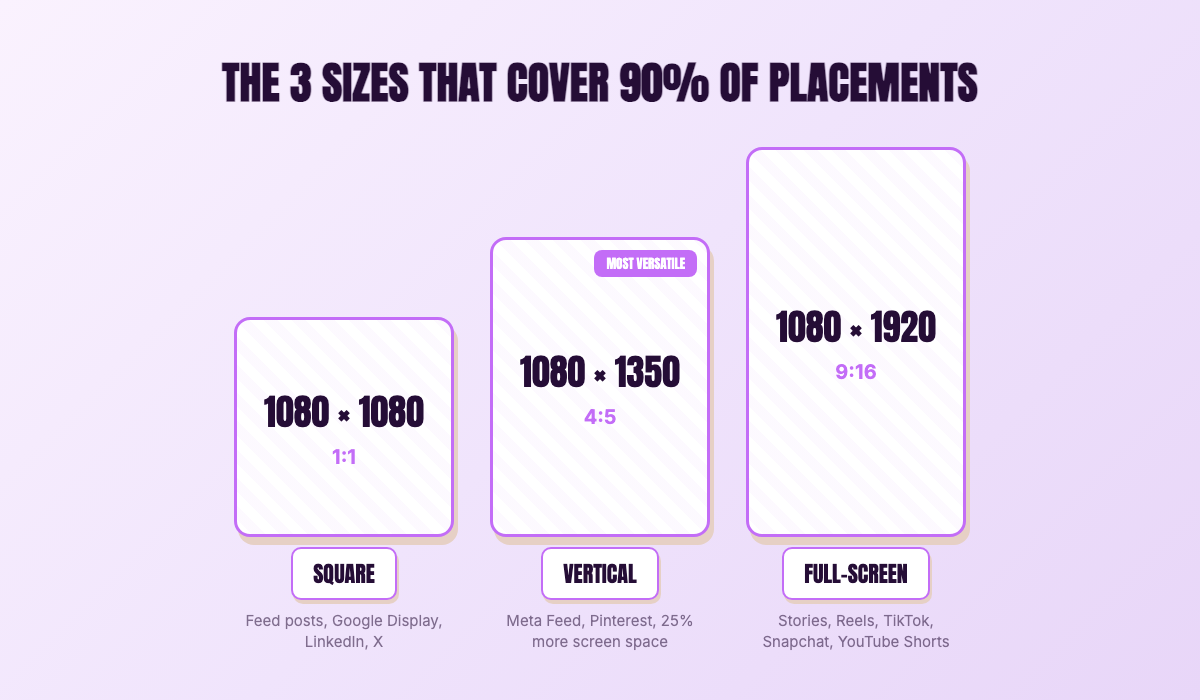
That's it. Three files cover Meta, TikTok, YouTube Shorts, Snapchat, LinkedIn, X, and Pinterest. If you're running product ads across platforms, start here and stop agonizing over whether your Facebook Marketplace image needs to be 1200 x 1200 or 1080 x 1080. (It works with both.)
4:5 vertical outperforms 1:1 square in mobile feeds — 31% more screen real estate. If you're making one static ad for Meta, make it 1080 x 1350.
AdDogs supports 14 aspect ratios — including all three from the table above (1:1, 4:5, 9:16) plus 16:9 for YouTube, 2:3 for Pinterest, and banner formats for display ads. Each generation produces one ad in one format. At $0.33 per ad on the Pro plan, generating all three core sizes costs under a dollar.
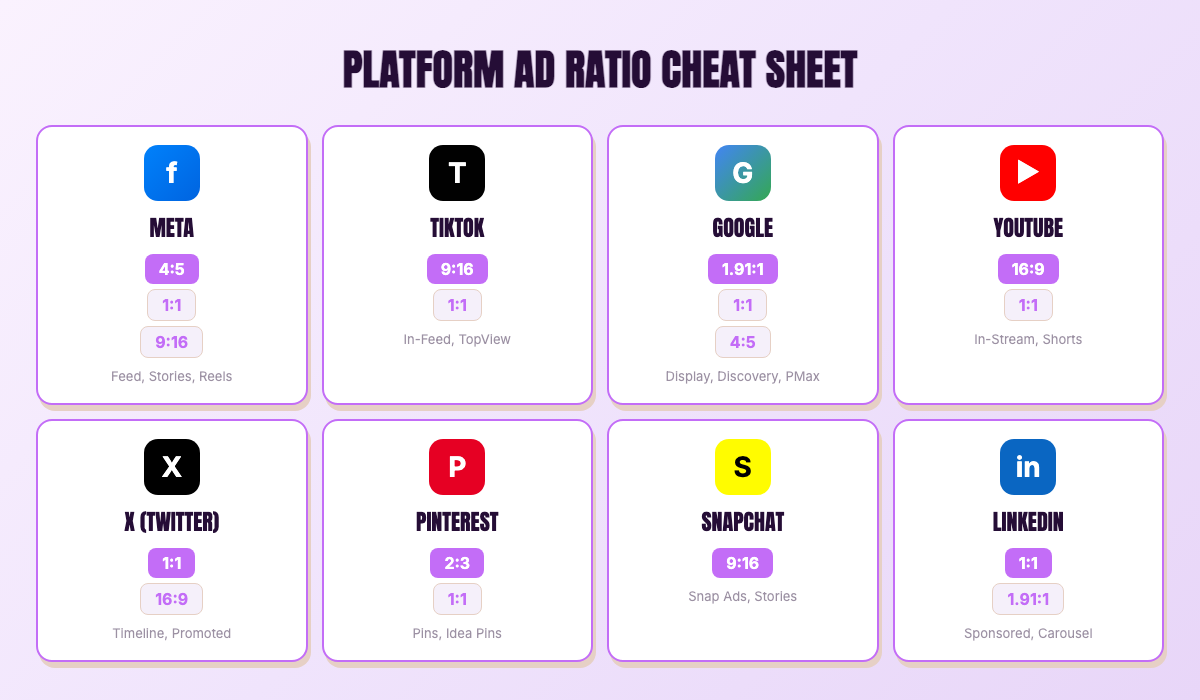
Here's the full spec sheet, platform by platform.
What are the ad sizes for Meta (Facebook + Instagram)?
Meta is the biggest ad platform by spend — and the most obnoxious to resize for. Full specs live in the Meta Ads Guide, with aspect-ratio recommendations broken out in Meta's "Best practices for aspect ratios across placements" help article. Four surfaces (Facebook, Instagram, Messenger, Audience Network), three aspect ratios, safe zones that hide your product if you get them wrong. One set of assets covers all four surfaces, but you need to get the sizes right.
Universal file requirements: Images max 30 MB (JPG, PNG). Videos max 4 GB (MP4, MOV). Videos use H.264 codec, AAC audio at 128 kbps+, 30 fps. Pulled from the Meta Ads Guide image and video format specs.
Facebook ad sizes
| Placement | Image size | Video size | Aspect ratio | Notes |
|---|---|---|---|---|
| Feed | 1080 x 1080 (1:1) or 1080 x 1350 (4:5) | 1080 x 1080 or 1080 x 1350 | 1:1 or 4:5 | 4:5 not available on desktop |
| Stories | 1080 x 1920 | 1080 x 1920 | 9:16 | Safe zone: 250 px top, 340 px bottom |
| Reels | 1080 x 1920 | 1080 x 1920 | 9:16 | Safe zone: 14% top, 35% bottom, 6% sides |
| Right Column | 1200 x 1200 | N/A | 1:1 | Desktop only, small display |
| Marketplace | 1080 x 1080 | 1080 x 1080 | 1:1 | Non-1:1 may be auto-cropped |
| In-Stream Video | N/A | 1920 x 1080 | 16:9 or 1:1 | Desktop: 5-15s non-skippable |
| Search Results | 1080 x 1080 | N/A | 1.91:1 to 1:1 | Same as feed specs |
Text limits: Primary text 125 characters (before truncation). Headline 27-40 characters depending on placement.
Instagram ad sizes
| Placement | Image size | Video size | Aspect ratio | Notes |
|---|---|---|---|---|
| Feed | 1080 x 1350 (4:5) | 1080 x 1350 | 1.91:1 to 4:5 | 4:5 takes up most mobile screen space |
| Stories | 1080 x 1920 | 1080 x 1920 | 9:16 | Safe zone: 250 px top, 340 px bottom |
| Reels | 1080 x 1920 | 1080 x 1920 | 9:16 | Up to 15 min; no licensed music |
| Explore | 1080 x 1080 | 1080 x 1080 | 1:1 or 4:5 | Same as feed for most specs |
| Shop | 1080 x 1080 | 1080 x 1080 | 1:1 | Product catalog pulls from feed assets |
Text limits: Primary text 125 characters. Reels: 72 characters only.
For Instagram product ads, 1080 x 1350 (4:5) gives your product the most screen space on mobile. Use it.
Meta safe zones — the part nobody else covers
Meta's Stories and Reels placements overlay UI elements on top of your ad: profile icons, CTA buttons, like/share buttons, the music ticker. If your product shot or headline lands in these zones, it's hidden. The exact pixel boundaries are documented in Meta's "Text overlays and the safe zone for ads in Stories and Reels" help article.
Stories safe zone: Keep all critical content within the center 1080 x 1420 px. That means 250 px clear at the top (14%) and 340 px clear at the bottom (20%).
Reels safe zone: Even tighter. Leave 14% at the top, 35% at the bottom, and 6% on each side. Your actual visible creative area is roughly 950 x 990 px out of a 1080 x 1920 canvas.
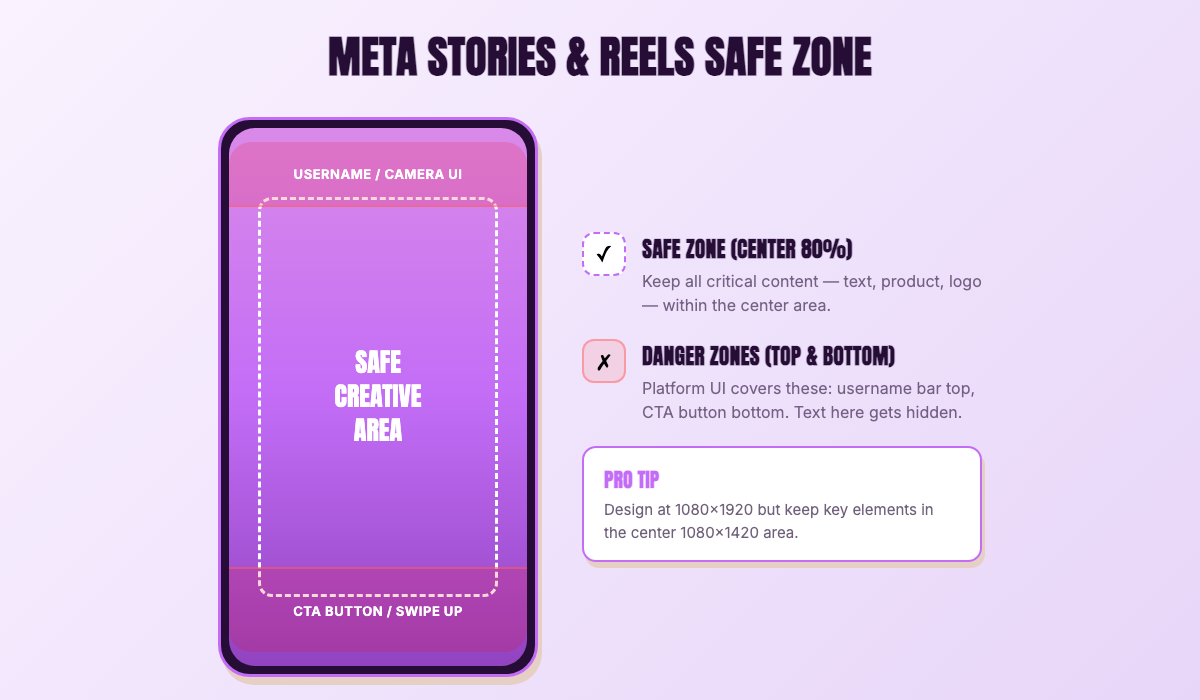
Design for the safe zone first, then fill the rest with background or non-essential visuals.
Meta's auto-crop gotcha
Meta's Advantage+ creative optimization automatically resizes your ad across placements. Upload a 1:1 square, and Meta may stretch it to 4:5 for Feed or 9:16 for Stories.
The problem: Meta's AI expands the canvas edges with generated fill that rarely matches your design. Your product gets pushed off-center or surrounded by artifacts.
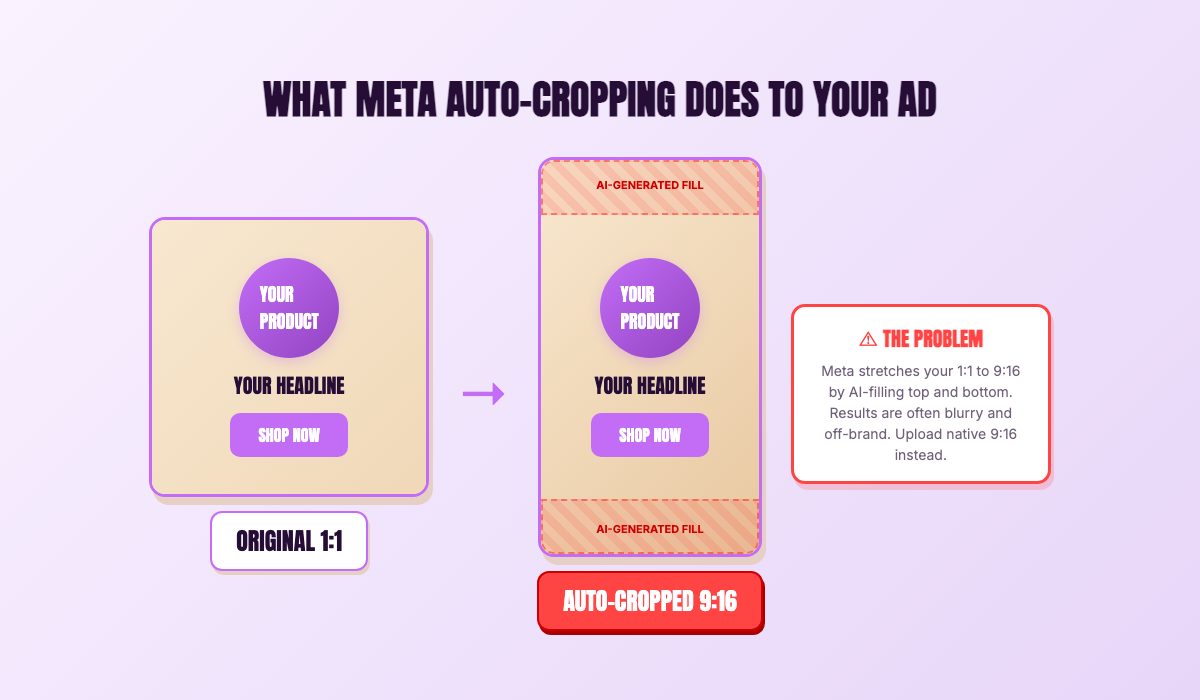
The fix: Upload creative in all three ratios (1:1, 4:5, 9:16) and assign them to specific placements manually. AdDogs supports all three natively — pick a template, choose your ratio, and generate. Three ratios = three generations, each taking seconds. No Photoshop, no manual resizing.
Threads ad sizes
Threads ads went global in January 2026. If you're already running Meta feed ads, you're already running Threads ads — same creative, same specs.
| Placement | Image size | Aspect ratio | Notes |
|---|---|---|---|
| Feed | 1080 x 1080 or 1080 x 1350 | 1:1 or 4:5 | Same creative as Facebook/Instagram feed |
The 4:5 format was only added in October 2025. Your existing Meta feed assets work without modification.
What are the ad sizes for TikTok?
TikTok is vertical-first. The platform's official ad products are catalogued on TikTok for Business. Every ad format is optimized for 9:16. One size, one orientation — the simplest platform to spec for after Snapchat.
| Placement | Dimensions | Aspect ratio | Video length | Notes |
|---|---|---|---|---|
| In-Feed | 1080 x 1920 | 9:16 (recommended), 1:1, 16:9 | 5s-10 min (21-34s optimal) | Also supports image ads at 100 MB max |
| TopView | 1080 x 1920 | 9:16 only | 5-60s | First post when app opens; sound-on |
| Spark Ads | Inherits from original post | Original ratio | No limit | Boosts existing organic TikTok posts |
| Video Shopping | 1080 x 1920 | 9:16 | 5-60s | Requires active TikTok Shop catalog |
| Search Ads | 1080 x 1920 | 9:16, 1:1, 16:9 | 5s-10 min | Same creative as In-Feed; toggled on in campaign |
File specs: Video max 500 MB. Formats: MP4, MOV. Image max 100 MB (JPG, PNG). Always design for sound-on — 93% of TikTok sessions have sound enabled.
Safe zone: Keep critical text and logos within the center 810 x 1290 px area of a 1080 x 1920 canvas. The username, CTA button, and music ticker overlap the edges.
The move for TikTok: Create your ad at 1080 x 1920 (9:16). That single asset covers In-Feed, TopView, Video Shopping, and Search placements. The same 9:16 works for Meta Stories/Reels, YouTube Shorts, and Snapchat. One vertical video, five platforms.
What are the ad sizes for Google and YouTube?
Google runs two ad worlds: display banners across millions of websites, and video ads on YouTube. The specs are different for each. Reference pages: Google Ads image specifications for uploaded display ads, and responsive display ad asset requirements for the auto-assembled variants.
Google display ad sizes
You don't need 15 banner ad sizes anymore. Google's Responsive Display Ads assemble themselves from your assets.
Responsive Display Ad assets:
| Asset type | Recommended size | Aspect ratio | Max file size |
|---|---|---|---|
| Landscape image | 1200 x 628 | 1.91:1 | 5 MB |
| Square image | 1200 x 1200 | 1:1 | 5 MB |
| Portrait image | 960 x 1200 | 4:5 | 5 MB |
| Logo (landscape) | 1200 x 300 | 4:1 | 5 MB |
| Logo (square) | 1200 x 1200 | 1:1 | 5 MB |
Upload up to 15 images and 5 logos. Google mixes and matches them across placements. The three most important are 1.91:1 landscape, 1:1 square, and 4:5 portrait.
Performance Max uses the same asset specs but accepts up to 20 images and 5 videos. If you don't provide video, Google auto-generates one from your images. It looks like a slideshow. Upload your own.
Google Shopping product images: minimum 100 x 100 px (250 x 250 for apparel), recommended 800 x 800+. White background, product filling 75-90% of frame. No watermarks, no promotional text.
Search Ads (text only): up to 15 headlines (30 characters each), 4 descriptions (90 characters each). Image extensions: 1200 x 628 (1.91:1) or 1200 x 1200 (1:1).
YouTube ad sizes
The format catalog (skippable in-stream, non-skippable, bumper, in-feed, Shorts, Masthead) is documented in Google's "About video ad formats" help center page and YouTube's advertising formats overview.
| Placement | Resolution | Aspect ratio | Length | Skippable? |
|---|---|---|---|---|
| Skippable in-stream | 1920 x 1080 | 16:9 | No max (12s minimum) | After 5 seconds |
| Non-skippable in-stream | 1920 x 1080 | 16:9 | 15 seconds max | No |
| Bumper ads | 1920 x 1080 | 16:9 | 6 seconds max | No |
| In-feed (Discovery) | 1920 x 1080 | 16:9 or 1:1 | No max | N/A (click to play) |
| YouTube Shorts | 1080 x 1920 | 9:16 | Up to 60s | Between Shorts |
| Masthead | 1920 x 1080 | 16:9 | Up to 30s autoplay | Reserved buy only |
File specs: Max 256 GB (yes, gigabytes). Formats: MP4, MOV, AVI, WebM. All videos must be hosted on YouTube.
YouTube Shorts ads require 9:16 vertical — the same 1080 x 1920 as TikTok and Meta Stories/Reels. Generate one 9:16 ad in AdDogs and it works on all five platforms.

Create your own all product ads
Create your ad
What are the ad sizes for X (Twitter)?
X publishes its current format catalog on the X Ads business site. Dimensions below match the long-standing promoted-tweet specs.
| Placement | Image size | Video size | Aspect ratio | Notes |
|---|---|---|---|---|
| Promoted tweet (image) | 1200 x 1200 | N/A | 1:1 or 1.91:1 | Max 5 MB |
| Promoted tweet (video) | 1200 x 1200 or 1920 x 1080 | Same | 1:1 or 16:9 | Max 1 GB; 2:20 max length |
| Carousel | 800 x 800 or 800 x 418 | 800 x 800 or 800 x 450 | 1:1 or 1.91:1 (uniform) | 2-6 cards |
| Timeline Takeover | 1200 x 1200 | 1200 x 1200 | 1:1 or 16:9 | 6s max (auto-loops) |
| Amplify Pre-Roll | 1920 x 1080 | Same | 16:9 | 6s non-skippable |
Text: 280 characters per tweet. Headline: 70 characters. Links consume 23 characters.
X favors 1:1 square for images, 16:9 for video pre-roll. The good news: X's ad specs are the least fussy of any major platform. Your Meta feed creative (1:1) works here without changes.
What are the ad sizes for Pinterest?
Pinterest is vertical-first, like TikTok — but with its own preferred ratio: 2:3. Full dimensions live in the Pinterest Business help center's "Review ad specs" article, with format guidance on Pinterest's creative best practices hub.
| Placement | Dimensions | Aspect ratio | Notes |
|---|---|---|---|
| Standard pin | 1000 x 1500 | 2:3 | Max 20 MB; taller than 2:3 gets truncated |
| Video pin | 1000 x 1500 or 1080 x 1920 | 2:3, 1:1, or 9:16 | 4s-15 min; 6-15s recommended |
| Shopping pin | 1000 x 1500 | 2:3 | Same as standard; pulls from product catalog |
| Idea pin/ad | 1080 x 1920 | 9:16 | 2-20 pages; mix of image and video |
| Carousel | 1000 x 1500 or 1080 x 1080 | 2:3 or 1:1 | 2-5 cards |
Text: Title 100 characters. Description 500 characters.
Pinterest's quirk: The platform's signature ratio is 2:3, not 4:5 or 9:16. A 1:1 square works but gets less visual space in the feed. Selling on Pinterest? Create at 1000 x 1500. AdDogs' 1:1 export works as a fallback, but dedicated Pinterest creative should be 2:3.
Snapchat
Snapchat is 9:16 vertical for everything. No exceptions. Format breakdowns are catalogued on Snapchat for Business' ad formats page.
| Placement | Dimensions | Aspect ratio | Video length | Notes |
|---|---|---|---|---|
| Snap Ads (image) | 1080 x 1920 | 9:16 | N/A | Max 5 MB |
| Snap Ads (video) | 1080 x 1920 | 9:16 | 3-180s (3-5s recommended) | Max 1 GB |
| Collection Ads | 1080 x 1920 (hero) + 160 x 160 (tiles) | 9:16 | 3-180s | 4 product tiles |
| Story Ads | 1080 x 1920 | 9:16 | 3-180s per snap | 3-20 snaps |
| Spotlight Ads | 1080 x 1920 | 9:16 | 5-60s | Sound-on environment |
| Filter Ads | 1080 x 2340 | 9:19.5 | N/A | PNG, transparent BG, max 300 KB |
Text: Brand name 25 characters. Headline 34 characters.
Safe zone: Same principle as TikTok — keep critical content within the center 810 x 1290 px to avoid UI overlaps.
The easiest platform to spec for. Your TikTok 9:16 asset works here with zero modification.
LinkedIn ad sizes
LinkedIn supports more aspect ratios than most platforms — 1.91:1, 1:1, 4:5, and 16:9 all work. The full format menu lives on LinkedIn Marketing Solutions' Ads page, with deeper specs on the Sponsored Content product page.
| Placement | Image size | Aspect ratio | Notes |
|---|---|---|---|
| Single image | 1200 x 628 or 1080 x 1080 or 1080 x 1350 | 1.91:1, 1:1, or 4:5 | Max 5 MB |
| Video | 1920 x 1080 or 1080 x 1080 | 16:9, 1:1, or 4:5 | 3s-30 min; 15-30s recommended; max 200 MB |
| Carousel | 1080 x 1080 | 1:1 only | 2-10 cards; max 10 MB per card |
| Message ads (banner) | 300 x 250 | 1.2:1 | Max 2 MB; appears in InMail |
| Document ads | PDF, PPT, DOCX | Varies | Max 100 MB; up to 300 pages |
Text: Intro text 150 characters before truncation (600 max). Headline 70 characters recommended.
1:1 square now performs as well as the traditional 1200 x 628 landscape across most LinkedIn placements. Use the same 1080 x 1080 from your Meta campaigns.
What changed in 2025-2026
If you're updating your creative specs from last year, here's what's different:
Threads ads went global (January 2026). Specs covered in the Meta section above — your existing feed creative works.
Meta's Advantage+ auto-crop is aggressive. Meta's AI now resizes your 1:1 creative to 4:5 for Feed or 9:16 for Stories automatically. Upload all three ratios to control the output.
Instagram grid now crops to 4:5. Profile thumbnails changed from 1:1 square to 4:5 portrait. This affects how feed ads appear when users visit a brand's profile.
TikTok expanded In-Feed video to 10 minutes. Up from 60 seconds. Spark Ads have no duration limit at all.
Google Performance Max accepts 4:5 portrait images. Added at 960 x 1200 px alongside the existing 1.91:1 and 1:1 formats. Three aspect ratios now, not two.
Meta removed the "6 ads per ad set" recommendation. Top performers now test 10-50 ads per ad set with genuine creative diversity. More sizes, more variations, more testing — which means more production volume needed per campaign.
The production problem (and how to solve it)
Here's the math that every ad specs guide ignores. (If you're also wondering whether to invest in static or video ads, read that breakdown first — the sizing math changes depending on format.)
You need three aspect ratios minimum (1:1, 4:5, 9:16) to cover the major platforms. You need at least 3-5 creative variations per ad set for proper testing. That's 9-15 ad assets per product, per campaign.
If you're running a Shopify store with Facebook ads and testing 5 products, that's 45-75 ad files. Here's what that costs:
- Fiverr designer: $75-150 per ad. Total: $3,375-$11,250.
- Canva Pro: $13/month, but you're manually resizing every asset for every placement. Hours of drag-and-drop per campaign.
- AdCreative.ai: $39/month for 10 credits. That's $3.90 per ad, and you still need to generate each size separately.
- AdDogs: $33/month for 100 credits. That's $0.33 per ad. One credit = one ad in one format, seconds.
Pick an ad from the 14,000+ ad library, upload your product photo, choose your aspect ratio, and the AI rebuilds the ad in seconds. Need three sizes? Three credits, 30 seconds. Those 45-75 ads cost $14.85-$24.75 total.
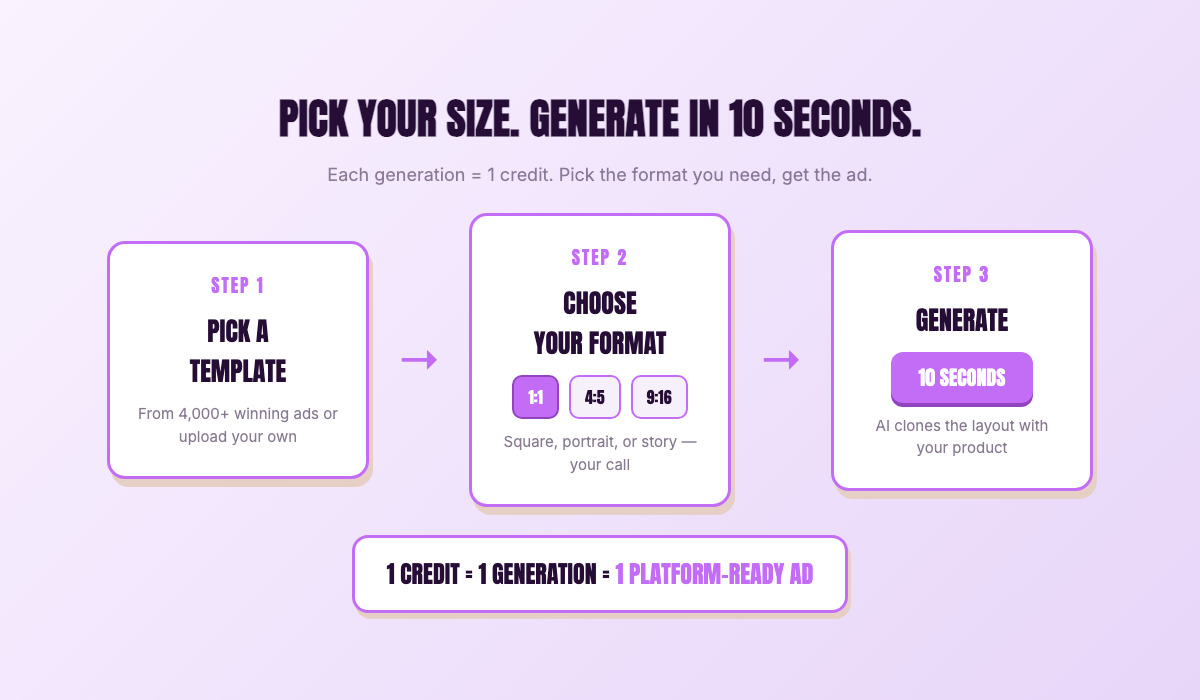
A Fiverr designer charges $11,250 for the same output. AdCreative.ai charges $175.50-$292.50. Canva costs you a weekend. Whether you're creating skincare ads or testing 20 products at once, the math is the math.
FAQ
What are the most common social media ad sizes in 2026?
Three sizes cover 90%+ of placements: 1080 x 1080 px (1:1 square) for feed ads across all platforms, 1080 x 1350 px (4:5 vertical) for Meta and LinkedIn mobile feeds, and 1080 x 1920 px (9:16 full vertical) for Stories, Reels, TikTok, Shorts, and Snapchat.
Do I need different ad sizes for each platform?
Not for most placements. A 1:1 square works on Meta, X, LinkedIn, Pinterest, and Google Display. A 9:16 vertical works on TikTok, Snapchat, Meta Stories/Reels, and YouTube Shorts. The only platform-specific size is Pinterest's 2:3 ratio (1000 x 1500 px) — and even there, 1:1 still works, it just takes up less feed space.
What happens if I upload the wrong ad size?
Most platforms will auto-crop or letterbox your image to fit. Meta's Advantage+ AI will stretch your creative across aspect ratios, often with poor results. Google will scale your Responsive Display assets dynamically. TikTok will add black bars to non-9:16 content. The safest approach: upload the correct ratio for each placement.
What ad size gets the best engagement?
Vertical formats win on mobile. 4:5 vertical takes up 31% more screen space than 1:1 square in Meta feeds. 9:16 vertical video achieves 33.8% higher completion rates than horizontal video on mobile. For static display ads, the 300 x 250 medium rectangle is the most-clicked size on the Google Display Network.
How many ad sizes does AdDogs export?
AdDogs supports 14 aspect ratios — 1:1, 4:5, 9:16, 16:9, 2:3, and more. One credit generates one ad in one format, in seconds. Need all three core sizes for a product? Three credits, under a dollar on the Pro plan. Paid plans start at $12/month.