Glossier ads teardown: how customer selfies built a $1.8B brand


Glossier ads are pastel-palette, UGC-heavy DTC beauty creatives built on five recurring layouts: TikTok UGC triptych, full-catalog shelf, customer selfie repost, copy-forward product ad, and minimalist single-SKU hero. Glossier built a $1.8B brand on these five patterns — and 80% of Glossier customers now come through peer referrals, with 70% of online sales following the same pipeline per founder Emily Weiss. Most brands copying Glossier ads lift the pastel palette and miss the system underneath — the UGC pipeline, the trademarked pink pouch, the flat-lay aesthetic that now defines a category. Full teardown below, with receipts. (AdDogs clones any reference ad layout with your product in seconds, from $12/month.)
TL;DR
- Glossier ads run a UGC repost pipeline: customer selfie → DM for permission → paid Meta/TikTok ad. UGC is 33% of their Instagram feed, 42% of their TikTok.
- Visual system: dressing-table flat lay, pastel pink plus cream, 50-70% negative space, single yellow accent, custom serif.
- Receipts: $1.8B at 2021 Series E. Fragrance alone hit $100M in 2024. Sephora: $100M first year, 73% blended retail lift.
- Portable layouts: TikTok UGC triptych, full-catalog shelf, customer selfie repost, copy-forward product ad, minimalist single-SKU hero. Off-limits: the trademarked pink pouch, serif wordmark, and "You Look Good" tagline.
- Cost to clone: Fiverr designer $50-150 per ad. AdCreative.ai $3.90 per ad. AdDogs $0.40 per ad. seconds per generation.
- Skip this post if you sell B2B, utilitarian commodities, or DTC under ~$100k without a pre-existing community. The UGC pipeline needs customers before it needs ads.
Glossier playbook at a glance
Every Glossier ad is built on the same system. Once you see it, you see it on Summer Fridays, Rare Beauty, and Rhode too.
Palette
Millennial pink, cream, warm nude, skin tones. One yellow accent used sparingly for promo banners. Saturation is muted — Glossier ads never compete with Drunk Elephant's vibrant clusters or Sol de Janeiro's tropical yellow. A signature since the first Into The Gloss launch post in 2014.
Typography
A custom serif (redrawn in 2022 for the "You Look Good" relaunch) paired with a restrained sans. Sits between Didot and a humanist serif, slightly condensed. Headline weight is low. Nothing shouts.
Aesthetic
Overhead dressing-table shot: marble or warm-neutral surface, 3-5 products arranged with intentional imperfection (one cap off, one droplet visible), soft window light from the left. Negative space fills 50-70% of the frame. Viewers complete the motion mentally — cap off, dropper out, dot on cheek — before they consciously read the ad.
Distinctive assets
Three show up in every campaign: the pink bubble-wrap pouch (trademarked by USPTO in 2020, in continuous use since October 2014), the thin serif wordmark, and the "You Look Good" tagline. That pouch alone generated $100M+ in associated sales by 2018, per Glossier's own trademark filing. Call it the brand's Coca-Cola bottle.
CTA restraint
Most Glossier ads carry no button in the creative — the tap comes from curiosity. When a CTA appears, it's "Shop now" in thin sans at the bottom, or a yellow banner. Compare the DTC norm of red "SHOP NOW" sticker bursts with fire emojis. Restraint is the asset.
5 Glossier ads doing all the work
Glossier runs five patterns on repeat. Each one covers a different stage of the funnel — and each one is cloneable.
Ad 1: The TikTok UGC triptych
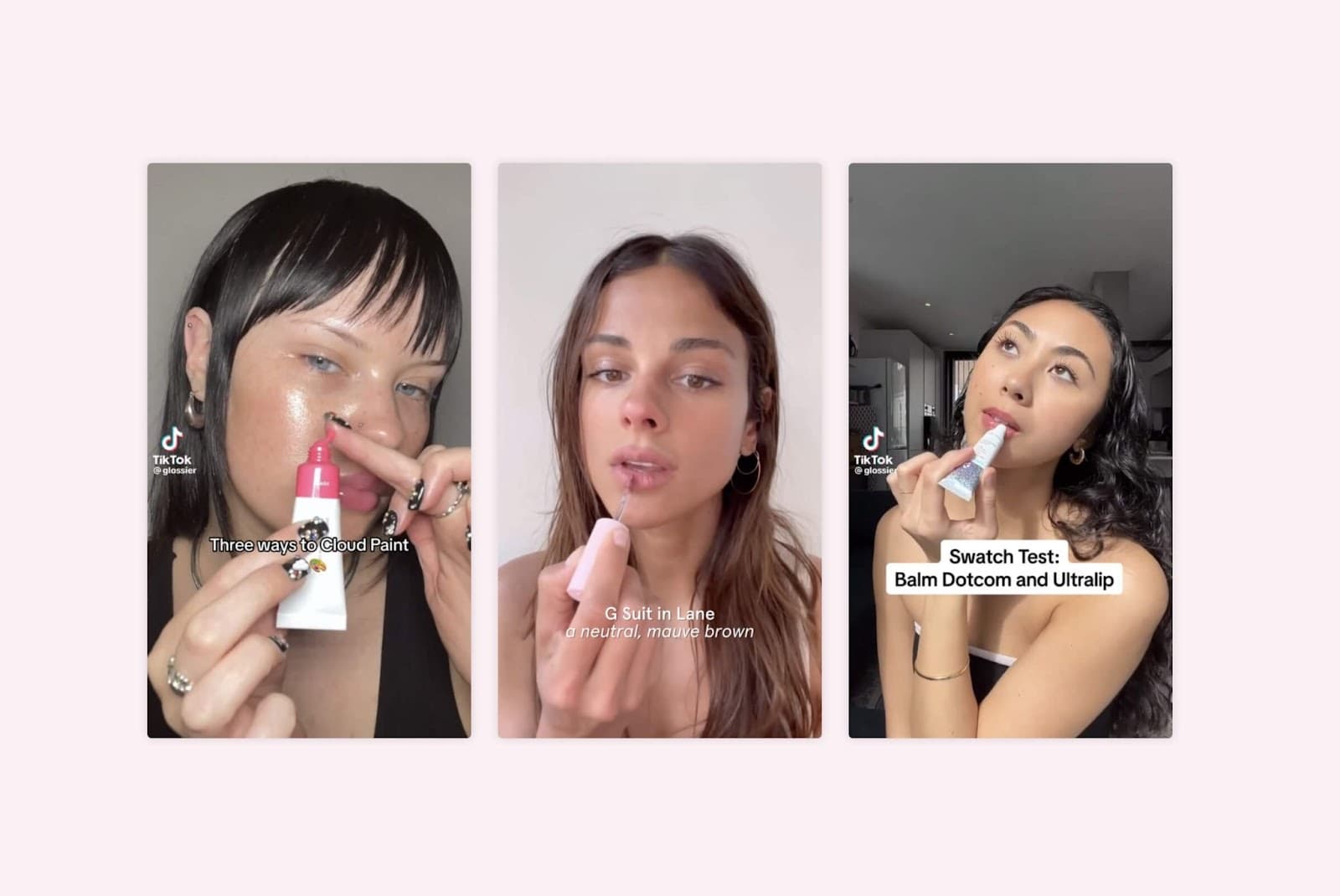
Three TikTok clips lined up on a single pink background. Creator 1 swipes Cloud Paint across her cheek ("Three ways to Cloud Paint"). Creator 2 applies G Suit lipstick ("G Suit in Lane, a neutral, mauve brown"). Creator 3 swatches Balm Dotcom and Ultralip on her lips. Each clip carries the TikTok @glossier watermark. The pastel pink glue turns three organic videos into one paid ad.
System 1 read: Real. Community-made. Not shot in a studio.
Mechanical breakdown. Three creator videos, one ad placement, near-zero production cost. The creators already shot and cut the content. Glossier handled the composition, the unified pink background, and the ad buy. The watermarks are kept intact — the brand wants viewers to know these are real customers, not paid actors. Scale comes from picking three hooks that each solve a different objection: demo, swatch-test, shade-reveal.
Framework. The UGC pipeline in its most literal form. UGC is 42% of Glossier's TikTok posts, and the triptych format compounds the bet — three creators per credit. The pastel pink background is a Byron Sharp distinctive asset at work. Viewers recognize the brand before they read a word.
Clone angle. If you have 3+ customers already posting about your product, stitch their videos together with a unified background color. AdDogs composes multi-creator grids from reference content — you pay for no original production. Works best for categories where demo is persuasion: makeup, hair, skincare, supplements, fitness.
Ad 2: The full-catalog shelf
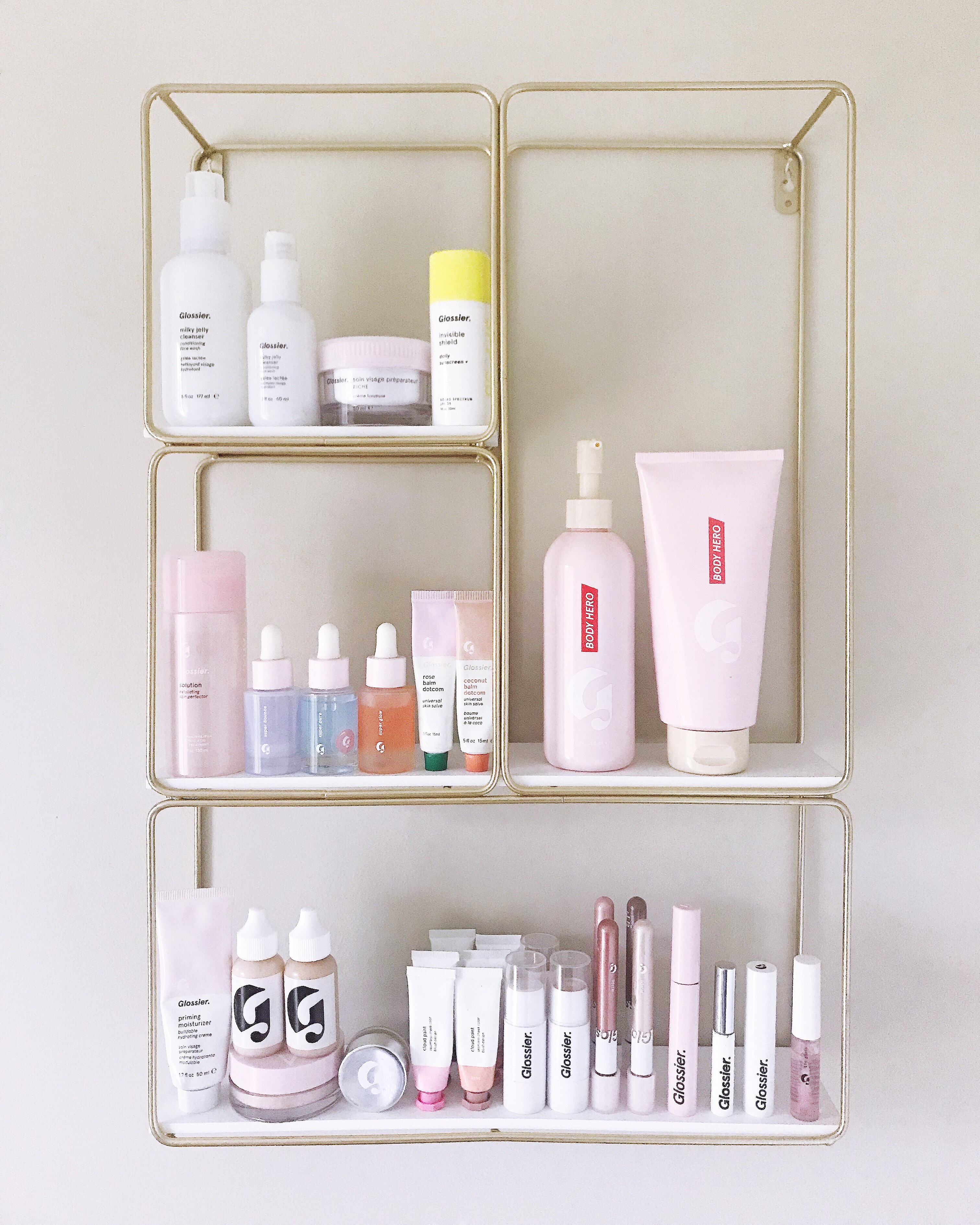
Gold wire apothecary shelving with the entire Glossier range arranged by tier. Skincare top shelf: Milky Jelly Cleanser, Priming Moisturizer Rich, Invisible Shield. Treatments mid shelf: Solution, facial drops, Body Hero duo on the right. Makeup bottom shelf: Boy Brow, Cloud Paint, lip products, mascaras. Every label faces forward. Pink-and-cream palette ties 20+ SKUs together. No model. No copy. No price.
System 1 read: Complete. Curated. A universe, not a product.
Mechanical breakdown. The ad is a merchandising flex: "you could own all of this." The gold wire frame is a distinctive asset by itself — spare, precious, almost museum-adjacent. Overhead angle flattens depth cues so no single SKU fights for the spotlight. This is the inverse of a conversion ad: there is no call to action, no urgency, no featured product. The viewer is meant to walk away thinking this is a world, not a SKU.
Framework. Textbook Binet & Field brand-building. Zero activation elements. 100% mental availability play. Long-tail ROAS, not same-day clicks — Glossier can afford this because downstream conversion runs through Sephora and referral. Most DTC brands run too much activation, not enough brand. This is the counterexample.
Clone angle. If you have 8+ SKUs, arrange them as a system instead of individually. The lineup IS the argument for your brand. Upload your catalog to AdDogs and the AI composes multi-subject grids with your palette extracted from your logo. Works for supplement stacks, pet-care lineups, coffee subscriptions with 5+ flavors, apparel capsule collections, candle ranges.
Ad 3: The customer selfie
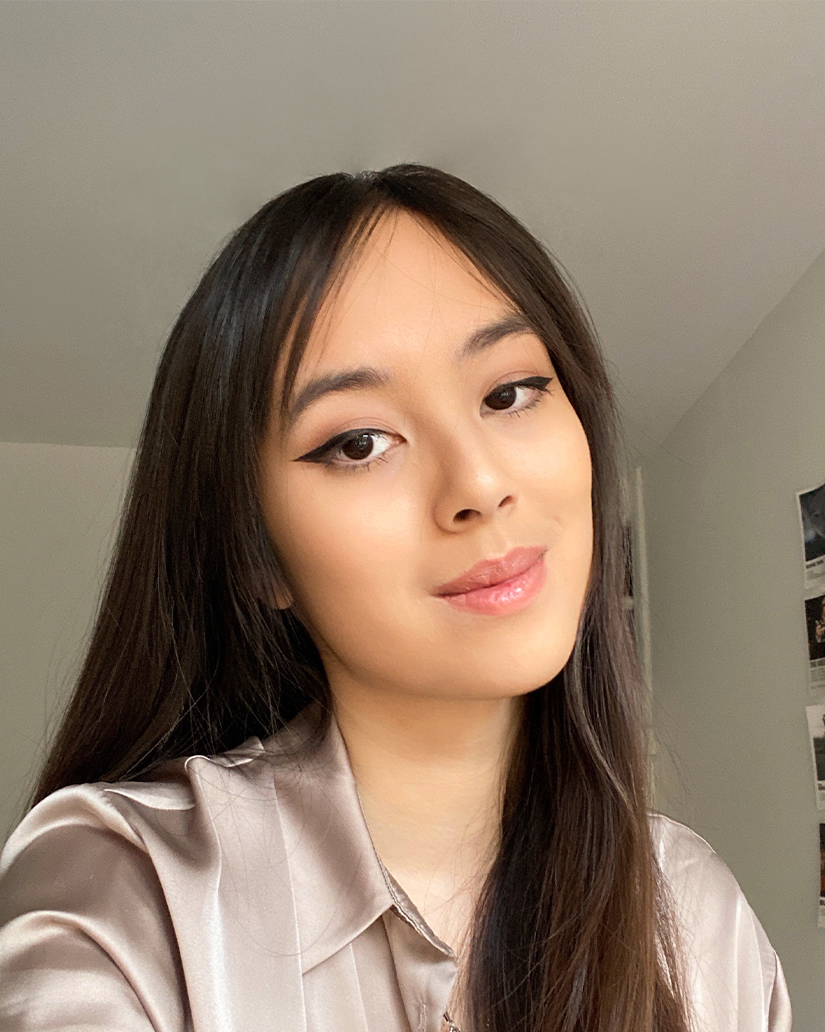
A portrait selfie. Winged liner. Glossy nude lip. Skin that reads barely-makeup. Long dark hair, silk blouse, home bedroom lighting. No product in frame. No overlay text. No brand treatment. If you didn't know this was Glossier, you'd assume it was an organic Instagram post.
System 1 read: Real girl. Real bedroom. Not a model.
Mechanical breakdown. This is what Glossier reposts as paid creative. A customer posted the selfie, the brand DM'd for permission, and now it runs as an ad. The absence of branding is the brand signal — Glossier customers know this is what Glossier ads look like. Everyone else assumes it's organic content and engages accordingly. Meta's ad-detection-resistant CTR lives here.
Framework. Pure UGC pipeline output. Emily Weiss has said 80% of Glossier customers come through peer referrals. This format is that referral, publicized. Kahneman System 1 processes format (friend's selfie) before content (paid ad by a $1.8B company), which is why it clears the ad-detection filter.
Clone angle. This is the single most copyable Glossier move for any DTC brand. You don't need 33% UGC share like Glossier has. You need ONE customer selfie per month, with permission, run as a paid ad. AdDogs applies your brand extraction to the subtle elements (filter, lighting, aspect ratio for placement). Keep the selfie aesthetic. Lose the agency gloss. Read the legal guide first — reposting a customer's face without permission is where this goes wrong.
Ad 4: The perfume copy-forward ad
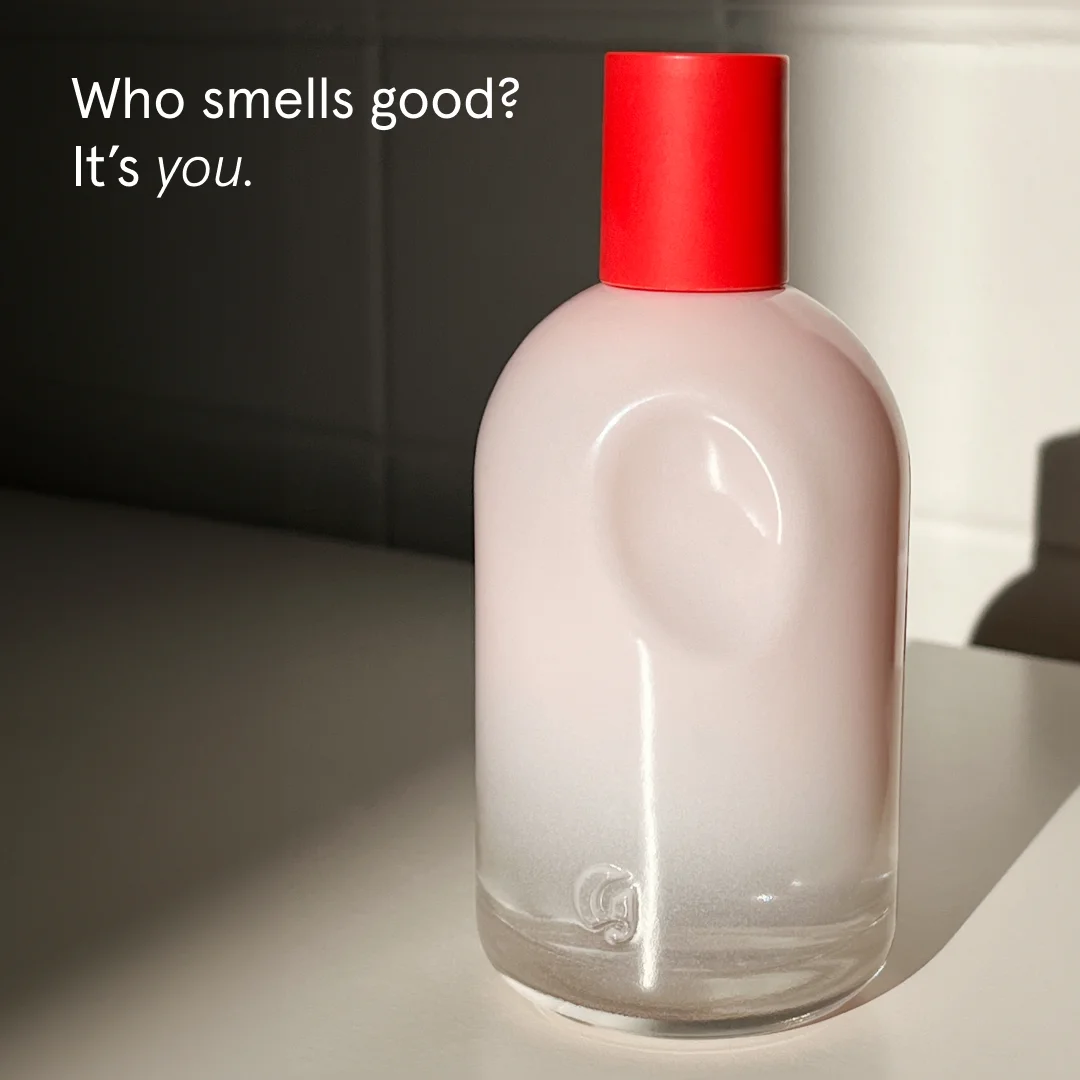
Glossier You perfume — frosted pink glass, bold red cap, G-wordmark at the base — shot against a dark tiled counter with a shadow falling to the right. White headline, top-left: "Who smells good? It's you." No other copy. No badge. No price.
System 1 read: Confident. Sensory. Not selling to you — selling to you.
Mechanical breakdown. Two lines of headline doing the work of 200 words of body copy. "Who smells good? It's you." flips the gaze back onto the reader — the product isn't what makes you smell good, you are. The italicized you holds the emphasis a half-beat longer than the eye expects. Dark tile isolates the bottle and the headline. The red cap is the only warm color in the frame. The bottle silhouette even echoes the letter G.
Framework. Rory Sutherland's "perception > reality" move. The perfume doesn't claim to be good; it claims to reveal what's already in you. Self-validation sells harder than product claims. Glossier You generated $100M in 2024 alone, top-selling fragrance at Sephora — copy-forward ads like this one carry a meaningful share of the lift.
Clone angle. If your category is crowded with claims about the product ("best moisturizer," "strongest formula," "most advanced"), flip the frame. Credit the buyer, not the product. "Who runs the fastest? You do. These just help." Works for supplements, fitness gear, fragrance, skincare — any category where self-image is the actual purchase driver. Upload your bottle and a 4-word headline to AdDogs; the composition and brand extraction handle the rest.
Ad 5: The Boy Brow minimalist hero
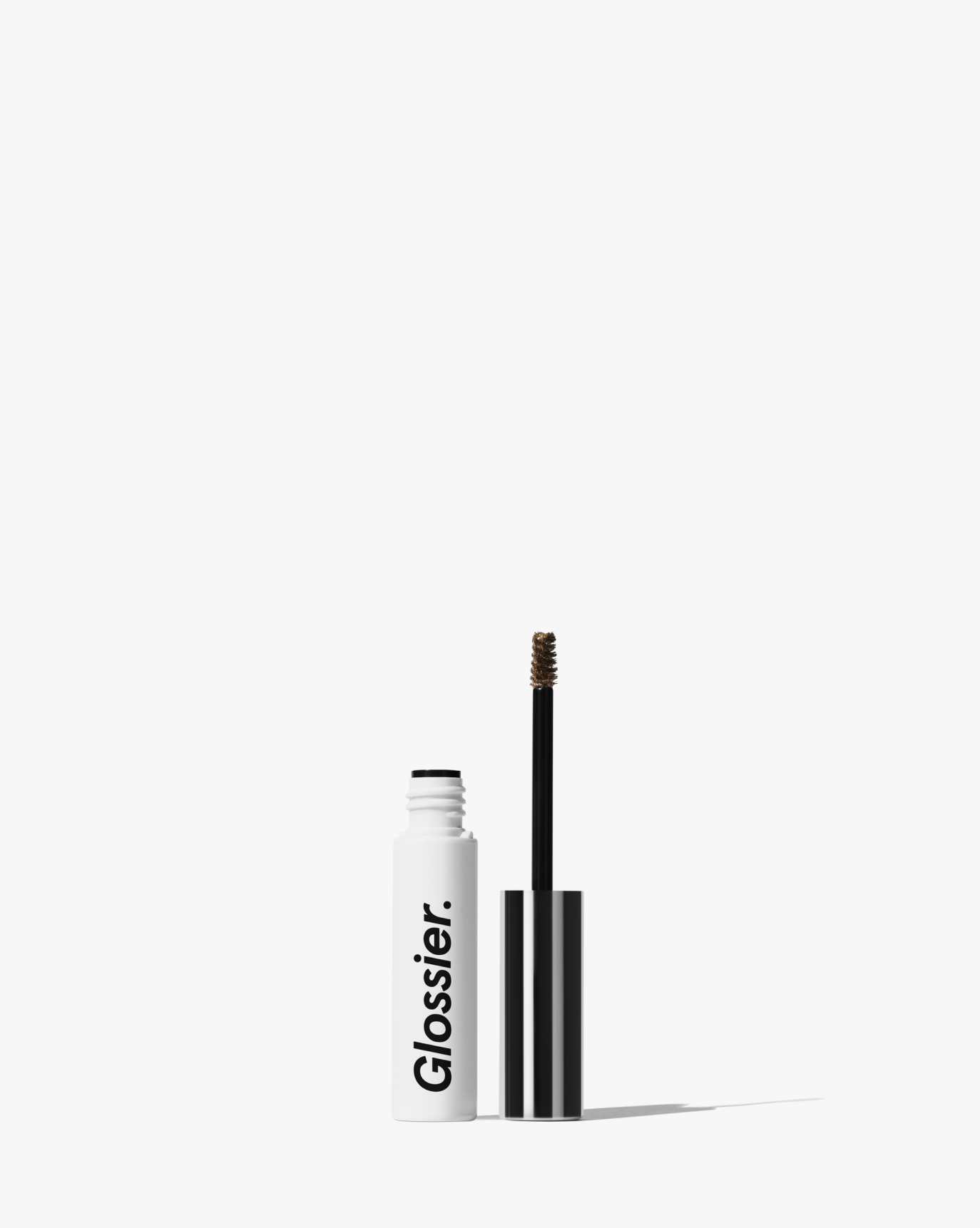
A single Boy Brow tube. White. Glossier wordmark down the side. The black applicator wand stands upright next to it. Pristine white background. 70%+ of the frame is empty space.
System 1 read: Confident. Iconic. This thing does not need explaining.
Mechanical breakdown. Restraint is the entire message. No lifestyle. No model. No copy. No price. The composition trusts the viewer to know what Boy Brow is — and if they don't, the negative space says find out. The applicator wand outside the tube is the single narrative choice — it shows the use in one gesture. Everything else is subtraction.
Framework. Byron Sharp mental availability made visible. Boy Brow has run in some variant since 2014. The minimalist product shot is the compounded distinctive asset — viewers recognize Glossier before they read the wordmark. 15M+ Boy Brow tubes sold lifetime per analyst estimates. A decade of repetition buys this kind of restraint.
Clone angle. This only works if your SKU already has brand equity. If you have a hero product with at least 12 months of sales and recognition, show it alone against white with nothing else. If you don't — don't. Minimalism reads as amateur when the product isn't iconic yet. Most dropshippers: run Ads 1, 2, or 3 first, earn the equity, then shoot this one.
Glossier ads receipts
Numbers kill the "does it actually work" objection.
| Metric | Number | Source |
|---|---|---|
| Series E valuation (2021) | $1.8B | BoF |
| Sephora launch, first-year sales | $100M | WWD |
| Blended retail sales YoY post-Sephora | +73% | WWD |
| Customers referred by a friend | 80% | Extole / Emily Weiss |
| Online sales from peer referrals | 70% | Extole / Emily Weiss |
| Fragrance business, 2024 alone | $100M | BoF |
| #glossier TikTok cumulative views | 1B+ | Skeepers |
| UGC share of Instagram feed | 33% | Skeepers |
| UGC share of TikTok posts | 42% | Skeepers |
Two numbers to underline.
Peer referrals at 80% is the lowest-CAC number in DTC beauty history. Most brands would kill for 15%. Glossier built it by reposting customers and paying them in visibility, not commission.
UGC at 33% of Instagram and 42% of TikTok is what most founders miss when they try to copy Glossier advertising from the outside. Nearly half of paid creative on the highest-ROI platform isn't produced by an agency. It's reposted from a customer with a DM permission trail. Production cost approaches zero; the budget goes to distribution.

Create your own skincare product ads
Create your ad
5 Glossier assets worth stealing (and what's trademark)
For dropshippers and DTC founders looking at Glossier ad examples wondering what's safe to clone, an honest split:
| Asset | Portable or trademark | Clone it or avoid it |
|---|---|---|
| Overhead flat-lay composition | Portable | Clone the angle, arrangement, and negative space |
| Testimonial-as-UI card | Portable | Clone the format, use your own quotes |
| Three-panel application sequence | Portable | Clone the grid, swap in your product demo |
| Pastel palette plus single accent banner | Portable | Clone the logic, pick your own colors |
| Serif headline plus 50%+ negative space | Portable | Clone the hierarchy, use your own typeface |
| Pink bubble-wrap pouch | Trademark (USPTO 2020) | Do not reproduce — legally off-limits |
| Serif "Glossier" wordmark | Trademark | Use your own wordmark |
| "You Look Good" tagline | Trademark (2022 relaunch) | Pick your own 3-word declarative |
| The word "Glossier" in any form | Trademark | Obviously — don't |
A cleaner legal line than most founders assume. Composition, palette logic, typography hierarchy, and layout grids are not copyrightable — they're ideas, not expressions. Specific wordmarks, taglines, and product packaging forms are. Clone the structure, bring your own brand.
Who else runs this playbook
Glossier didn't invent UGC-first DTC, but Glossier ads defined the current era of it. A short list of brands running variations of the same system:
The Ordinary. Ingredient-first minimalism. White dropper bottle on white background. Price in the ad (£5 or $7.90, depending on SKU). Glossier aesthetic stripped of the pink, which is itself a position. Where Glossier sells vibe, The Ordinary sells chemistry. Both kill the same overpriced incumbents.
Rare Beauty. Selena Gomez as creator-in-chief plus mental-health positioning. Pink-red palette, hand-held mirror poses. Rare Beauty is the Glossier flat-lay with a celebrity distinctive asset bolted on. Shares the UGC-repost pipeline; adds a face.
Sol de Janeiro. Body-care UGC plus scent-forward copy. Bright yellow and tropical palette. Anti-Glossier color logic. Landed TIME100 Most Influential Companies in 2024 riding the same Gen-Z micro-influencer pipeline, louder visuals.
Summer Fridays. Jet Lag Mask hero SKU, pastel vanity flat lays, rounded-serif wordmark. Reads as Glossier-adjacent on first glance, which is the point. Every minute a viewer confuses them is a minute of borrowed equity.
Topicals, Starface, Youth to the People. Each iterates with a different palette hook: citrus, star-shaped acne patches, green-glass clean-beauty jars. All Gen-Z-native, UGC-heavy, structurally Glossier. Starface sold 200 packs per minute at peak in 2023, turning a blemish treatment into a selfie accessory. Sharp's playbook in action.
Current differentiation between these brands is palette, not structure. That's exactly why clone-based ad generation works. Structure is stealable. Palette is yours to supply.
Where Glossier's playbook breaks
Every playbook has a failure mode, and Glossier ads are no exception. Their system breaks in specific, namable ways — worth flagging before any founder assumes they can run it tomorrow.
B2B. No one is reposting a customer selfie of a CRM. A UGC pipeline requires a product people photograph without being asked.
Utilitarian products. Screwdrivers, toilet paper, cables. No aspirational vanity flat lay fixes a commodity category where the buyer wants spec sheets, not vibes.
DTC under ~$100k revenue. Glossier had Into The Gloss with millions of monthly uniques before shipping product one in 2014. Launching from zero, you can't replicate the front half of the flywheel. You can only clone the creative output. AdDogs is how.
Glossier itself broke the playbook too. A few receipts the brand would rather you forget.
Glossier Play launched in 2019, discontinued within a year. Post-mortem: 2/3 of Play buyers were already Glossier customers (zero new acquisition), foil-wrapped packaging triggered a sustainability backlash, and a colorful sub-brand conflicted with the parent's no-makeup-makeup position.
January 2022: 80 employees laid off, a third of corporate staff. Emily Weiss publicly admitted "we made some mistakes" on over-investing in tech and non-core projects. Another 24 cuts followed. Three CEOs in ~3.5 years: Weiss stepped down 2022, Kyle Leahy took over, then announced her exit end-2025. Governance churn at that pace is a receipt the brand is still finding its post-founder identity.
Learn from the correction, not the original imbalance. Run the 80/20 brand-heavy strategy after $10M with paid acquisition handling activation. Not before.
Clone a Glossier ad in seconds
Five layouts. Five product categories they port to. One tool doing the composition work while you sleep.
The 3-step recipe
- Pick your reference. Screenshot a Glossier ad from Meta Ad Library, or browse the skincare ad examples filtered for pastel and minimal product layouts. The customer selfie and the copy-forward product ad are the two highest-converting starting points for cold-traffic DTC.
- Upload your product. PNG or JPG. AdDogs extracts your brand colors from your logo automatically — no hex codes, no Photoshop, no designer brief.
- Click Generate. one credit per variant, finished in seconds. One credit per ad. Exports in up to 14 aspect ratios for every Meta, TikTok, and Pinterest placement.
Which Glossier layout ports to your product
| If you sell... | Clone this Glossier layout | Why it ports |
|---|---|---|
| Makeup, skincare, haircare with creator demos | TikTok UGC triptych (Ad 1) | Three creators, one ad placement, near-zero production. You pay for distribution, not shoots. |
| Any 8+ SKU DTC range (supplements, pet food, candles, apparel) | Full-catalog shelf (Ad 2) | The lineup IS the argument. Lets you ship brand-building creative at scale without activation clutter. |
| Any wearable product where the customer is the best proof | Customer selfie repost (Ad 3) | Ad-detection-resistant. Customers trust other customers over brands 30:1. |
| Fragrance, supplements, fitness, any self-image-driven category | Copy-forward product ad (Ad 4) | Flip the frame — credit the buyer, not the product. Two lines of copy do heavy lifting. |
| Established SKUs with 12+ months of sales and recognition | Minimalist single-SKU hero (Ad 5) | Earn restraint by having equity. Don't skip to this one before customers recognize your SKU. |
The math, in one paragraph
Fiverr designer: $50-150 per ad. AdCreative.ai: $39/month for 10 credits = $3.90 per ad, every one generated from scratch with no reference-based cloning. AdDogs: $12/month for 30 ads on Basic ($0.40 per ad), or $33/month for 100 ads on Pro ($0.33 per ad). Cloning 10 Glossier-style variants against a new product costs $3.30 on Pro. The same test on AdCreative.ai costs $390. Fiverr quotes $500 minimum. Two orders of magnitude.
Payback math for a $30 skincare SKU at 30% gross margin: one sale covers 27 Pro variants. Your first winner ad pays for 3 months of Pro subscription.
Two workflow tips for Glossier clones
- For the catalog shelf: feed in at least 8 SKUs at once. The shelf format only works when the lineup is the story — individual SKU uploads default to hero-shot layouts.
- For the customer selfie: always get DM permission in writing first, and pull the quote from the same customer if you can. "Heaven in a bottle" beats any copywriter. Fake quotes read fake. If you don't have reviews yet, wait until your first 10 sales ship and pull from the Shopify product page.
Choose a plan and clone your first Glossier layout before your next cold coffee. Basic starts at $12/month for 30 ads.
FAQ
Why do Glossier ads all look the same?
Glossier runs five ad patterns on repeat: TikTok UGC triptych, full-catalog shelf, customer selfie repost, copy-forward product ad, and minimalist single-SKU hero. Consistency compounds recognition — viewers recognize a Glossier ad in under 200ms before they read the brand name. Byron Sharp calls this mental availability, and it's the reason Glossier's Meta CPMs run below beauty-category peers despite lighter ad spend.
Does Glossier pay for advertising?
Yes, but less than you'd think. Glossier historically ran an 80/20 brand-building-to-activation split, heavy on organic and retargeting, light on prospecting. Sephora now handles cold acquisition for them — the partnership hit $100M in first-year sales and drove a 73% blended retail lift YoY. UGC reposts remain 33% of Glossier's Instagram feed, which keeps paid creative costs near zero.
Can I legally copy a Glossier ad?
Composition, color logic, and layout grids are ideas — not copyrightable. You can clone the structure of any Glossier ad. Pink bubble-wrap pouch (trademarked USPTO 2020), serif "Glossier" wordmark, and "You Look Good" tagline are trademarks — legally off-limits. Full breakdown in the legal guide to cloning ads.
What's the best Glossier ad of all time?
Depends how you score it. By revenue, the Glossier You perfume copy-forward ad ("Who smells good? It's you.") sells a bottle every 40 seconds and drove $100M in 2024. By brand equity, the Boy Brow minimalist hero has run in some form since 2014, which makes it the most-compounded distinctive asset in the catalog. By creative ambition, the 2022 "You Look Good" OOH-plus-Meta relaunch rebuilt the wordmark and repositioned the brand in a single campaign. Pick your frame.
How do I clone Glossier ads without violating their trademarks?
Clone the composition, palette logic, typography hierarchy, and layout grid — none of those are protected. Avoid the pink bubble-wrap pouch (trademarked USPTO 2020), the serif "Glossier" wordmark, and the "You Look Good" tagline. Use your own brand name, your own tagline, and a palette that reads as yours, not theirs. A safe rule: if a Glossier customer would recognize the element as "Glossier's," rebuild it.
More ad teardowns in the series:
- Skincare ad examples that convert in 2026 — 30+ teardowns from Glossier, CeraVe, The Ordinary, and others.
- Liquid Death ads teardown: 7 static templates from a $1.4B brand — what the Glossier "distinctive asset" playbook looks like in a different category.