Is it legal to clone a competitor's ad? (2026 Guide)


US law only. Principles here overlap with most common-law jurisdictions, but the specific statutes and cases (17 U.S.C., the Lanham Act, Cal. Civ. Code § 3344, the D.C. Circuit in Thaler) are US. If you're running ads outside the US, read this as a map, not a manual, and pair it with local counsel. Everything below is educational, not legal advice. If you're holding a cease-and-desist letter or staring at a disabled account, talk to an intellectual property (IP) lawyer in your state.
Reviewed for accuracy against current US statutes and 2024–2026 case law (17 U.S.C., Lanham Act § 43(a), Cal. Civ. Code § 3344). Last editorial review: April 17, 2026.
The short answer: clone structure, not expression
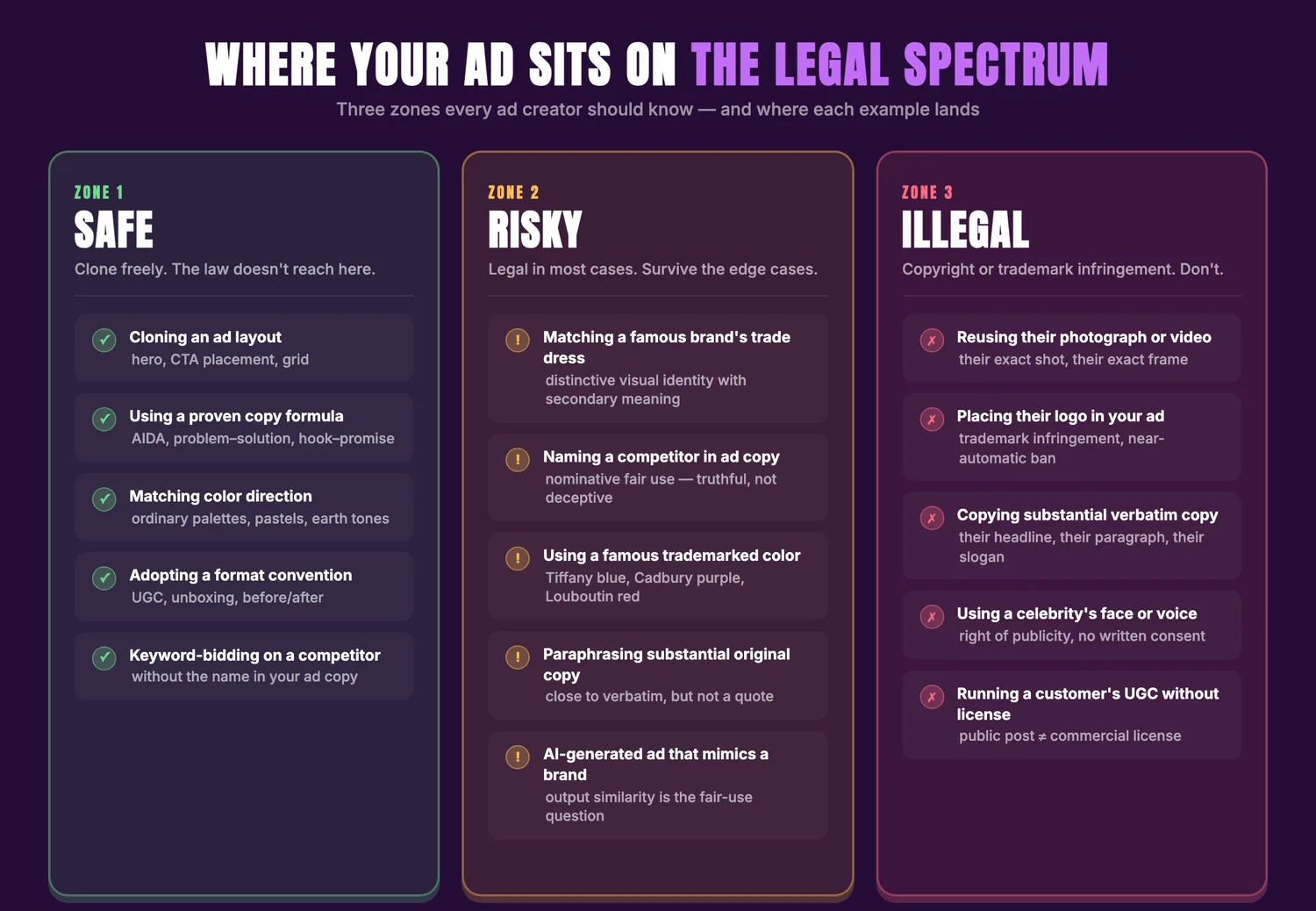
You can clone the structure of an ad. You cannot copy its protected expression. Whether it's legal to copy a Facebook ad — or any other competitor's ad — comes down to that line. Platforms may still take you down either way. That's a separate problem.
That's the verdict. Screenshot it if you need to.
You're reading your seventh tab on this question because nobody else in the space will say it plainly. Both camps get paid when you stay scared. Google hands you two kinds of content. One stack is lawyerly hedge-posts — UpCounsel, PatentPC, law-firm Q&A pages — engineered to end in "consult us." The other is marketing-blog handwaves — DirectPayNet, Foreplay, dropshipping blogs — using words like "inspiration" and "imitation" and citing zero statutes. Neither camp quotes 17 U.S.C. § 102(b). Neither tells you what Meta's actual ad policy says.
Not accidental. A brand with Meta's Brand Rights Protection access files one form and your ad is gone before anyone reads the policy. You, running a store out of your bedroom, file the same form and wait for manual review that may never come. Same platform, two systems — one for rights-holders with lawyers, one for everyone else. That's the real villain: the gap between what's legal and what a well-lawyered competitor can do to your ad account before anyone reviews the merits.
Three words to keep straight:
- Clone. Reproduce the exact creative — same photo, same copy, same logo. Illegal if the elements are protected.
- Copy. Create something substantially similar — close enough that the ordinary observer sees one work in the other. Depends on what's copied.
- Remix. Use the same idea, structure, or format with your own expression. The zone the law leaves open.
What follows is the receipts. Statutes, cases, policy text, platform-by-platform enforcement, AI rules as of April 2026, and a 5-step playbook for doing it without getting sued or suspended.
Banned vs illegal — two different problems
Treating "Meta will ban me" and "I'll get sued" as the same risk is the single biggest source of founder fear. They aren't.
"Banned" is a private company enforcing its terms of service. Unilateral, fast, often triggered by a rights-holder report rather than any actual legal violation. "Illegal" is a federal court applying federal statutes, with discovery and a judge. One takes a weekend. The other takes 18 months.
| Consequence | Enforcer | Trigger | Example |
|---|---|---|---|
| Ad disapproval | Platform automated review | Policy keyword match, image hash, rights-holder report | Stock photo flagged by Meta's Rights Manager |
| Ad account restriction | Platform policy team | Pattern of disapprovals or validated IP complaint | Three disapprovals in 30 days trips review |
| Ad account disabled | Platform trust-and-safety | Repeat infringer policy, Digital Millennium Copyright Act (DMCA) § 512 | Counterfeit product ad → warning → termination |
| Cease-and-desist letter | Opposing counsel | A brand believes you infringed — not a lawsuit | Rights-holder demands you pull the ad |
| Copyright infringement suit | Federal district court, 17 U.S.C. § 501 | Substantial similarity of protected expression + access | Plaintiff claims you reused their photo |
| Trademark / trade-dress suit | Federal district court, 15 U.S.C. § 1125(a) | Consumer confusion about source, sponsorship, or affiliation | Plaintiff claims your ad imitates their brand identity |
| Right of publicity suit | State court | Commercial use of a person's name, face, or voice without consent | Celebrity photo in an ad (Cal. Civ. Code § 3344) |
Two things follow.
Most of what founders call "getting banned for cloning ads" is the first three rows — platform enforcement, not litigation. The fix is a counter-notification or an appeal, not a lawyer.
The courtroom track has a higher bar. You don't get sued for a split-screen layout. You get sued for reusing a protected asset — photograph, copyrighted copy, logo, celebrity likeness. Those are the elements that carry a dollar sign attached.
Conflating the two risk tracks is the #1 reason founders freeze on "Generate." Separate them, and most of the fear evaporates.
What copyright actually protects in an ad
Ad copyright law starts with one statute. Verbatim, because paraphrasing is how the fog starts:
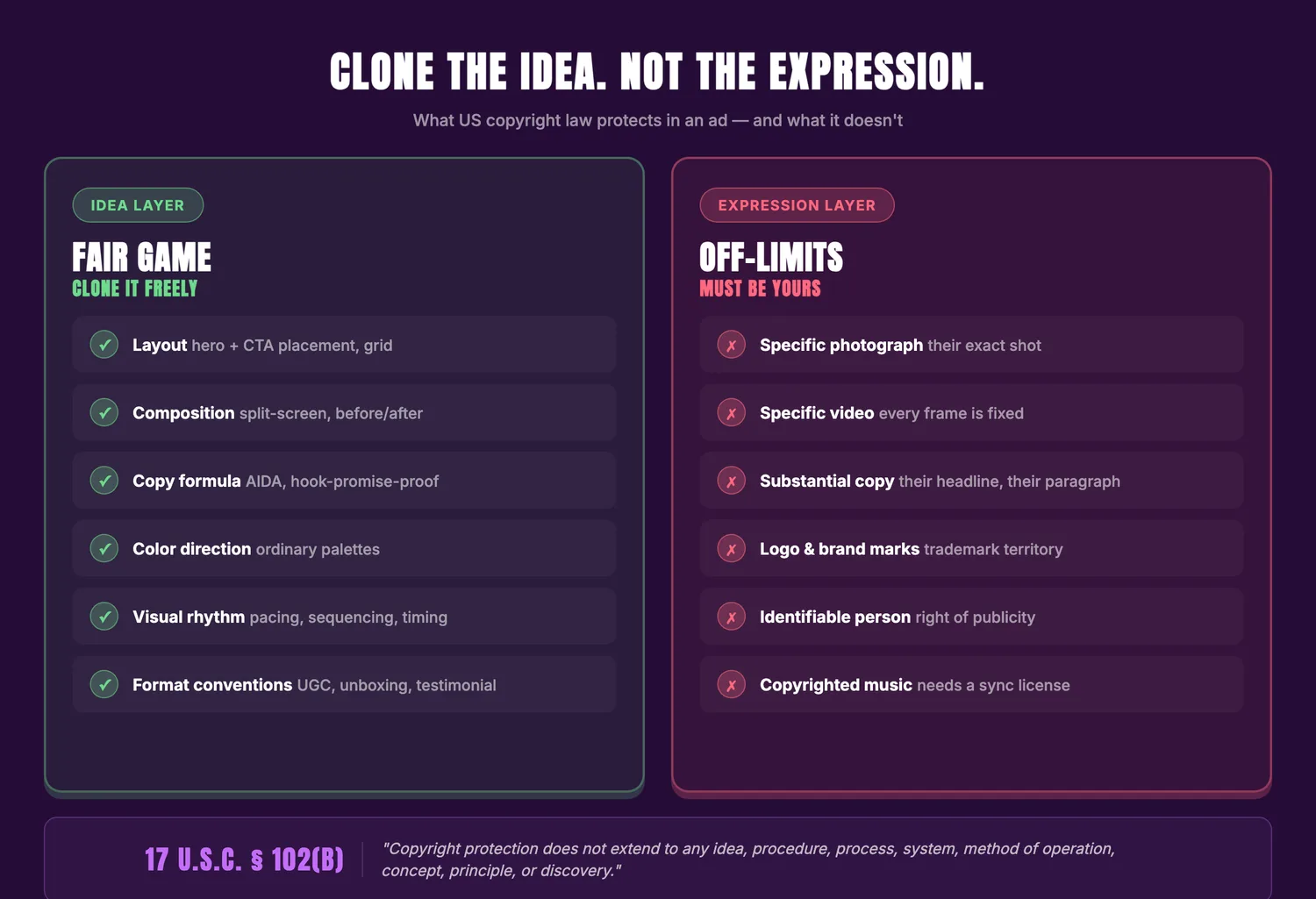
In no case does copyright protection for an original work of authorship extend to any idea, procedure, process, system, method of operation, concept, principle, or discovery, regardless of the form in which it is described, explained, illustrated, or embodied in such work.
Forty-four words. They do more work than the 2,000-word "consult a lawyer" posts combined.
Translated: copyright protects specific creative output, not the method or idea behind it. A photograph is protected. "Product against a white background with a pastel shadow" is not. Body copy is protected if it rises above short functional phrases. The copy formula — problem, agitation, solution — is not. The particular arrangement of this headline, image, CTA, testimonial is protected. The template concept "headline over hero image over CTA" is not.
The idea–expression dichotomy in 90 seconds
Two cases set the floor.
Baker v. Selden (1879): Selden copyrighted a book describing a bookkeeping system. Baker published account-books using the same system with different column arrangements. The Supreme Court held Selden's copyright "did not confer upon him the exclusive right to make and use account-books, ruled and arranged as designated by him." Copyrighting the explanation of a system does not give you a monopoly on the system. Copyrighting one ad does not give you a monopoly on the format.
Feist v. Rural Telephone (1991) locked this into modern law. Rural compiled a white-pages directory. Feist copied the listings. The Court held facts aren't copyrightable, alphabetical ordering isn't copyrightable, and copyright requires "independent creation plus a modicum of creativity." One line cited in every ad-creative dispute: "copyright rewards originality, not effort." You can spend $50,000 on a proprietary ad layout. If the layout is a method, copyright doesn't care.
What's fair game
Things you can clone without a copyright problem:
- Layout. Hero on the left, product on the right. Split-screen before/after. Three-column grid. Methods.
- Composition. Subject centered, negative space top-right, CTA lower-left. Visual conventions.
- Copy frameworks. AIDA. PAS. "Hook, promise, proof, offer, CTA." Formulas.
- Color direction. Earth tones, pastel minimalism, high-saturation TikTok palettes. Ordinary palettes aren't protected.
- Visual rhythm and pacing. The 15-second TikTok structure. Pacing is an idea.
- Format conventions. UGC testimonial. Unboxing. Problem-dramatization-solution. Stock scenes.
That last category has a name: scènes à faire. Courts strip out "elements that are indispensable, stock, standard, or commonplace" in a genre before similarity analysis. Nobody owns happy family at breakfast, product on white, or before/after for fitness.
What isn't
Things you cannot clone:
- The specific photograph. Framing, lighting, subject, composition of the actual shot. Textbook infringement.
- The specific video shot. Every frame is fixed expression.
- The specific copy if it exceeds short functional phrases. "Shop now" is too short. Their 150-word body paragraph isn't.
- The logo — trademark territory, not copyright.
- A distinctive model's likeness — right of publicity.
- Copyrighted music. Every ad using music needs a sync license.
Short functional phrases — slogans, CTAs, three-word headlines — generally aren't copyrightable but may be trademarked. "Just Do It" isn't a copyright problem. It's a Nike-owns-this-phrase-federally problem.
Apple v. Microsoft — the GUI precedent that settles the ad question
Courts already ran this analysis for a close cousin of ad design: graphical user interfaces.
In Apple v. Microsoft (9th Cir. 1994), Apple sued over Windows's overlapping windows, icons, trash can, and desktop metaphor. The Ninth Circuit rejected Apple's "look and feel" theory: "Apple cannot get patent-like protection for the idea of a graphical user interface, or the idea of a desktop metaphor." After filtering unprotectable ideas, the remaining similarities weren't substantial.
A GUI layout is a close cousin of an ad layout — both are functional arrangements guiding user attention. If Apple couldn't monopolize "overlapping windows with a taskbar," no brand monopolizes "hero product over CTA button." Lotus v. Borland (1st Cir. 1995) reinforced this: menu command hierarchies are "methods of operation" and sit outside copyright.
Jangle Vision v. Alexander Wang — the modern ad-to-ad case
Most direct precedent is recent. Jangle Vision v. Alexander Wang (9th Cir. 2023) involved tall, thin, masked, pink-bodysuited figures in an ad campaign. Plaintiff claimed the Wang ad copied the vibe. The Ninth Circuit filtered out unprotectable ideas and held the remaining protectable expression wasn't substantially similar. No infringement. "I cloned your vibe" is not a copyright claim that wins.
The contrast: Lions Gate v. TD/Havas, where an ad agency's piggy-bank spot reused the iconic lift from Dirty Dancing and the film's song "(I've Had) the Time of My Life." Lions Gate's copyright claim survived a motion to dismiss. Not the idea of a dance lift — the specific copyrighted imagery plus a licensed song. Reframing it as homage didn't save it.
Most cloned "vibes" that ship successfully sit on the Jangle Vision side of the line — same format, same category conventions, fresh protected expression. Browse hundreds of Facebook ad examples or Instagram product ad examples and notice how many are the same layout with different brands. And if you're cloning in a regulated vertical, the limits go beyond copyright — see advertising regulated products like supplements for the FTC and platform rules that apply on top.
Trademark and trade dress — the other legal layer
Copyright protects creative expression. Trademark protects consumer understanding of who made what. Different statutes, different tests. Conflating them is why most ad-cloning questions get bad answers.
The federal trademark cause of action lives at 15 U.S.C. § 1125(a), Lanham Act § 43(a). Plain English: you can't use "any word, term, name, symbol, or device" in commerce that is "likely to cause confusion, or to cause mistake, or to deceive" about affiliation, origin, sponsorship, or approval. The test is consumer confusion about source, not aesthetic similarity.
Dilution is the other hammer, at § 1125(c). Famous marks — Nike, Apple, Coca-Cola, Tiffany — get protection against uses that blur or tarnish, even without confusion.
Using a competitor's name vs using their logo
You can use their name carefully. You almost never want to use their logo.
The doctrine is nominative fair use, from New Kids on the Block v. News America (9th Cir. 1992). Three-part test: (1) the product isn't readily identifiable without the trademark; (2) only as much as needed is used; (3) the use doesn't suggest sponsorship or endorsement.
"Like AdCreative.ai but 10× cheaper" passes if the comparison is truthful, you use the text name (not the logo), and you don't imply endorsement. "AdCreative.ai recommends AdDogs" fails — false sponsorship. Logo in your ad fails — you don't need the logo to identify them.
The Second Circuit locked in the keyword-advertising version in 1-800 Contacts v. JAND (Warby Parker) (October 8, 2024). Bidding on a competitor's trademark as a Google Ads keyword — without using the mark in ad copy — isn't infringement. Eric Goldman's analysis is blunt: "Second Circuit tells trademark owners to stop suing over competitive keyword advertising."
Trade dress — the "look and feel" statute
Trade dress extends trademark protection to the "total image" of a product or brand — packaging, décor, color schemes, design elements that identify source. Two Pesos v. Taco Cabana, 505 U.S. 763 (1992), confirmed restaurant trade dress can be inherently distinctive, no secondary meaning required.
The next case narrowed this hard. Wal-Mart v. Samara Brothers, 529 U.S. 205 (2000), held product design trade dress is never inherently distinctive and always requires secondary meaning. Ads sit closer to product design than to physical décor. A brand has to prove its "ad style" has become a source identifier before suing over a structural clone — a high bar no reported case has cleared for pure layout-level similarity.
Famous color trademarks — the narrow exceptions
A few colors are trademarked. Tiffany blue. Cadbury purple. Louboutin red on high-heel soles specifically. Each required secondary meaning, fame, and decades of consistent use. Ordinary palettes — pastels, neutrals, earth tones — aren't protectable. You can match a competitor's color direction without opening a trade-dress claim unless they're in this tiny club. Even then, the claim applies to the color in product context, not a TikTok ad background.
Comparative advertising — the safe harbor
The FTC has endorsed comparative advertising since 1979. The test: truthful, not deceptive, substantiated. "AdCreative.ai charges $39/month for 10 credits. AdDogs charges $12/month for 30 credits" qualifies — math verifiable, pricing accurate, nobody confused about who made what. Statutory safe harbor lives at § 1125(c), which excludes "fair use, including a nominative or descriptive fair use" from dilution liability.
The Tenth Circuit applied the copyright version in I Dig Texas v. Creager (2023): a competitor used company product photos in a comparative ad and fair-use factor 4 wasn't adversely affected. Translation: you can put their price next to yours, their name next to yours, and the receipts next to yours. If the math is right, the statute has your back.
Platform-by-platform — what each network actually enforces
The law is one system. Platform policy is another. You can lose an ad on either.
Every platform's IP policy focuses on three things: (a) copyrighted content (photos, video, audio, copy), (b) trademarks (names, logos, slogans), and (c) source confusion. None of them explicitly prohibit "structural similarity" or "layout copying." Every quote below is pulled directly from the policy page, not paraphrased.
| Platform | Policy URL | Auto-detection | Takedown trigger | Appeal path |
|---|---|---|---|---|
| Meta (Facebook + Instagram) | Copyright and Trademarks · Third-party IP | Rights Manager (image and video hashing). Ads scanned against rights-holder reference library. Human review layered on top for complaints. | Policy text: "Ads may not contain content that violates the intellectual property rights of any third party, including copyright, trademark or other legal rights." Plus: ads that "Are likely to confuse people about the source, sponsorship or affiliation of the goods or services." | In-product ad review request. DMCA counter-notification for copyright. Full-account appeal for account-level restrictions via Restricting Accounts. |
| TikTok Ads | IP Infringement Policy | TikTok IP Operation team review. Automated content-matching for music and known infringing clips. | Policy text: "Ads that infringe on the intellectual property rights of others, including copyright, trademark, and distributing or selling counterfeit goods, are not allowed." Prohibits "display or use of unauthorized third-party names, logos, or brands in a way that could mislead users about brand affiliation." | Webform report at ads.tiktok.com. Validated infringements removed "promptly within 2 working days." Counter-notification path under TikTok's Global Copyright Policy. |
| Google Ads | Trademarks · Copyrights | Automated scan against trademark-complaint database. DMCA takedown workflow for copyright. | Policy text: "Google doesn't allow ads to use copyrighted content in a way that infringes copyright." For trademarks: restrictions apply when marks are used "in a confusing, deceptive, or misleading way" in ad copy, not as keywords. | DMCA counter-notification restores ads pending litigation. Policy: "Multiple disapproved ads can trigger account suspension" and resubmission without a valid counter-notification "may result in the termination of their account under Google's repeat infringement policy." |
| YouTube | Content ID | Content ID fingerprinting for audio and video. Scans on upload and continuously. | Rights-holder claims on matched content. Automated options: block, monetize, or track. Ads using unlicensed music or video clips get claimed at upload. | Dispute within YouTube Studio. If the claim isn't released, the standard copyright-strike ladder applies. Three strikes terminates the channel. |
| X (Twitter) | Copyright Policy | Lighter than Meta or Google. DMCA-notice-driven rather than proactive hashing. | DMCA takedown filed under § 512. Trademark complaints via a separate report form. | Counter-notification under § 512. Repeat-infringer policy applies. |
Two things jump off this table.
None of the policy text prohibits structural similarity. Every quoted sentence targets protected expression, trademarks, or source confusion. Cloning structure while swapping your own protected expression (your photograph, your copy, your logo) doesn't sit inside any of these prohibitions on a plain reading.
Platform enforcement is report-driven for non-obvious cases. Velocity depends on whether the brand has Rights Manager or Brand Rights Protection (BRP) enrolled. A Fortune 500 brand with BRP access files one form and your ad disappears fast — often the same day. You file the same form and wait for manual review that may never come.
Cross-account impact — one creative flagged, connected Business Manager accounts hit — is reported widely by affected operators, even if Meta's Restricting Accounts page doesn't name the phenomenon in policy text. The progressive strike ladder is documented. The cross-account cascade is folklore with receipts.
The takeaway: platform policy is broader than federal law, enforcement is unequal, and the cheapest protection is not relying on someone else's protected expression in the first place.
Are swipe files legal?
Swipe files are as old as direct-response copywriting. Gary Halbert kept one. Dan Kennedy built his career on one. David Ogilvy wrote about the practice.
Collecting is legal. Saving screenshots to a folder, a Notion doc, or a paid tool like Foreplay or Minea is observation. Nothing in copyright, trademark, or platform policy prohibits looking at ads and saving what you see. Meta's Ad Library exists so anyone can browse for transparency.
Studying is legal. Reverse-engineering why an ad works — layout, hook, CTA placement, pacing — sits squarely inside the § 102(b) exclusion.
Republishing other people's ads as your own isn't. Taking a competitor's actual ad — their photo, copy, logo — and running it is textbook copyright and trademark infringement. The Ad Library makes ads viewable — not licensed for reuse.
Selling swipe files is a gray zone. A paid product packaging other people's ads raises real copyright questions. The defense is usually education and commentary, pulling § 107 fair use into play. Fair use in a commercial product is narrower than fair use in a classroom. Tools like Foreplay and Minea argue they operate in observation and analytics (organizing public information, not licensing creative) — plausible, but not litigated cleanly in the US.
One pattern: the "copied competitor ad" cases that actually get litigated almost never involve pure structural copying. Lions Gate involved a copyrighted song plus iconic imagery. Jangle Vision filtered out at substantial-similarity. The absence of a reported case on layout-only cloning is itself evidence plaintiffs don't bother — they lose.
Collecting, studying, drawing inspiration: that's the job. Uploading somebody else's creative verbatim and calling it your campaign: that's the problem.
Dropshipping-specific scenarios
Three clone patterns dropshippers run into that the general doctrine doesn't cover cleanly:
Supplier stock photos (AliExpress, CJDropshipping, Spocket, Zendrop). Using your supplier's product photo in your own ad is usually covered by the supplier's implicit commercial license to the reseller — the whole point of the product photo is that retailers resell the product. But supplier terms vary. If the platform's terms explicitly prohibit commercial reuse (rare) or the photo was clearly licensed from a third-party stock library (check for watermarks), you need to source your own. Safest: shoot your own product on white. Takes 10 minutes with a phone and a window.
Viral TikTok → paid ad conversion. Saw a creator's organic video blow up and want to run it as a paid ad? That's textbook unlicensed UGC. The creator owns the copyright in the video and a right-of-publicity interest in their image. Public posting is not a commercial license. Either get a signed usage agreement (UGC creators often sell paid rights separately) or shoot your own UGC to the same pacing. Running a scraped creator clip as a paid ad is the #1 dropshipping-to-lawsuit pipeline.
Meta Ad Library reuse. Seeing an ad in the Library means a real brand paid to run it. It does not mean the ad is public-domain. The Library is a transparency surface, not a licensing portal. You can study the ad, map its structure, and build your own version with your product and expression — exactly what this whole post describes. You cannot right-click-save the creative and upload it as yours.

Create your own facebook product ads
Create your ad
Is an AI-generated ad legal? The 2026 state
The law on AI-assisted advertising finally has structure, and it cuts cleaner than most marketers expect. Disclosure moved from guidance to statute later in the year, with New York's synthetic-performer rule in force since June 9, 2026 and the EU AI Act's Article 50 since August 2; the state of AI in advertising 2026 report tracks every rule and platform policy, and what audiences made of disclosed AI.
Human authorship is required. The D.C. Circuit unanimously affirmed in Thaler v. Perlmutter (March 18, 2025). The Supreme Court denied cert on March 2, 2026. Holding: "The Copyright Act of 1976 requires all eligible work to be authored in the first instance by a human being." An AI alone cannot be the author.
Human-assisted AI work is still copyrightable. The Copyright Office's Part 2 report (January 29, 2025) drew the line: AI outputs can be copyrighted "only where a human author has determined sufficient expressive elements." Prompts alone don't cut it. Human arrangement, selection, and modification does. The March 2023 registration guidance still governs: register the human-authored portions, disclaim the AI-generated material.
Part 3 is pending. The Copyright Office announced a third report on training data and fair use. Publication status: pre-publication as of April 2026. When it lands, the analysis for AI-ad tools that train on scraped creative will sharpen.
Getty v. Stability is split across jurisdictions. The UK High Court ruled November 4, 2025, rejecting Getty's primary copyright and database-right claims while finding limited trademark infringement for specific Stable Diffusion outputs. In the US, Getty refiled in N.D. Cal. on August 14, 2025. A motion to dismiss was argued February 10, 2026, with a ruling pending. Single biggest litigation to watch for AI-generated-ad implications.
FTC has rules around AI in advertising. The Fake Reviews Rule (16 C.F.R. Part 465), effective October 21, 2024, prohibits AI-generated consumer reviews, testimonials, and celebrity testimonials that misrepresent identity or experience. Civil penalties. A fake customer face saying "this product changed my life" — that customer does not exist — is FTC territory regardless of platform policy.
State AI-ad laws are losing in court. E.D. Cal. permanently enjoined California's AB 2655 and AB 2839 (election deepfakes) on August 29, 2025 — Section 230 preemption plus First Amendment. Commercial AI ad laws at the state level will face similar challenges but have better constitutional footing than political-speech rules.
Federal NO FAKES Act is pending. HR 2794 was introduced April 2025 with bipartisan support and backing from Google, RIAA, MPA, SAG-AFTRA, YouTube, and OpenAI. Not enacted as of April 2026. If passed, it creates a federal floor under state publicity laws.
Tennessee's ELVIS Act is already law. ELVIS (effective July 1, 2024) extends Tennessee's right of publicity to voice specifically and creates a cause of action against tool providers whose "primary purpose" is unauthorized voice replicas. Matters if you're cloning video ads with voice-over.
The architecture matters. Most AI ad tools — AdCreative.ai, Canva, Pencil, and the long tail of generate-from-scratch platforms — sit in the copyright-ambiguous zone because they generate from prompts without a strong human selection-and-arrangement layer. Under Part 2's framework, the ad you just paid $3.90 to generate from a prompt may not be copyrightable at all. AdDogs sits in a different architecture by design: you pick the reference (human selection of structure), upload your product photograph (your own protected expression), select the output, export. Under Part 2, that's the profile of AI-assisted work that qualifies for copyright in the arrangement — because the human role determines expressive elements. See AdDogs vs AdCreative.ai for how the two architectures differ.
Celebrities, influencers, and UGC
Right of publicity is a state-law patchwork and the fastest way to turn an ad into a lawsuit when the image of a person is involved.
California — Cal. Civ. Code § 3344 makes it unlawful "for the purpose of advertising or selling…to knowingly use another's name, voice, signature, photograph, or likeness" without consent. 70-year postmortem right. California law reaches any ad shown in the state.
New York — N.Y. Civil Rights Law §§ 50–51 applies to any person, not just celebrities. Using any identifiable person's photo in a New York ad without written consent is actionable.
Tennessee — The ELVIS Act adds voice-specific protection and targets tool providers whose primary purpose is unauthorized voice replicas.
No federal statute — yet. The NO FAKES Act would create one. Until it passes, right of publicity is a state-by-state map.
Public posts are not commercial licenses. A customer tagging your brand on Instagram does not license their post for paid ads. Copyright belongs to the creator. Likeness is the person's right-of-publicity interest. Running it without written permission triggers two causes of action. Reported seven-figure user-generated content (UGC) demands are not outliers.
Model releases are the baseline. If a real person appears in your ad, you need a signed release covering (a) copyright in the photo or video, (b) right-of-publicity consent, and (c) scope of use. Stock licenses usually include one. Cloning an ad that uses a real person means your clone needs its own release — you cannot inherit the original's.
How to clone an ad legally — 5-step playbook
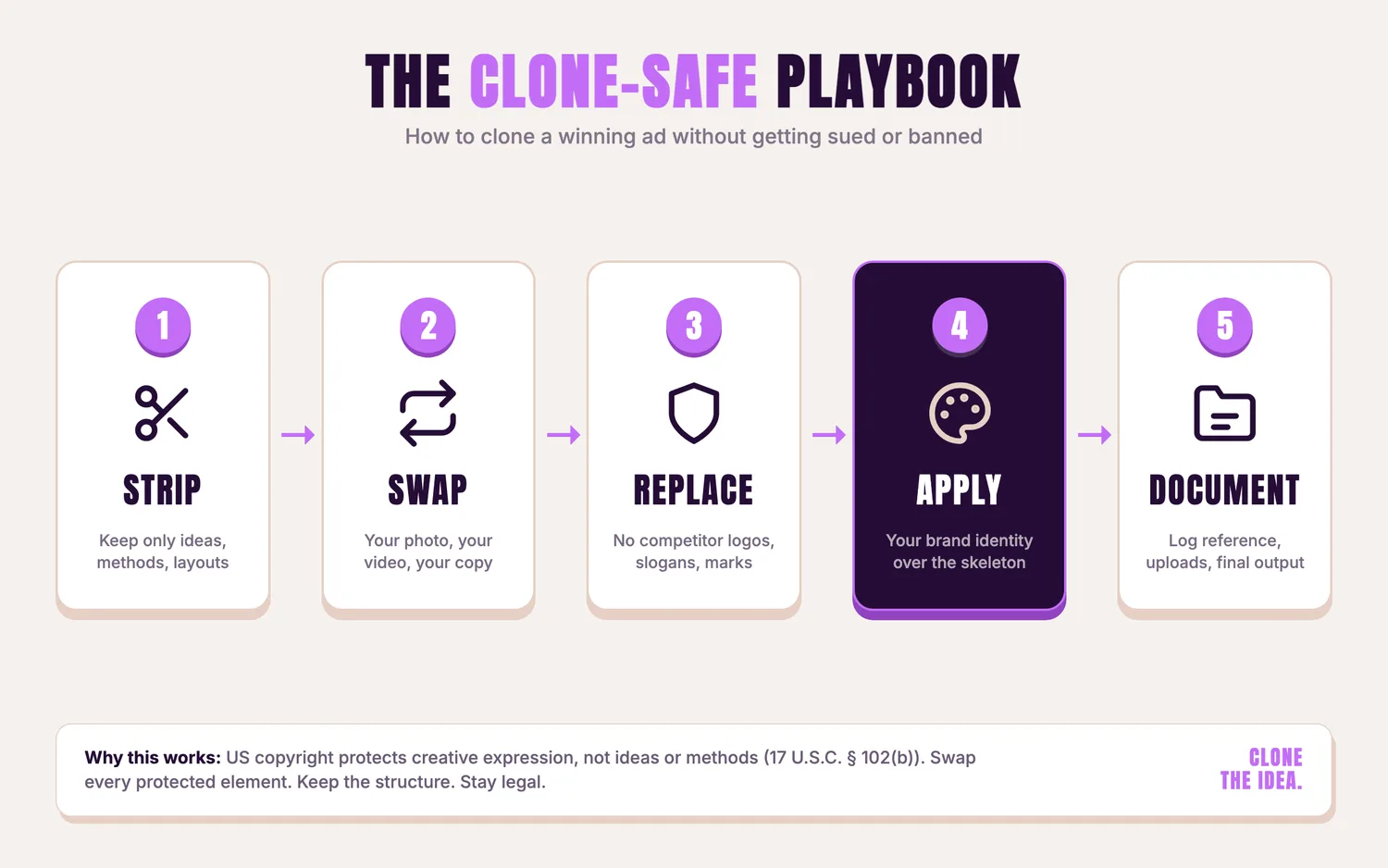
A repeatable process for cloning a winning ad without touching the expression that makes it actionable.
Step 1. Strip to structure. List only the elements that are ideas, methods, or scènes à faire. Layout grid. Composition. Hook formula. CTA placement. Copy framework. Color direction. Pacing. None are copyrightable under § 102(b).
Step 2. Swap every copyrighted asset. Your photograph, not theirs. Your video, not theirs. Your written copy, not theirs. If the reference uses a 15-second UGC clip, yours is your own clip shot to the same pacing. That keeps you inside Jangle Vision v. Wang and out of Lions Gate v. TD/Havas.
Step 3. Replace every trademark. Your logo, your brand name, your distinctive fonts. Registered slogans ("Just Do It") are off-limits. Famous color marks (Tiffany blue, Cadbury purple, Louboutin red) get routed around. Nominative fair use covers calling a competitor by name in comparative copy — the visual system stays yours.
Step 4. Apply your own brand identity. Two ads using the same composition with different brand colors and logos read as two different ads — because they are. AdDogs automates this: it extracts your brand palette and logo and applies them to whatever reference structure you pick. See cloning in AdDogs vs Canva for how this differs from designing from scratch.
Step 5. Document your process. Save the reference, your uploads, and the generated output. If anyone claims "substantial similarity," your log shows your expression is independently created, the structural similarities filter out under the idea-expression dichotomy, and no protected element was reused.
What to do if your ad gets flagged — runbook
If your ad gets flagged or disapproved, the first decision is whether it's a platform policy issue (fix it in-app) or an intellectual property strike (respond with a DMCA counter-notification within 10–14 business days). Most flags — roughly 80% in our reading of founder reports — are platform-policy friction, not lawsuits. The runbook below covers both tracks.
Already running a cloned ad and worried? You aren't automatically in trouble. Nothing retroactive triggers until a rights-holder reports you or a platform auto-detection hits. The federal copyright statute of limitations is 3 years from discovery (17 U.S.C. § 507(b)) — old campaigns don't compound risk absent a complaint. Run the campaign through the 3-question pre-flight checklist further down. If it passes, keep running. If it doesn't, swap the flagged element and re-upload. If you've already received a cease-and-desist or a disabled-account notice, jump to the relevant step below before anything else.
Read the actual policy cited. Not the summary email — the specific policy URL in the disapproval. Meta citing "intellectual property" can mean copyright, trademark, or source confusion: three different fixes. TikTok citing "IP infringement" covers a broader bucket including counterfeits. Google Ads citing "copyright" is a DMCA flow. The fix depends on the precise cite.
Distinguish IP strike from content strike. An IP strike means a rights-holder reported you. Response is corrective (remove the contested element) or adversarial (DMCA counter-notification). A content strike — deceptive claims, prohibited categories, community-standards — is a separate workflow.
File a DMCA counter-notification if the cite is copyright. 17 U.S.C. § 512(g) is the statute. Identify the removed material and location, make the statement under penalty of perjury that removal was by mistake or misidentification, consent to jurisdiction, include contact info. If the claimant doesn't initiate court proceedings within 10–14 business days, the platform typically restores the content.
Use Meta's appeal window for ad-account restrictions. Restricting Accounts describes the progressive ladder. Early-stage restrictions have in-product appeal. Later-stage and permanent disables require Business Help Center tickets. Cross-account impact on shared business assets is real in practice — appeal each affected account individually.
A cease-and-desist is a written demand, not a lawsuit. You aren't obligated to comply. You're signaling whether the sender needs to escalate. Most C&Ds about ads resolve without litigation once a lawyer reads the creative against the idea-expression filter and the nominative-fair-use test. Don't ignore one. Don't spend before assessing whether the claim has legs.
Lawyer up on specific triggers. Not before. Triggers: (a) a formal complaint filed in federal court; (b) cited exposure of six figures or more; (c) a claimant enrolled in Brand Rights Protection capable of cascading takedowns; (d) right-of-publicity claim for a named individual. Absent those, handle platform tracks yourself and escalate only if it goes sideways.
The 3-question pre-flight checklist
Before you ship, run the ad through three questions.
- Does the ad reuse a specific image, phrase, or logo from the reference? If the ad uses their exact photograph, their exact headline, or their logo — stop. Swap it.
- Would a reasonable viewer confuse the two brands? If yes, differentiate further — your logo larger, your colors more prominent, your name in the headline.
- Would the ad pass the substantial-similarity sniff test? Strip both down to protected expression — photograph, specific copy, distinctive graphics, logo. If any element is close enough that the ordinary observer sees one in the other, replace it.
Any yes means rework. All no means ship.
FAQ
Is it legal to copy a competitor's ad?
Depends what you copy. Cloning structure — layout, composition, copy framework — is legal under 17 U.S.C. § 102(b), which excludes ideas, systems, methods. Copying protected expression — their photograph, specific copy, logo, trade dress — is not.
Is it illegal to recreate an ad with my own product?
No, if you recreate the structure and swap in your own expression — product photo, copy, logo, brand. Federal copyright doesn't reach layouts or formulas (§ 102(b), Feist). Yes, if the recreation reuses the original's photograph, copy, or logo.
Can I get sued for cloning an ad layout?
In principle no — layouts are methods, not expression. Trade-dress claims under Lanham § 43(a) can reach distinctive brand looks with proven secondary meaning (Wal-Mart v. Samara). Pure layout clones almost never reach litigation — plaintiffs lose on substantial-similarity filtering (Jangle Vision v. Wang).
Will Meta ban me for copying a competitor's ad?
Meta's ad policy prohibits ads that infringe IP or "confuse people about the source, sponsorship or affiliation." Structural copying that doesn't reuse protected elements isn't on the written policy. Rights-holder reports drive most enforcement — a complaint can take down your ad before any merits review.
What happens if Facebook detects a copied ad?
Meta's progressive ladder runs warning → ad-creation restrictions → account restrictions → permanent disablement. First strikes are typically appealable in-product. Fix: DMCA counter-notification if copyright, in-product appeal for policy disapprovals.
Can I use a competitor's logo in my ad?
Almost never safely. The logo is a registered trademark, and putting it in your ad creates source-confusion exposure under Lanham Act § 43(a). Nominative fair use requires using only as much of the mark as needed — and the text name usually identifies them without the logo.
Can I use a competitor's product name in my ad copy?
Yes, under nominative fair use if (1) the product isn't identifiable without the name, (2) you use only as much as needed, and (3) you don't suggest sponsorship. "Like AdCreative.ai, but $0.40 per ad instead of $3.90" passes. "AdCreative.ai recommends AdDogs" fails — false sponsorship. Google Ads' trademark policy tracks this.
Can I use a celebrity's photo or likeness in my ad without permission?
No. State right-of-publicity statutes prohibit commercial use of a person's name, image, or likeness without written consent. Cal. Civ. Code § 3344. N.Y. Civil Rights Law §§ 50–51 covers any person. Tennessee's ELVIS Act extends this to AI voice replicas.
If an ad is in Facebook's Ad Library, can I use it?
No. The Ad Library makes ads publicly viewable for transparency. Viewing is permitted — reuse isn't. Meta's IP policies still apply, and so does federal copyright law.
Can I use AI to generate an ad that looks similar to another brand's ad?
Yes, if the output doesn't reproduce protected expression or cause source confusion. The Copyright Office Part 2 report (January 29, 2025) confirms AI-assisted works are copyrightable where a human determines sufficient expressive elements.
Who owns the copyright in an AI-generated ad?
The human who made the creative choices. Thaler v. Perlmutter (D.C. Cir. 2025, cert denied March 2026) held AI alone cannot be an author. The Part 2 report confirms outputs are copyrightable where a human determines expressive elements.
Do I need a model release for a person in my ad?
If the person is identifiable and the ad is commercial, yes — regardless of where the photo was taken. State right-of-publicity statutes plus copyright in the photograph. Stock licenses typically include releases; agency shoots require one per person.
Can I use a customer's public social post as an ad?
Not without a signed usage license. A public post is not a commercial license. Running creator content as paid ads without written permission is copyright infringement plus a right-of-publicity claim. Reported seven-figure UGC demands are not outliers. Get the release.
Can I be sued for using a competitor's color palette?
Rarely. Ordinary palettes aren't protected. A handful of famous color trademarks exist — Tiffany blue, Cadbury purple, Louboutin red on high-heel soles — but each required secondary meaning, fame, and specific product context. Matching pastels, earth tones, or TikTok saturations isn't actionable.
What are the penalties for ad copyright infringement?
Statutory damages range from $750 to $30,000 per work, up to $150,000 for willful infringement (17 U.S.C. § 504(c)). A plaintiff can elect actual damages plus infringer profits instead. Attorneys' fees are discretionary (§ 505). Pre-litigation DMCA takedowns carry no monetary penalty — only removal of the content.
What is Meta's Brand Rights Protection program?
Brand Rights Protection (BRP) is Meta's enrolled-rights-holder tool. Enrolled brands file one consolidated report to take down infringing ads, listings, and accounts across Facebook, Instagram, and Marketplace. Non-enrolled rights-holders use the standard IP report form and wait for manual review. BRP takedowns typically clear within a day; standard reports can take a week or more.
Can I clone an ad that uses an AI-generated voice?
Only if the voice is not modeled on an identifiable person. Tennessee's ELVIS Act (effective July 1, 2024) creates a cause of action against both the advertiser and the tool provider whose primary purpose is unauthorized voice replicas. Generic synthetic voices — not derived from a real person's recordings — don't trigger state right-of-publicity statutes. Licensed voice libraries (ElevenLabs voice marketplace, for example) are safe when the underlying voice holder has granted commercial rights.
Clone ads the legal way
You just read the legal line. Clone the structure. Swap the protected expression. That's the entire thesis, and 17 U.S.C. § 102(b) is the sentence that draws it: "In no case does copyright protection for an original work of authorship extend to any idea, procedure, process, system, method of operation, concept, principle, or discovery."
AdDogs is that sentence in product form. You pick a reference ad from 14,000+ ad examples — or upload one yourself. AdDogs keeps the layout, composition, and visual rhythm. It swaps in your product photo, your brand colors, and your logo. The photograph is yours. The copy is yours. The logo is yours. The shape of the winning ad is common structural ground the statute explicitly does not protect.
Choose a paid plan and try it with your product. Basic starts at $12/month for 30 ads. The statute says the layout isn't protected. The product does the rest.