Creative Testing Is the Only Targeting Lever Left in 2026


A campaign underperforms, and the first instinct is to go dig around in audience settings — narrow the interests, try a lookalike (an audience of people similar to your existing customers), exclude a segment. That instinct is now wrong on all three major ad platforms.
Targeting, in the old sense of manually picking who sees an ad, isn't the lever it used to be. Creative — the actual images, angles, and product presentation fed into a campaign — is what's left. Meta's Advantage+ Sales campaigns, Google's Performance Max, and TikTok's GMV Max all default to algorithm-controlled audience selection, placement, and budget allocation in 2026. None of them ask a beginner to build an audience from scratch anymore.
This isn't a call to abandon strategy. It's a redirect: the platforms automated the part beginners used to obsess over, and left the part most beginners under-invest in — producing and testing enough ad variations for a winner to surface. Creative testing, systematically producing and evaluating multiple ad variations, is where the real lever moved.
Three platforms, one pattern. Here's what each one actually automates, what's genuinely left in your hands, and why volume — not precision — is the skill that matters now.
The Algorithms Already Picked Your Audience
Meta Advantage+ Sales
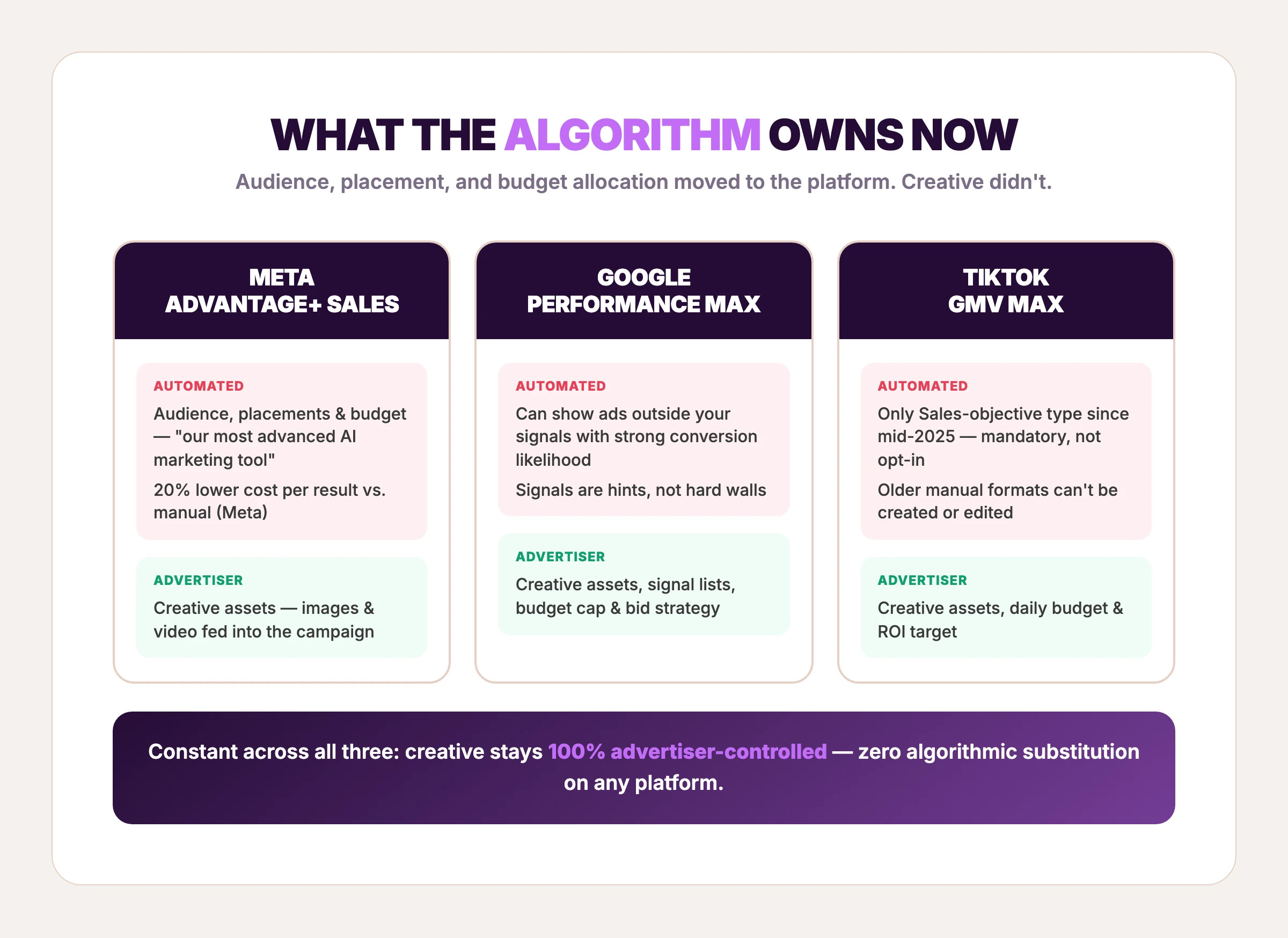
Meta describes its flagship e-commerce campaign type as "an automated, end-to-end sales solution" — in Meta's own words, "our most advanced AI marketing tool optimises your audience, placements and budget automatically." That's the default setup most beginners land in the moment they open Ads Manager.
It's not a downgrade. Meta states that "businesses like yours are driving a 20% lower cost per result on average with Advantage+ sales campaigns" compared to manual setups. The audience-building instinct beginners bring in isn't just automated away — it's measurably outperformed by letting the algorithm run it.
Google Performance Max
Google's Performance Max works from advertiser-supplied "signals" — customer lists, page visitors, interest categories — but treats them as hints, not walls. Google's own help center is explicit: "Performance Max may show ads to relevant audiences outside of your signals if they have a strong likelihood of converting to help you meet your performance goals." Signals "help guide machine learning models on the ideal way to optimize your campaign," but the system keeps final discretion.
What a beginner still controls here: which signal lists to supply (Customer Match, page-visitor segments), a bid strategy (how much you're willing to pay per result) and budget cap, and the creative assets themselves. What's out of their hands: exactly where each impression lands, how the budget splits across placements, and which combination of headlines and images the system assembles for any given viewer.
TikTok GMV Max
TikTok made the shift the most bluntly. GMV Max (GMV stands for Gross Merchandise Value — total sales driven through the platform) became "the only Sales-objective campaign type" for TikTok Shop starting in mid-2025 — a mandatory switch, not an opt-in, and it's already fully in force by the time this post is being read. Older formats like Video Shopping Ads, Product Shopping Ads, and manually configured LIVE Shopping campaigns can no longer even be created or edited on TikTok Shop; GMV Max is the only door left.
That's worth correcting directly, because the common assumption is that this is still "rolling out." It isn't. It's the settled default a beginner launching a TikTok Shop campaign today walks straight into, with audience and bid decisions already handled by the system before a single interest is typed in.
GMV Max applies to TikTok Shop / commerce sellers specifically — app-install campaigns run under a separate TikTok objective and aren't affected by this shift.
What You Still Control (and What You Don't)
Strip away the audience-building myth and a shorter, more honest list is left. Across Meta, Google, and TikTok, the algorithm now owns audience selection, ad placement, and most of the budget-allocation logic inside a campaign. What's still fully in an advertiser's hands: the signal lists and segments supplied to the system, the budget cap and bid strategy (the total spend and price ceiling an advertiser sets, separate from the budget-allocation logic above, which is how the algorithm splits that money across placements and audiences), and — with zero algorithmic substitution on any of the three platforms — the creative assets themselves.
That last one matters more than it sounds. Every automated campaign type still needs images and video fed into it; none of the three platforms generate a product's creative on your behalf. It's the one input where a beginner's decisions land directly, untouched by the algorithm's discretion.
It's also the fastest thing to check. CTR (click-through rate), the fastest read on whether your creative is working, tells within the first day or two whether an ad is earning attention or getting scrolled past — long before revenue or CPA (cost per acquisition) numbers mean anything. Low CTR isn't a signal to go fix the audience anymore. On platforms that already pick the audience, low CTR is a creative problem.
Why Volume Beats Precision
The numbers below all apply to the same container: the ad set (Meta's term) or ad group (TikTok's term) — the unit inside a campaign that holds a group of creatives sharing one budget and one audience. Google's Performance Max has no ad-group level at all; its closest equivalent is the asset group, a bundle of creative assets and targeting signals, not a container split by audience.
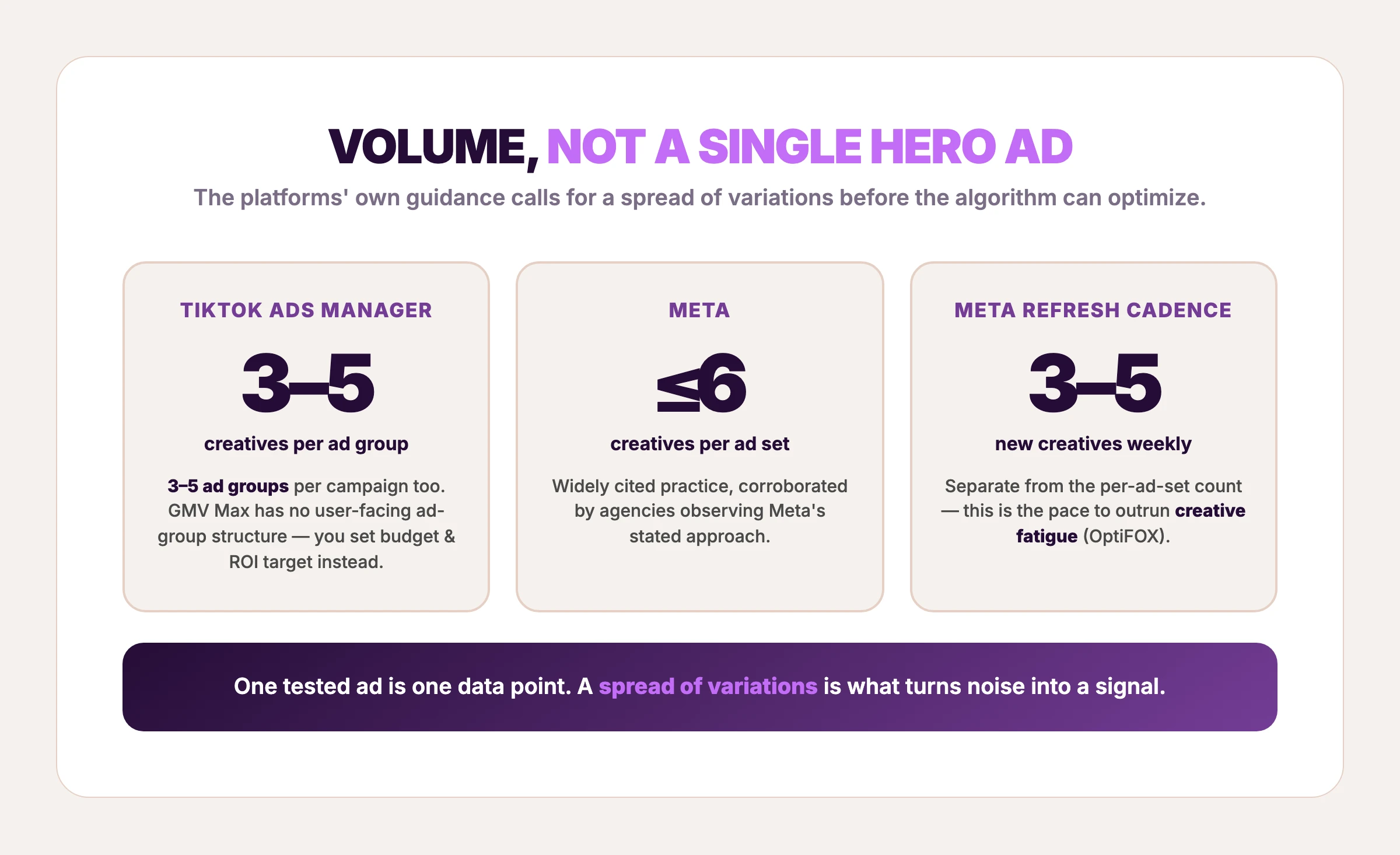
TikTok's own creative guidance is specific, not vague: "between 3-5 different creatives per ad group and 3-5 diversified ad groups per campaign." That guidance covers standard, legacy TikTok Ads Manager campaigns — GMV Max itself has no user-facing ad-group structure; advertisers supply a daily budget, an ROI target, and a product list, and the system decides creative, audience, and placement from there. Still, the same underlying principle — a spread of variations, not a single hero ad — is what GMV Max's own automation needs to find a winner.
Meta's widely cited practice, corroborated by agencies observing Meta's own stated approach, is six or fewer creatives per ad set. Separately, industry guidance from sources like OptiFOX recommends refreshing with 3-5 new creatives weekly to keep pace with creative fatigue — a different cadence, not the same count.
Here's the part no platform states directly, because it's not a platform claim, it's basic statistics: one tested ad can't tell an advertiser anything reliable. A single creative running against a single audience produces one data point. There's no way to know if it under-performed because the concept was weak, the product angle was wrong, or the algorithm simply hadn't finished exploring yet. Testing multiple structurally different creatives at once is what turns noise into a signal — the platforms are effectively saying the same thing by requiring a spread before the algorithm can optimize confidently.
That's the actual skill gap for most beginners: not a lack of strategy, a lack of enough tested variations. The system for producing and testing them — clone, test, kill, scale — covers the full production and evaluation loop in detail.

Create your own static product ads
Create your ad
The Old Playbook vs. the New Reality
The old playbook was: stack three or four interests, build a lookalike off existing customers, layer in exclusions, tune it for a week, then judge the ad by how it performed inside that hand-built audience. That playbook assumed the advertiser was the one deciding who saw the ad.
The new reality, backed by everything above: supply signals if a platform asks for them, cap a budget, pick a bid strategy — and spend the effort that used to go into audience-tuning on creative diversity and volume instead. Even advice like "six or fewer ads per set" is increasingly in tension with what Advantage+ and GMV Max actually default to in 2026 — systems built to explore a wide creative set fast, not to have an advertiser hand-curate a narrow one. The gap between old habits and current platform defaults is exactly where beginners lose their first week.
What This Means If You're Just Starting Out
Don't spend week one adjusting audience sliders on a campaign that's already deciding audience for you. Spend it producing several structurally different creative variations — different angles, different product presentations, different opening frames — and watching CTR as the first read on which ones earn attention.
Reading CTR, CPM (cost per thousand impressions), CPA, and the rest of an ad account correctly is its own skill; the metrics glossary breaks down every metric a beginner needs in plain English, with real dollar examples, before diving into a live account.
How AdDogs Fits
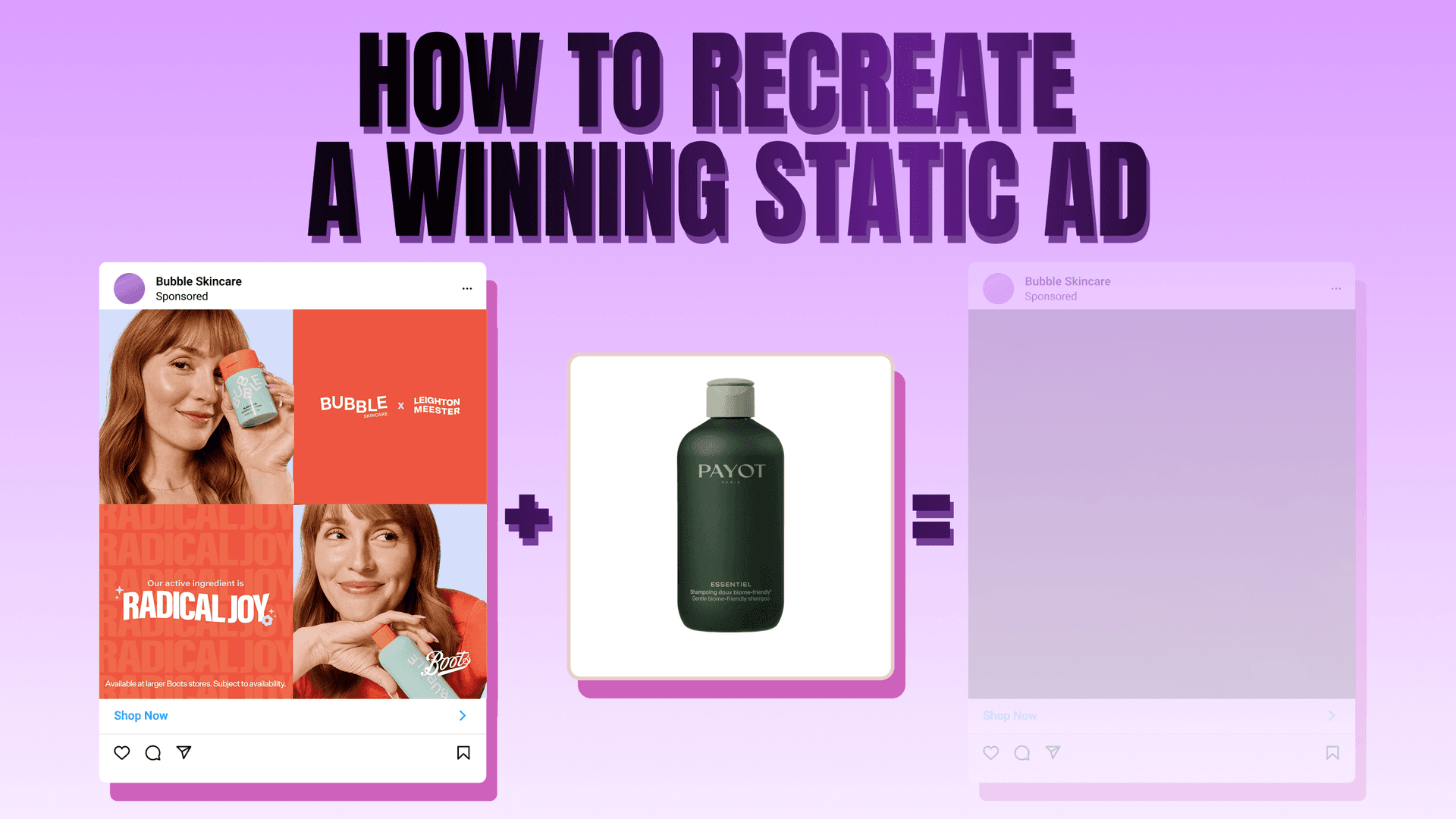
The bottleneck this post keeps circling back to — producing enough tested creative variations, fast enough for the platforms' own guidance to matter — is exactly the gap AdDogs closes. A beginner usually has one product photo, no design team, and no time to brief a freelancer for each variation. AdDogs clones a proven ad's layout and style, swaps in your product, and hands back a new testable variation in seconds. Repeat across a handful of reference ads and a real test batch — TikTok's 3-5 per ad group, Meta's six-or-fewer per ad set — is built in minutes, not days.
For the e-commerce and DTC side of this: 14,000+ ad examples is the library to pull reference layouts from — proven structures across 20 industries and every major platform, ready to clone and swap. For software readers, the 31 best SaaS ads roundup collects proven layouts with run-time receipts, including a live Shopify headline test. For mobile-app and UA readers: that library is DTC-shaped and doesn't cover app-store or game creative, so the move is to upload any reference ad sourced from your own research — a competitor's screenshot, a TikTok Creative Center pull, anything with a layout worth testing — and clone it against your own app.
Clone a proven ad and swap in your product to see the first variation in seconds.
Worth being direct about the limits, too: AdDogs generates static creative only — it's not a video or UGC tool, and if a hook needs to become a video ad, treat the static output as a concept or thumbnail seed, not a finished video asset. For TikTok specifically, where GMV Max leans on Video Shopping Ads and LIVE Shopping, that means treating an AdDogs render as the product image card or opening-frame concept feeding into a video edit — not a substitute for the video itself. One credit produces one ad in one selected aspect ratio; Pro and Ultimate unlock all 14 aspect-ratio options, but each generation still uses one credit for one dimension, not the full set at once. On pricing: Basic runs $12/mo for 30 credits across 3 formats; Pro is $33/mo for 100 credits, all 14 formats, and logo extraction; Ultimate is $63/mo for 212 credits with the same all-14-format and logo access.
FAQ
What is creative testing in advertising?
Creative testing is the practice of producing multiple ad variations — different images, angles, or product presentations — and running them against real traffic to see which ones earn clicks and conversions. Instead of guessing which single ad will work, an advertiser lets the data from several variations decide. In 2026, with audience selection increasingly automated across Meta, Google, and TikTok, creative testing is the part of a campaign a beginner has the most direct control over.
Does audience targeting still matter in 2026?
It hasn't disappeared, but it's shrunk to a supporting role. Google's own guidance describes advertiser-supplied signals as inputs that "help guide machine learning models" rather than hard boundaries — Performance Max can and does show ads outside those signals when it sees a strong chance of converting. Meta goes further in the same direction: practitioner guidance commonly recommends defaulting to Advantage+ audience for most campaign types, stepping outside it mainly for retargeting or VIP remarketing lists where manual control still pays off. Targeting is a signal an advertiser feeds the system now, not a structure they build by hand.
What is Meta Advantage+?
Meta Advantage+ Sales is Meta's default e-commerce campaign type — an automated, end-to-end sales solution where Meta's AI optimizes audience, placement, and budget automatically, all inside one setup rather than a manually structured set of ad sets and audiences.
How many ad creatives should I test?
TikTok's own published guidance is 3-5 creatives per ad group and 3-5 ad groups per campaign, for standard TikTok Ads Manager campaigns — GMV Max itself has no user-facing ad-group structure. Meta's widely cited practice, corroborated by agencies rather than a single Meta quote, is six or fewer creatives per ad set. Both numbers point the same direction: a spread of variations, not one hero ad. For the full method — how to produce that spread fast, when to kill a loser, and when to scale a winner — see the ad creative testing system.
Is TikTok GMV Max mandatory?
Yes. GMV Max became the only Sales-objective campaign type for TikTok Shop starting in mid-2025, and older formats like Video Shopping Ads and Product Shopping Ads can no longer be created or edited on TikTok Shop. It's not an upcoming change — by the time this is being read, it's already the sole default a TikTok Shop advertiser launches into.