Emotional ad examples: 20 ads that convert


Only about 1% of the 20,000+ ads System1 has tested earn its top 5-star emotional rating. The other 99% make people feel nothing. That is the real risk with emotional ads: most of them miss. So don't gamble on a blank canvas. Study the rare ad that already provoked the feeling and learn what made it land. These 20 emotional advertising examples show the lever each one pulls and why it works — so you can see how the feeling is built, not just admire a million-dollar film.
An emotional advertisement is an ad designed to trigger a specific feeling — love, nostalgia, grief, pride, belonging — instead of leading with a product spec or a price. The feeling does the persuading. Research from the IPA and Nielsen shows emotion is the single biggest driver of long-term ad effectiveness, which is why a mother's hug sells more than a feature list.
Why emotional ads convert
Emotion is not the soft part of advertising. It's the part that moves money, and it's why emotional ads keep outperforming spec sheets. Neuroscientist Antonio Damasio's somatic-marker work showed that people with damage to the brain's emotional centers can't make good decisions at all: emotion is a requirement for rational choice, not a distraction from it. An ad that makes you feel something is an ad your brain tags as worth acting on.
The five levers
Every emotional ad pulls at least one of five mechanisms. Name the lever first, and the composition follows.
- Memory encoding: strong feeling makes the brand stickier. You remember the ad that made you cry; you forget the one that listed three benefits.
- Narrative transportation. A tiny story pulls the viewer inside it, lowering their guard against the pitch.
- Identity signaling: the ad says "people like you choose this," and belonging does the rest.
- Mirror neurons. Watch someone feel something and you feel a muted version yourself. A static image of a real face works the same way.
- Peak-end rule: people remember the emotional peak and the ending, not the middle. The product lands at the peak.
The proof
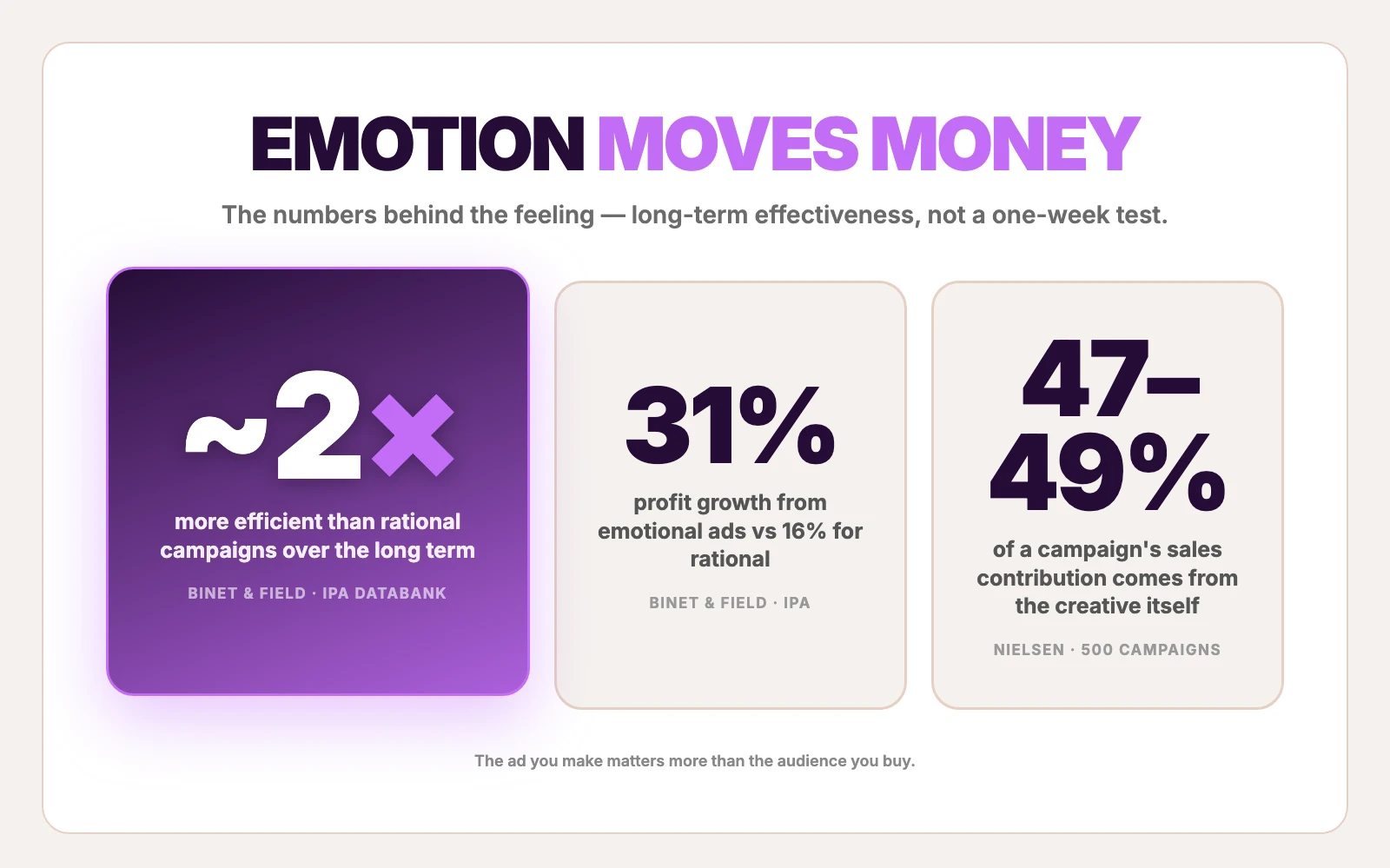
The numbers back the feeling. Across 996 campaigns in the IPA Effectiveness Databank, Les Binet and Peter Field found that emotional campaigns are roughly twice as efficient as rational ones and deliver about twice the profit over the long term. Nielsen puts a number on the creative itself: in a 500-campaign analysis, creative quality drove 47–49% of a campaign's sales contribution, a bigger lever than targeting or reach. The ad you make matters more than the audience you buy.
Caveat — emotion is a long-game lever. Binet and Field also found the one place rational beat emotional: short-term, direct-response performance marketing. If you're a dropshipper running a one-week conversion test, a clear product-and-offer ad can out-convert a pure-emotion one. Use emotion to build the brand people choose; use a sharp offer to close the sale this week. The smart move is to run both.
Family ad examples — the universal lever
Family is the most universal lever in advertising: everyone has one, wants one, or is building one, which is why family ads convert across every category and audience. These are the campaigns that pull it best — the lever each one leans on, and the static composition underneath it.
Procter & Gamble — "Thank You, Mom"
Lever: Care. A montage of mothers waking kids before dawn, driving them to practice, watching from the stands as those kids become Olympians.
Watch: P&G — "Thank You, Mom"
- It reframes a sponsor (P&G) as the brand that sees the unseen labor of parenthood, so gratitude transfers to the logo.
- The payoff is delayed. You watch the sacrifice for 90 seconds before the athlete wins, which makes the emotional peak hit harder (peak-end rule in action).
- The work delivered, not just teared up: P&G credited the campaign with $500M in incremental global sales and a +10% trust lift, the biggest campaign in its 175-year history.
Coca-Cola — "Share a Coke"
Lever: Belonging. Bottles printed with first names turned a generic soda into a personal gift you hand to someone you love.
Watch: Coca-Cola — "Share a Coke"
- Seeing your own name — or your mom's — on a bottle collapses the distance between a global brand and a personal moment.
- It engineered sharing into the product itself, and the US run lifted sales after more than a decade of decline.
John Lewis — "The Man on the Moon" and "Where Love Lives"
Lever: Generosity. A young girl spots a lonely old man living on the moon and sends him a telescope so he knows someone sees him. A decade later, "Where Love Lives" carries the same unspoken bond between generations.
Watch: John Lewis — "The Man on the Moon" · John Lewis — "Where Love Lives"
- The product (a gift) becomes the language for something words can't say, which is exactly how John Lewis sells gifting at Christmas.
- "Man on the Moon" helped drive record like-for-like Christmas sales and tied to a senior-loneliness cause, so the warmth had somewhere real to go.
- It proves the unspoken-bond angle isn't a one-off: the brand rebuilt the same emotional structure ten years later and it still landed.
Apple — "Misunderstood"
Lever: Family love. A teen seems glued to his phone all through a family Christmas — until the reveal that he was quietly filming a heartfelt video of everyone, which he plays for the family.
Watch: Apple — "Misunderstood"
- The misdirection is the mechanism: it builds a small judgment ("kids and their phones") then dissolves it, and relief reads as warmth.
- It turned the exact criticism aimed at the product, screen obsession, into proof the product captures what matters. That earned Apple an Emmy for best commercial.
Pandora and Extra Gum — sensory memory and lifelong love
Lever: Memory. Pandora's "touch test" blindfolded children and asked them to find their own mother by touch alone — every child did. Extra Gum's "Sarah & Juan" tracked a couple's whole relationship through gum wrappers a boy sketched into drawings.
Watch: Pandora — "The Unique Connection" · Extra Gum — "The Story of Sarah & Juan"
- Both tie an ordinary product to an irreplaceable bond, so it inherits the emotion instead of demanding it.
- Extra's wrapper-as-keepsake turns a disposable item into a memory object, the sharpest trick for cheap products that struggle to feel meaningful.
Edeka and Google — absence and grief turning to tenderness
Lever: Longing. Germany's Edeka ran "#Heimkommen," where a lonely grandfather fakes his own death to get his scattered family to finally come home for Christmas. Google's "Loretta" followed a widower using Assistant to recall memories of his late wife.
Watch: Edeka — "#Heimkommen" · Google — "Loretta"
- Loss makes the reunion (or the remembering) land harder. The ad earns its warmth by first making you ache a little.
- Both place the brand as the keeper of connection: the dinner table, the saved memory. That's a high-trust position to occupy.
McDonald's and Nintendo — small gestures, big feeling
Lever: Tenderness. A teen gets handed the keys to a parent's old car (McDonald's "First Car"); separated siblings reconnect over a shared game (Nintendo Switch). Treat these as illustrative craft examples, not headline metrics: the lesson is that a small, lived-in moment frozen at its turn outperforms spectacle, because the viewer has actually been there.
Watch: McDonald's — "The Gift" · Nintendo Switch — "Come Together and Play"
- Small, recognizable gestures beat grand spectacle for relatability. Most viewers have lived the moment, not the Olympics.
- Each makes the product the quiet enabler of the gesture, never the star, which is what keeps it from feeling like a sales pitch.
Nostalgia ads — borrowing the past
Nostalgia is family's close cousin: it sells a feeling of safety from a remembered time. It also has a hard commercial edge. In six experiments published in the Journal of Consumer Research, nostalgia made people willing to pay more and part with more money — the feeling literally weakened their grip on their wallets. For nostalgia ads, that's the whole game: make the viewer miss something, then offer it back.
Coca-Cola — the holiday caravan
Lever: Nostalgia. The red truck, the snow, the Santa the brand all but invented. Coca-Cola runs the same warm, retro winter imagery year after year because the repetition is the nostalgia.
Watch: Coca-Cola — "Holidays Are Coming"
- Consistency compounds: every December the ad reactivates 80 years of stored holiday memory in one frame.
- The product is woven into a seasonal ritual, so buying it feels like keeping a tradition rather than making a purchase.
Apple — "Shot on iPhone"
Lever: Pride-of-craft nostalgia. Real photos from real users, blown up huge, captioned only with the model that took them. The recent runs lean into film-grain and analog warmth that nod to a pre-digital era of photography.
Watch: Apple — "Shot on iPhone"
- Letting customers' own memories be the creative makes the nostalgia personal and unfakeable.
- Minimal copy means the image carries everything: proof that one strong photo plus one line beats a busy layout.
A retro DTC pick — Y2K and analog revival
Lever: Era nostalgia. DTC brands increasingly mine Y2K and analog aesthetics — denim, chrome type, disposable-camera flash — to feel like a memory the audience can buy. Treat this as the craft pattern, not a single named campaign: the era-coding is the move.
- Era-coded styling signals "this is for people who remember," which is a powerful identity filter for younger millennial and Gen-Z buyers.
- It's the cheapest emotional lever to fake well, because the props and palette do most of the work.

Create your own facebook product ads
Create your ad
Tearjerker emotional ads — when sadness sells
Sadness is the highest-stakes lever, and the sad commercials people still quote years later prove how far it can carry a brand. Done right, a tearjerker burns the brand into memory. Done as a money-grab, it backfires. And there's a structural catch worth knowing before you reach for it.
John Lewis, Save the Children, Toyota, and Spark NZ
Lever: Sadness. John Lewis built an annual ritual on bittersweet Christmas stories. Save the Children's "Most Shocking Second a Day" showed a London girl's life unravel through a war, one second per day, racking up 70M+ views. Toyota's "Jessica Long" told the true story of a Paralympian's adoption and perseverance. Spark NZ's wedding film centered an absent father.
Watch: Save the Children — "Most Shocking Second a Day" · Toyota — "Jessica Long" · Spark NZ — wedding film
- Sadness paired with a turn toward hope (or a cause) gives the viewer somewhere to put the feeling. Pure despair just makes people scroll away.
- The strongest tearjerkers attach to a real stake, a charity or a true story, so the emotion reads as earned, not manufactured.
Caveat — sadness lowers shareability. In Jonah Berger and Katherine Milkman's peer-reviewed study of what makes content go viral, high-arousal emotions like awe and excitement drove sharing, while sadness — a low-arousal state — reduced it. A sad ad can be unforgettable and still get shared less than a joyful one. If organic reach is the goal, end on the lift, not the loss.
Emotional appeal in advertising — the other levers
Family, nostalgia, and sadness are three of the loudest emotions, but emotional appeal in advertising runs on a wider set. Good emotional appeal advertising matches the right feeling to the right product, and each lever below maps to a recognizable composition. happiness is worth singling out: System1 found happiness is the emotion most strongly tied to long-term brand growth, and high-energy joy is also what gets an ad shared.
Belonging, pride, inspiration, humor, and urgency
- Belonging — Nike "You Can't Stop Us." A split-screen montage matching athletes across sports and bodies into one continuous motion.
- Inspiration — Dove "Real Beauty Sketches." A forensic artist drew women as they described themselves versus how strangers saw them — the stranger's version was always kinder. 163M views by mid-2013.
- Humor — Budweiser "Puppy Love." A puppy and a Clydesdale become inseparable friends. Warmth plus a laugh is the most shareable combination there is.
- Pride and status. Luxury and performance brands sell who you become.
- Urgency and FOMO. Drops and limited runs weaponize the fear of missing out.
Emotion × industry matrix
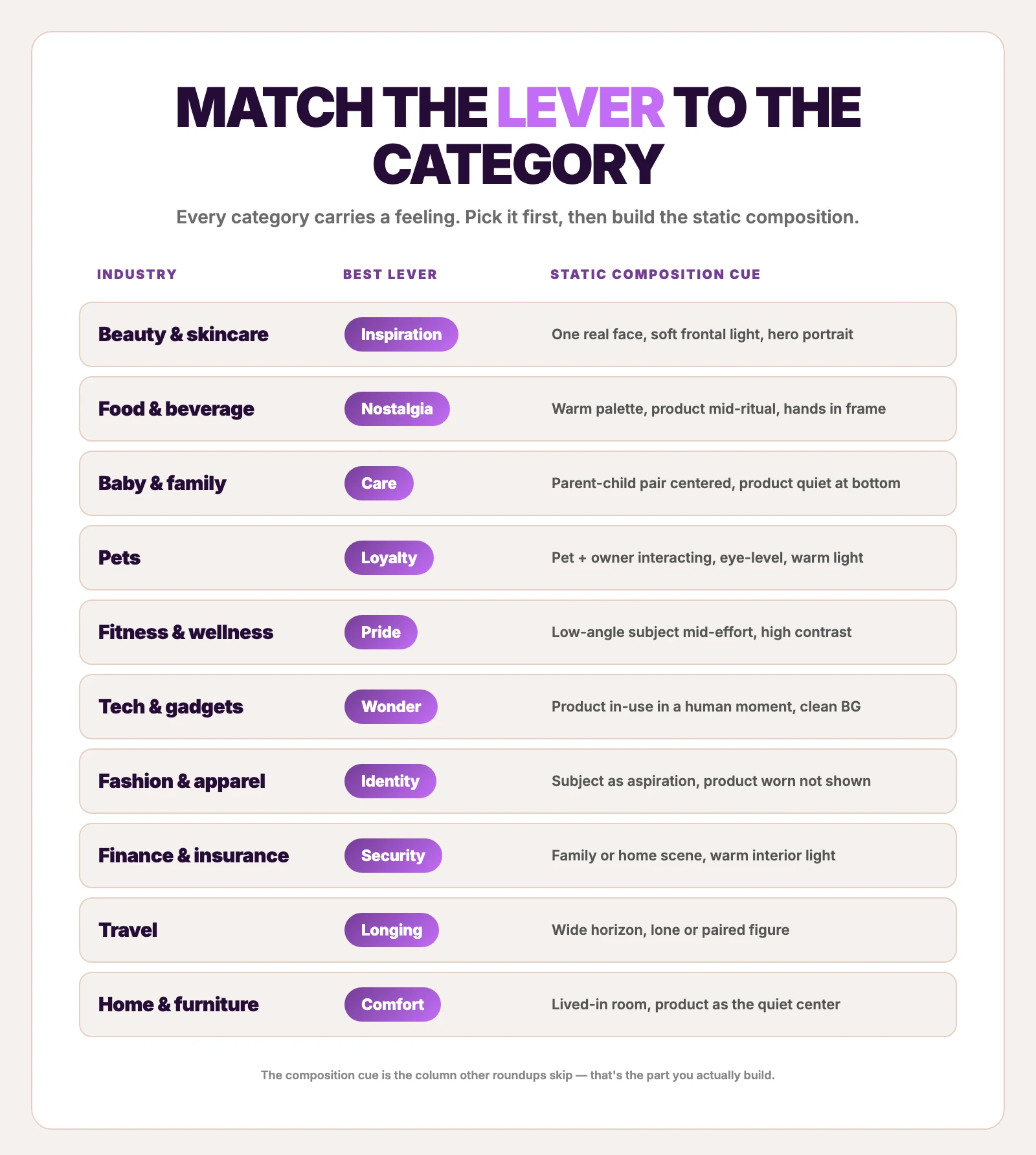
Different products carry different feelings naturally, so the best emotional ads start by matching the lever to the category. This table maps the lever to the category to the static composition cue you'd actually build, the column no competing roundup gives you.
| Industry | Best emotional lever | Why it fits | Static composition cue |
|---|---|---|---|
| Beauty & skincare | Inspiration / self-worth | Sells confidence, not chemistry | One real face, soft frontal light, before/after split or single hero portrait |
| Food & beverage | Nostalgia / belonging | Eating is memory and gathering | Warm palette, product mid-ritual, hands in frame |
| Baby & family | Care / tenderness | Parents buy on protection | Parent-child pair centered, soft daylight, product quiet at bottom |
| Pets | Loyalty / love | The bond is the purchase | Pet and owner interacting, eye-level, warm light |
| Fitness & wellness | Pride / transformation | People buy the future self | Low-angle subject mid-effort, high contrast, product as enabler |
| Tech & gadgets | Wonder / belonging | Sells what it lets you feel, not specs | Product in-use in a human moment, clean background, one feature visible |
| Fashion & apparel | Identity / status | Clothes signal who you are | Subject styled as the aspiration, negative space, product worn not displayed |
| Finance & insurance | Security / family | Sells peace of mind | Family or home scene, warm interior, product implied not shown |
| Travel | Longing / freedom | Sells the feeling of being elsewhere | Wide horizon, lone or paired figure, cool-to-warm light |
| Home & furniture | Comfort / belonging | Sells the life lived in the space | Lived-in room, soft light, product as the room's quiet center |
The emotional-ad formula
Strip away the budgets and almost every piece of emotional marketing runs four beats: setup, twist, emotional peak, product as resolution. A normal moment, a broken expectation, the feeling, then the product as the thing that made the peak possible, never before it. It's the structure that separates emotional ads that land from the 99% that don't.
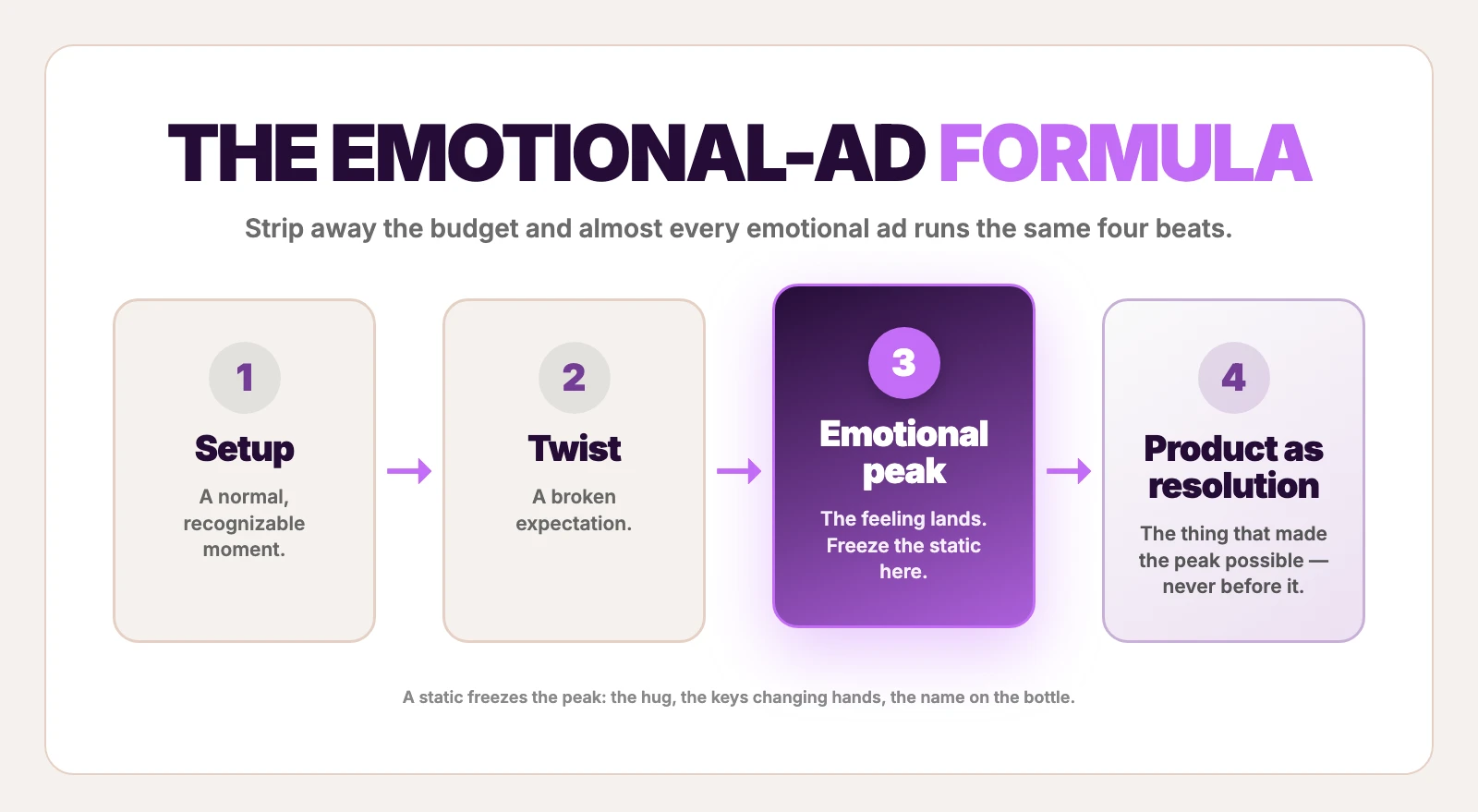
That's video's home turf, but it ports cleanly to a static image: the frame is the peak. You freeze the single moment a video would build toward — the hug, the keys changing hands, the name on the bottle — and let the composition carry the rest. Most of the ads above are films, so here's how to turn an emotional video ad into a static without losing the feeling.
Caveat — inauthentic emotion backfires. Emotion only works when it matches the brand and the product. Peer-reviewed research on purpose and "femvertising" ads found that when the feeling reads as a profit grab rather than a genuine value, it triggers skepticism and backlash — the "wokewashing" effect erodes trust instead of building it. Don't borrow a feeling you can't back up. A skincare brand can sell self-worth; it can't credibly sell grief.
FAQ
What is an emotional advertisement?
An emotional advertisement is an ad built to trigger a specific feeling — love, nostalgia, grief, pride, or belonging — instead of leading with a product feature or price. The feeling does the persuading. Across the IPA's 996-campaign databank, emotional campaigns proved roughly twice as efficient as rational ones over the long term.
What is the saddest commercial ever?
There's no single winner, but the most-cited tearjerkers are John Lewis Christmas films, Save the Children's "Most Shocking Second a Day" (70M+ views), Google's "Loretta," and Germany's Edeka "#Heimkommen," where a lonely grandfather fakes his death to reunite his family. Sad ads burn into memory, but they tend to get shared less than joyful ones.
What is an example of an emotional appeal advertisement?
Coca-Cola's "Share a Coke" is a clean example: printing first names on bottles turned a generic soda into a personal gift and pulled US sales back up after a decade of decline. The emotional appeal is belonging — seeing your own name collapses the distance between a global brand and a personal moment.
Are emotional ads effective?
Yes, with one caveat about timing. Nielsen's 500-campaign analysis found creative quality drives 47–49% of a campaign's sales contribution, a bigger lever than targeting or reach, and emotional creative is the strongest driver of that. The caveat: for short-term, direct-response conversion tests, a clear product-and-offer ad can out-convert a pure-emotion one.
How do you make an emotional ad without a big budget?
Skip the film crew and make a static. Find an emotional ad whose composition already works, then rebuild that exact layout — the focal pair, the warm light, the product placement — around your own product. A single strong still that freezes the emotional peak can carry the feeling at a fraction of the cost of a video shoot.