Mobile game ad creative testing without a creative budget


Players hate it, but the data is brutal: the mobile game ads that show fake gameplay outperform real footage by 4 to 5 times, and a "pure failure" hook — the level you watch someone lose on purpose — lifts installs 65% over showing your game succeeding. Mobile game ad creative testing isn't about making the prettiest ad. It's about finding which version of your game converts, then finding out fast and cheap, before you spend real money producing it.
"Fast and cheap" is exactly what nobody tells you how to do. Every guide says test more. None of them tells you how to afford it.
What mobile game ad creative testing actually is
Mobile game ad creative testing is the practice of launching multiple ad concepts and variations, measuring which ones drive cheap installs, and killing the rest before they drain your budget. The metric that decides it is IPM — installs per thousand impressions. A high IPM means the creative converts attention into downloads. That's the number a user acquisition team lives and dies by.
Why does creative carry so much weight now? Because targeting stopped working. After Apple's App Tracking Transparency rolled out, gaming opt-in rates settled around 36 to 39%, down from roughly 85% before. Apple's change knocked iOS advertising revenue share from 60% to 46% almost overnight, and cost-per-install on iOS climbed 88% in under two years. When the algorithm can't see who your player is, the creative has to do the targeting. The ad itself signals who it's for.
Concentration follows, and it's extreme. AppsFlyer analyzed 1.1 million video variations against $2.4 billion in spend and found the top 2% of creatives drove 53% of total ad spend. A handful of winners carry the entire account. Everything else is the cost of finding them.
So the job isn't "make a good ad." The job is to run enough tests, cheaply enough, that the math gives you a winner before the budget runs out.
The volume problem nobody budgets for
Standard advice falls apart at exactly this point.
The benchmark agencies publish is volume. One framework claims that hitting 100-plus creative variations a month correlates with a 117% average return on ad spend. At the top end, gaming apps spending $7 million a quarter produce 2,743 video variations every quarter — roughly 30 new creatives a day, every day.
Now price it. A performance-agency video runs $100 to $500 per ad with a one-to-five-day turnaround. A single playable costs $3,000 to $5,000 and takes two to four weeks. Run the math on 100 videos a month and you're staring at a creative budget between $10,000 and $50,000 — before a dollar of media spend.
That's the trap. The volume that wins is priced for studios with a dedicated creative team and a seven-figure UA budget. Every framework prescribes the volume, then goes quiet on the cost. For an indie or mid-market studio, "just test 100 a month" is the same as "just have more money."
The fix isn't a bigger budget. It's testing the idea before you pay to produce it.
Why you test on static first
A video and a playable are how a winning concept gets scaled. They are the worst possible place to discover one.
Strip a mobile game ad down to what's actually being tested and you're testing a concept: a hook, a promise, a reason to tap. "Save the dog by pulling the right pin." "Build the empire you keep failing to build." "Your home is a mess — fix it." The motion and polish come later. The concept is the variable. And a concept can be tested on a static image for a fraction of the cost of motion.
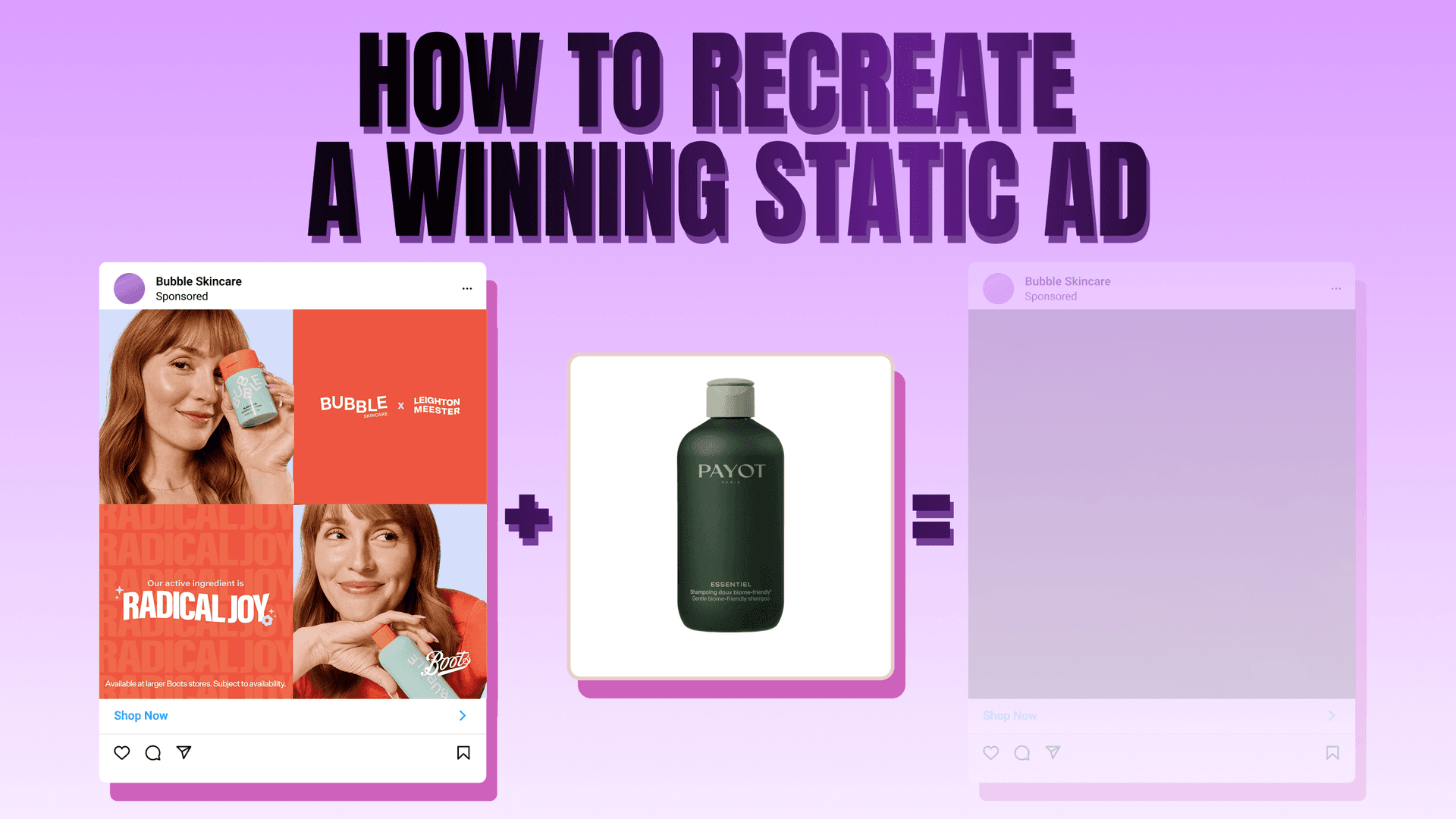
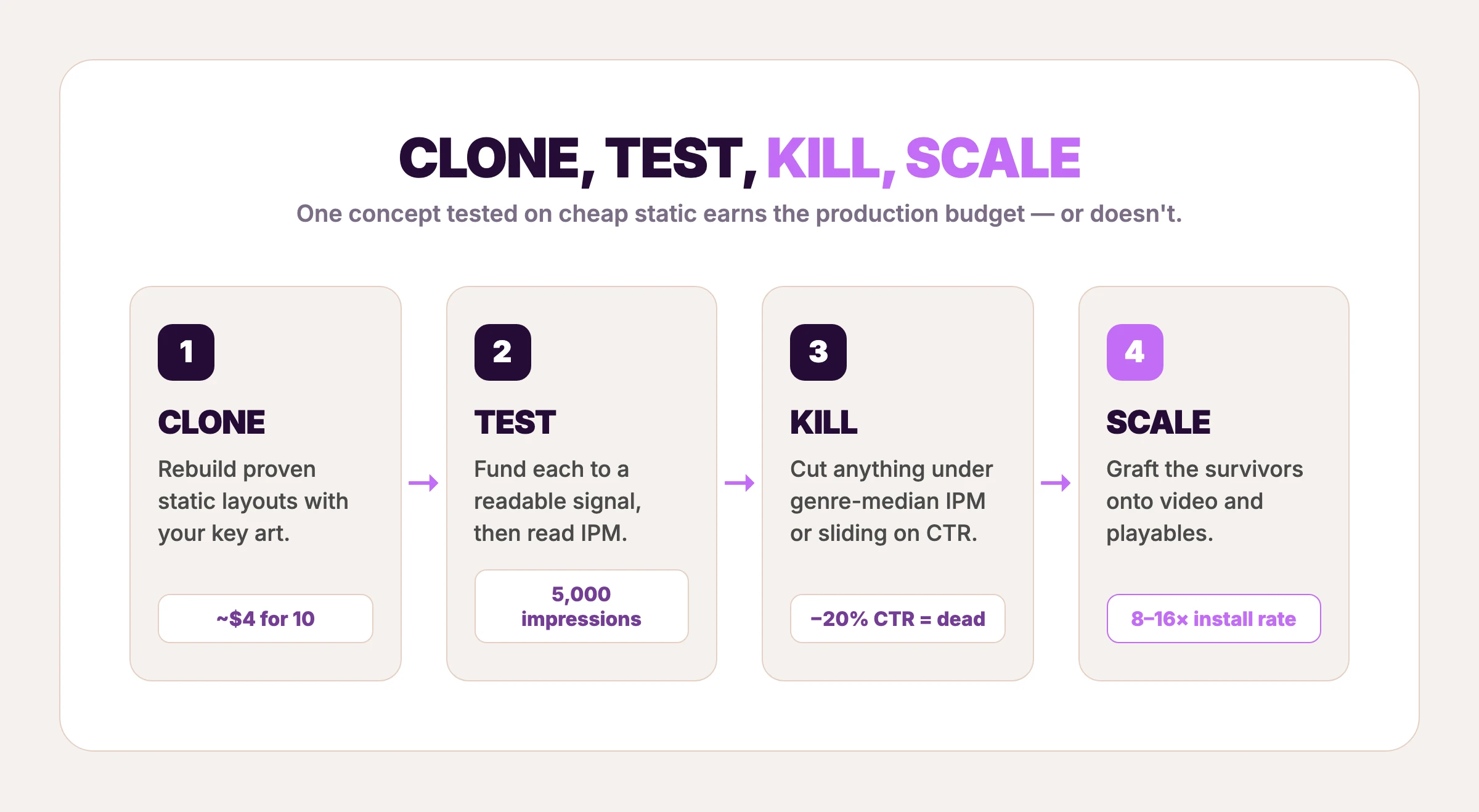
Run the clone, test, kill, scale system on a game and the same logic holds. You don't start from a blank canvas. You start from a layout that already converted — a competitor's static interstitial, a winning end card, a top-performing concept from the Meta Ad Library — and you rebuild it with your game's key art. The design question is already answered. You're testing whether your hook lands in a proven frame.
Concept versus variation is the distinction that matters. A concept is a new hypothesis about why someone installs — a different fantasy, a different pain. A variation is the same concept with a swapped headline, character, or color. You explore concepts broadly on cheap static, find the one with signal, then pour variation and motion into the survivor.
AdDogs fits exactly this slot. Clone a proven static layout, drop in your character art or a screenshot, and generate a batch of concept variations in seconds at $0.40 an ad on the Basic plan. It won't build your playable — that's a different job for a different tool. It produces the cheap static test batch that tells you which concepts deserve a playable at all. Test ten static hooks for the price of one freelance video edit, and only the winners earn the $4,000 production.
The metrics that decide kill or scale
You can't read a test you don't have benchmarks for. A 3% click-through rate is a disaster in one genre and a win in another. Below is what "good" looks like, and where the numbers come from.
| Metric | Benchmark | Source |
|---|---|---|
| Global median IPM (gaming) | 4.27 installs / 1,000 impressions | Segwise / Adjust, 2024 |
| IPM by genre | Racing 24.99 · Music 14.41 · Hypercasual 8.86 | Segwise, 2024 |
| iOS gaming CTR | 4.3% (Jan 2025) → 13.4% (Jun 2025) | Singular, Q3 2025 |
| CPI, casual puzzle (US) | $0.80–$2.00 Android · $1.50–$3.50 iOS | Admiral Media, 2025 |
| CPI, iOS casino | $21.03 | Liftoff / Singular, 2025 |
| D30 ROAS, casual games | 47% iOS · 15% Android | Liftoff, 2025 |
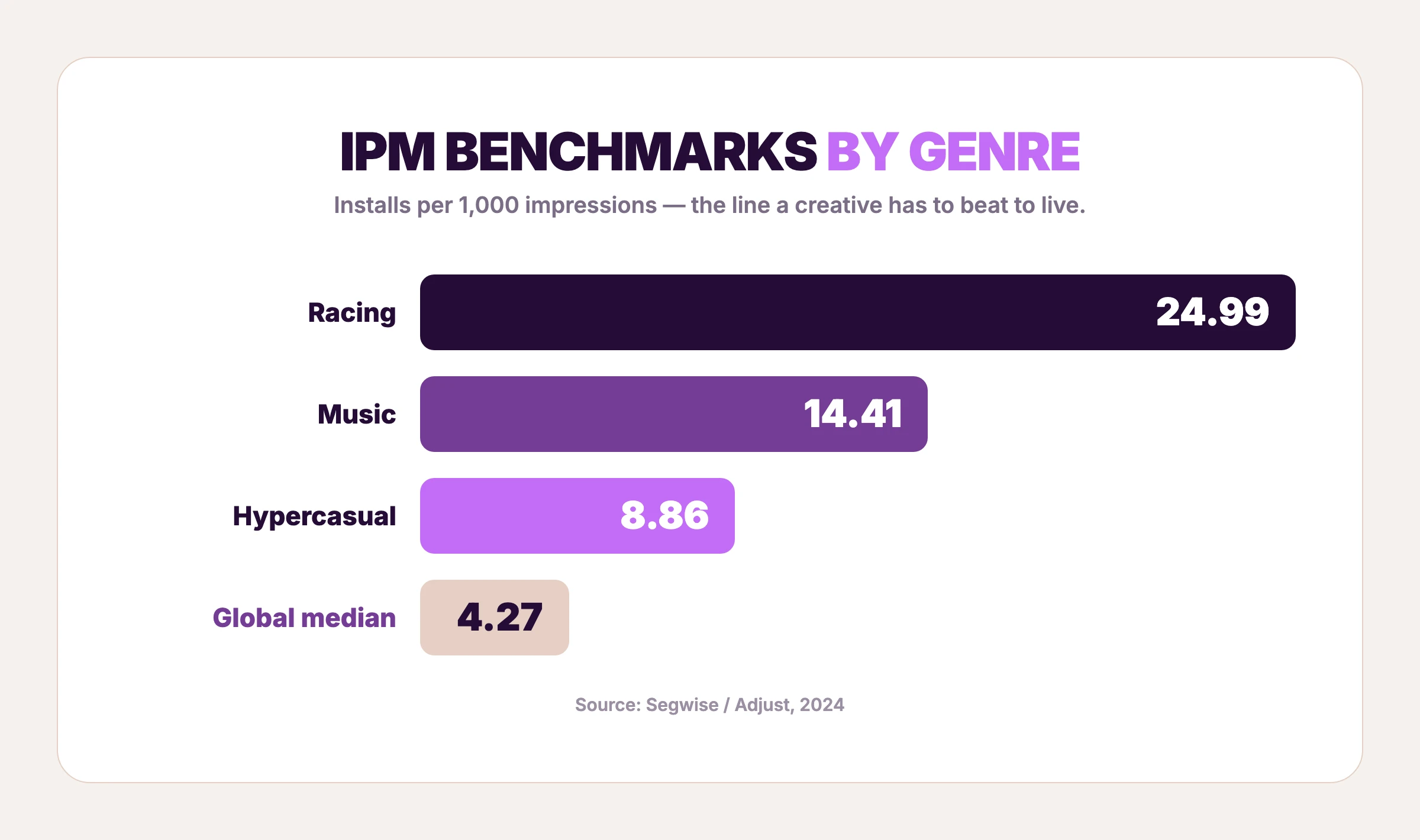
IPM is your read at the test stage because it isolates the creative. CPI tells you what an install costs once the network's pricing folds in. ROAS tells you whether that install pays you back. At low test spend you won't have clean ROAS — there isn't enough data — so you read IPM first and let the cheap installs filter up to the campaigns that can afford to chase return.
Kill signals are just as concrete. When a creative's click-through rate falls 20% on a three-day rolling average, it's done. Stop feeding it. The point of cheap static volume is that killing a test costs you nothing but the impressions already spent — you're not protecting a $4,000 sunk production cost, so you can be ruthless about it.
Why fake gameplay and failure hooks win
Once you're testing concepts instead of polishing one ad, the question becomes: which concepts? The data points somewhere uncomfortable.
Fake mobile game ads exist because they convert. The pin-pull "save the hero" puzzle that Playrix ran for Gardenscapes and Homescapes barely appears in the actual game — but it printed installs for years, and half the casual genre copied it. The mechanism is frustration. Watching someone pull the wrong pin and drown the character creates an itch the install scratches. AppsFlyer's data backs the pattern: a pure-failure hook lifts IPM 65% over a success-focused one on social and search channels.
Metaplay is the other winner — selling the story or progression rather than the core loop. Creative aligned with what the player actually fantasizes about delivered a 93% IPM lift in Liftoff's index. Segwise reverse-engineered 4,162 creatives behind the $184-million merge game Gossip Harbor and found 90% leaned on 50-plus-second storytelling, with two-thirds built on a tragic or unresolved hook. Nobody installs a merge game for the merging. They install for the affair plot the ad teased.
You clone the structure, not the art. The fail-state setup. The unresolved-tension hook. The fantasy that has nothing to do with your core loop. Rebuild that structure with your game's assets on static, and you find out in a day whether it works for your title instead of guessing for a month.

Create your own product product ads
Create your ad
Creative fatigue: the clock you're racing
Even a winner has a short life, and it's getting shorter.
Creative fatigue used to take six weeks. On Meta it now hits in two to three weeks; on TikTok, often inside two. Conversion likelihood drops about 45% by a viewer's fourth exposure to the same ad. The algorithm burns through your best creative faster than a small team can replace it by hand.
That's the real argument for static volume. The networks demand a constant refresh — AppLovin campaigns want fresh creative every one to two weeks, TikTok wants two to three new ad sets weekly. You cannot feed that cadence with $4,000 playables. You feed it with cheap static concepts, tested continuously, so there's always a fresh winner ready when the current one fatigues. The pipeline never empties because the input never gets expensive.
Scaling the winners
A concept that proves itself on static has earned the production budget. Now you spend.
Take the static winner and graft it onto the formats that scale. Now you make the static-versus-video decision on evidence instead of a hunch. Playables are the heavy hitter: they convert at 8 to 16 times the install rate of non-playable formats, which is exactly why top games put 35% more spend behind them. Adding user-generated-style content to a campaign lifted impression-to-install 152%. Pairing a winning template with top-tier assets drove a 350% increase in scaled spend.
Budget the scale the way the practitioners do: roughly 70% on proven performers, 20% on promising tests, 10% on experiments. The 10% is your cheap static exploration. The 70% is where last month's static winners now run as polished video and playables. One caution: the same creative behaves differently per network, so a winner on Meta isn't automatically a winner on AppLovin or Moloco. Re-read IPM per channel before you scale spend into it.
What a test actually costs
Producing the creative is the cheap part. Buying enough impressions to trust the read is the part every guide skips — and, until now, so did this one.
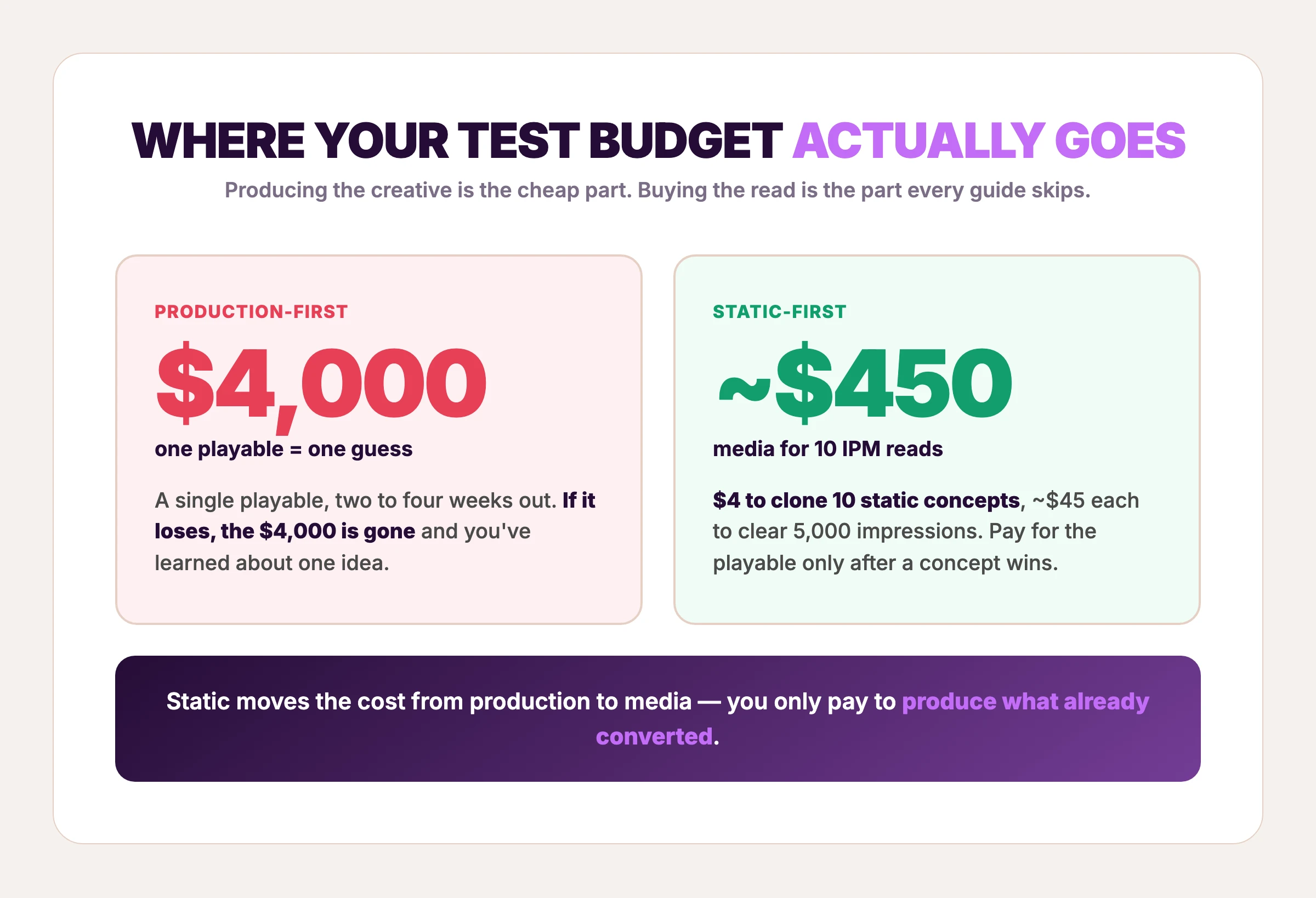
A creative's IPM means nothing until it has volume behind it. Most testing frameworks won't read a concept until it clears a minimum impression threshold — call it 5,000 impressions per creative. Below that, ten ads at 200 impressions each tell you exactly nothing.
So price the read, not the file. Your cost per thousand impressions is roughly your CPI times your IPM: at the casual-puzzle benchmarks above — a ~$1.50 CPI and an IPM near 6 — that's about a $9 CPM, so 5,000 impressions runs you around $45 per concept. A ten-concept batch needs $300 to $500 of media to return a clean first read. That's the number the "test 100 a month" crowd never prints.
Which is why concept count scales with budget, not ambition. On $800 a month you don't test ten concepts a week — you test three or four, fund each past its impression threshold, and trust the read. On $80,000 a month you run the full ten and parallelize. Static makes the production free. It doesn't make the media free — it just means every impression you buy tests a proven structure instead of a guess.
A realistic weekly testing loop
A two-person team can run this loop without a creative department.
- Monday — clone your concepts. Pull the longest-running static interstitials and end cards from your genre in the Meta Ad Library, upload each into AdDogs, and rebuild it with your key art — you're borrowing the structure, the same way you would from any library of proven layouts. Ten concepts if your budget runs to it, three or four if it doesn't. Cloning a proven structure is a sitting's work, not a sprint.
- Tuesday — fund each to a readable signal. Push them into an IPM campaign with enough budget to clear roughly 5,000 impressions per concept — below that you're reading noise, not signal. You're buying a read, not installs.
- Thursday — read IPM, kill the bottom half. Anything below your genre's median IPM, or sliding 20% on CTR, gets cut. No sentiment.
- Friday — pick one or two survivors. The concepts with real signal earn variations: new headline, new character, new color.
- Next week — produce the proven winner as motion. Only now does a concept get the $4,000 playable or the video edit. You're paying to scale a known winner, not to discover one.
Run that loop continuously and you've inverted the cost structure. The studios spend big to find winners. You spend almost nothing to find them and save the big spend for scaling. That's how you compete at testing velocity without a UA budget that matches theirs.
Where to start
Open the Meta Ad Library, find the static ad in your genre that's run longest — longevity means it's profitable — and upload it into AdDogs to rebuild its structure with your game's art. Generate three or four variations, fund each to 5,000 impressions, and kill the losers by Thursday. The studios drowning your feed in creative aren't more creative than you. They started sooner and paid more to find their winners — now you can find yours for the price of the impressions, not the production.
FAQ
What is mobile game ad creative testing?
Mobile game ad creative testing is the process of launching multiple ad concepts, measuring which drive cheap installs (primarily by IPM — installs per thousand impressions), and killing the underperformers before they waste budget. Since Apple's ATT degraded targeting, the creative does the work the algorithm used to, which is why the top 2% of creatives drive 53% of spend.
Why do fake mobile game ads outperform real gameplay?
Because frustration converts. Fake "pull the pin" or "you failed this level" ads create an unresolved tension that the install resolves. The data is consistent: fake gameplay can beat real footage by 4 to 5 times, and a pure-failure hook lifts IPM 65%. The creative sells a feeling, not an accurate preview of the game.
How many creatives do you need to test to find a winner?
More than most teams budget for. Top-spending studios produce around 2,743 video variations a quarter, and one agency benchmark ties 100-plus variations a month to a 117% ROAS lift. The practical answer for a small team is to test concepts cheaply on static at high volume, rather than chasing that number with expensive video.
How fast do mobile game ad creatives fatigue?
Fast, and getting faster. Creative fatigue on Meta now hits in two to three weeks, often inside two on TikTok, with conversion likelihood dropping roughly 45% by the fourth exposure. Networks like AppLovin and TikTok demand fresh creative every one to two weeks, which is why a continuous cheap-static pipeline beats occasional expensive production.
Can you test mobile game ad creative without a big budget?
Yes — by moving the cost from production to media. A static concept costs cents to generate, versus $3,000 to $5,000 for a single playable. You still pay to buy impressions for the read — budget roughly $25 to $50 per concept to clear a trustworthy IPM signal — but you only pay to produce the concepts that already proved they convert.