Fitness ads: 23 real examples and the rules behind them
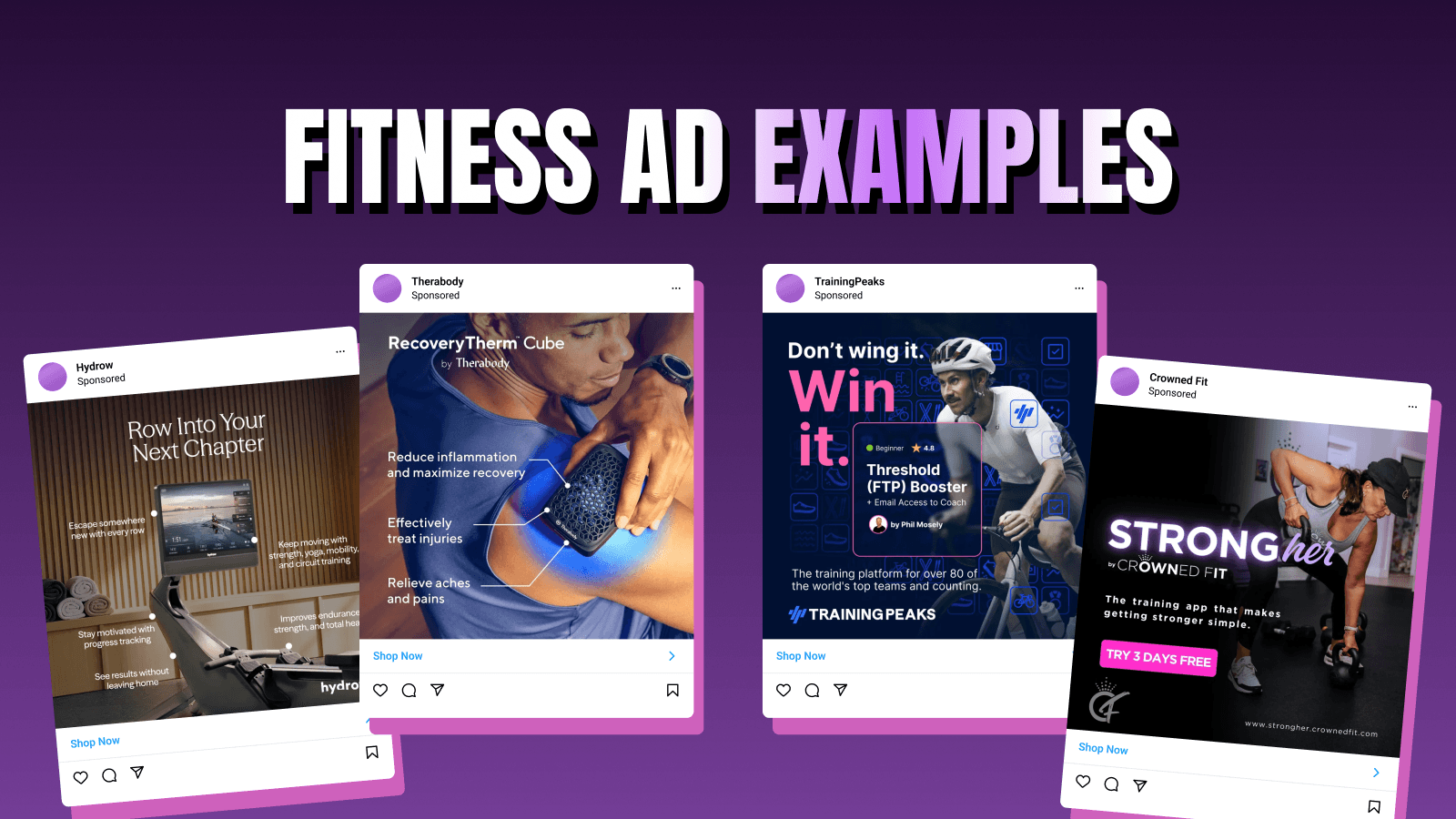


Crowned Fit's StrongHER app ad had been running for 524 days when Meta's Ad Library was last checked. One woman mid-row with two kettlebells, a glowing wordmark, and "Try 3 days free." No before-and-after, no six-pack, no countdown. Most fitness ads roundups list gym promotions and Super Bowl spots. Below are 23 real fitness ads from equipment brands, training apps, wearables, recovery gear, and studios, with dated run-lengths for 16 of them, a count of what they share, and the Meta and FTC rules that decide what a transformation ad can say.
What makes fitness ads different
Fitness ads sell a future version of the buyer, and that's the problem. A body before and a body after, the obvious ad, is the one Meta restricts and the FTC reads as a promise. So the fitness ads that keep running sell something the viewer can measure without a mirror: a faster 5K, a heart-rate number, a 28-day plan, a free week.
Counting cues across the 23 ads below shows how often that happens:
| Cue | Count of 23 | Ads |
|---|---|---|
| A person or body in frame | 14 | Tai chi challenge, chair workout, TRX ×2, Therabody, TrainingPeaks, Whoop ×2, Peloton ×2, Strava + Runna, Crowned Fit, posture challenge, Yoga International |
| An app or device screen with data | 6 | Runna (plan cards), TrainingPeaks, Whoop ×2, Garmin, Strava + Runna |
| A number promising a result | 5 | Runna ×2, chair workout, Bruce Bolt, Strava + Runna |
| A fixed-length plan or challenge | 4 | Runna (8 weeks), chair workout (4 weeks), posture challenge (28 days), tai chi challenge (by a date) |
| A visual progress sequence | 3 | Tai chi challenge, chair workout, posture challenge |
| A review or member quote | 3 | Runna (5K), Peloton (member), TRX (comment) |
| A free trial or free access | 3 | Crowned Fit, Peloton (30 days), Yoga International |
| Fine print or a disclaimer on the image | 3 | Tai chi challenge, Peloton ×2 |
| "Us vs. them" comparison | 2 | Crossover Symmetry, Bruce Bolt |
| Text only, no product | 2 | Rogue Invitational, Strava |
| Vertical 9:16 | 10 | Runna ×2, tai chi challenge, Bruce Bolt, Whoop ×2, Garmin, Strava ×2, Peloton (trial) |
Two numbers stand out. Only three of 23 use a visual progress sequence, and all three come from advertisers that don't put a brand name on the image. And six put a data screen in the ad, which is the fitness version of a product shot: the metric is the product.
How we picked these 23 fitness ads
Every ad comes from the AdDogs fitness ad examples library. We pulled the sports and fitness category, viewed every image, and dropped apparel (covered in a separate post), supplements (see our supplement ad examples), low-resolution files, duplicates, ads that weren't about fitness, and one ad whose brand label in the library didn't match the product on the image. We kept at most two ads per brand.
"Days" is the number of days the ad had been live when last checked, and we only report it when the figure comes from Meta's Ad Library or from Foreplay, the ad-tracking service the library uses. Meta checks for these ads fall between August 12 and October 9, 2026, and Foreplay checks on April 8, 2026, so several have run longer since. Sixteen of the 23 are dated that way and show exact days. Five more (Runna's 5K quote, both Whoop ads, and both Strava ads) carry only a duration band from the source gallery's label, not a dated record, so they show a range such as "30 to 90 days." Two (Therabody and Hyperice) have no run-length on record. Either kind proves the advertiser kept paying, not what the ad returned. Three ads carry no advertiser name in the library or on the image, and we label them "unnamed advertiser." To check a run-length, search the brand in the Meta Ad Library with the active filter and read "Started running on." Our Meta Ad Library guide shows how.
Progress and transformation fitness ads
Progress is the strongest promise in fitness and the most regulated. Four ads show four ways to make it, from a stopwatch to a body. We include the last two as warnings, not models.
1. Runna — a 5K time in quotes
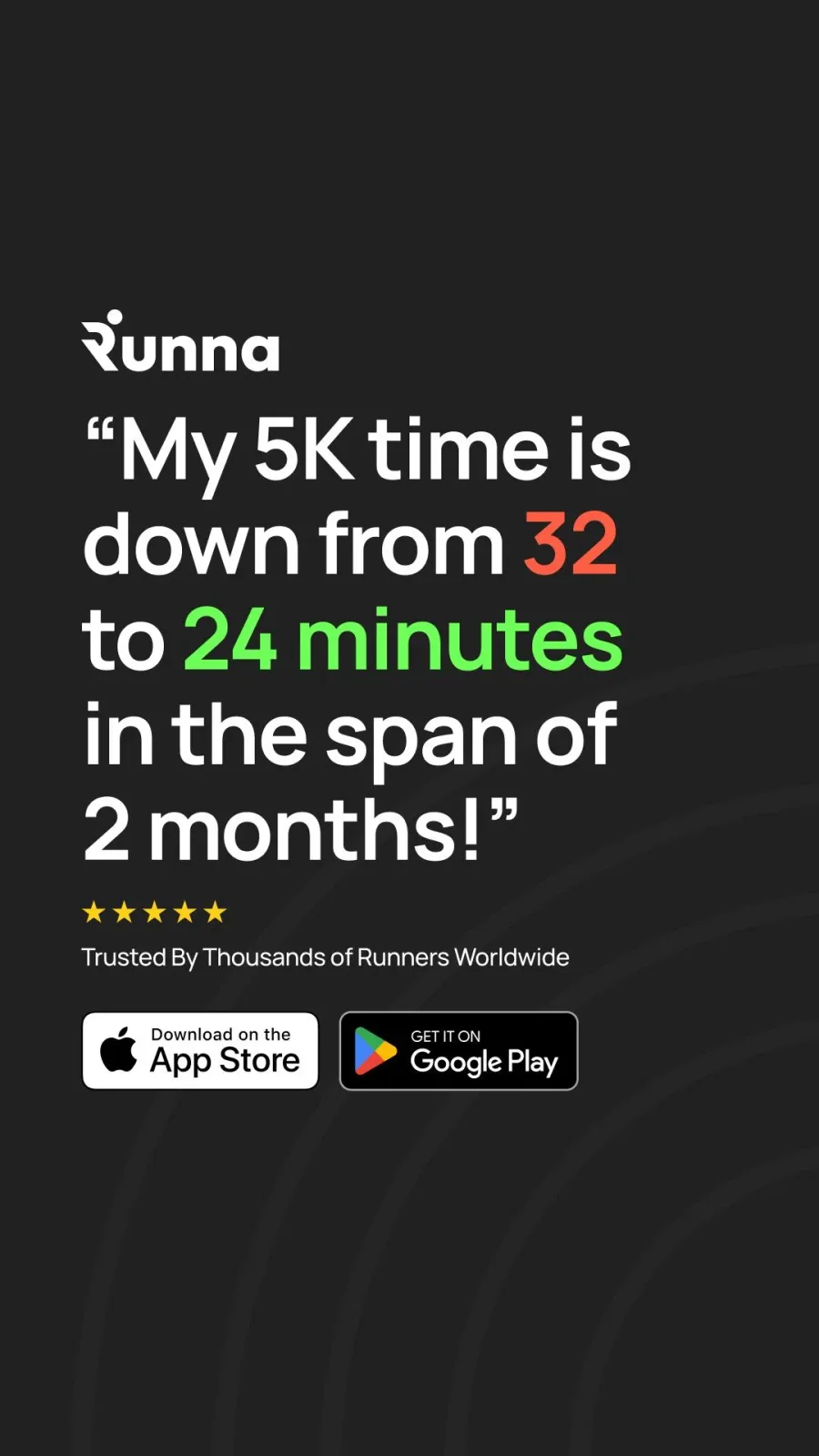
White and colored type on near-black: "My 5K time is down from 32 to 24 minutes in the span of 2 months!" with the 32 in red and the 24 in green, five stars, "Trusted By Thousands of Runners Worldwide," and App Store and Google Play badges. 9:16. Under 30 days.
Why it works: A race time is a transformation without a body. Coloring the two numbers turns the quote into a before-and-after you read in a second.
Clone it: Pick the one metric your customers brag about (minutes, kilos lifted, resting heart rate) and put two values of it in a quote, colored old and new. Read the FTC note on testimonials below before you choose a dramatic one.
2. Runna — four plans, one estimate
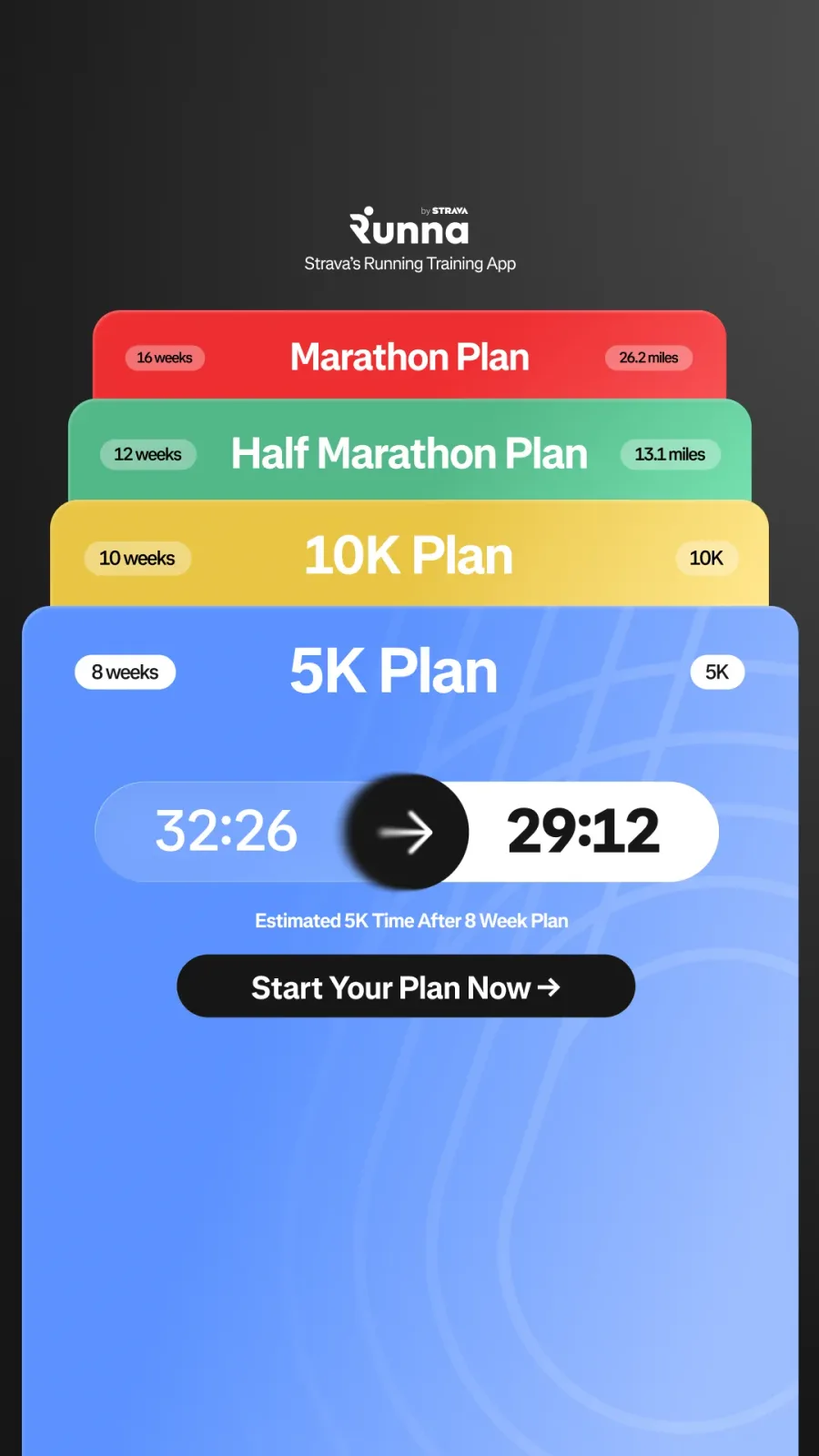
Four stacked plan cards (Marathon 16 weeks, Half Marathon 12, 10K 10, 5K 8), with the front card showing "32:26 → 29:12" and the label "Estimated 5K Time After 8 Week Plan." "Runna, Strava's Running Training App" at the top and a "Start Your Plan Now" button. 9:16. 14 days.
Why it works: "Estimated" and "after 8 week plan" frame the result as a projection with conditions. It's the same promise as the 5K quote, worded so it reads as a forecast.
Clone it: Show your program as a menu of fixed-length plans and attach one estimated outcome, labeled as an estimate.
3. Unnamed advertiser — a tai chi "transformation"
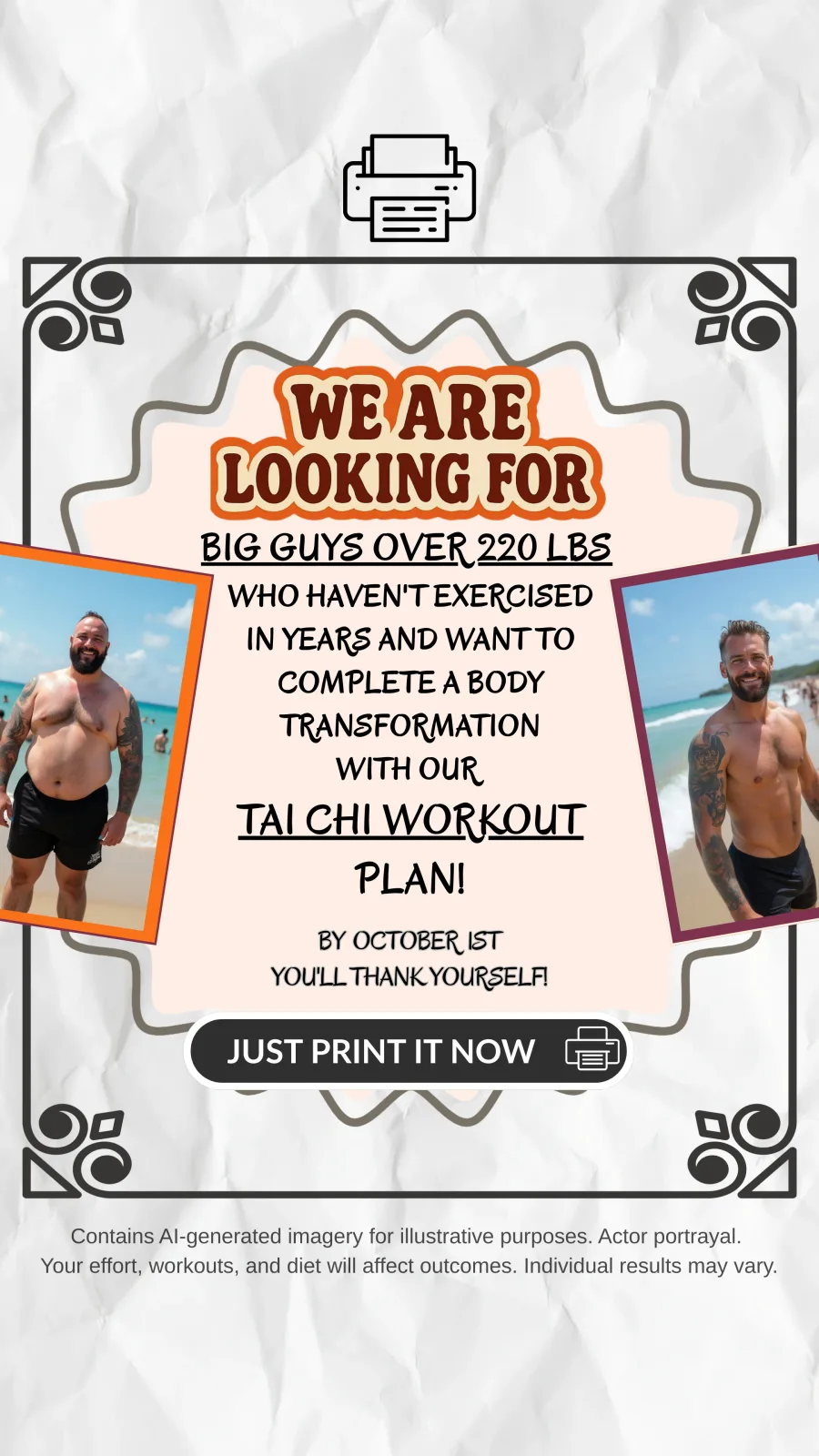
A printer icon and an ornate frame on crumpled paper: "WE ARE LOOKING FOR BIG GUYS OVER 220 LBS who haven't exercised in years and want to complete a body transformation with our TAI CHI WORKOUT PLAN! By October 1st you'll thank yourself!" Two beach photos flank it, a heavier man left and a leaner man right, and a "Just print it now" button. Under the frame: "Contains AI-generated imagery for illustrative purposes. Actor portrayal. Your effort, workouts, and diet will affect outcomes. Individual results may vary." 9:16. 204 days.
Why it works, and why we don't recommend it: A call-out ("big guys over 220 lbs") qualifies the audience in the first line, and a deadline date makes the plan feel urgent. Everything else is a warning. By its own disclaimer, the "transformation" photos are AI-generated actors, and a "results may vary" line is the kind of disclosure the FTC calls insufficient (see the rules section).
Clone it: Keep only the call-out and the date. Drop the paired body photos entirely.
4. Unnamed advertiser — four weeks in four shirts
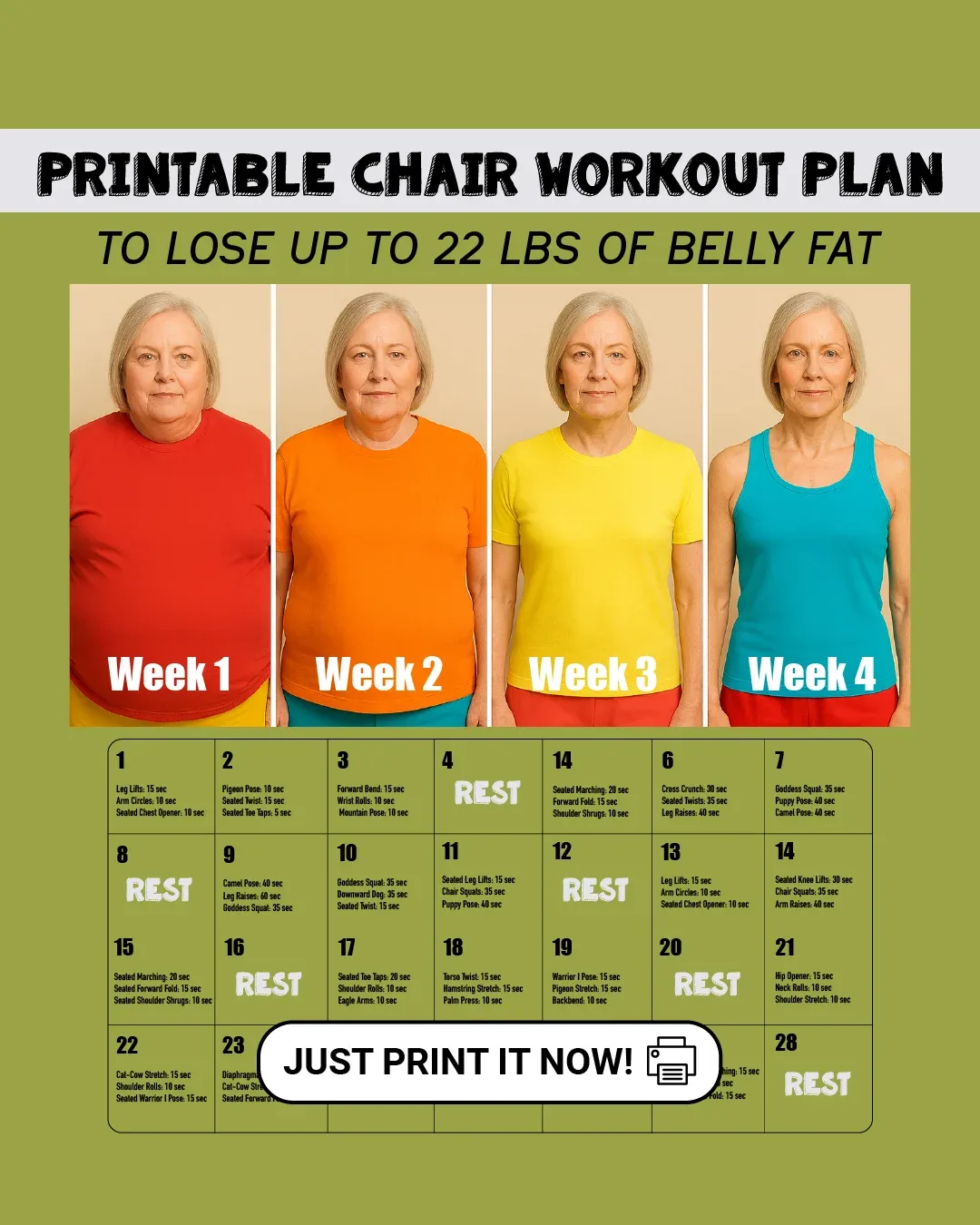
"PRINTABLE CHAIR WORKOUT PLAN / TO LOSE UP TO 22 LBS OF BELLY FAT" over four photos of the same older woman in red, orange, yellow, and teal shirts, labeled Week 1 to Week 4 and progressively slimmer, above a 28-day calendar and a "Just print it now!" button. 4:5. 180 days.
Why it works, and why we don't recommend it: A color change makes the four photos read as time passing, and the calendar makes the plan look doable. It's also the riskiest ad in the set: a weight-loss before-and-after with a specific number ("up to 22 lbs") and no qualifier on the image.
Clone it: Keep only the calendar. A weekly body strip paired with "up to 22 lbs" is close to the before-and-after example the FTC uses in the rules section below, and Meta's standard bars time-bound weight-loss promises without qualifiers.
Equipment demo fitness ads
Equipment is easier to advertise than results. Show the thing, show where it fits, and say what it does.
5. TRX — a door is the gym
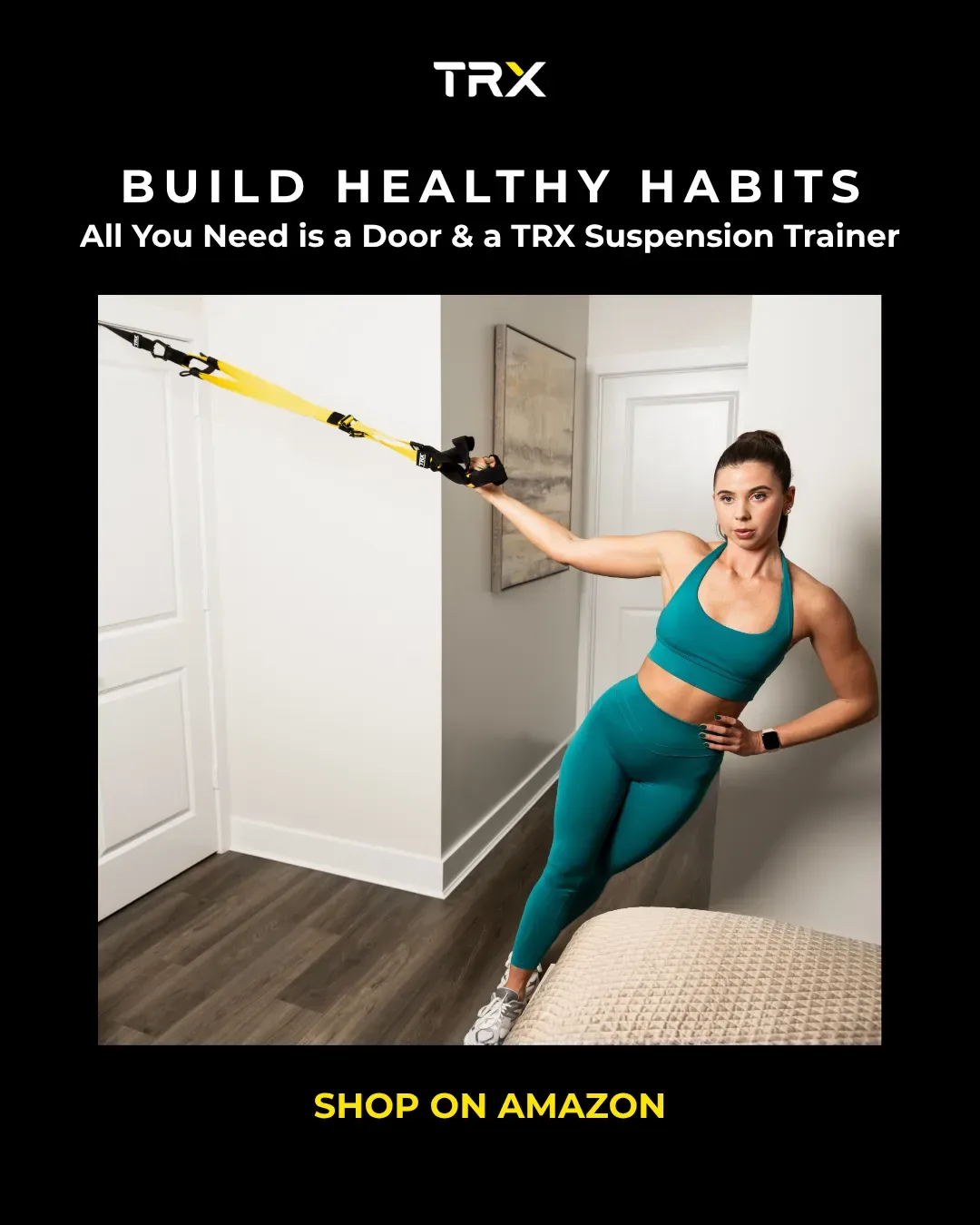
A black letterbox around one photo: a woman in a teal set doing a single-arm row on a yellow-and-black TRX strap anchored over a bedroom door. "BUILD HEALTHY HABITS / All You Need is a Door & a TRX Suspension Trainer" above, "SHOP ON AMAZON" in yellow below. 4:5. 157 days.
Why it works: "All you need is a door" answers the space and setup objection in one line, and the bedroom shows the door. Pointing to Amazon borrows trust in the checkout.
Clone it: Photograph your equipment in the smallest real space it works in and name that space in the headline.
6. Hydrow — five callouts around one rower
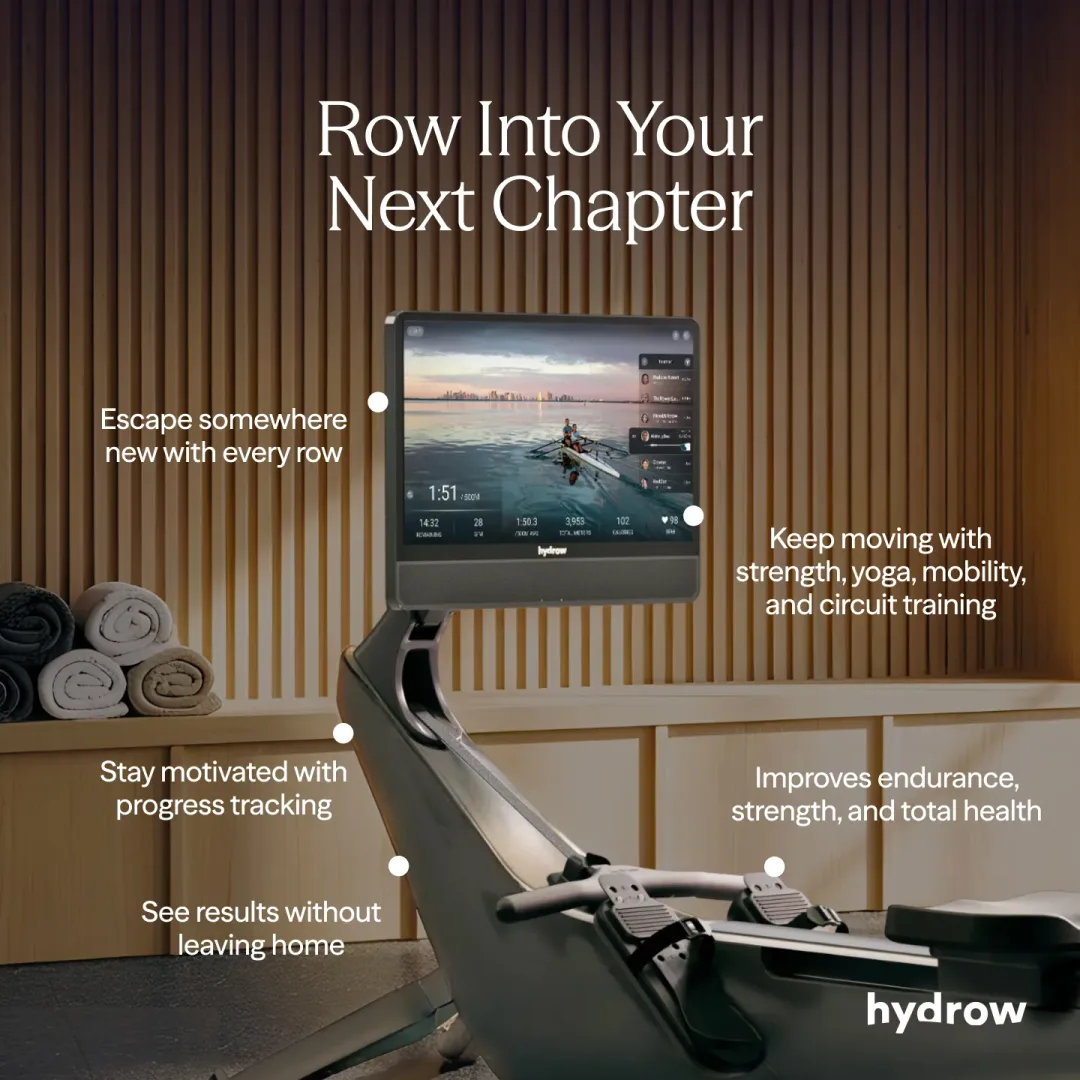
A Hydrow rower in a warm wood-paneled room with its screen showing a river, under "Row Into Your Next Chapter." Five thin callout lines point at it: "Escape somewhere new with every row," "Keep moving with strength, yoga, mobility, and circuit training," "Stay motivated with progress tracking," "Improves endurance, strength, and total health," and "See results without leaving home." Square. 74 days.
Why it works: A big-ticket machine needs reasons, and callouts give five without a paragraph. Its wood-paneled room sells it as furniture that belongs in a home.
Clone it: Product in its real room, four or five callouts, one benefit each, in short type.
7. Crossover Symmetry — three checks, three X's
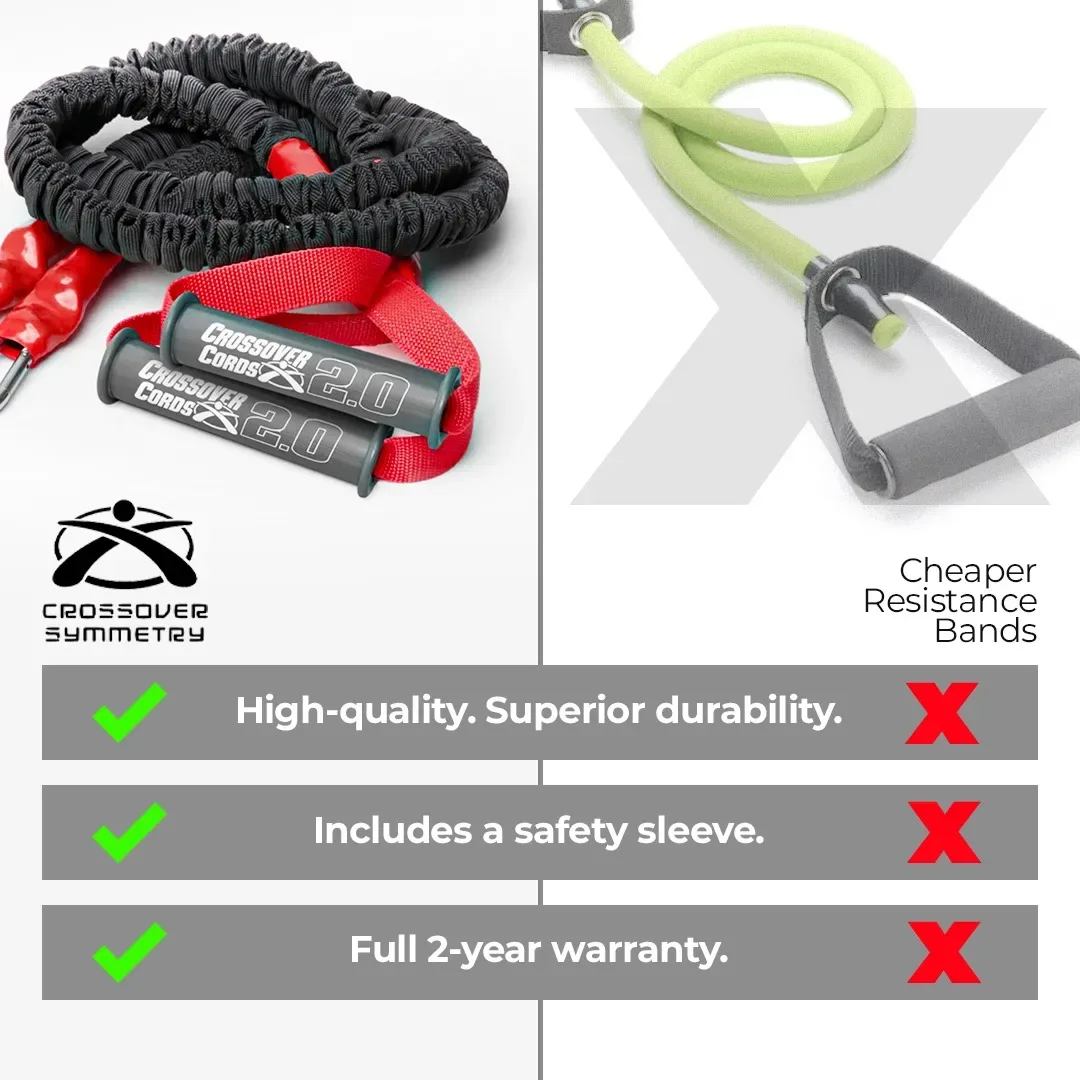
A split frame: Crossover Symmetry's black-sleeved bands with red handles on the left, "Cheaper Resistance Bands" in lime green under a gray X on the right. Three rows run across: "High-quality. Superior durability.", "Includes a safety sleeve.", "Full 2-year warranty.", green checks left, red X's right. Square. 511 days, the longest-running equipment ad in this set.
Why it works: It names the real alternative (cheap bands from anywhere) and picks three differences a buyer can verify: sleeve, warranty, build. Every row is checkable, so none needs a disclaimer.
Clone it: Compare yourself to the generic version of your product on three verifiable features, not to a named rival.
8. Bruce Bolt — one glove, a thousand swings
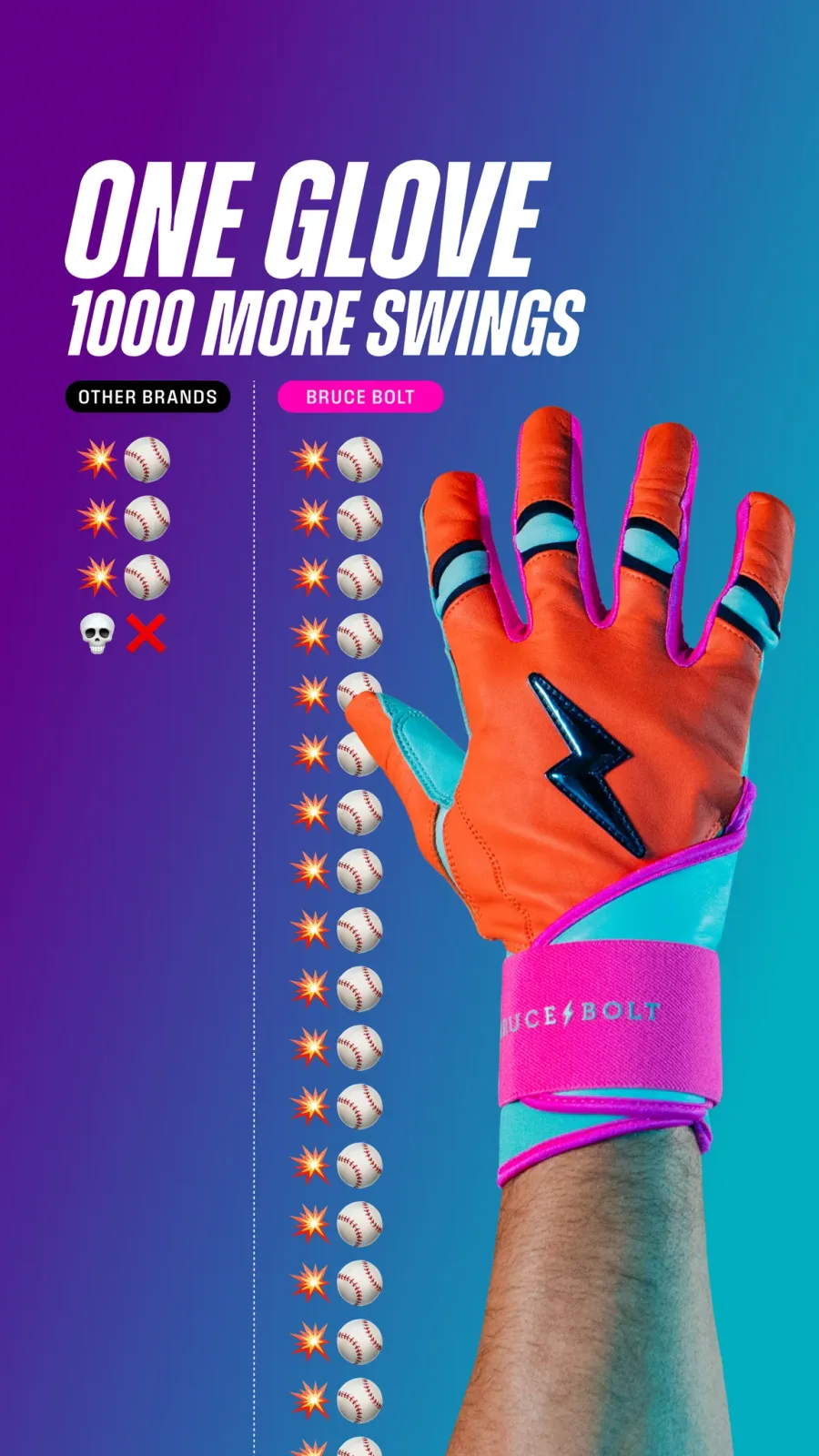
"ONE GLOVE / 1000 MORE SWINGS" in heavy italic over a purple-to-teal gradient. A raised hand wears an orange batting glove with a lightning bolt, and two columns of emoji tally the difference: "OTHER BRANDS" gets three baseballs and a skull, "BRUCE BOLT" gets a column that runs off the frame. 9:16. 65 days.
Why it works: A durability claim drawn as a chart you count with your eyes. A skull emoji says "it tore" without a word.
Clone it: Turn a durability claim into a tally. Be ready to back the number: "1000 more swings" is a performance claim.
9. Therabody — three claims on a shoulder
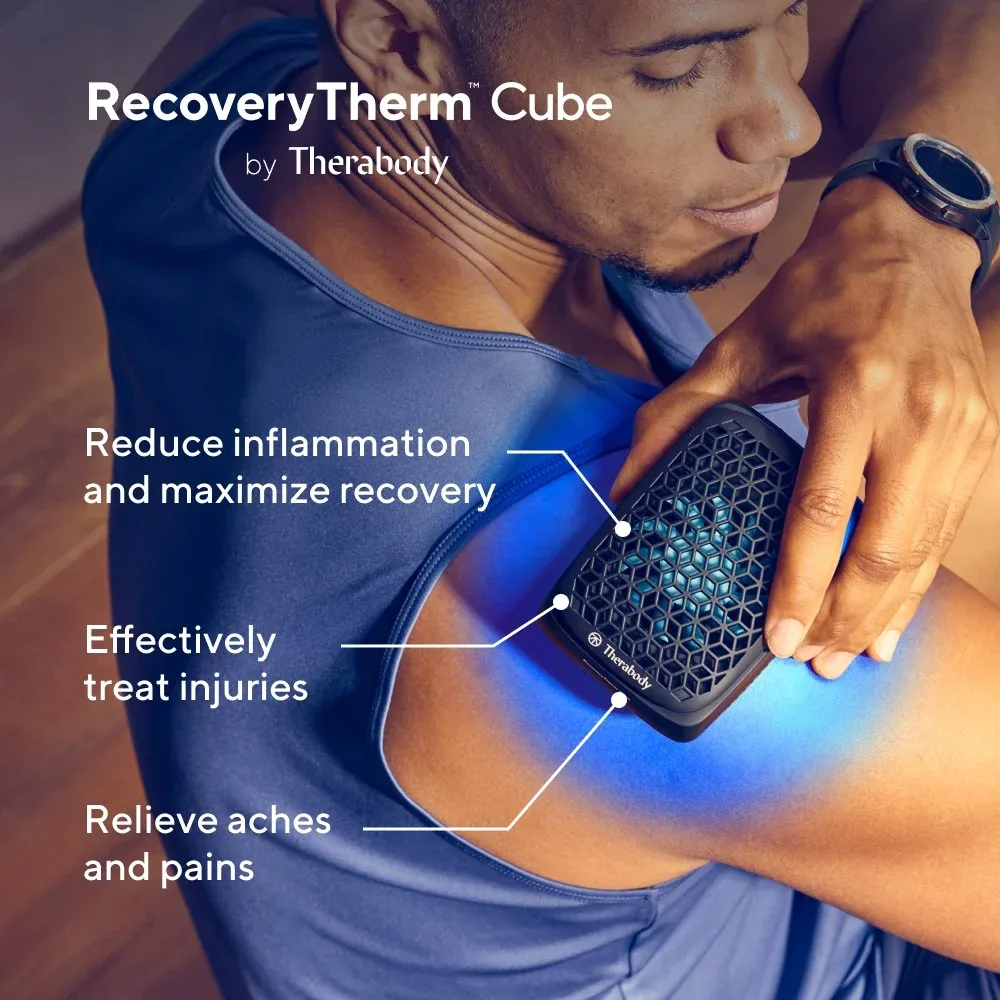
A man holds the RecoveryTherm Cube, glowing blue, against his shoulder in a dim room. "RecoveryTherm™ Cube by Therabody" at the top and three callouts: "Reduce inflammation and maximize recovery," "Effectively treat injuries," and "Relieve aches and pains." Square. No run-length on record.
Why it works: A blue glow makes the technology visible and the in-use shot shows exactly where it goes. Its callouts are health claims, which is the line recovery gear walks.
Clone it: Show the device on the body part it's for. Treat "treat injuries" and "reduce inflammation" as claims that need clinical evidence, per the FTC guidance below.
Coach, athlete, and member fitness ads
A person the viewer trusts does the selling: a named coach, a pro athlete, or a member who sounds like a neighbor.
10. TrainingPeaks — a coach's plan card
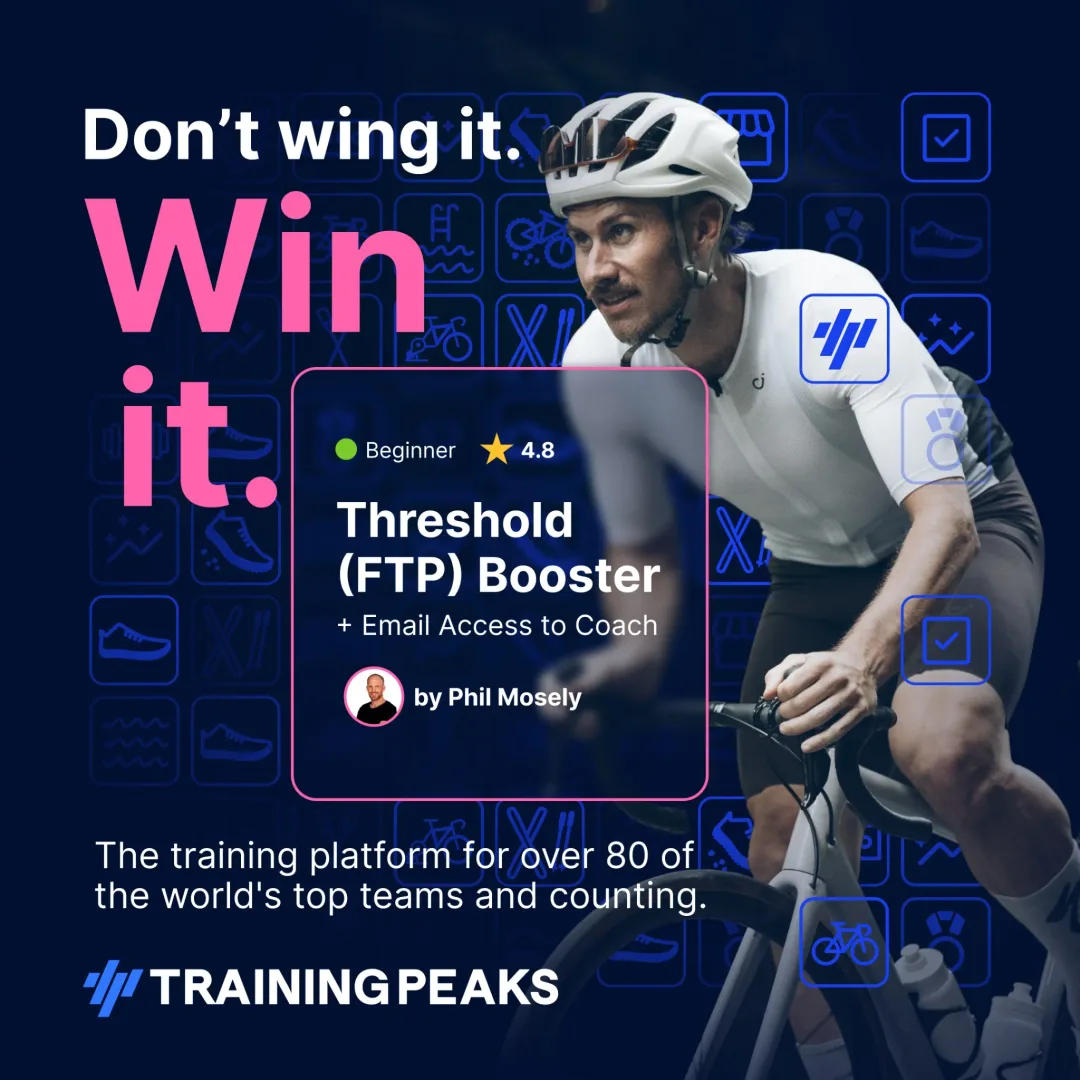
"Don't wing it. Win it." in white and hot pink over a navy field of sport icons, a cyclist in a white helmet, and a plan card: "Beginner ★ 4.8 / Threshold (FTP) Booster + Email Access to Coach / by Phil Mosely." Bottom line: "The training platform for over 80 of the world's top teams and counting." Square. 75 days.
Why it works: A plan card names the coach and the rating, so the viewer buys a person's program, not software. "Over 80 of the world's top teams" is authority without a celebrity fee.
Clone it: Put one program on a card with its author, level, and rating, and a one-line proof of who else uses you.
11. Whoop — a pro golfer and one number
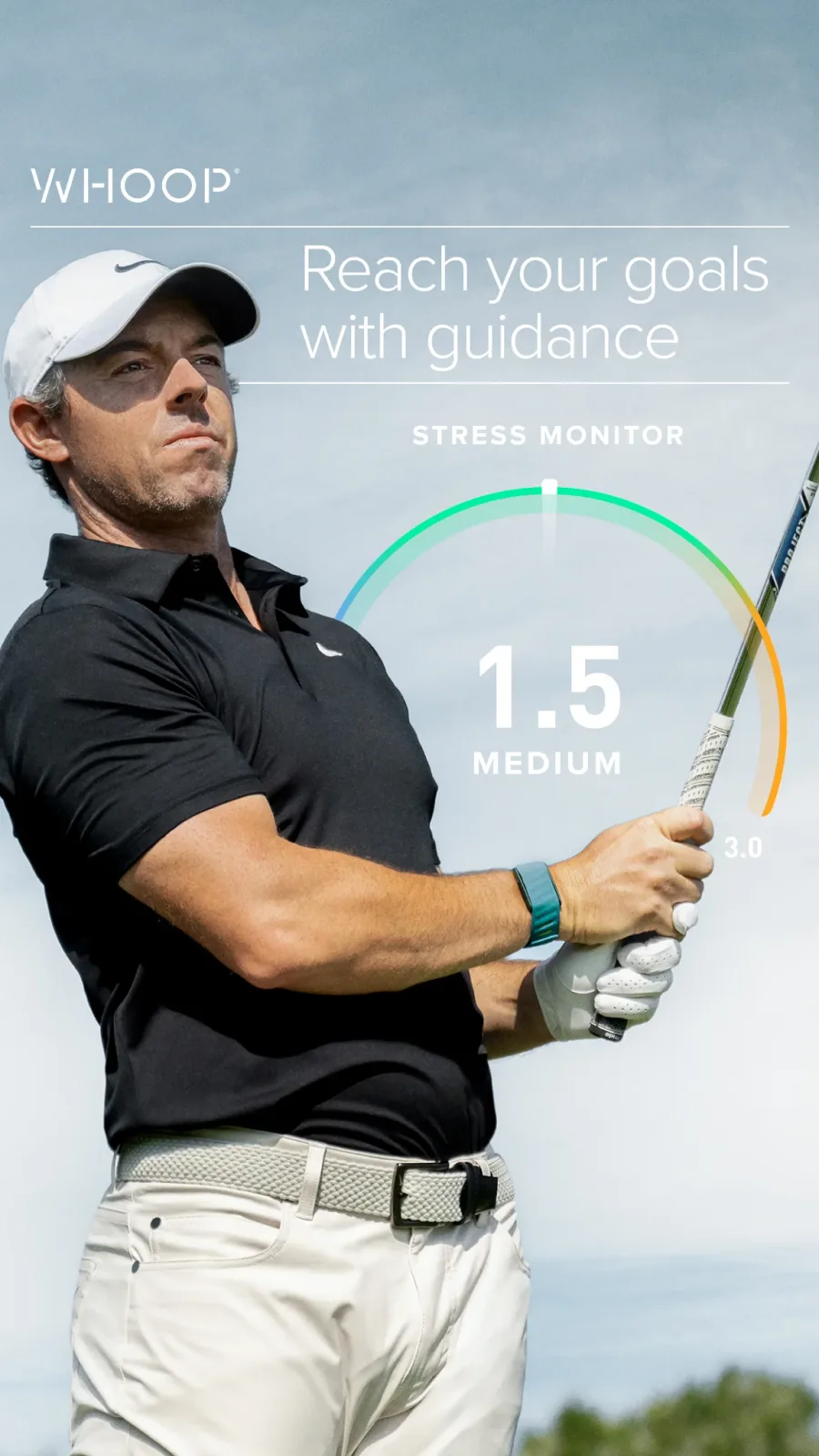
A pro golfer in a black polo mid-follow-through, a teal Whoop band on his wrist, and a stress monitor gauge reading "1.5 MEDIUM" arcing across the frame. "WHOOP" and "Reach your goals with guidance" at the top. 9:16. 30 to 90 days.
Why it works: A calm number on a pressure sport sells the band's promise (control) in one image. An athlete sets the context, and the gauge is the product.
Clone it: Pair a user with the one metric your product shows in the moment it matters to them.
12. Peloton — a member and his son
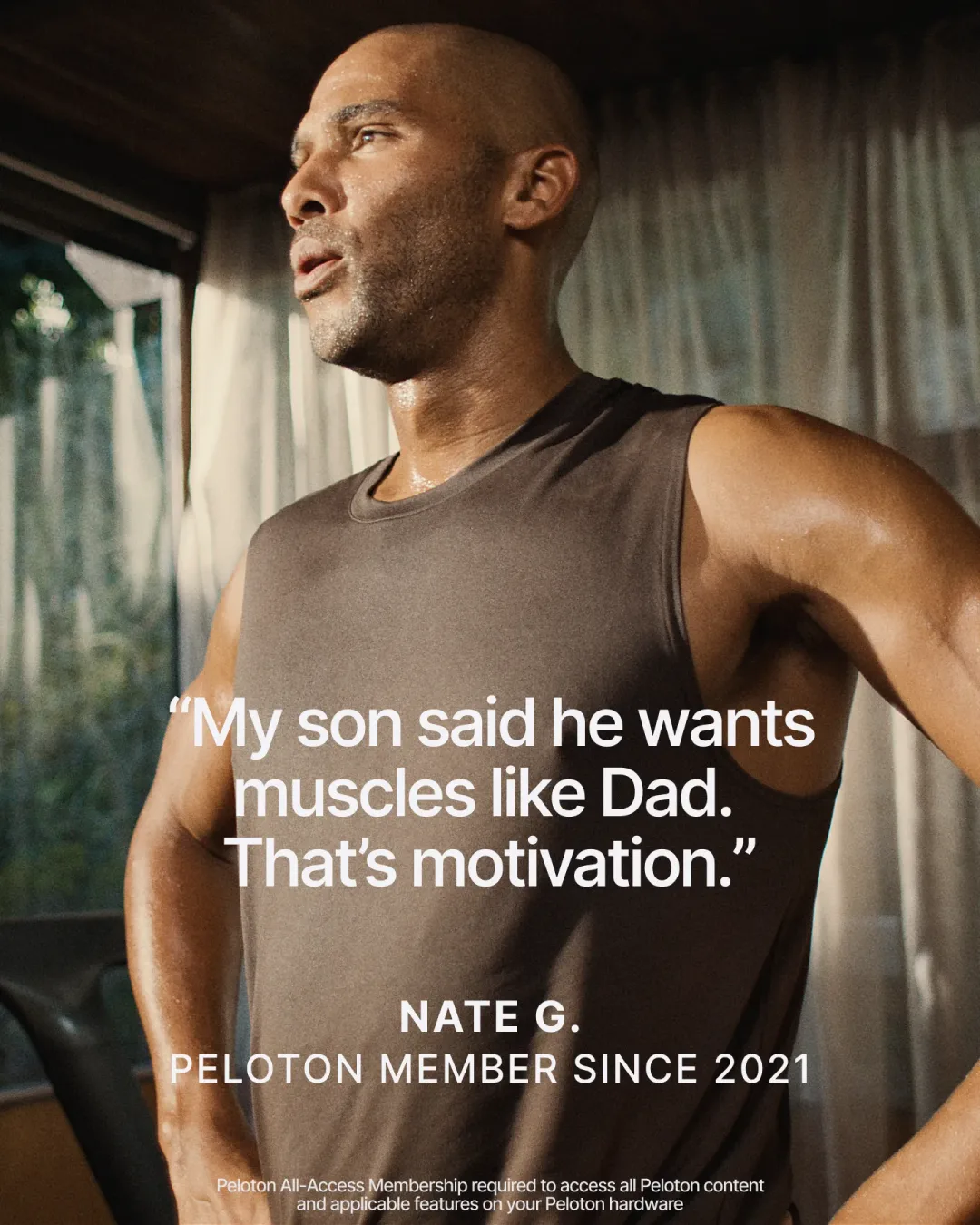
A man in a gray tank top, sweating, looking off-frame. "My son said he wants muscles like Dad. That's motivation." then "NATE G. / PELOTON MEMBER SINCE 2021," with fine print that an All-Access Membership is required for Peloton content. 4:5. 52 days.
Why it works: Its quote is about a reason to keep going, not a result, so it needs no expected-results disclosure. "Member since 2021" adds tenure as proof.
Clone it: Ask customers why they keep training, not what they lost. Run the best answer with first name, initial, and tenure. More formats are in our testimonial ad examples.
Data and metric fitness ads
Wearables and apps sell numbers, so the ad shows the numbers.
13. Garmin — three watch faces of data
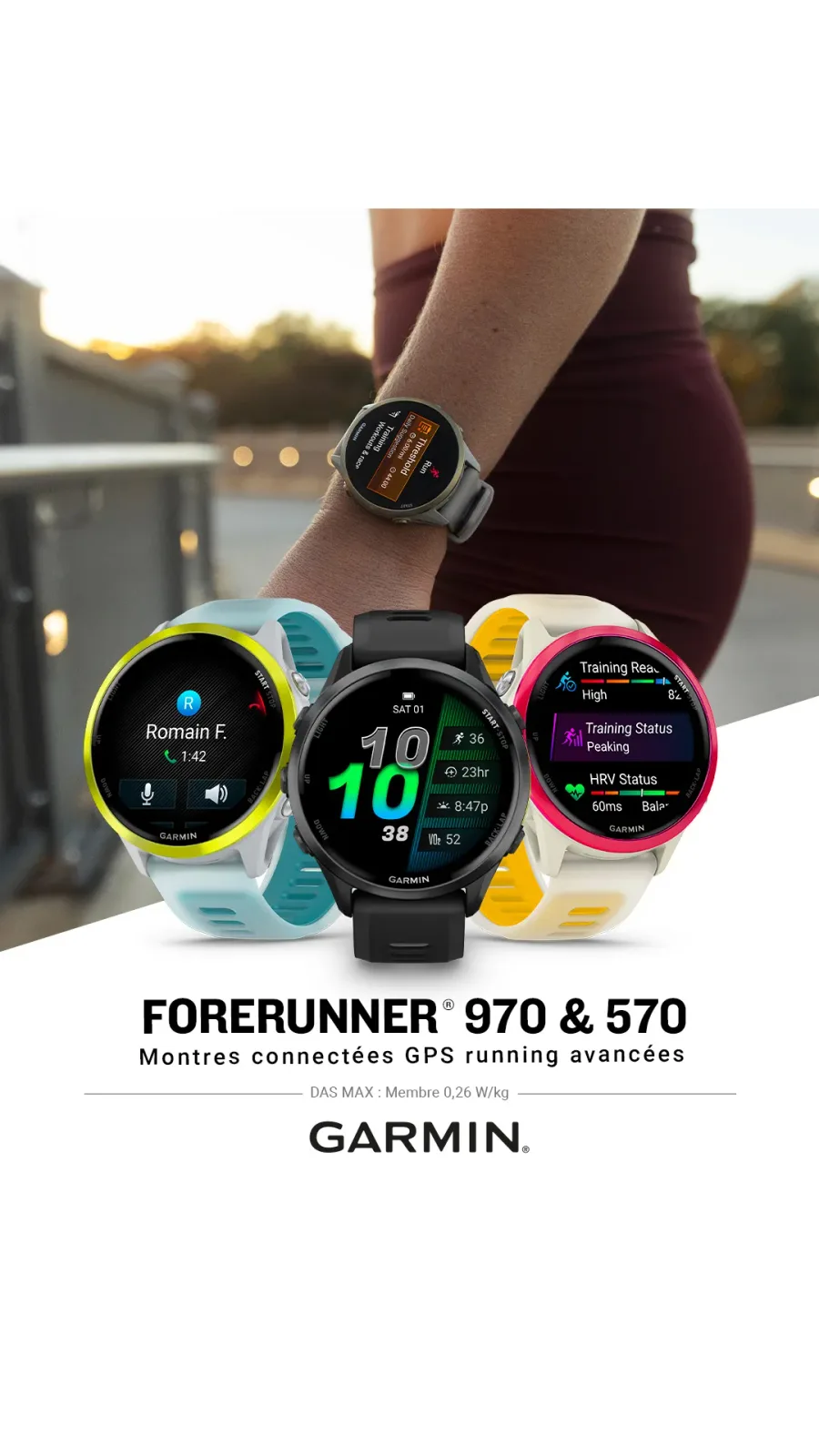
A runner's wrist with a watch at the top, and three Forerunner watches in yellow, black, and pink below, each showing a different screen: a call, a time and stats, and training readiness and HRV. "FORERUNNER® 970 & 570" and a French subline for advanced GPS running smartwatches above the Garmin wordmark. 9:16. 192 days.
Why it works: Three screens show three jobs (phone, pace, recovery) without a feature list. Different band colors widen the appeal in the same frame.
Clone it: Show your device three times, each with a different screen, and let the screens be the bullet points.
14. Whoop — five vitals on one card
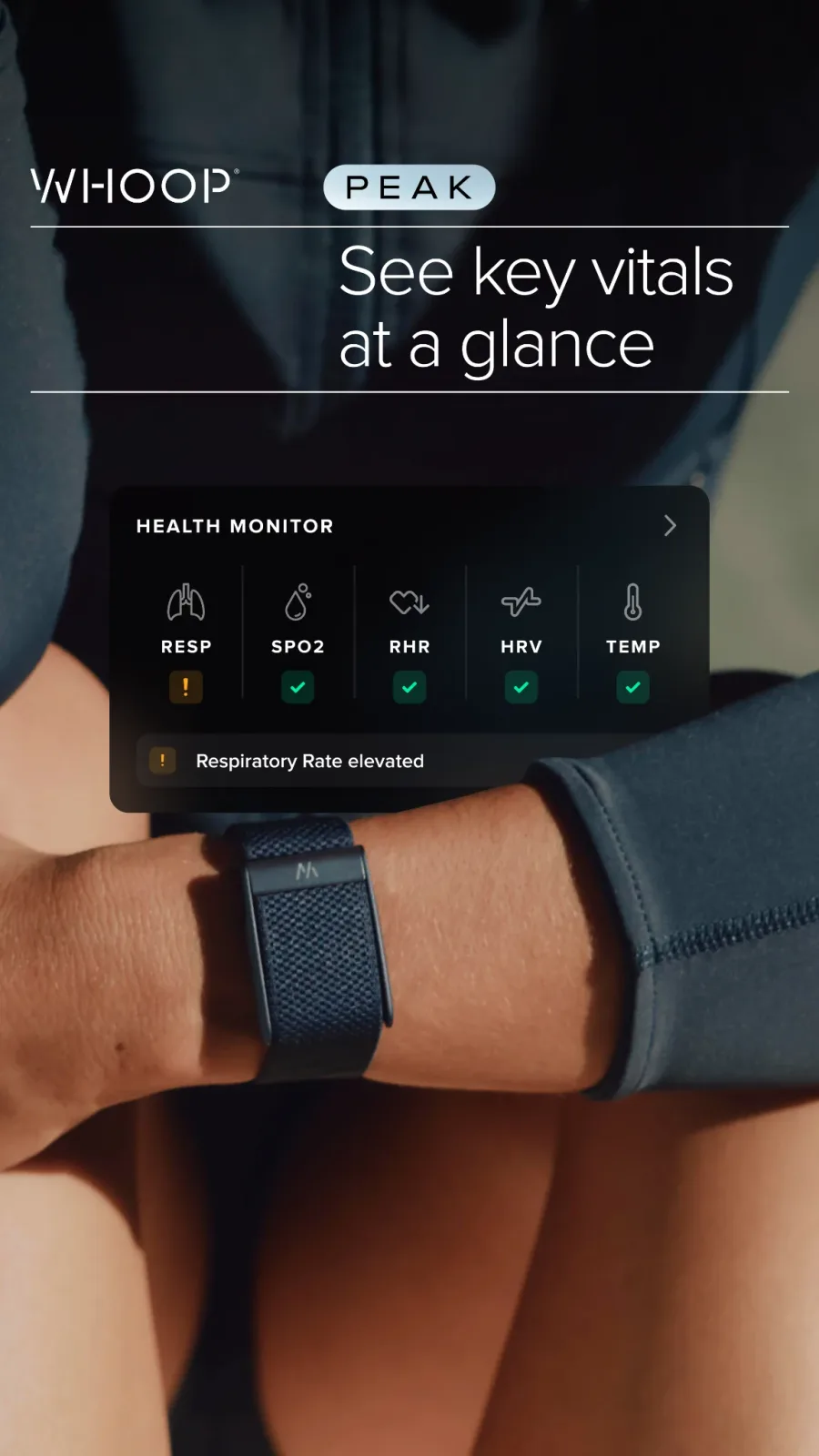
"WHOOP / PEAK / See key vitals at a glance" over a dark forearm close-up with a navy band. A health monitor card lists RESP, SPO2, RHR, HRV, and TEMP, four checked and one flagged: "Respiratory Rate elevated." 9:16. 30 to 90 days.
Why it works: One flagged metric makes the card feel real and shows the product doing its job, catching something. A screen with all green checks would read as decoration.
Clone it: Show your dashboard with one meaningful alert, not a perfect score.
15. Strava and Runna — 86% and a training week
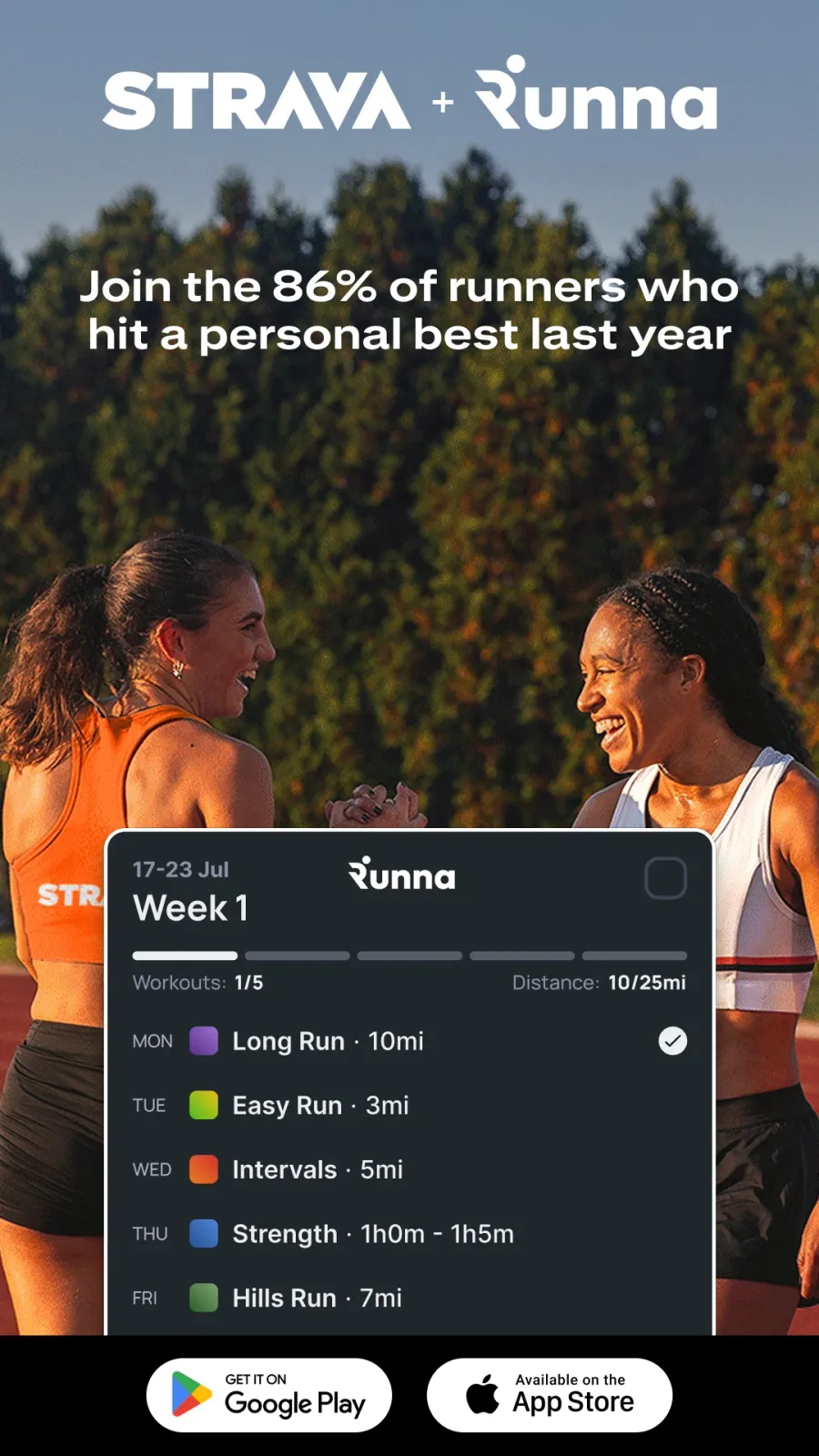
"STRAVA + Runna" at the top and "Join the 86% of runners who hit a personal best last year" over two women laughing on a track. A Runna card lists week one: long run, easy run, intervals, strength, and hills. Store badges at the bottom. 9:16. Under 30 days.
Why it works: A percentage turns a personal best into the normal outcome and invites the viewer to join the majority. A plan card shows what the first week involves.
Clone it: If you have a real stat about what most of your users achieve, lead with it and show week one. Keep the source of that number on file.

Create your own sports-fitness product ads
Create your ad
Program, challenge, and community fitness ads
Fixed-length programs and events give a fitness ad a start date, which is easier to sell than a goal.
16. Crowned Fit — 524 days of one frame
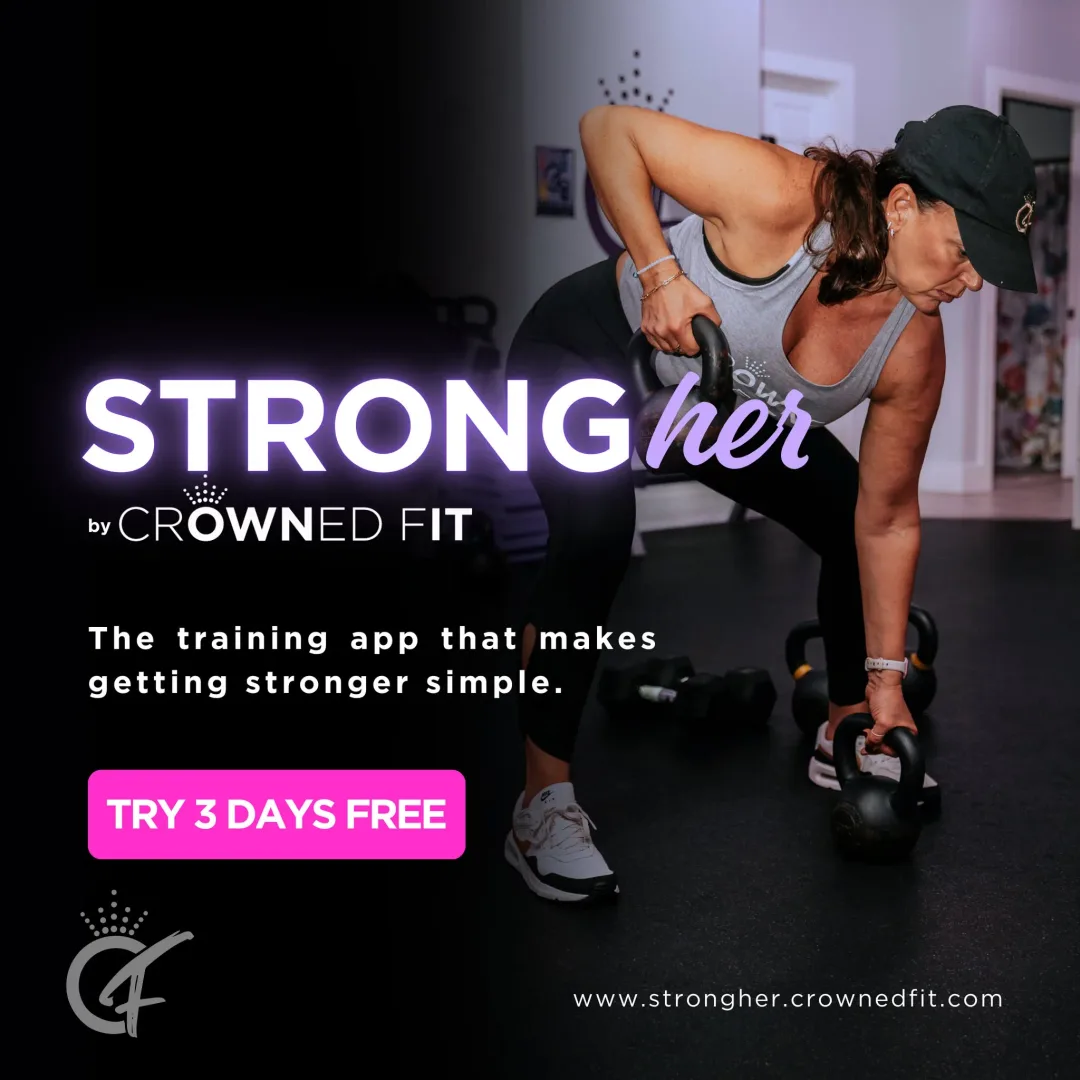
A woman in a black cap and gray tank mid-row with kettlebells in a dim gym, purple light behind. "STRONGher by Crowned Fit" in glowing type, "The training app that makes getting stronger simple.", a pink "TRY 3 DAYS FREE" button, and the URL. Square. 524 days, the longest run in this set.
Why it works: Every element sells capability: a heavy weight, good form, no mirror shot. "Simple" lowers the bar, and a three-day trial costs the viewer nothing.
Clone it: One person doing one hard movement well, a one-line promise, and a short free trial.
17. Unnamed advertiser — a 28-day posture calendar
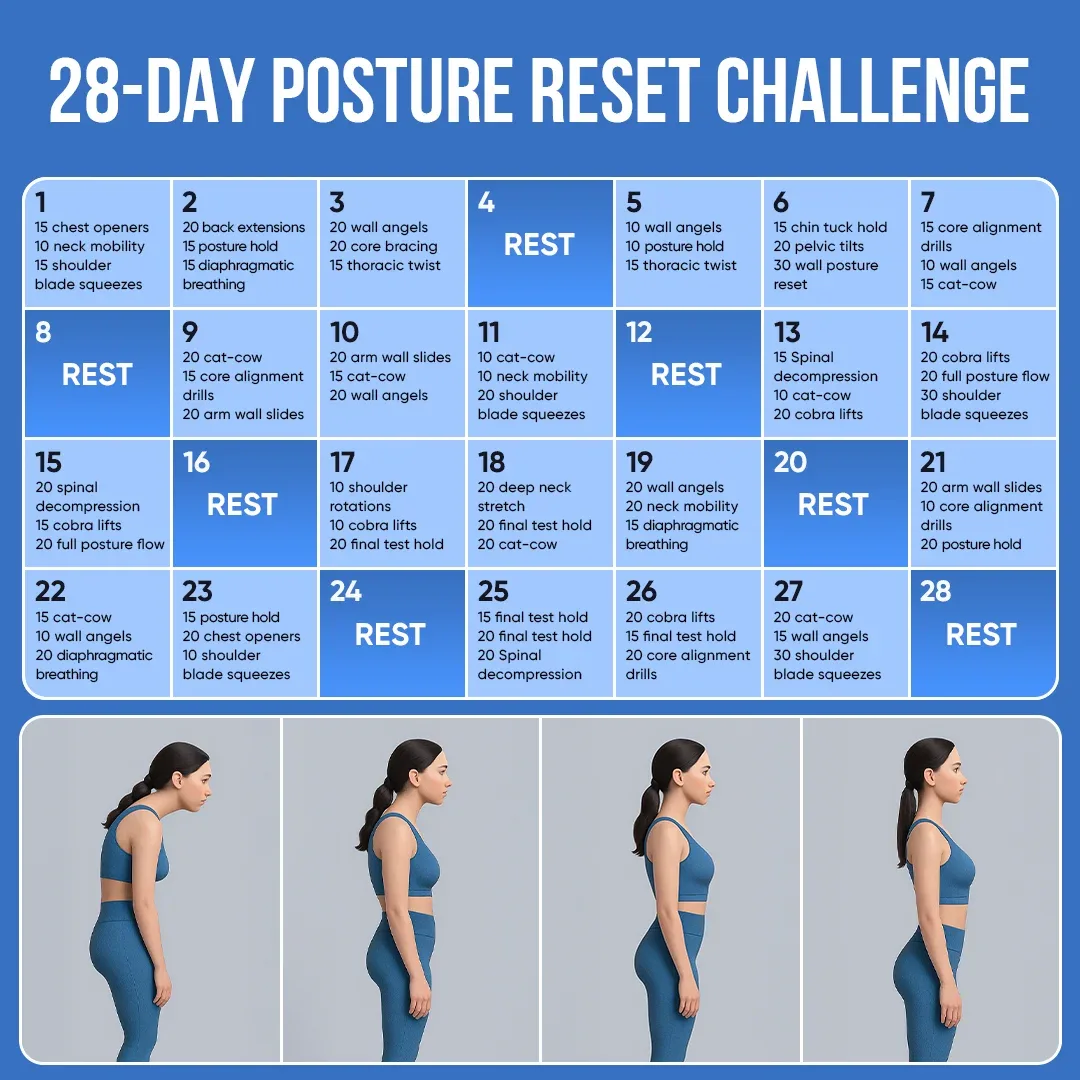
"28-DAY POSTURE RESET CHALLENGE" over a blue calendar with every day's exercises written in (cat-cow, wall angels, chin tucks) and "REST" on days 4, 8, 12, 16, 20, and 24. Below, four side-view photos of a woman in blue standing progressively straighter. Square. 199 days.
Why it works: A full calendar is a free sample of the product, the kind of plan people save. Its progress strip is posture, not weight, which keeps it on the general well-being side of Meta's rules.
Clone it: Publish the whole plan in the ad. Sell the app, printable, or coaching that comes with it.
18. Rogue Fitness — a fight poster for a competition
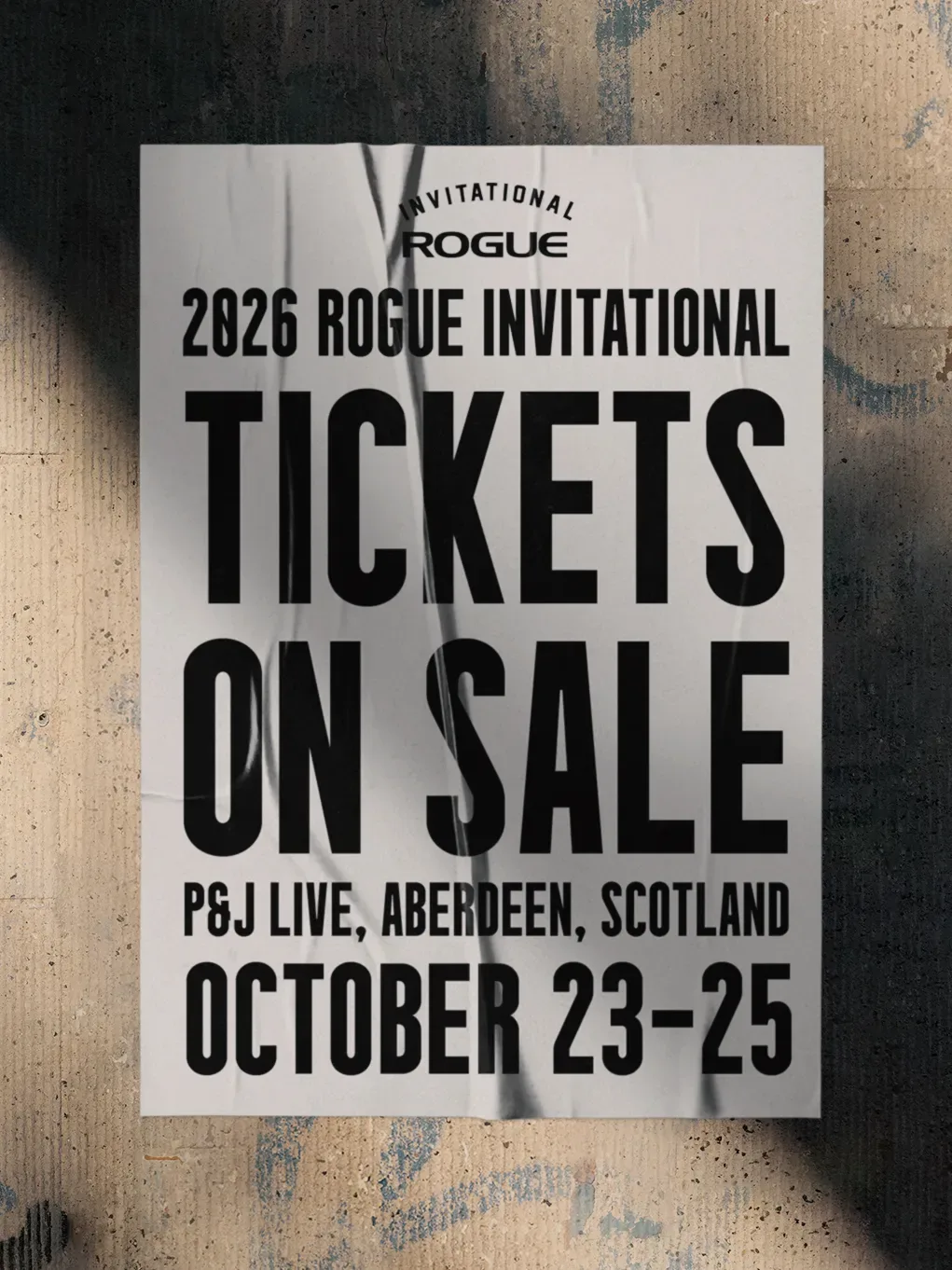
A creased paper poster taped to concrete: "INVITATIONAL / ROGUE / 2026 ROGUE INVITATIONAL / TICKETS ON SALE / P&J LIVE, ABERDEEN, SCOTLAND / OCTOBER 23–25" in tall condensed type. 3:4. 172 days.
Why it works: It looks like a flyer on a gym wall, which is where its audience already looks for events. An equipment brand selling tickets builds the community that buys the barbells.
Clone it: Announce your challenge, meetup, or event as a physical poster photographed in place.
19. Strava — three steps, no photo
"Step 1: track it / Step 2: beat it / Step 3: repeat" in large white type on dark green, "Track your journey on Strava" below, and one thick orange line curving across the bottom like a route. 9:16. 30 to 90 days.
Why it works: Three steps describe the whole habit loop of a fitness app, and the orange line is the brand's route map reduced to a stroke.
Clone it: Write your product as a three-step loop and let one brand shape carry the visual.
Review and offer fitness ads
A stranger's comment or a free month removes the last reason not to try.
20. TRX — a comment from a real buyer
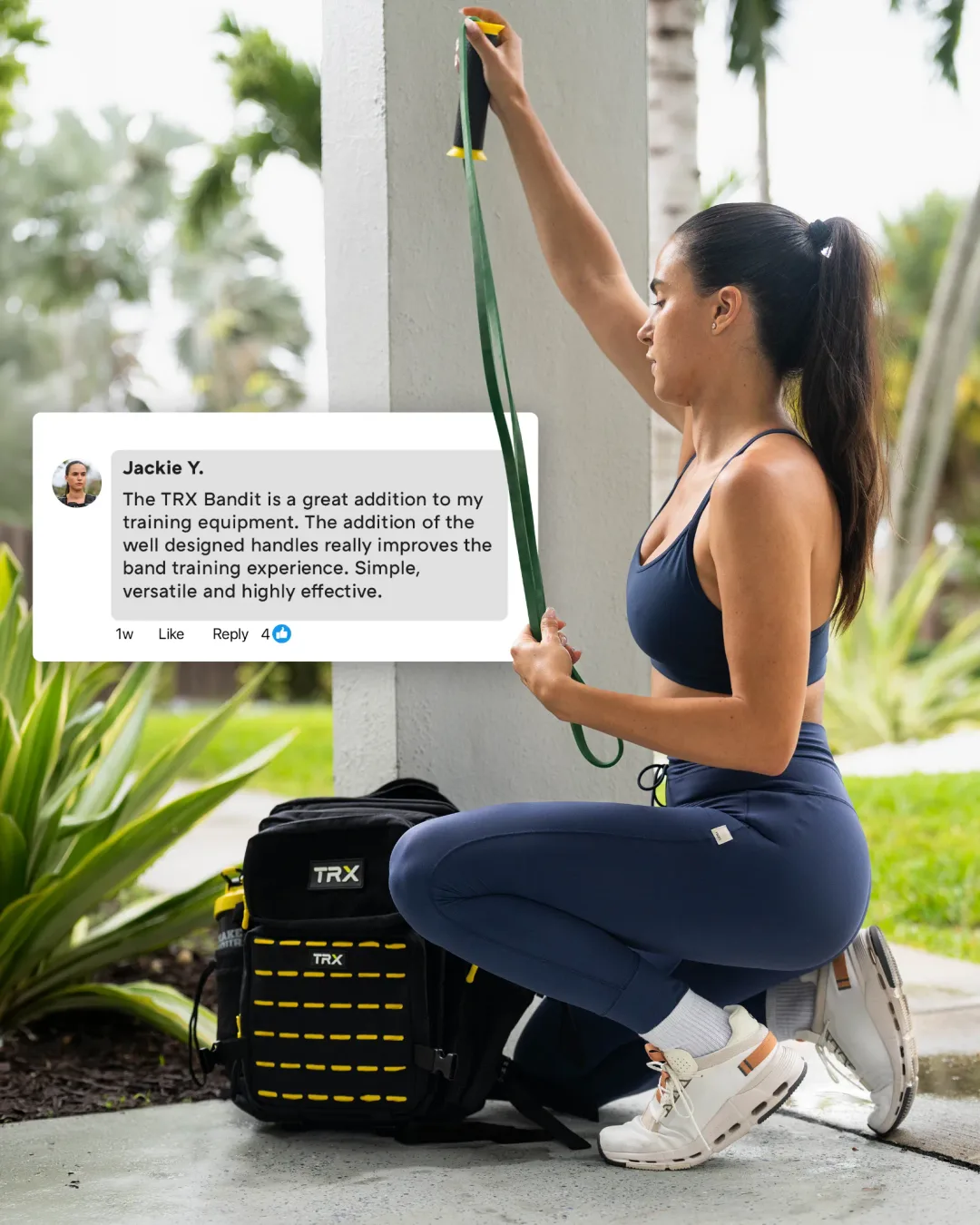
A woman in navy kneels by a TRX backpack, pulling a green band anchored to a white column. Over her shoulder sits a social comment: "Jackie Y. / The TRX Bandit is a great addition to my training equipment. The addition of the well designed handles really improves the band training experience. Simple, versatile and highly effective." with "1w," "Like," "Reply," and four likes. 4:5. 58 days.
Why it works: A comment formatted like a social post reads as overheard. It praises one specific feature, the handles, which makes it believable.
Clone it: Pick a review that names a feature and lay it over the product in use, in native comment styling.
21. Peloton — sweat the workout, not the purchase
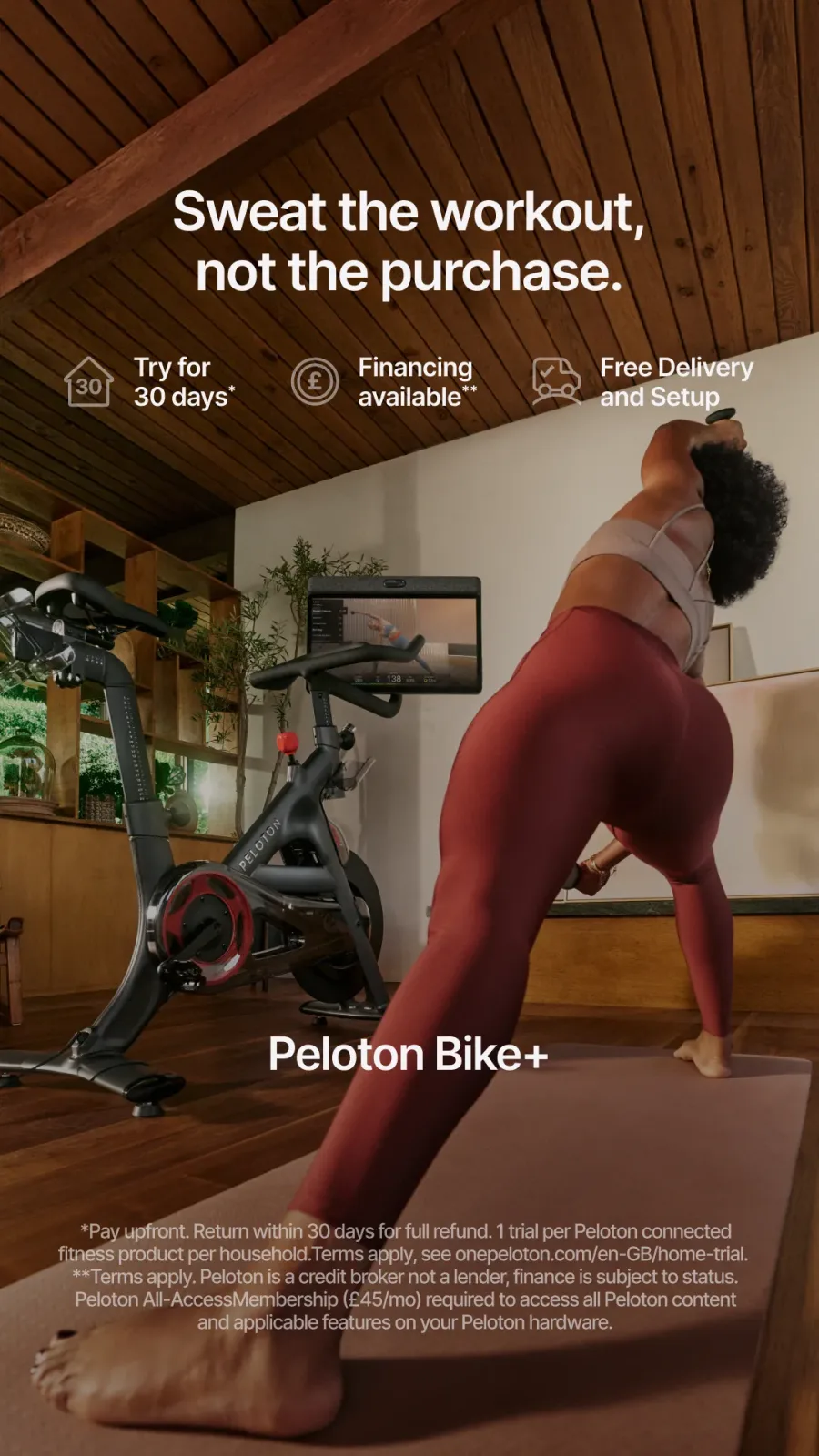
"Sweat the workout, not the purchase." over a woman in a deep stretch next to a Peloton Bike+ in a wood-paneled room. Three icons: "Try for 30 days," "Financing available," and "Free Delivery and Setup." Fine print covers the return terms, financing, and the £45/month All-Access Membership. A UK ad. 9:16. 58 days.
Why it works: Its headline names the real objection (a big purchase) and the three icons answer it. Its fine print is long and visible, which is the honest way to run a "try" offer.
Clone it: Name the purchase anxiety in the headline and answer it with three risk reducers as icons. Put the terms on the image.
22. Yoga International — a struck-through price

A smiling woman in tree pose against pale gray, "SLOW FLOW YOGA" in heavy black type, "$129" struck through beside "FREE FOR MEMBERS" in orange, a line about stability, strength, and serenity, and an orange "GET STARTED" button. 4:5. 183 days.
Why it works: A struck-through $129 gives the free course a value, and the instructor's smile and age signal a gentle class for people who aren't athletes.
Clone it: Price a course or program, strike it, and make it free with membership.
23. Hyperice — an award as the whole ad
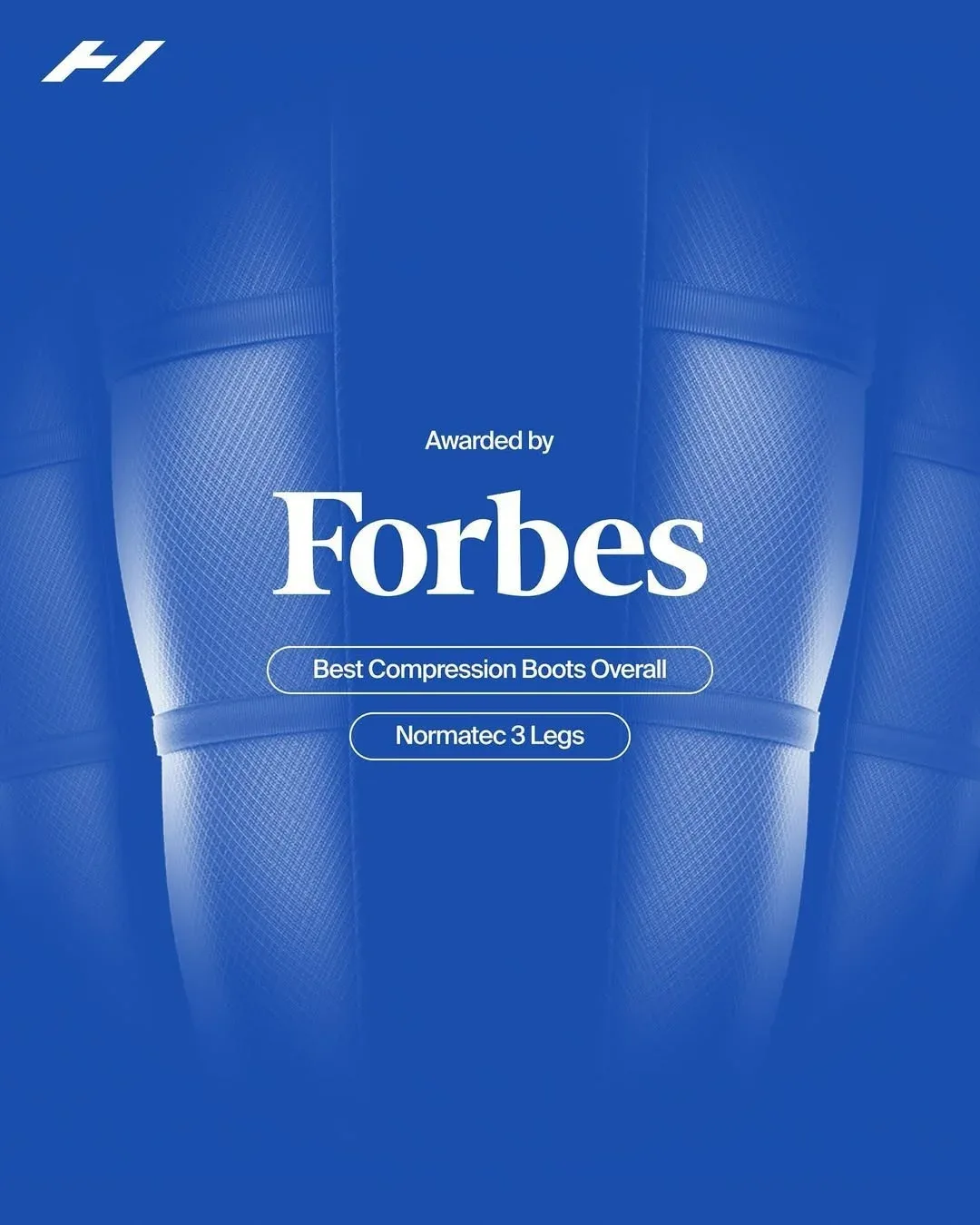
A close-up of quilted compression-boot fabric washed in blue, the Hyperice mark top-left, and centered: "Awarded by / Forbes / Best Compression Boots Overall / Normatec 3 Legs." 4:5. No run-length on record.
Why it works: A third-party "best" does the work a claim from the brand couldn't, and the fabric texture is enough product.
Clone it: If an outlet has ranked you, make the award the headline and keep the product as texture.
What these fitness ads have in common
Four patterns hold across the 23, and the longest runs follow them.
Measurable beats visible. Three of the four longest dated runs sell a number, a plan, or a trial, not a body: Crowned Fit's three-day trial (524 days), Crossover Symmetry's three checks (511), and the posture calendar (199). One exception: the tai chi challenge (204), a body "transformation" built on AI-generated actors, which shows that long runs aren't proof of good practice. Runna's two ads make a 5K time the transformation.
Equipment ads answer one objection each. TRX answers space ("all you need is a door"), Hydrow answers value with five callouts, Crossover Symmetry answers "why not cheap bands," and Peloton answers the price. None tries to answer all four.
A data screen is the product shot. Garmin, Whoop, TrainingPeaks, and Runna put their interface in the ad. Whoop's flagged respiratory rate shows the most useful version: a screen that catches something.
Transformation ads come from the margins. All three progress sequences come from advertisers whose name isn't on the image, and the two with bodies lean on disclaimers or carry none. Branded advertisers in this set avoid the format.
Rules for fitness ads: Meta and the FTC
Fitness advertising sits next to two sets of rules: Meta's health and wellness ad standard, which decides whether an ad runs, and the FTC's Endorsement Guides, which decide whether a testimonial is deceptive.
Meta's health and wellness standard. Meta's Health and wellness ad standard bars weight-loss and weight-gain ads that show a "close up on specific body area by pinching fat" or claim "results can be achieved solely by using wearable products." Health, weight-loss, and weight-gain ads can't use clickbait such as "promises of specific outcomes within a set time frame without disclaimers or qualifiers," or statements of inferiority about physical appearance. Dietary weight-loss products are allowed only when targeted to people 18 and older and must "clearly indicate the time taken to achieve noticeable results." Products and services "marketed for general well-being, such as fitness services and equipment, and health clubs" are exempt from that age restriction. Meta keeps a separate "personal health and appearance" standard that commentators cite for before-and-after weight-loss images. It returned an error each time we tried to load it, so check it in Meta's Transparency Center before running a transformation ad.
FTC: testimonials imply typical results. Under 16 CFR 255.2(b), a consumer testimonial on a key attribute "will likely be interpreted as representing that the endorser's experience is representative of what consumers will generally achieve." If the advertiser can't back that up, the ad "should clearly and conspicuously disclose the generally expected performance." The same section's examples say a disclosure like "Results not typical" is "insufficient," because tested consumers still read the testimonial as typical. Another example covers before-and-after pictures with "I lost 50 pounds in 6 months": if consumers can't generally expect that, the ad is deceptive. And 255.2(c) says ads presented as showing "actual consumers" should use actual consumers or clearly disclose that they aren't.
FTC: health claims need science. The FTC's Health Products Compliance Guidance says health-related claims need "competent and reliable scientific evidence," generally randomized, controlled human clinical testing, and that anecdotal testimonials aren't enough on their own.
Read against those rules, the ads above fall into three groups:
| Ad | What it claims | How it sits with the rules |
|---|---|---|
| Runna 5K quote (#1) | One user cut a 5K from 32 to 24 minutes | A results testimonial, so 255.2(b) expects either typical-results backing or a disclosure of generally expected performance |
| Runna plan cards (#2) | "Estimated" time after an 8-week plan | Framed as an estimate with conditions, the safer way to state a result |
| Tai chi challenge (#3) | "Body transformation," paired photos | Discloses AI imagery and actors (255.2(c)). "Individual results may vary" is the kind of line the FTC calls insufficient |
| Chair workout (#4) | "Lose up to 22 lbs of belly fat," weekly photos | A weight-loss before-and-after with a specific number and no time-to-results qualifier on the image |
| Therabody (#9) | "Effectively treat injuries," "reduce inflammation" | Health claims that the FTC guidance says need clinical evidence |
| Posture calendar (#17) | 28-day plan, posture progression | General well-being, no weight or appearance claim |
None of this is legal advice. For a specific claim, read the source and talk to counsel.
Fitness ad sizes
Ten of the 23 ads are 9:16, which runs in Stories and Reels, and most of the rest are square or 4:5 for feeds. Meta now recommends 1440 x 1800 for 4:5 and 1440 x 2560 for 9:16, and it reserves the bottom 35% of Reels for the caption and button, so keep plan cards and prices higher. Every placement is in our Meta ad sizes guide.
Make your own fitness ads from these layouts
All 23 fitness ads above are layouts: a plan card, a data screen, a callout diagram, a comparison table, a struck-through price. AdDogs rebuilds any of them from the fitness ad examples library around your own product photo with the static ad generator, one credit per ad in the aspect ratio you pick. Basic ($12/mo, 30 credits) covers 1:1, 9:16, and 16:9. Pro and Ultimate include all 14 ratios, 4:5 among them. Test the equipment demo against the member quote and the free-trial frame, and keep the claims on the right side of the rules above.
FAQ
How do you advertise a fitness product on Facebook and Instagram?
Start with three layouts from this set: an equipment or app demo that answers one objection, a member quote or review, and a free-trial offer. Export 4:5 for feeds and 9:16 for Stories and Reels, and let them run long enough to compare. In this set, the longest run was 524 days for a single trial-offer frame.
What makes a good fitness ad?
It sells something measurable: a time, a metric, a fixed-length plan, or a free trial. In this set, six of 23 ads put a data screen in the frame and only three used a visual progress sequence, and none of those three carried a brand name on the image.
Are before-and-after photos allowed in fitness ads on Meta?
Meta's health and wellness standard bans weight-loss ads that show fat-pinching close-ups, claim results from wearables alone, or promise specific outcomes in a set time frame without qualifiers, and it limits dietary weight-loss ads to people 18 and older. Meta's separate personal health and appearance standard covers before-and-after imagery, so check it in the Transparency Center before running one.
Does "results not typical" protect a fitness testimonial?
No. FTC Endorsement Guides give "Results not typical" as an example of a disclosure that is "insufficient" (16 CFR 255.2). If a testimonial's result isn't what customers generally achieve, the ad should clearly disclose the generally expected result.
What size should fitness ads be?
For Meta, 4:5 at 1440 x 1800 px for feeds and 9:16 at 1440 x 2560 px for Stories and Reels. Ten of the 23 ads here are 9:16. Our Meta ad sizes guide lists every placement.
How long should a fitness ad run before you change it?
No fixed number exists. In this set, the 16 ads with dated run-lengths ranged from 14 days to 524 days, and the four longest (Crowned Fit, Crossover Symmetry, the tai chi challenge, and the posture calendar) had all passed 199 days. A long run shows the advertiser kept paying, so it's a signal to study the layout, not proof of return.