Jewelry ads: 12 real examples and how to shoot them


Abbott Lyon's pink opal earrings ad had been running for 509 days when it was last checked. Six heart charms on pink marble, a wordmark, and four words of meaning. No model, no price, no button. Most jewelry ads roundups show screenshots and stop. Below are 12 real jewelry ads with how long each one ran where we know it, a count of what they share, how to photograph something small and shiny, and the words the FTC's Jewelry Guides control. For the luxury end of the category, see the sibling post on luxury ad examples.
What makes jewelry ads different
Jewelry ads sell an object smaller than a thumbnail on a phone screen, made of metal that reflects everything around it, at a price the viewer can't judge from a photo. So the ads that last do three things: make the piece big, put it on a body for scale, and prove it won't tarnish, break, or turn out to be something other than what the ad says.
Counting cues across the 12 ads below makes that concrete:
| Cue | Count of 12 | Ads |
|---|---|---|
| Piece shown on a body | 7 | Mejuri, Missoma, ABLE, Abbott Lyon (POV), Joy Dravecky ×2, Jaxxon |
| Product-only shot, no body | 3 | Abbott Lyon (opal), Jeulia, Moedermelk Sieraden |
| No product photo at all | 2 | Atolea ×2 |
| A full face in frame | 1 | Joy Dravecky (tarnish grid) |
| Durability or longevity claim | 5 | Abbott Lyon (warranty), Atolea ×2, Jaxxon, Joy Dravecky (tarnish grid) |
| Review or user post as the creative | 2 | Atolea (Reddit), Joy Dravecky (review) |
| A price or discount on the image | 2 | Atolea ($39.99), Moedermelk Sieraden (flash sale) |
| Material or stone named on the image | 2 | Abbott Lyon ×2 (pink opal; sterling silver and aquamarine) |
| Vertical 9:16 | 6 | Abbott Lyon ×2, ABLE, Atolea ×2, Jaxxon |
Two numbers stand out. Only one ad shows a whole face, and a face competes with a pendant for the eye. And five of 12 spend their words on durability, more than on price, material, or offer.
How we picked these 12 jewelry ads
Every ad comes from the AdDogs jewelry ad examples library, which sources live ads from the Meta Ad Library and from Foreplay, an ad-tracking service. We pulled the jewelry category plus fashion and luxury ads that mention necklaces, earrings, bracelets, or rings, viewed each image, and dropped low-resolution files, duplicates, and non-jewelry products. We kept at most two ads per brand and none of the ads already used in the luxury post.
"Days" is the number of days the ad had been live when it was last checked, from its Meta Ad Library start date or from Foreplay. Four ads are dated that way (Abbott Lyon 509, Moedermelk Sieraden 189, Atolea 107, Mejuri 39), with checks between April 7 and October 12, 2026, so they may have run longer since. Four more (ABLE, Abbott Lyon's POV, Atolea's Reddit thread, and Jaxxon) carry only a duration band from the source gallery's label rather than a start date, and we give the band ("90 to 180 days," "30 to 90 days"). Run-length is the only performance number we hold: it proves the advertiser kept paying, not what the ad returned. Four of the 12 (Jeulia, Missoma, and both Joy Dravecky ads) have no run-length on record and are marked. To check one yourself, search the brand in the Meta Ad Library with the active filter and read the "Started running on" date. Our Meta Ad Library guide shows how.
Macro product hero: let the piece fill the frame
Product-only jewelry ads work when the piece takes up most of the canvas and the background does the mood.
1. Abbott Lyon — pink opal hearts on marble
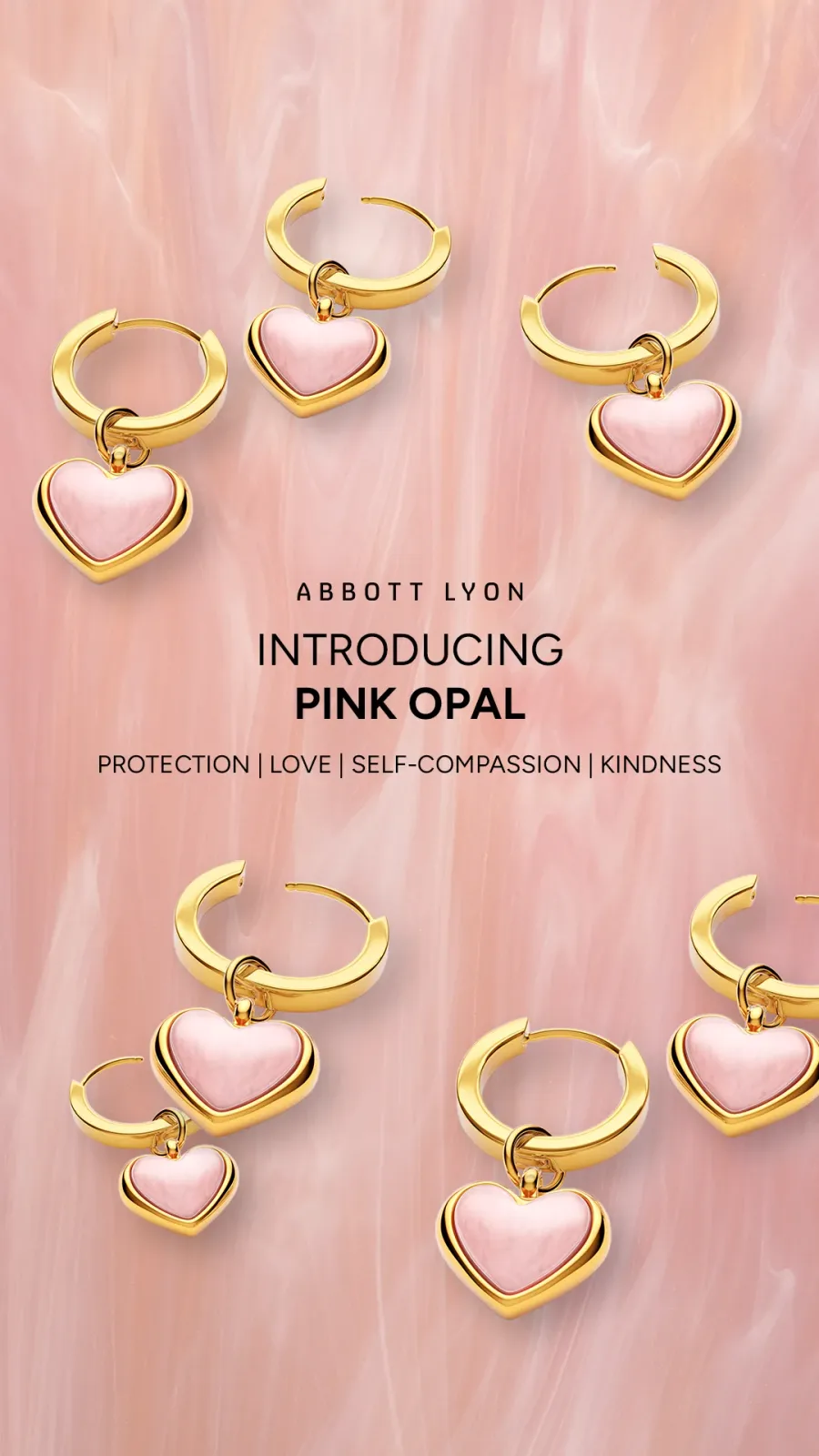
Six gold huggie hoops with pink opal heart charms, scattered top and bottom of a 9:16 frame on pink marble. Centered between them: "ABBOTT LYON," "INTRODUCING PINK OPAL," and "PROTECTION | LOVE | SELF-COMPASSION | KINDNESS." 509 days, checked October 9, 2026, the longest run in this set.
Why it works: Pink marble matches the stone, so the whole frame reads as one color story, and repeating the earring six times does the job of a close-up without blowing a small charm up past its real size. Four words give a gift buyer a reason to pick this stone over another.
Clone it: One product, repeated, on a texture that matches its color. Put the meaning of the stone where the price would go.
2. Jeulia — one enamel ring, close
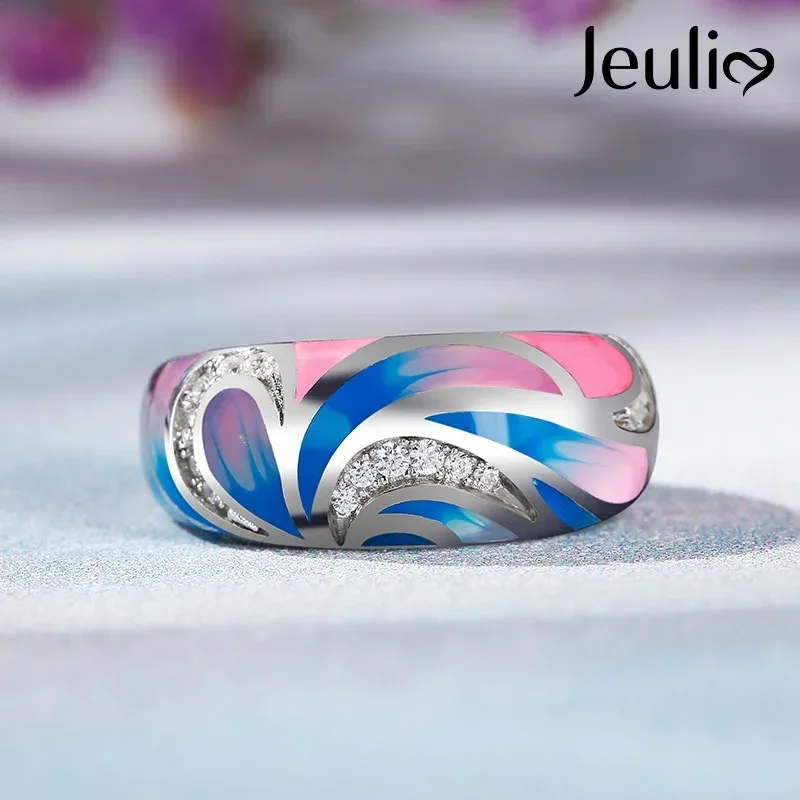
A wide band in pink and blue enamel with lines of pavé stones, shot low and close on a blurred lilac surface. A script logo top right, nothing else. 1:1. No run-length on record.
Why it works: Low camera height and a shallow focus make a ring look like sculpture. Enamel colors carry the frame, so no copy is needed.
Clone it: For a colorful piece, shoot at table level and let the background go soft in the piece's own colors.
On-body crops: neck, wrist, no face
On a body, jewelry gets a scale reference. Ads that last crop the face out so the piece stays the subject.
3. Mejuri — a five-bracelet stack
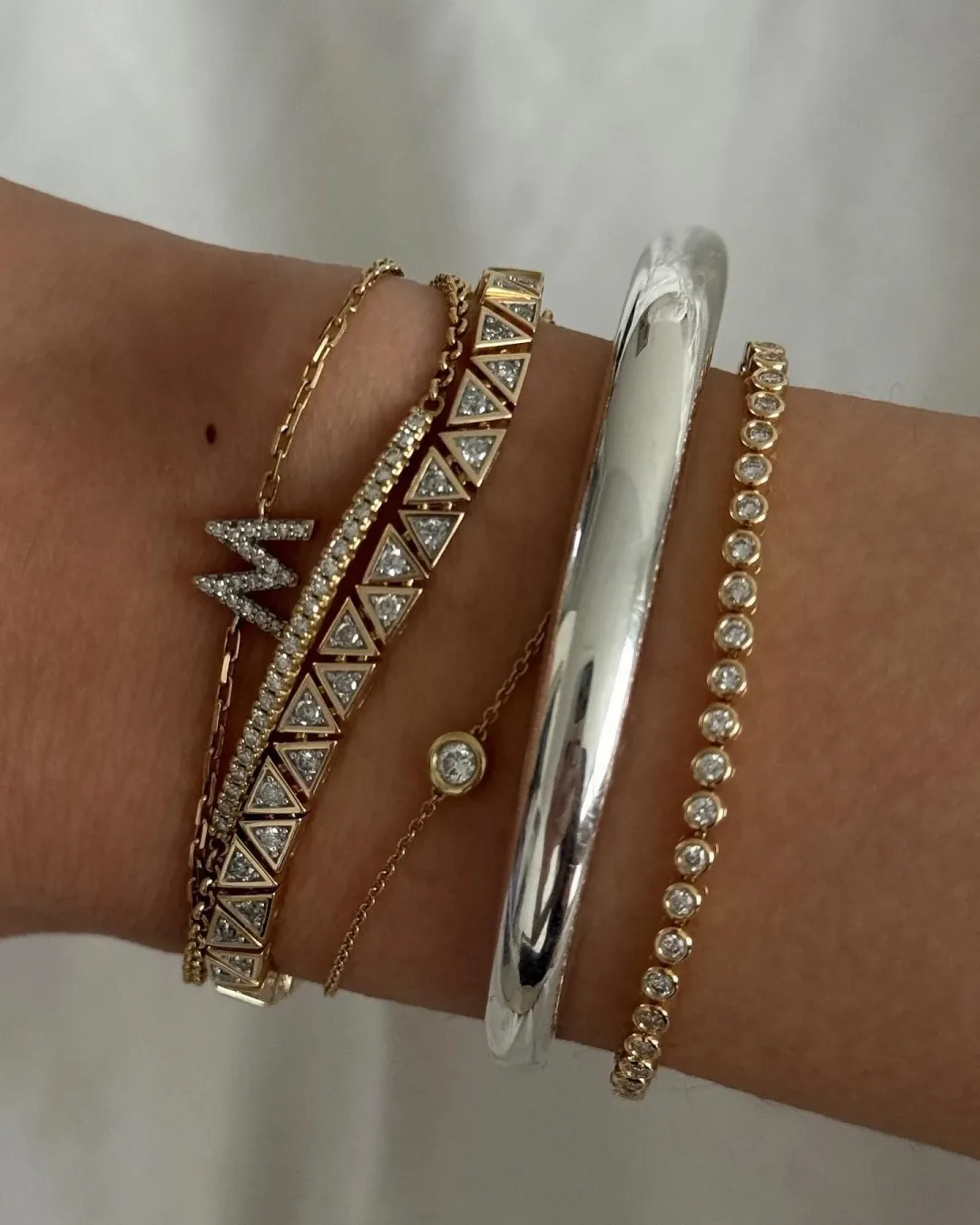
A forearm against a pale wall wearing five bracelets: a fine chain with a pavé initial charm, a gold bangle set with triangles, a chain with one bezel stone, a polished silver bangle, and a bezel tennis bracelet. No text and no wordmark. 4:5. 39 days, checked October 12, 2026.
Why it works: Mixing gold and silver on one wrist sells the stack, several pieces at once, not a single bracelet. With no copy, it looks like a post from a friend.
Clone it: Style three to five of your pieces together and shoot them on one wrist or one ear.
4. Missoma — the chain and the heart
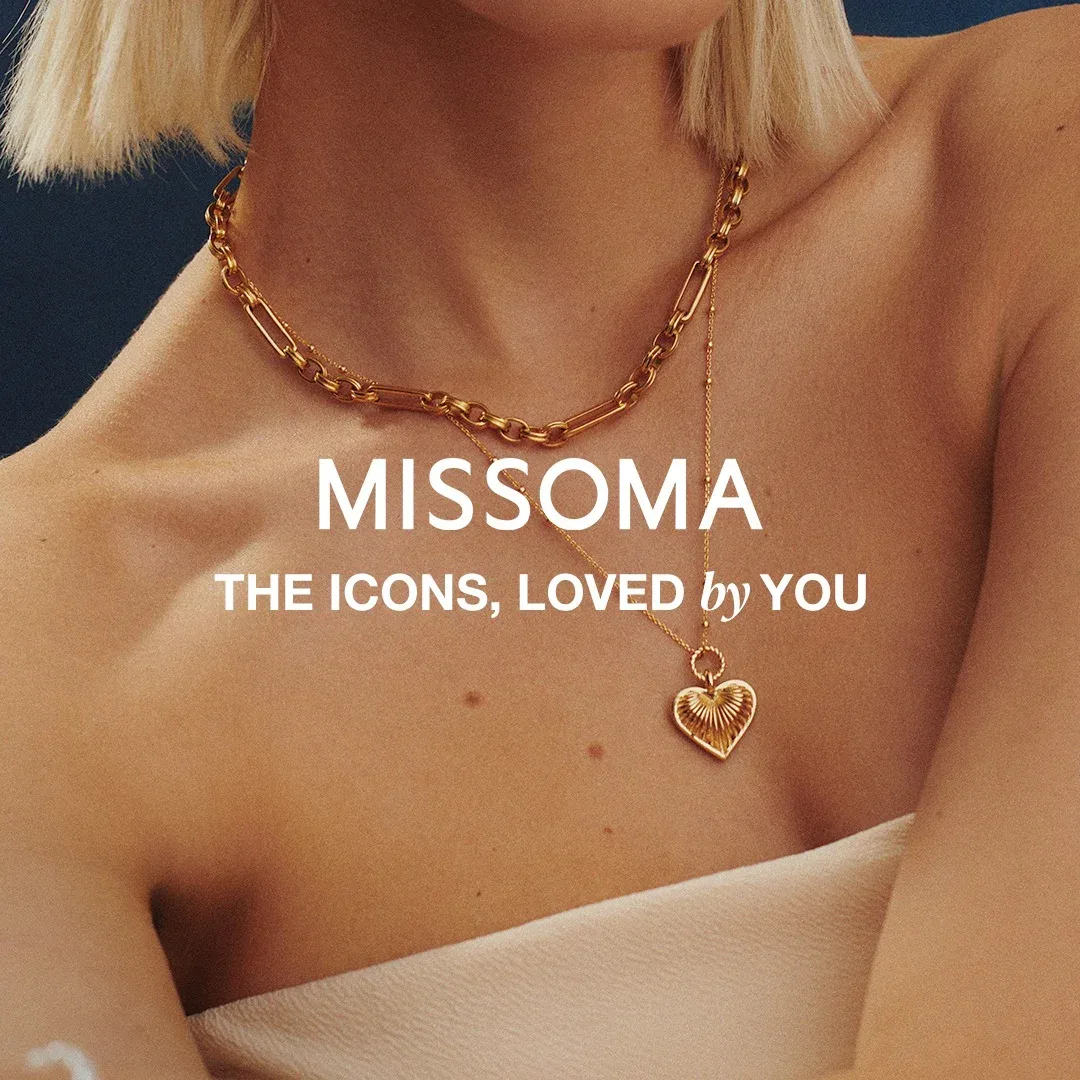
Blonde hair, bare shoulders, and two gold necklaces: a chunky paperclip chain and a long chain with a ridged heart pendant. "MISSOMA" and "THE ICONS, LOVED by YOU" in white over the chest. Square. No run-length on record.
Why it works: "The icons" positions two best-sellers as the default first purchase. "Loved by you" borrows social proof without a single review on the image.
Clone it: Name your two best-sellers as the starting point and crop to collarbone height.
5. ABLE — an engraved bar necklace
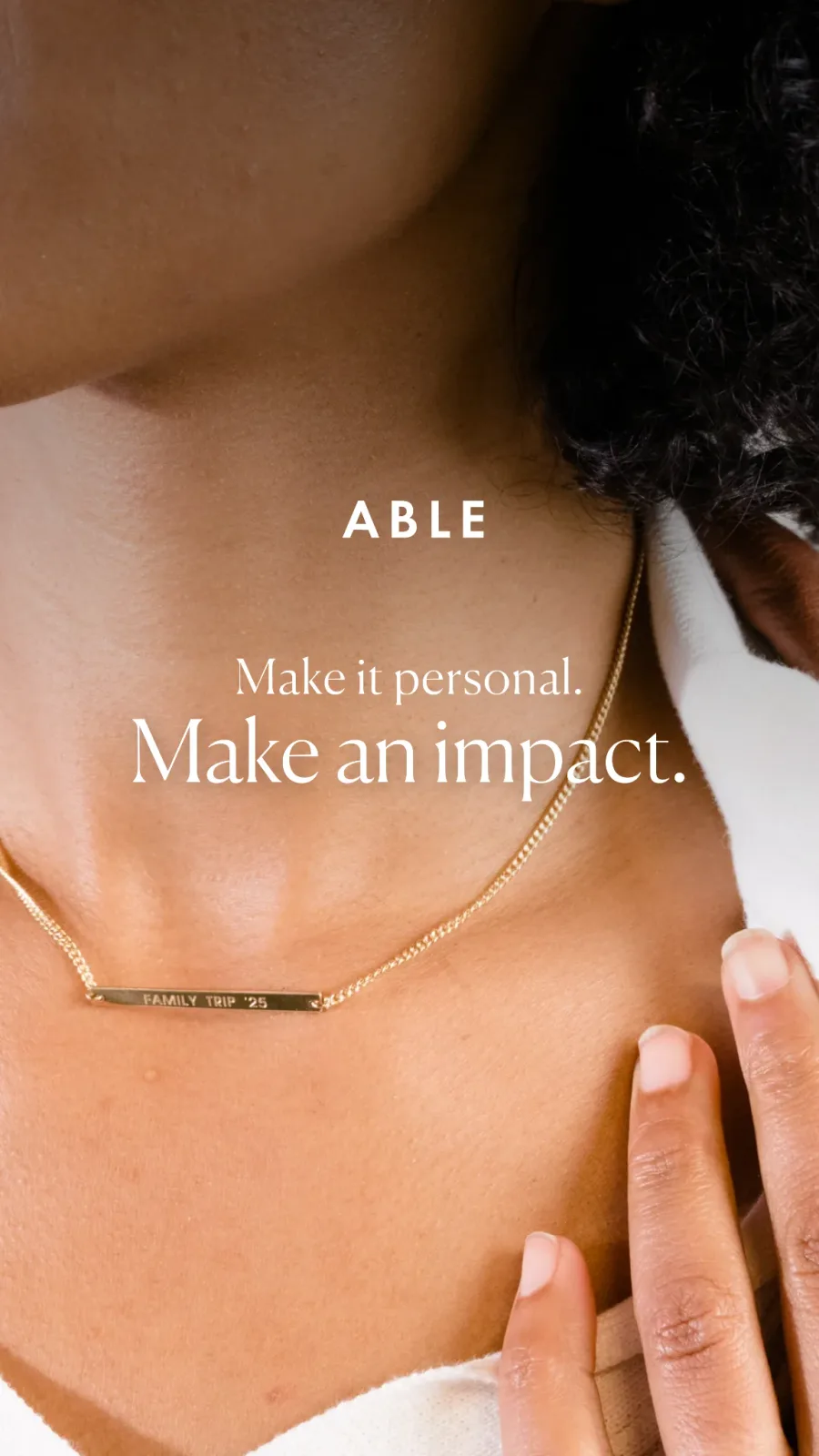
A tight crop of the neck and collarbone, fingertips touching a gold bar engraved "FAMILY TRIP '25." "ABLE" at the top, "Make it personal. / Make an impact." in a light serif. 9:16. 90 to 180 days.
Why it works: A legible engraving shows what personalized means without a word of explanation. Readers fill in their own words.
Clone it: Personalized pieces should show a real-looking engraving at legible size in the photo.
Gift and occasion framing
Gift buyers need a reason and a date. A dated occasion gives the ad a deadline without a discount.
6. Abbott Lyon — something blue, in POV
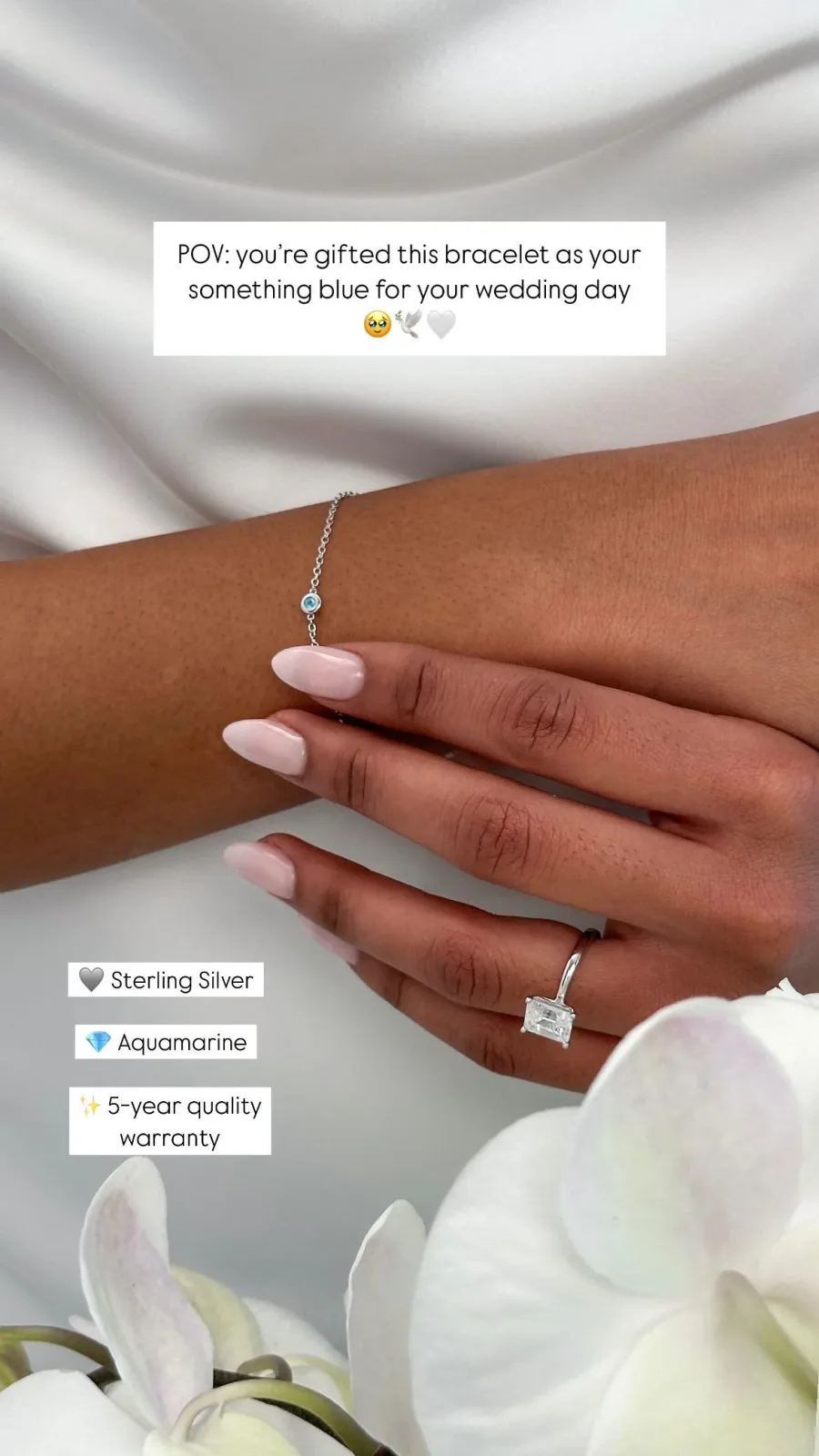
A bride's hand on white satin, a fine sterling silver chain with one aquamarine, an engagement ring, and white orchids. A caption box reads "POV: you're gifted this bracelet as your something blue for your wedding day," and three chips list "Sterling Silver," "Aquamarine," and "5-year quality warranty." 9:16. 90 to 180 days.
Why it works: The POV caption hands the buyer the gift scenario, and the three chips answer the three questions a gift buyer has: what metal, what stone, and will it last. Material named in plain words is also what the FTC Guides ask for.
Clone it: Write the occasion as a POV caption and list metal, stone, and warranty as chips.
Proof it lasts: reviews and durability
Tarnish is the objection every jewelry buyer brings, so the most common claim in this set is that the piece won't tarnish.
7. Atolea Jewelry — a Reddit thread as the ad
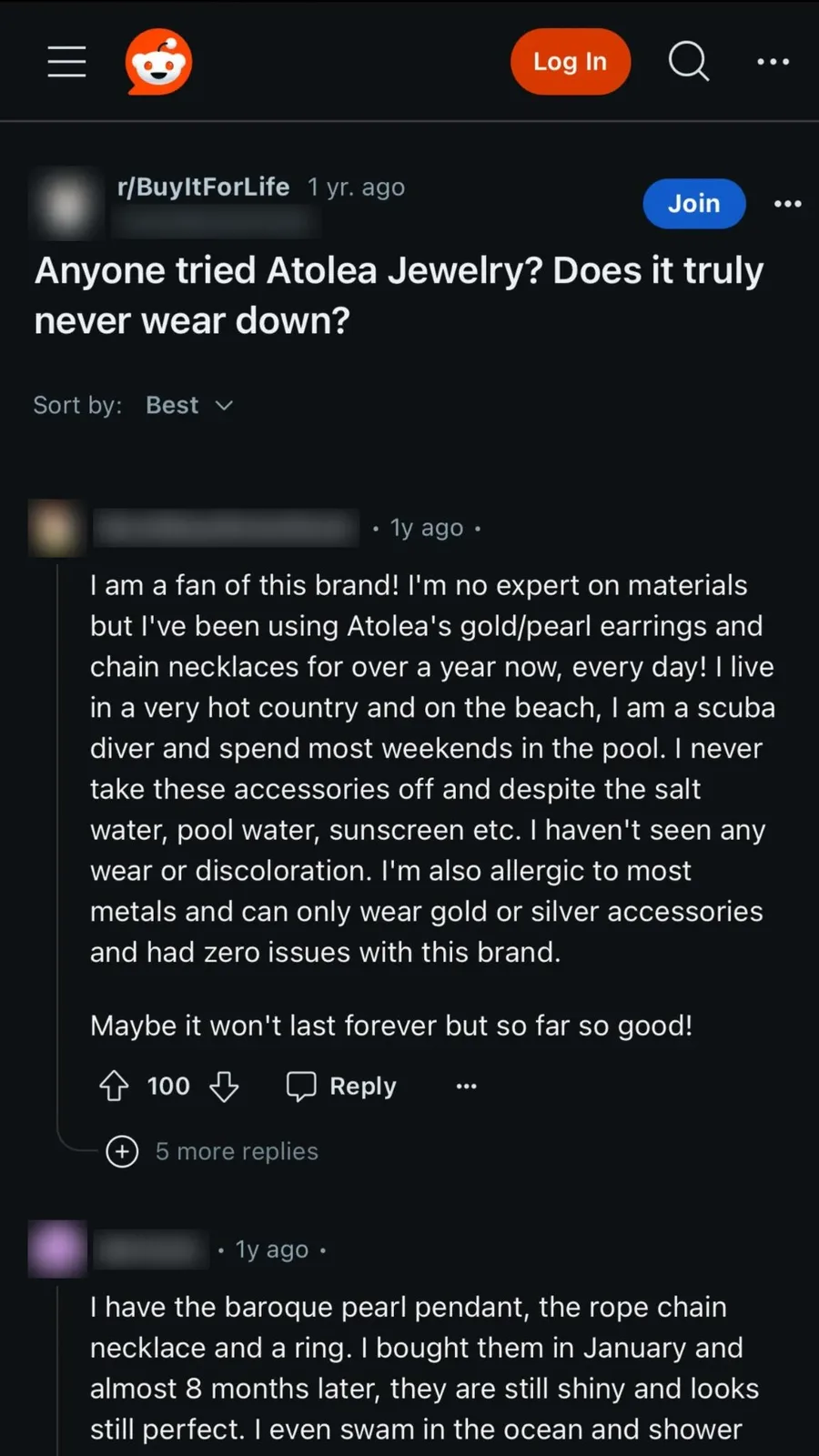
A dark-mode screenshot of an r/BuyItForLife thread titled "Anyone tried Atolea Jewelry? Does it truly never wear down?" The top reply, at 100 upvotes, describes a year of daily wear through salt water, pool water, and sunscreen and ends "Maybe it won't last forever but so far so good!" 9:16. 90 to 180 days. Usernames and avatars blurred by us. In the live ad, they're visible.
Why it works: It states the buyer's doubt in the headline and answers it in a stranger's words, hedge included. That hedge makes it believable.
Clone it: Use a real public post that answers your product's biggest objection, with permission and unedited. More formats are in our testimonial ad examples.
8. Joy Dravecky — one review over the product
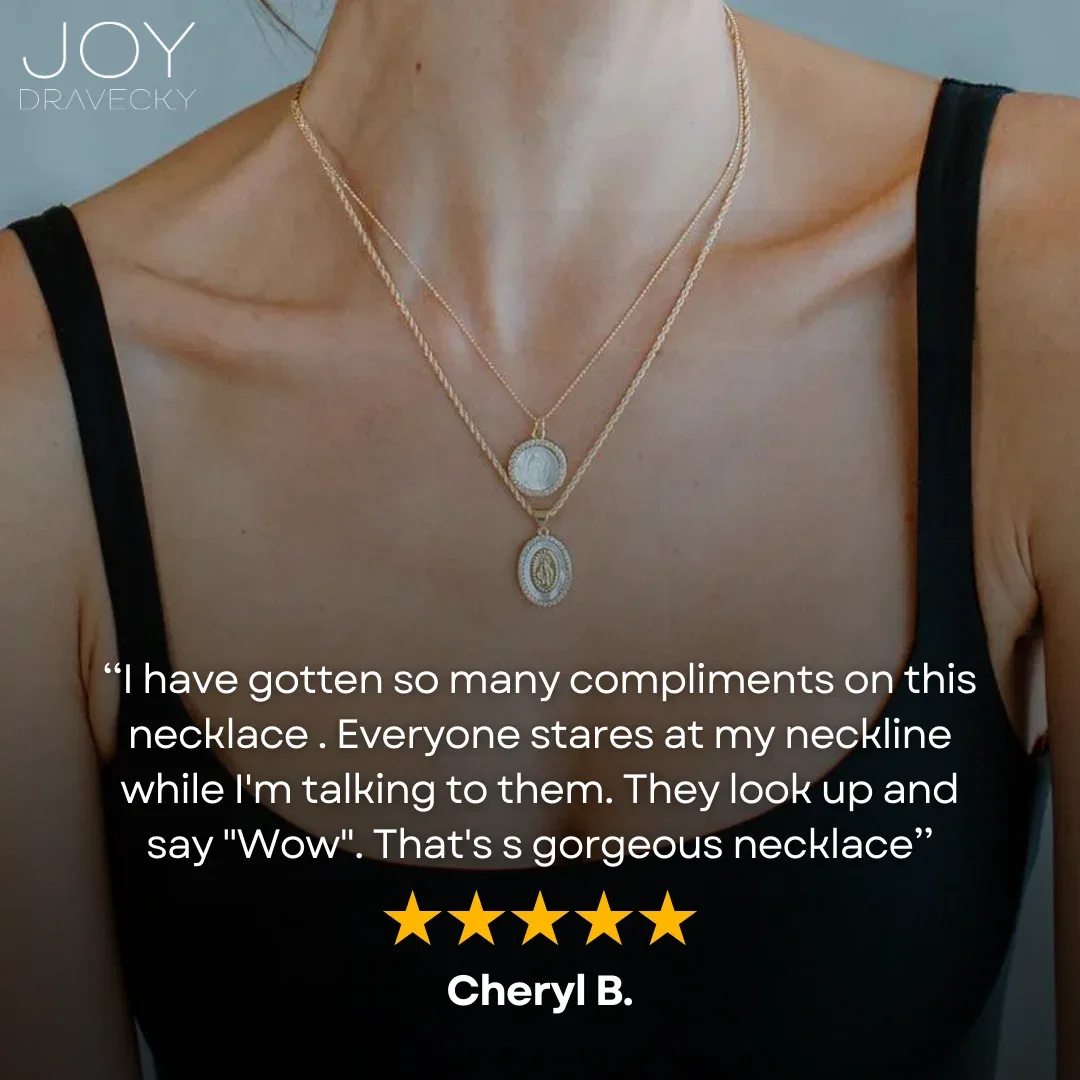
A neck in a black tank top wearing two layered gold necklaces with coin pendants. Over the lower third: "I have gotten so many compliments on this necklace. Everyone stares at my neckline while I'm talking to them…", five gold stars, and "Cheryl B." Square. No run-length on record.
Why it works: Its review is about compliments, the result a buyer wants, not the product. Pendants sit right above the quote, so the eye moves from proof to product.
Clone it: Pick a review about how the piece made someone feel, and lay it directly under the product.
9. Jaxxon — swim, sweat, shower
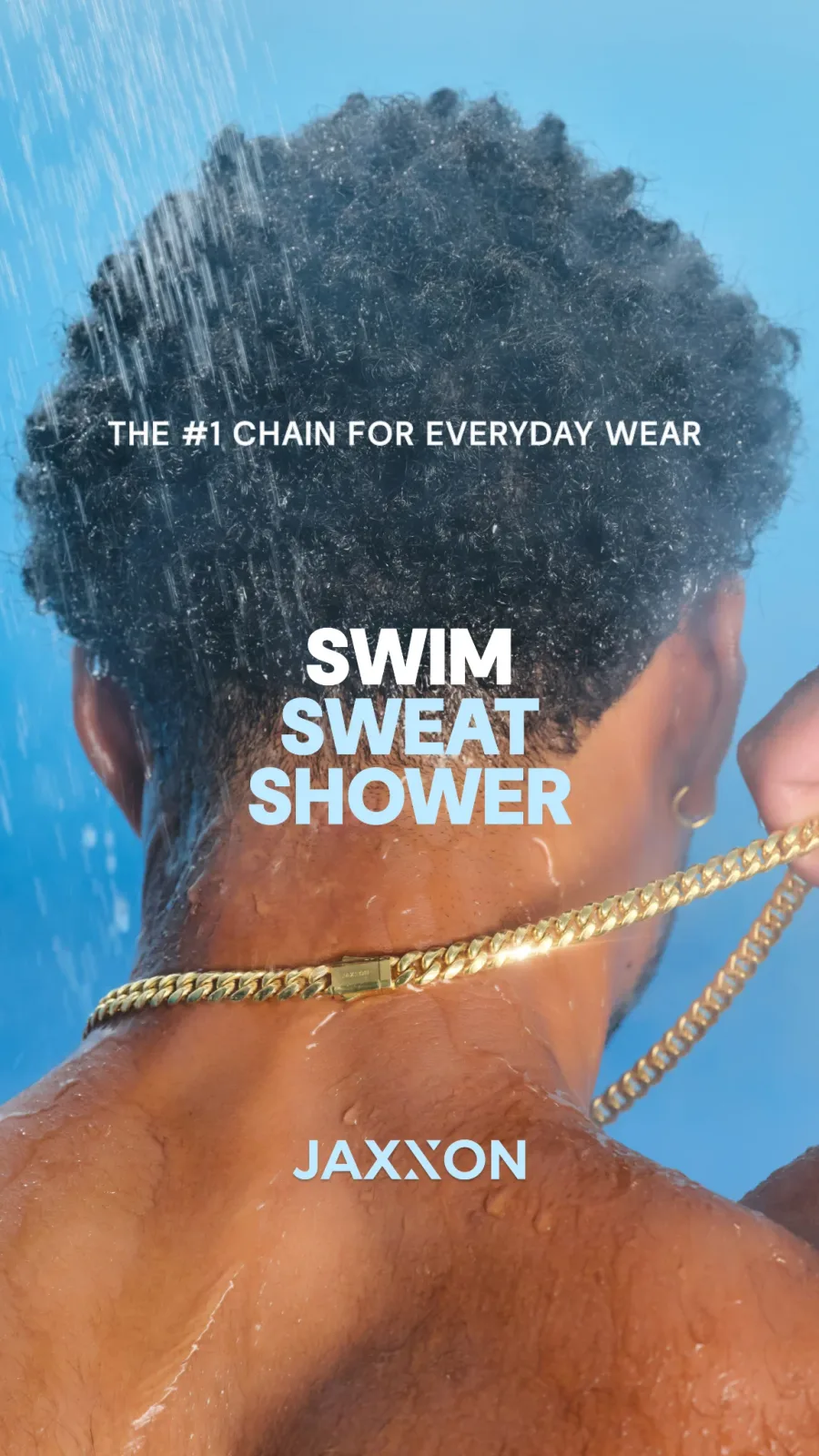
A man from behind under falling water on a blue background, pulling a gold Cuban chain against his neck. "THE #1 CHAIN FOR EVERYDAY WEAR" in small caps, then "SWIM / SWEAT / SHOWER" in heavy type, and "JAXXON" at the bottom. 9:16. 30 to 90 days.
Why it works: It shows the product in water, the exact condition buyers worry about. Three verbs do the work a spec sheet would.
Clone it: Photograph the piece in the situation buyers fear: water, the gym, a shower. Back a "#1" claim with a source, or drop it.
10. Joy Dravecky — tarnish resistant, with the range
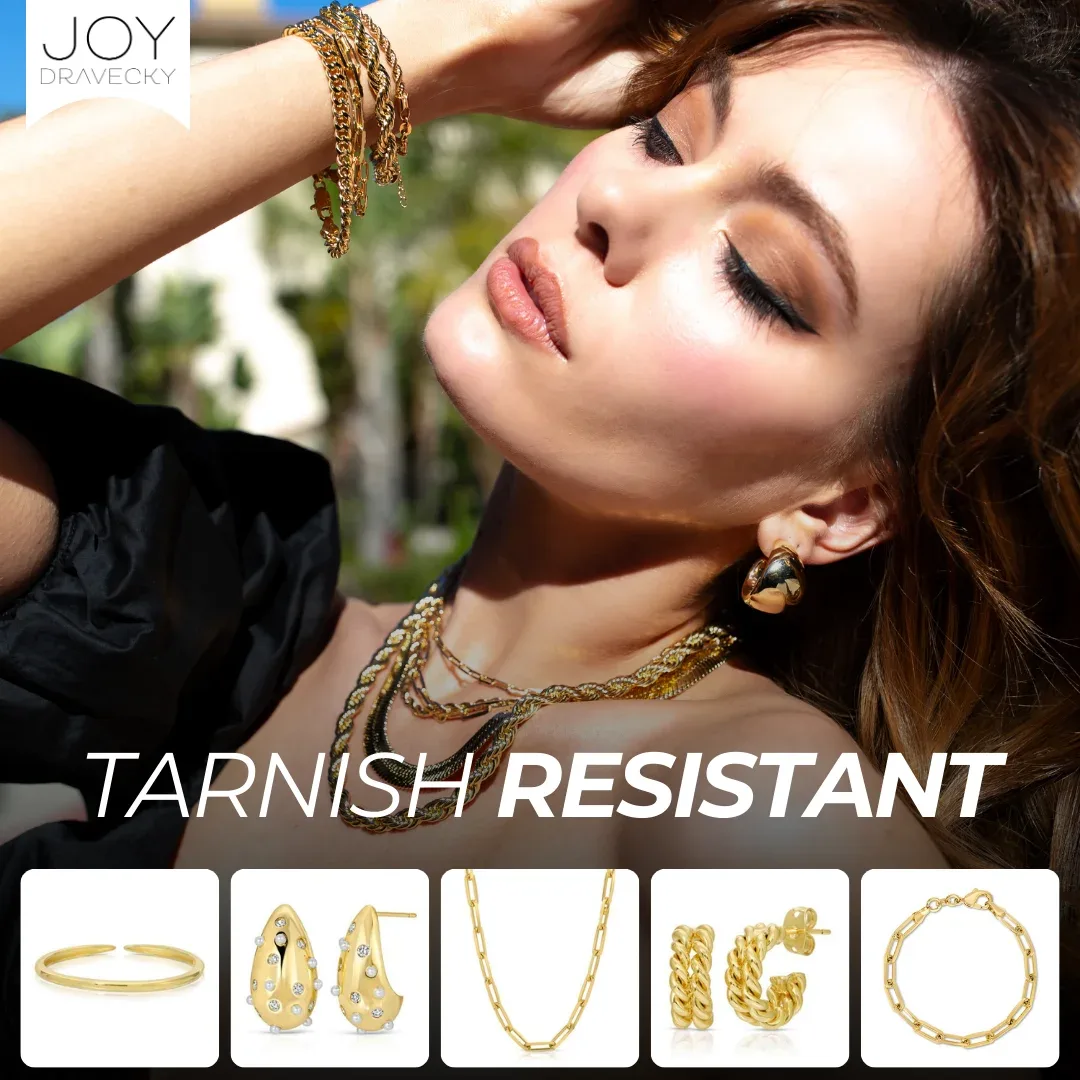
A woman in gold necklaces, earrings, and a bracelet, eyes closed, face to the sun. "TARNISH RESISTANT" across the middle, and a row of five white tiles with a bangle, drop earrings, a chain, chunky hoops, and a chain bracelet. Square. No run-length on record.
Why it works: A lifestyle half sells the look and the tile row turns the ad into a mini catalog. It's also the only full face in the set. "Resistant" is a softer, safer word than "proof," and the FTC distinction is below.
Clone it: Top two-thirds lifestyle, bottom third a row of four or five product tiles on white.

Create your own jewelry product ads
Create your ad
Price and offer jewelry ads
Two ads in the set lead with money. Neither shows the product prominently.
11. Atolea Jewelry — text only, no product
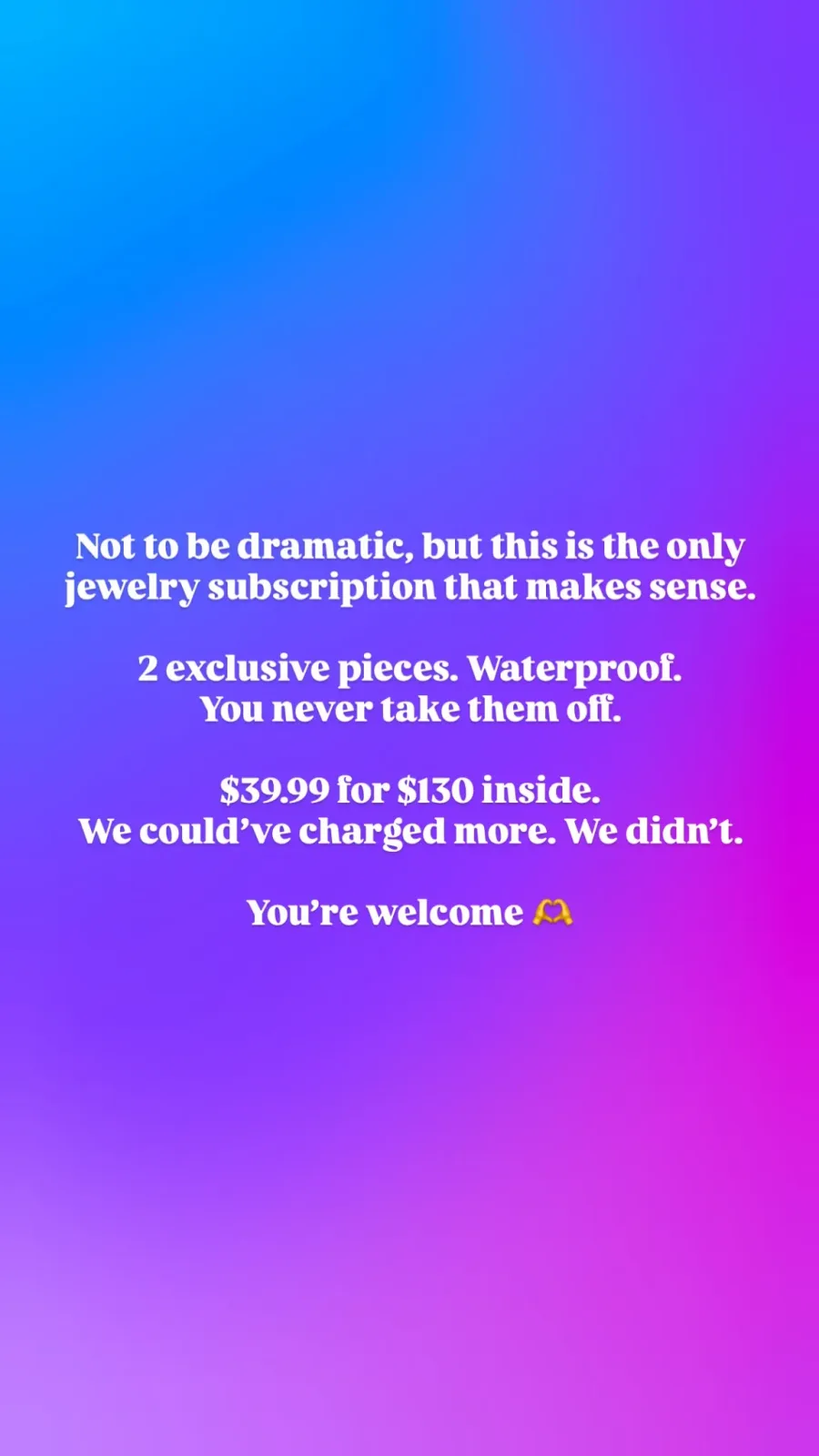
White text on a blue-to-magenta gradient: "Not to be dramatic, but this is the only jewelry subscription that makes sense. 2 exclusive pieces. Waterproof. You never take them off. $39.99 for $130 inside. We could've charged more. We didn't. You're welcome." No product, no wordmark. 9:16. 107 days, checked October 9, 2026.
Why it works: In a feed full of gold on marble, a gradient with a voice stops the scroll. "$39.99 for $130 inside" is a value anchor, not a discount, so it doesn't expire.
Clone it: Write the offer like a text message and anchor it to the retail value. Test it against your best product shot.
12. Moedermelk Sieraden — a weekend flash sale
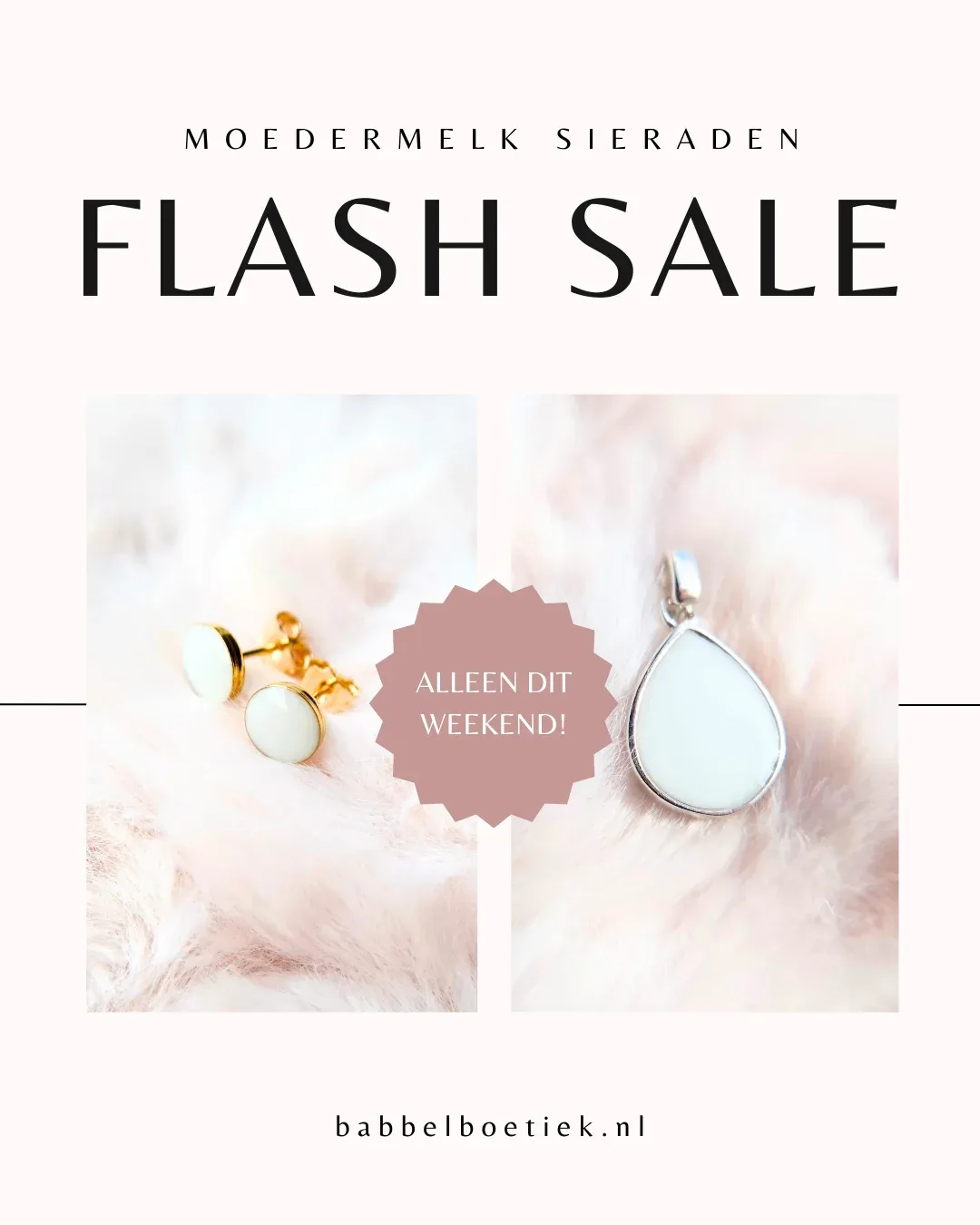
A Dutch brand whose name means "breast-milk jewelry." "FLASH SALE" in a thin wide serif over two photos, milky white stud earrings and a teardrop pendant on pink fur, split by a scalloped badge reading "ALLEEN DIT WEEKEND!" ("only this weekend"). A store URL sits at the bottom. 4:5. 189 days.
Why it works: No percentage means nothing goes stale. A weekend-only badge on an ad that ran 189 days means one of two things: the advertiser switches the creative on for each weekend sale, or the deadline isn't real. Only the first is safe to copy.
Clone it: Keep the sale ad generic enough to rerun (a deadline badge, no number, two product photos), and only run it while the deadline is true.
What these jewelry ads have in common
Four patterns hold across the 12, and each one runs against how most jewelry ads get made.
Product size beats production value. The longest dated run in the set, Abbott Lyon's opal hearts (509 days), is a flat studio shot on a marble texture with no model. Jeulia's enamel ring and Moedermelk Sieraden's two sale photos (189 days, dated) work the same way: no model, and a piece that fills most of the frame.
Crop the face, keep the scale. Seven ads put jewelry on a body and six of those crop the face out. A neck, a wrist, or the back of a head tells the viewer the size without competing with the piece.
Answer "will it tarnish?" before "how much?" Five of 12 make a durability claim and only two show a price. Atolea's Reddit ad and Jaxxon's shower shot turn that claim into evidence.
Name the material in plain words. Abbott Lyon's chips ("Sterling Silver," "Aquamarine") and opal headline are the only ads that name what the piece is made of. That's also where FTC trouble starts, so it's worth getting right.
How to photograph jewelry for ads
Most jewelry ad problems start at the shoot: smeared reflections, half the ring out of focus, and a stone that looks bigger than it is.
- Control what the metal reflects. Polished, curved metal mirrors the room, the camera, and you. Ben Tuxworth's macro jewelry guide for Adaptalux, a company that sells macro lighting kits, notes that reflections "will capture the surrounding area and display it in the image," and that diffusers show up in the reflections too. His fix: a curved sheet of white paper over the piece to make one long, soft highlight.
- Kill stray light. Tuxworth also advises cutting ambient lights "wherever possible," because each one becomes a hot spot on the metal.
- Stop down, then focus-stack. More magnification means less depth of field, so a ring's front prong is sharp and its back is soft. Stopping down helps a little. Tuxworth's conclusion is that focus stacking, blending several frames focused at different depths, is the only way to remove the soft focus fully.
- Show true size somewhere. The FTC's Jewelry Guides say a depiction of a diamond or gemstone "in greater than its actual size may mislead consumers, unless a disclosure is made about the item's true size." A macro hero is fine, but pair it with an on-body shot or state the dimensions.
- Shoot for the placement. Make a 4:5 for feeds and a 9:16 for Stories and Reels, and keep the piece out of the bottom 35% of the 9:16, where Meta's caption and button sit. Every size is in our Meta ad sizes guide.
What jewelry ads can say: the FTC Jewelry Guides
Jewelry advertising has its own FTC guides, and they cover your ad copy as well as your hallmarks.
Published as 16 CFR Part 23, the FTC Guides for the Jewelry, Precious Metals, and Pewter Industries apply to claims "in labeling, advertising, promotional materials, and all other forms of marketing," including "illustrations" and "depictions" (§ 23.0). They describe the FTC's current thinking, not a statute. Words they cover show up in jewelry ads every day:
| Word in the ad | What the Guides say | Section |
|---|---|---|
| "Gold" (unqualified) | Only for 24-karat gold throughout. Alloys need a karat mark, such as 14K | § 23.3 |
| "Gold electroplate," "gold plated" | At least 10-karat gold, with the karat named first, such as "12K gold electroplate." Electroplate needs at least 0.175 microns of fine gold. Mechanically applied gold plate needs at least 1/40th of the article's metal weight | § 23.3 |
| "Gold filled" | Gold alloy of at least 10 karat making up at least 1/20th of the metal's weight, with the karat named first | § 23.3 |
| "Vermeil" | Sterling silver base, gold of at least 10 karat, at least 2.5 microns thick | § 23.4 |
| "Sterling silver" | At least 925/1,000 pure silver | § 23.5 |
| "Rust proof," "corrosion proof" | Every part must stay free of corrosion for the product's life. "Resistant" needs the major portion of its life | § 23.11 |
| "Diamond" for a lab-made stone | Needs "laboratory-grown," "laboratory-created," or "[manufacturer]-created," clearly and conspicuously | § 23.12 |
| "Ruby," "sapphire," "gem" for a lab-made stone | Must be preceded, equally conspicuous, by "laboratory-grown" (or similar), "imitation," or "simulated." "Faux" isn't enough | § 23.25 |
| "Real," "genuine," "natural" | Not for anything manufactured or produced artificially | § 23.27 |
| "Pearl" for a cultured or imitation pearl | Must be preceded by "cultured" or by "imitation," "artificial," or "simulated" | § 23.20 |
Durability claims fall under the general rule too. Section 23.1 calls it deceptive to misrepresent a product's "durability" or "serviceability," and says any qualifier must sit close to the claim in readable type. "Waterproof," "never tarnishes," and "lifetime color" are claims you should be able to back with testing and a warranty, which is what Abbott Lyon's "5-year quality warranty" chip does. Atolea's other ads in the library pair "waterproof" with a "Lifetime Color Warranty" for the same reason. Not legal advice: for a specific claim, read the section and talk to counsel.
Make your own jewelry ads from proven layouts
All 12 jewelry ads above are layouts, and layouts transfer. AdDogs rebuilds an ad from the jewelry ad examples library around your own product photo with the static ad generator, one credit per ad in the aspect ratio you pick. Basic ($12/mo, 30 credits) covers 1:1, 9:16, and 16:9. Pro and Ultimate include all 14 ratios, 4:5 among them. Shoot the piece once, then test the macro hero, the on-body crop, and the review layout against each other. For more product-first layouts, see Instagram static product ad examples.
FAQ
How do you advertise jewelry on Instagram and Facebook?
Start with three layouts from the patterns above: a product-filled macro shot, an on-body crop without the face, and a review or durability proof. Export each at 4:5 for feeds and 9:16 for Stories and Reels, and let them run long enough to compare. Four of the 12 ads in this post have dated run-lengths and four more have a duration band; the longest dated run is 509 days.
What makes a good jewelry ad?
A good one fills most of the frame with the piece, uses a body for scale, and the copy answers whether it will tarnish or break. In this set, five of 12 ads made a durability claim and only two showed a price.
What size should jewelry ads be?
For Meta, 4:5 at 1440 x 1800 px for Facebook and Instagram feeds and 9:16 at 1440 x 2560 px for Stories and Reels, per Meta's Ads Guide. Six of the 12 ads here are 9:16. Our Meta ad sizes guide lists every placement.
Can lab-grown diamonds be called "diamonds" in ads?
Only with a clear qualifier. FTC Jewelry Guides say a lab-made stone can be called a diamond if the word is clearly and conspicuously qualified with "laboratory-grown," "laboratory-created," "[manufacturer]-created," or similar (§ 23.12). And "faux" isn't an adequate disclosure for lab-created stones (§ 23.25).
Can gold-plated jewelry be called "gold" in ads?
Not unqualified. "Gold" alone means 24-karat gold throughout. Plated pieces need at least 10-karat gold with the karat named first, such as "14K gold plated," and electroplate needs a layer of at least 0.175 microns of fine gold (§ 23.3).
Should jewelry ads show a model's face?
Rarely, based on this set. Only one of 12 shows a full face, and six of the seven on-body ads crop to the neck, wrist, or ear so the piece stays the subject. Use a face when the ad sells a look across several pieces, as Joy Dravecky's tarnish-resistant grid does.