40+ luxury ad examples and what makes them look expensive


Boll & Branch has been running the same Facebook ad for 1,794 days. A made bed, sage and walnut, ten words in a serif: "Build your fall dream bed one layer at a time." No price. No button. Four years and eleven months later it is still spending. That restraint is the whole grammar of luxury ads, from Chanel's $33M N°5 film to the luxury advertising that runs for a year on Meta, and it is a composition system rather than a budget. Below: 14 luxury commercials with receipts, 28 real luxury brand ads with their run-lengths, the evidence behind the codes, and how a $60 product borrows them for $0.40. Or jump to the 28 statics.
What makes luxury ads different
Luxury ads sell the standing of the brand rather than the merits of the product. It withholds the things a mass-market ad leads with, such as price, offer, call to action, and benefit copy, and replaces them with craft, heritage, negative space, and a single object or person given room to breathe. The viewer is meant to want in.
That definition is not a stylistic preference. In The Luxury Strategy, Jean-Noël Kapferer and Vincent Bastien wrote it into their 24 anti-laws of marketing: "the role of advertising is not to sell" (anti-law 9), "do not sell" (15), "keep stars out of your advertising" (16), and "do not test" (20). The canon below breaks 16 constantly, which says something about how much celebrity is worth to a fragrance. It obeys the rest almost without exception.
| Cue | Mass-market ad | Luxury ad |
|---|---|---|
| Price | In the frame, often the headline | Absent (27 of the 28 statics below) |
| Call to action | Button plus urgency | None, or a tone-on-tone button (27 of 28) |
| Copy | 15–40 words of benefits | 0–8 words, or only a wordmark (20 of 28) |
| Logo | Large, top-left | Small, late, or implied by the product |
| Palette | Saturated, high contrast | Tonal, two hues plus one accent (22 of 28) |
| Products in frame | Several cutouts | One object, or one series |
| Proof | Reviews, badges, before and after | Material close-ups, heritage, a press quote at most |
| Pacing (video) | Fast cuts, voiceover | Long takes, near silence, logo last |
The counts in the table come from the 28 Meta and Instagram ads analyzed later in this post. The evidence that the codes do something to a viewer comes from three independent studies.
| Claim | Figure | Source | Independent? |
|---|---|---|---|
| Empty space and a luxurious typeface raise perceived luxury and product quality with only a logo on the pack | n=1,193, 2×2×2 experiment | Iseki, Mase & Kitagami, Journal of Sensory Studies 2025 | Peer-reviewed |
| Logo visibility is the least important purchase driver for luxury consumers | n=10,000+ | BCG–Altagamma True-Luxury 2026 | Consultancy study, independent of any brand |
| Wealthy buyers with low need for status pay a premium for quiet goods only insiders recognize | Field experiments plus market data | Han, Nunes & Drèze, Journal of Marketing 2010 | Peer-reviewed, 1,600+ citations |
Read together: the cheapest luxury signal is empty canvas around the product, and the buyers worth having prefer it to a bigger logo. The emotional triggers luxury ads lean on, status and belonging, work harder when the ad refuses to ask for anything.
The state of luxury advertising in 2026, in numbers
Luxury is advertising into a shrinking room. The personal luxury goods market came in at €358B in 2025, down 2% at current exchange rates, and the customer base fell from about 400M people in 2022 to 340M in 2025 (Bain & Company and Altagamma). Sixty million buyers left in three years. More than 70% of them say they intend to come back (Bain, June 2026).
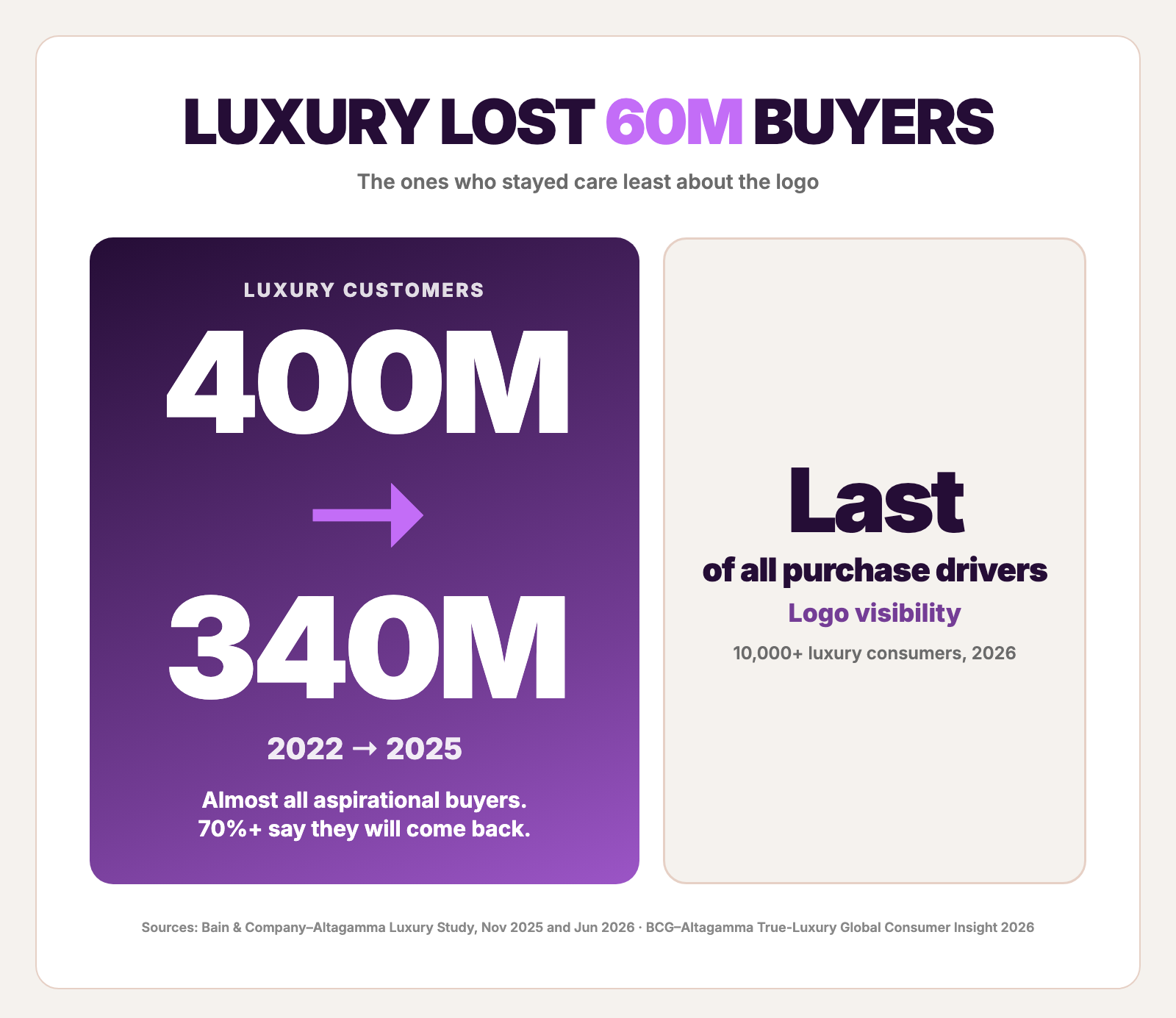
The buyers who stayed are the top of the pyramid. Top-tier clients grew from 14% to 24% of luxury spend in a decade, 70% of consumers walked away from a purchase over pricing they could not justify, and, asked what drives a purchase, they ranked logo visibility last (BCG–Altagamma 2026, n=10,000+).
The money behind the ads is enormous and oddly split. LVMH spent more than €9.2B on advertising and promotion in 2025, about 11.4% of its €80.8B revenue (Statista, from the annual report); its full marketing-and-selling line, which also pays for the stores, was €29.9B. Hermès posted a 41% operating margin on €16B of revenue (FY2025 results) and, per its artistic director, "doesn't have a marketing department"; a Birkin requires "a proven purchase history of other Hermès items" (Fortune). LVMH buys attention. Hermès rations it, at a 41% margin.
Discovery has moved to social even where trust has not. In a TikTok-commissioned study of 3,000+ luxury consumers, 38% discover luxury through user content and two-thirds of first-time buyers cite social as their entry point (TikTok, platform-funded). Luxury brands post on Instagram to 0.2% engagement against 2.2% on TikTok, per Dash Social's 2026 benchmarks across 3,363 Instagram accounts (vendor data). And BCG's luxury consumers trust influencers at roughly half the level they trust an AI assistant, with brand websites the most trusted source of all. The counter-signal is Bottega Veneta, which deleted its social accounts in 2021, sat sixth on the Lyst Index by late 2024, and grew 19% in North America in Q1 2025 while its parent Kering fell 14% (FashionUnited).
What that means for a brand nobody has heard of: the departed 60 million are your audience, they discover on social, they distrust influencers, and they do not care about logos. Owned creative that looks like a house campaign is the format the evidence points at.
The luxury commercials everyone studies
Fourteen films, 1996 to 2023, every video ID verified against YouTube on September 18, 2026 (method at the end). Eleven are clean successes, one is contested, and two are the failures the category learns from. Where the brand deleted its own upload, the embed is an archive copy and says so.
| # | Brand and campaign | Year | What the film does | Luxury code | Strongest number | Verdict |
|---|---|---|---|---|---|---|
| 1 | Chanel N°5 "The Film" (Nicole Kidman, dir. Baz Luhrmann) | 2004 | A star escapes fame into one stranger's cab | Cinema scale, product last | £18M / $33M, Guinness most expensive TV ad | Success |
| 2 | Dior J'adore (Charlize Theron, dir. Jean-Jacques Annaud) | 2011 | Theron walks Versailles past CGI icons | Heritage by association | Theron has fronted J'adore since 2004 | Success |
| 3 | Louis Vuitton "L'Invitation au Voyage" | 2012 | A trunk in the Louvre, a balloon over Paris | Heritage, travel as myth | LV's first-ever TV ad | Success |
| 4 | Cartier "L'Odyssée de Cartier" | 2012 | The panther crosses the world in 3:31 | Brand animal as protagonist | €4M budget (press-reported) | Success |
| 5 | Burberry "Open Spaces" | 2021 | Four figures fly over British fields | Craft VFX, zero copy | Two Gold Lions, Film Craft, Cannes 2022 | Success |
| 6 | Tiffany & Co. "About Love" (Beyoncé, Jay-Z) | 2021 | "Moon River" in the 128-carat Tiffany Diamond | Celebrity couple, heirloom | 17.2M views; art-world backlash | Contested |
| 7 | Patek Philippe "Generations" | 1996–ongoing | Father and son, one sentence | Heritage as inheritance | Running 25+ years on one line | Success |
| 8 | Rolls-Royce "Spectre" reveal | 2022 | Slow tracking shots, near silence | Silence, scarcity, no price | Record 6,032 cars sold in 2023 | Success |
| 9 | Porsche "The Heist" (Super Bowl LIV) | 2020 | A Taycan is "stolen" from the Porsche Museum | Heritage fleet as cast | 17.7M YouTube views vs 5.3M benchmark | Success |
| 10 | Dior Sauvage (Johnny Depp) | 2015 | Depp buries his jewelry in the desert | Lone celebrity, landscape | $20M+ re-signing in 2022 | Success |
| 11 | Bleu de Chanel (Timothée Chalamet, dir. Martin Scorsese) | 2023 | Chalamet slips the press and drives off | Auteur director, escape trope | 7.9M views on the 30-second cut | Success |
| 12 | Jacquemus "Le Bambino" bags on wheels | 2023 | CGI bags drive through Paris | Surrealism, social-first | Searches +900% in a day | Success |
| 13 | Dolce & Gabbana "Eating with Chopsticks" | 2018 | A Chinese model struggles with pizza | Condescension | Show canceled; up to 20% off a $937M brand value | Failure |
| 14 | Dior Sauvage "We Are the Land" | 2019 | Depp plays guitar beside Native regalia | Borrowed heritage | Pulled within hours | Failure |
Six of them below, chosen for what a still can borrow.
Chanel N°5, 2004. Baz Luhrmann, Nicole Kidman, a sanitized New York, and the bottle only at the end. Guinness lists it as the most expensive TV commercial ever made at £18M, about $33M. Twenty-two years later it is still the template for "perfume ad as short film": the product appears in the final seconds, after the brand has done its work.
Patek Philippe "Generations," 1996 onward. A father, a son, a quiet moment, and one line that has not changed in three decades: "You never actually own a Patek Philippe. You merely look after it for the next generation." Patek's own site says the campaign has run over 25 years. It is the longest-running entry here and the only one whose copy does the heavy lifting, which is the exception that proves how little copy the rest use.
Cartier "L'Odyssée de Cartier," 2012. Bruno Aveillan sends the Cartier panther out of a boutique window and across Russia, China, and India before it returns to Paris, three and a half minutes with no dialogue. French trade press put the budget at €4M, a figure Cartier never confirmed. The brand's animal is the protagonist and the jewelry is scenery. Cartier's own upload is gone; this is an archive copy.
Porsche "The Heist," 2020. Porsche's first Super Bowl spot since 1997: a museum guard "steals" the new Taycan and the staff give chase in a dozen classic Porsches. Agency Cramer-Krasselt reported 17.7M YouTube views against a 5.3M benchmark and Porsche called it its most successful integrated campaign to date. It is the fast-cut exception in a slow canon and the template for luxury car ads that want to move, and the only entry whose commercial effect the brand itself documented (Shorty Awards entry). Archive upload; Porsche's original now returns a 404.
Bleu de Chanel, 2023. Martin Scorsese directs Timothée Chalamet slipping the press in a New York hotel and driving off alone. The 30-second cut on Chanel's channel sits at 7.9M views. It is the Kidman film's plot, 19 years on, with a younger star and a male fragrance, which tells you Chanel considers the "escape from fame" trope a house asset rather than a one-off idea.
Jacquemus, 2023. Bus-sized Le Bambino bags drive past the Paris Opéra in a CGI clip by Ian Padgham that most viewers took for real (Hypebeast). Searches for "Jacquemus ad campaign" rose 900% in a day and the TikTok drew 1.7M likes (CG Labs, secondhand counts; the 46M-view figure often attached to this clip belongs to Maybelline's mascara train). The native version is a vertical Reel, so watch it on Jacquemus's TikTok. It cost a studio fee, which is the modern half of the canon: surprise bought what Chanel bought with $33M.
The two failures share one mistake. Dolce & Gabbana's 2018 Shanghai spots had a Chinese model struggling to eat pizza with chopsticks over a mock-Mandarin voiceover; the show was canceled hours before curtain, Tmall and JD.com delisted the brand, and Brand Finance estimated up to 20% wiped from a $937M brand value (Fortune, Forbes). A year later Dior staged Johnny Depp beside a Rosebud Sioux dancer for a fragrance called "Sauvage" and pulled the film within hours (CNBC). Neither failed on craft, casting, or budget. Both borrowed someone else's heritage as a set, and luxury's whole claim is that the heritage is its own.
| Pattern across the 14 | Films that show it | Exceptions |
|---|---|---|
| Slow pacing, long takes, near silence | Chanel N°5, LV, Cartier, Burberry, Patek, Rolls-Royce, Bleu | Porsche is fast-cut; Jacquemus is 24 seconds |
| Copy volume near zero; the logo arrives last | 9 of 14 | Patek, where one sentence carries the campaign |
| The product is embodied by a person, animal, or place rather than shown | Chanel, Dior, LV, Cartier, Patek, Sauvage, Bleu | Rolls-Royce, Porsche, Jacquemus keep the product on screen |
| Heritage staged as a set | Versailles, the Louvre, the Porsche Museum, a 150-year-old trunk | D&G and Dior 2019 borrowed heritage they did not own |
| One human face, usually alone, usually escaping | Chanel, Dior, Tiffany, Patek, Sauvage, Bleu | Cartier (a panther), Rolls-Royce, Jacquemus have no human lead |
| Modern hits trade production scale for surprise | Jacquemus vs Chanel's $33M | Porsche splits it: real cars, playful tone |
The budgets do not transfer to a still. The codes do, and the static versus video question for a small brand is mostly settled by cost.
Luxury ads on Meta: 28 statics that ran for months
Every ad below is a real Meta or Instagram ad from the AdDogs library, with its run-length. "Days" is the number of days the ad had been live when Foreplay, the ad-tracking service the library sources from, last checked it; for these 28 the checks fall between April 7 and August 31, 2026, so several have run longer since. It is the only performance number we hold, and it is a blunt one: it proves the advertiser kept paying, not what the ad returned. It is still more than any luxury advertising roundup shows. Twenty-four of the 28 ran at least 180 days and 12 ran more than a year. To verify one, search the brand in the Meta Ad Library with the "active" filter (for example, Rimowa's live ads) and read the "Started running on" date; the Meta Ad Library guide walks through it. The same restraint shows up in Facebook static ads that run for months across every category.
One admission up front. The library carries no Gucci, Dior, Chanel, or Louis Vuitton statics; the heritage houses' Meta ads rarely surface in Foreplay. What it carries is the accessible end of luxury, the brands that borrowed the codes and pay for performance: Rimowa, Reiss, Mejuri, Boll & Branch, Aesop, Cuyana, and one Christian Louboutin. That is the more useful set for a brand with a $60 product, because these advertisers had to make luxury codes convert.
Negative space and one object. The simplest luxury move is to put one thing in the frame and leave the rest empty.
1. Rimowa — two cases, one wordmark
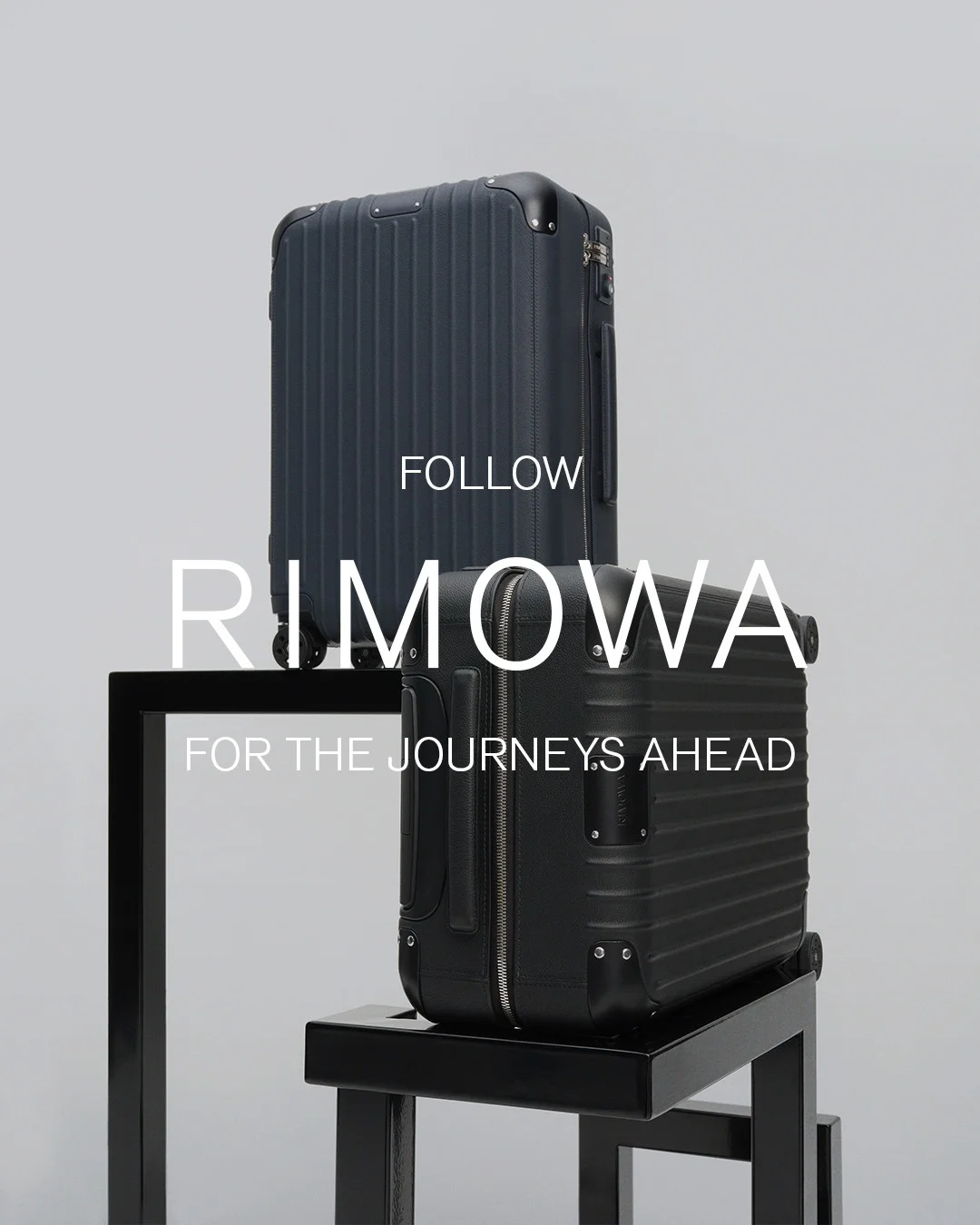
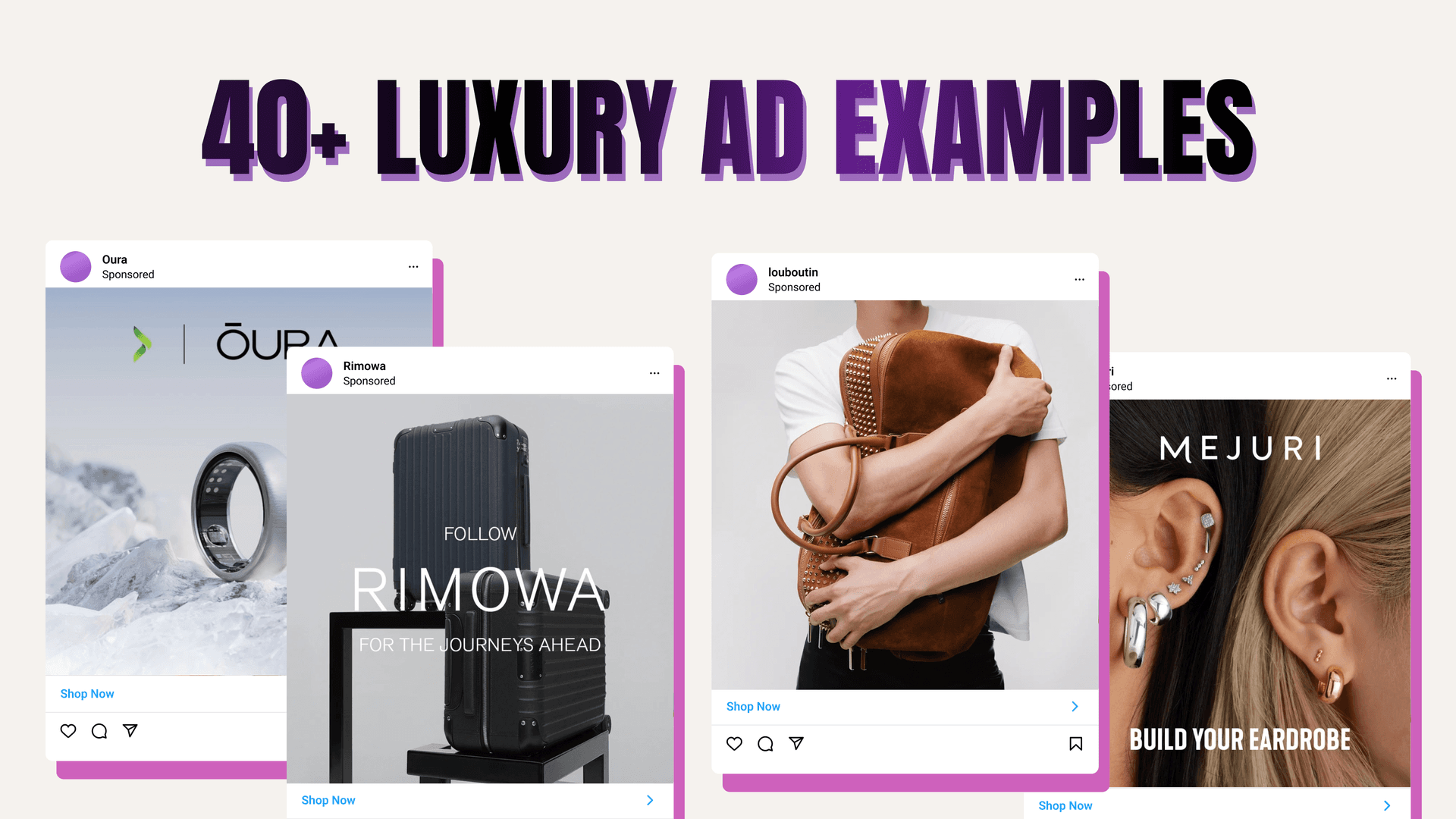
Two cases on two black plinths, a navy grooved carry-on above, a leather-trimmed trunk on another, a flat cool-gray seamless, and the top third of the frame empty. Three words in a thin, wide-tracked sans: "FOLLOW," "RIMOWA," "FOR THE JOURNEYS AHEAD." No button, no price, no logo beyond the wordmark, which is set so large it overlaps the product. 403 days.
Why it works: A brand ad that only asks for a follow never goes stale, and the enormous type turns the name into the composition. The two sizes show a range without a grid. Everything the product needs to say, the grooves and the corners, is in the light.
Clone it: Any rigid object with a silhouette: cookware, speakers, bottles, bags. Stack two sizes, set your name huge and thin, ask for nothing. Library page.
2. Oura — a ring on ice
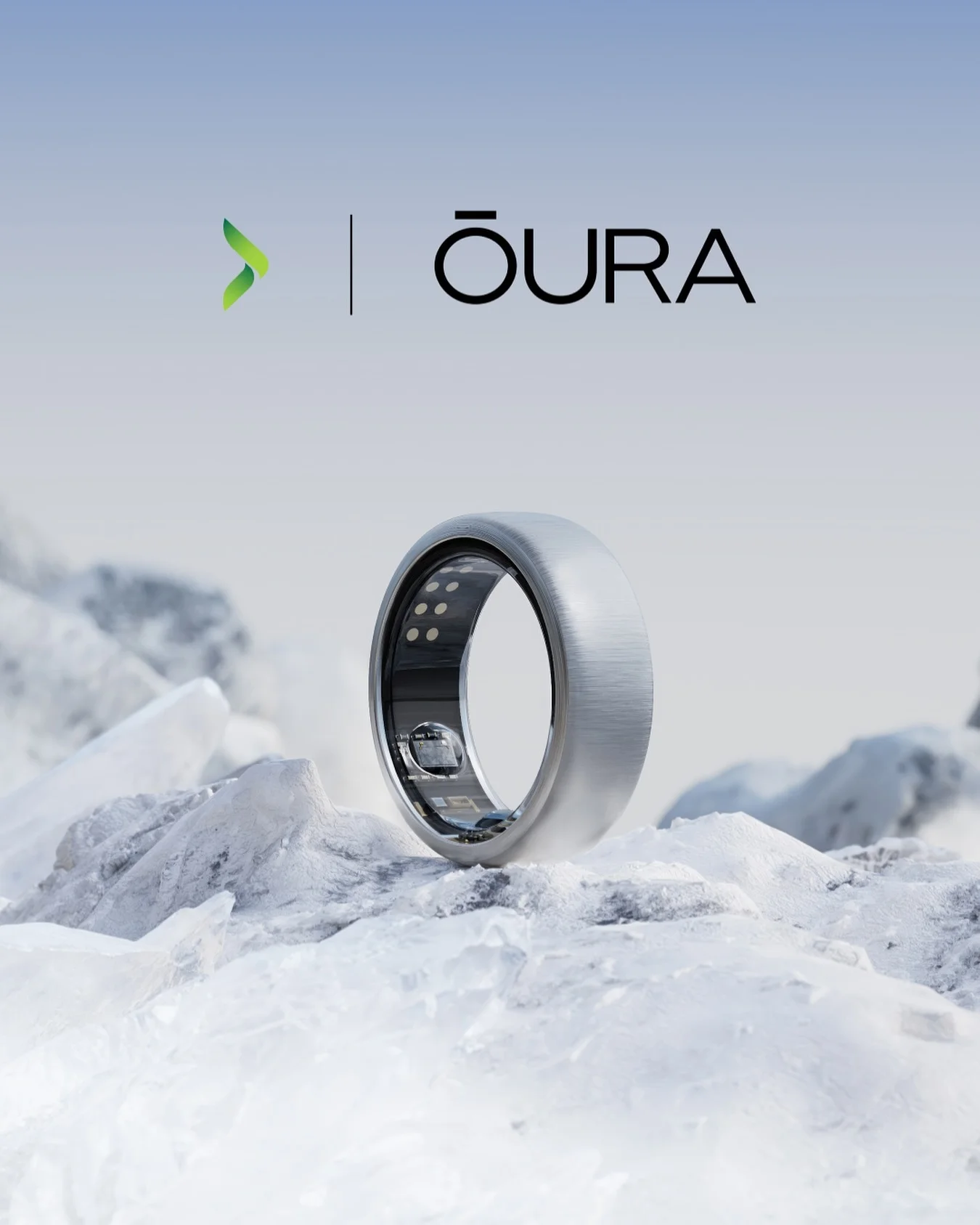
One brushed-silver ring stands upright on ice shards, sensors visible inside the band, a pale-blue-to-white gradient sky, and two logos centered in the upper third. No headline at all. 370 days.
Why it works: A $300 piece of hardware shot like a jewel. The product is oversized against a natural texture, which is a watch-ad move, and the absence of copy leaves the material to make the claim.
Clone it: Earbuds, watches, rings, anything small and hard. Put it on stone, ice, or sand, and skip the words. Library page.
3. Oura — the product is the background
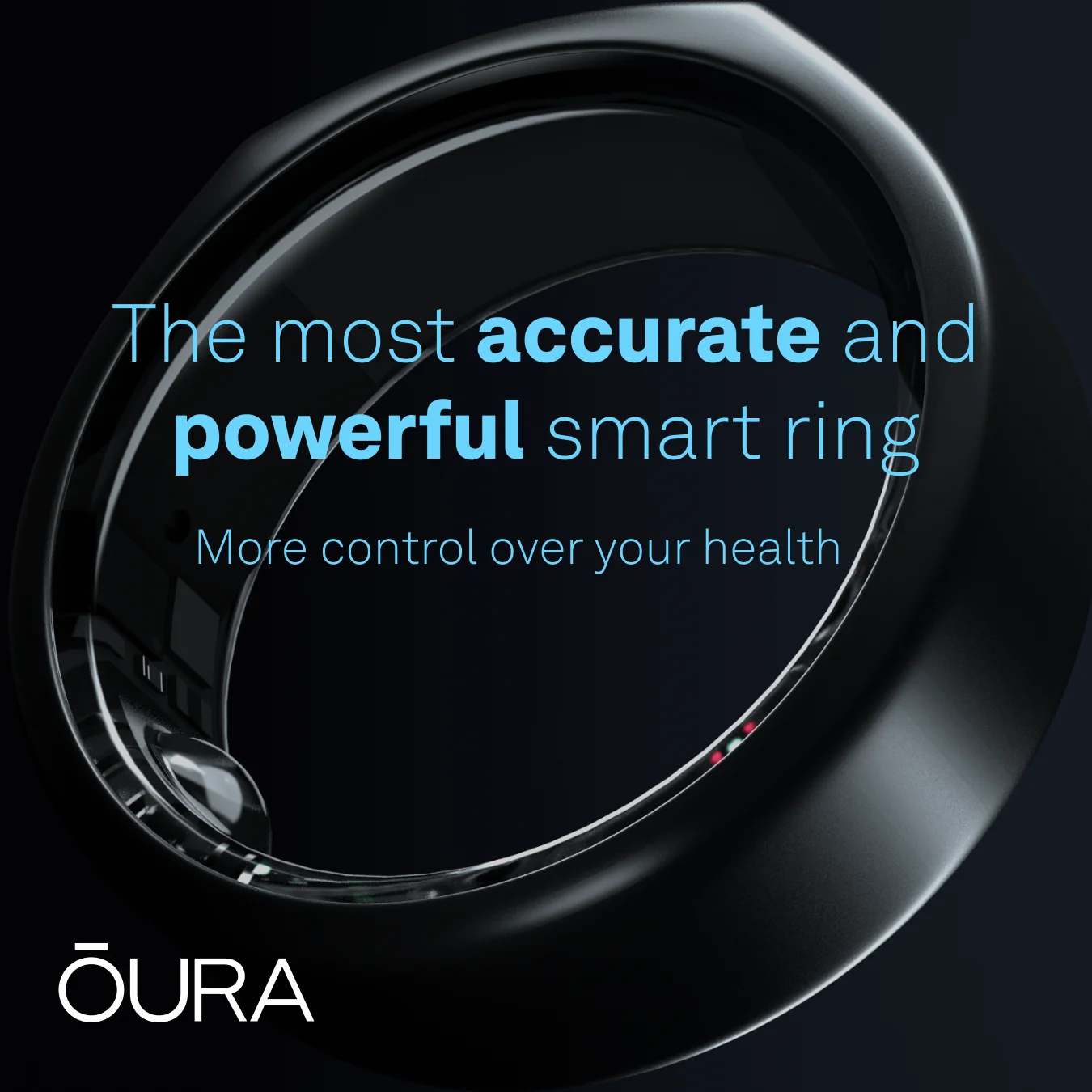
The same ring in extreme macro, edge to edge, on near-black, with "The most accurate and powerful smart ring" set over it in light sans and two words picked out in sky blue. 229 days.
Why it works: Black plus one accent is the tightest palette in the set, and cropping the product past the frame makes a small object feel monumental. The superlative is the one non-luxury note; the run-length suggests the audience forgave it.
Clone it: Any dark hard-goods product. Crop tight, headline over it, one accent color. Library page.
4. PHLUR — four bottles, five words
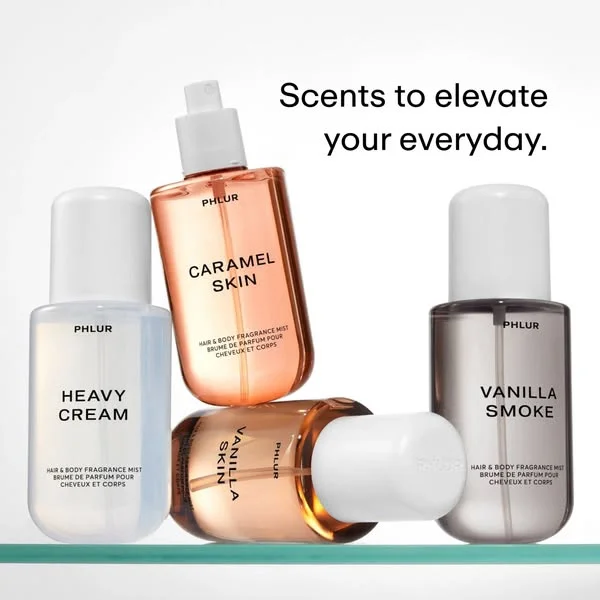
Four translucent mist bottles in milk, peach, amber, and smoke on a glass shelf, one lying on its side, white gradient behind. Five words top-right in regular black sans: "Scents to elevate your everyday." 180 days.
Why it works: The liquids are the color story, so the ad needs no palette decision at all. Tipping one bottle breaks the row without adding anything.
Clone it: Any three-to-five-SKU range in translucent packaging. Line them up, tilt one. Library page.
5. Christian Louboutin — no wordmark, just spikes
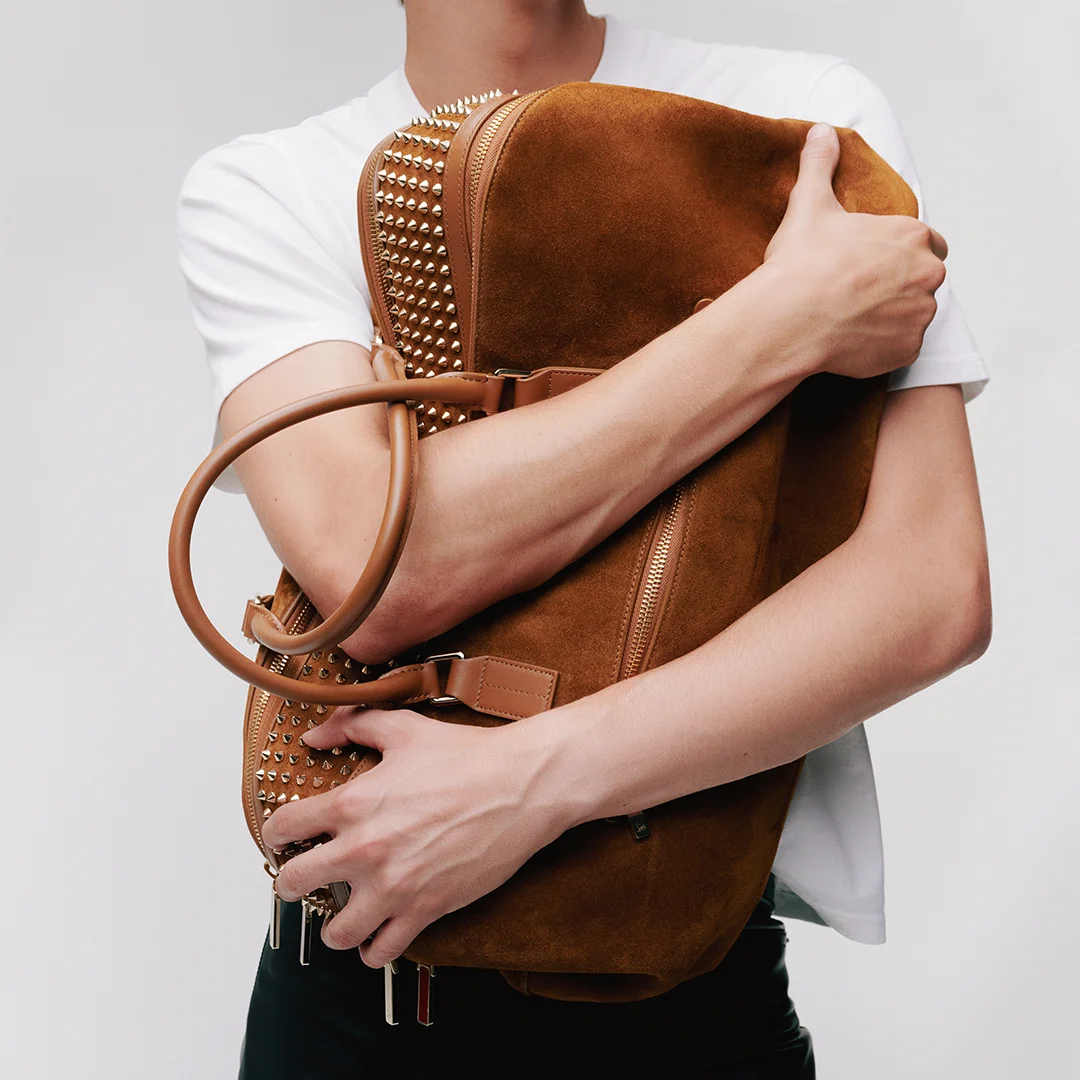
Somebody in a white tee and black trousers hugs a tan suede duffel with gold-spike panels and rolled leather handles, on flat light gray. The face is cropped out. There is no copy and no logo. 190 days.
Why it works: The only ad in the set with no wordmark, because the spikes are the wordmark. This is Han, Nunes, and Drèze's quiet-goods finding as a Meta ad: the buyer who recognizes the house signature is the buyer the house wants. The hug turns a product shot into a possession.
Clone it: Bags and outerwear. Hug it, crop the face, add nothing. Only works if your product has a signature the reader already knows; if not, keep the wordmark. Library page.
Material as proof. Luxury ads, and luxury jewelry ads above all, rarely make claims about quality. They show the surface and let you draw the conclusion.
6. Rimowa — the split that became a system
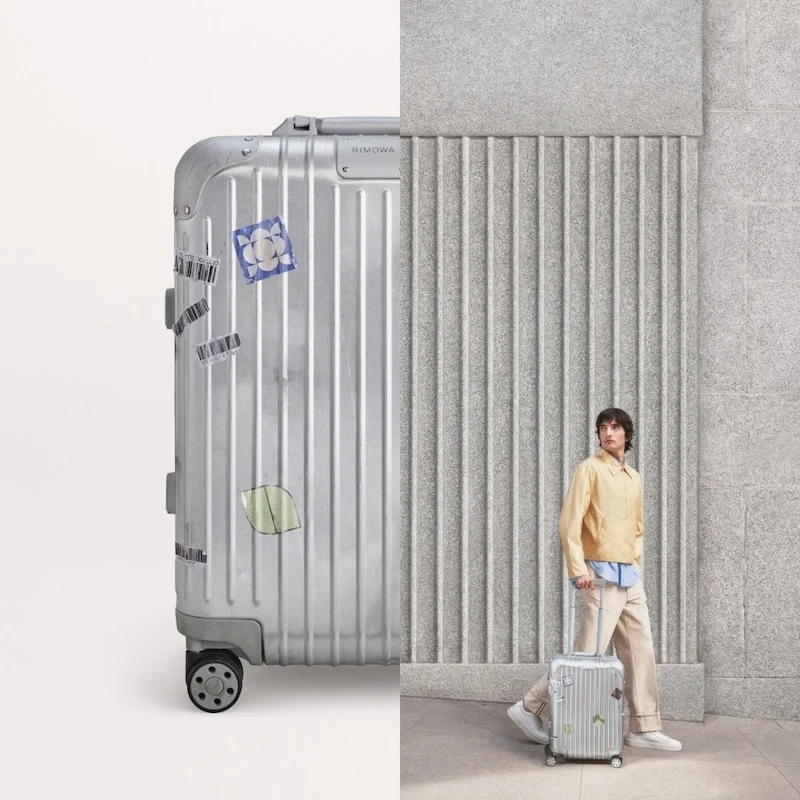
A vertical seam at exactly 50%. Left: a grooved aluminum case covered in years of stickers and a barcode tag, on warm off-white. Right: a model in a butter-yellow jacket wheeling a small aluminum case past a ribbed granite wall. Not a single word. 402 days.
Why it works: The detail panel proves material and the lifestyle panel proves scale; the stickers say "this case has been places" without a line of copy. Zero copy also means zero things to date the ad.
Clone it: Any product where texture is the story: leather, denim, cookware, watches. Macro left, in-hand right. Library page.
7. Rimowa — same frame, new scene
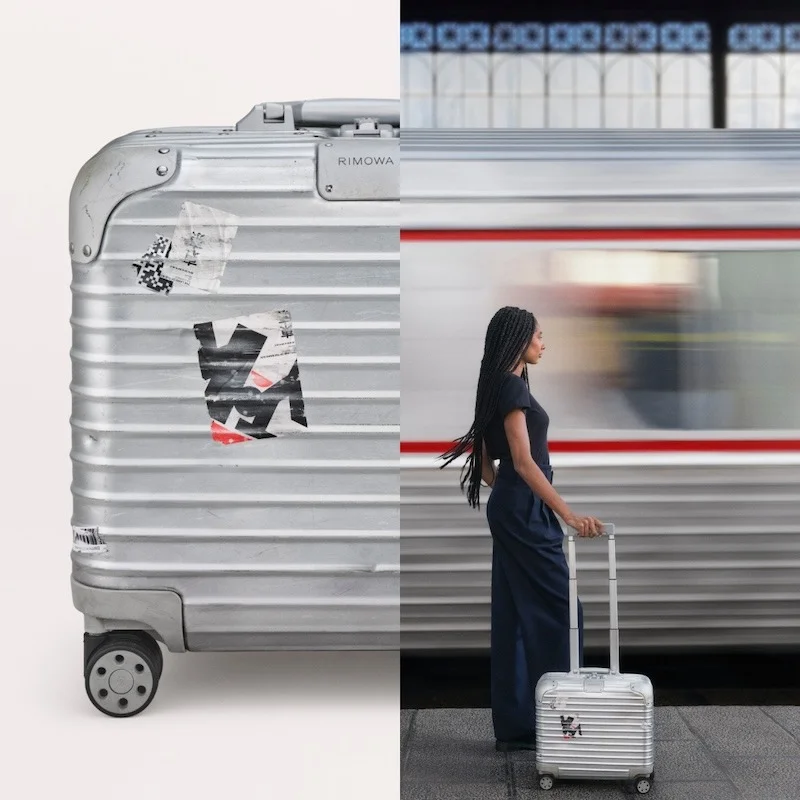
The same template as the ad above with the right panel swapped: a model in navy wide-leg trousers on a station platform, a silver train motion-blurred behind, holding a mini aluminum case. Silver, navy, white. 402 days.
Why it works: Rimowa runs a system, and both halves of the pair have run more than 400 days. The train's ribbing echoes the case's ribbing, which is the kind of detail an art director gets paid for and a template gets for free.
Clone it: Build the split once and swap only the right-hand photo per campaign. The single most cloneable finding in this post. Library page.
8. Mejuri — jewelry at 1:1 scale
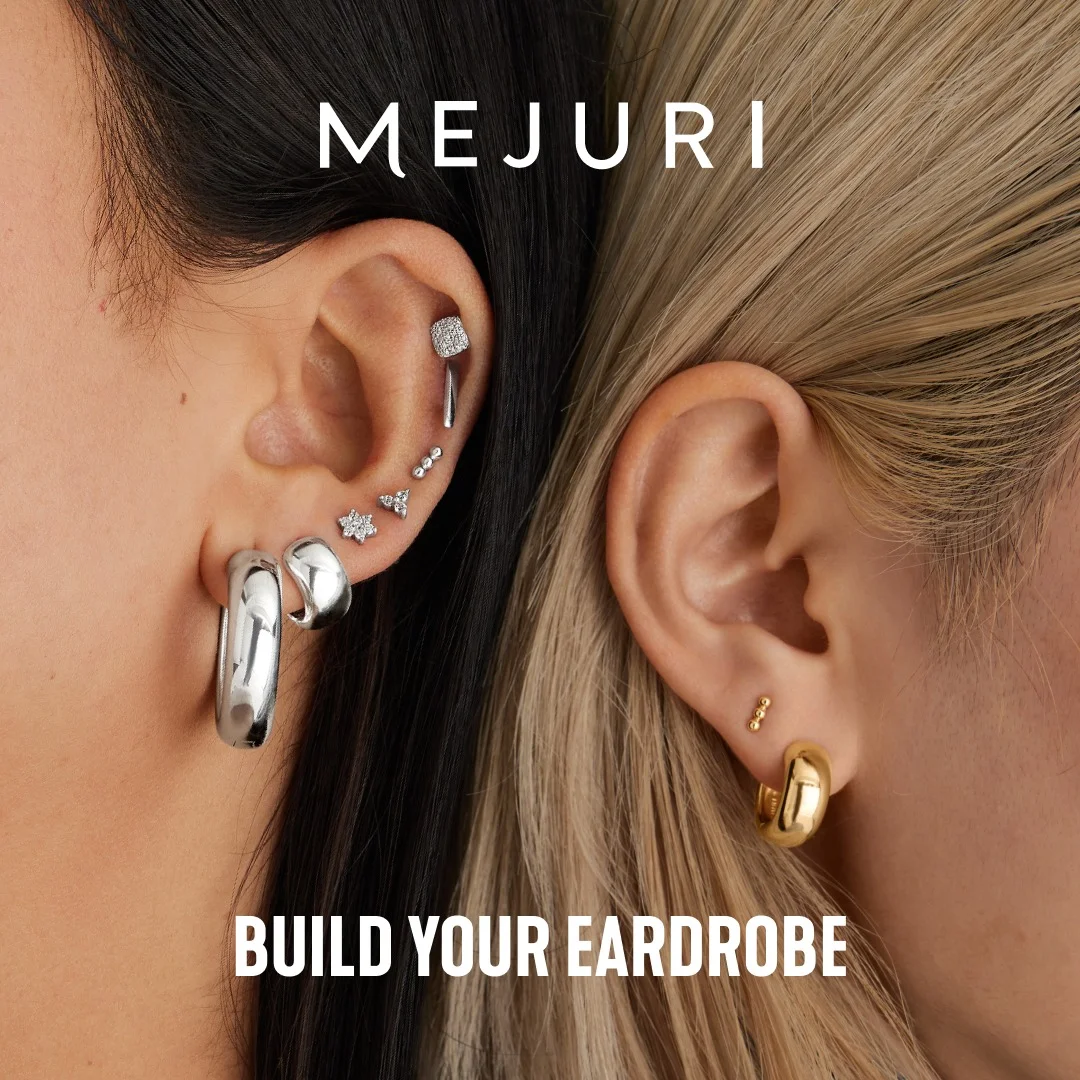
Two ears, mirrored, in extreme macro: one stacked with silver hoops, a pavé stud, and a climber; the other with a single gold huggie and a tiny bar stud. The wordmark sits at the top in thin wide sans, and "BUILD YOUR EARDROBE" at the bottom in heavy condensed caps. 346 days.
Why it works: Product on the body at actual size, showing the two styling extremes so every buyer sees herself in one ear. The macro does the job a catalog spread would take a page to do.
Clone it: Rings on hands, watches on wrists, glasses on faces. Two-up macro, one line. Library page.
9. Augustinus Bader — the box is the ad
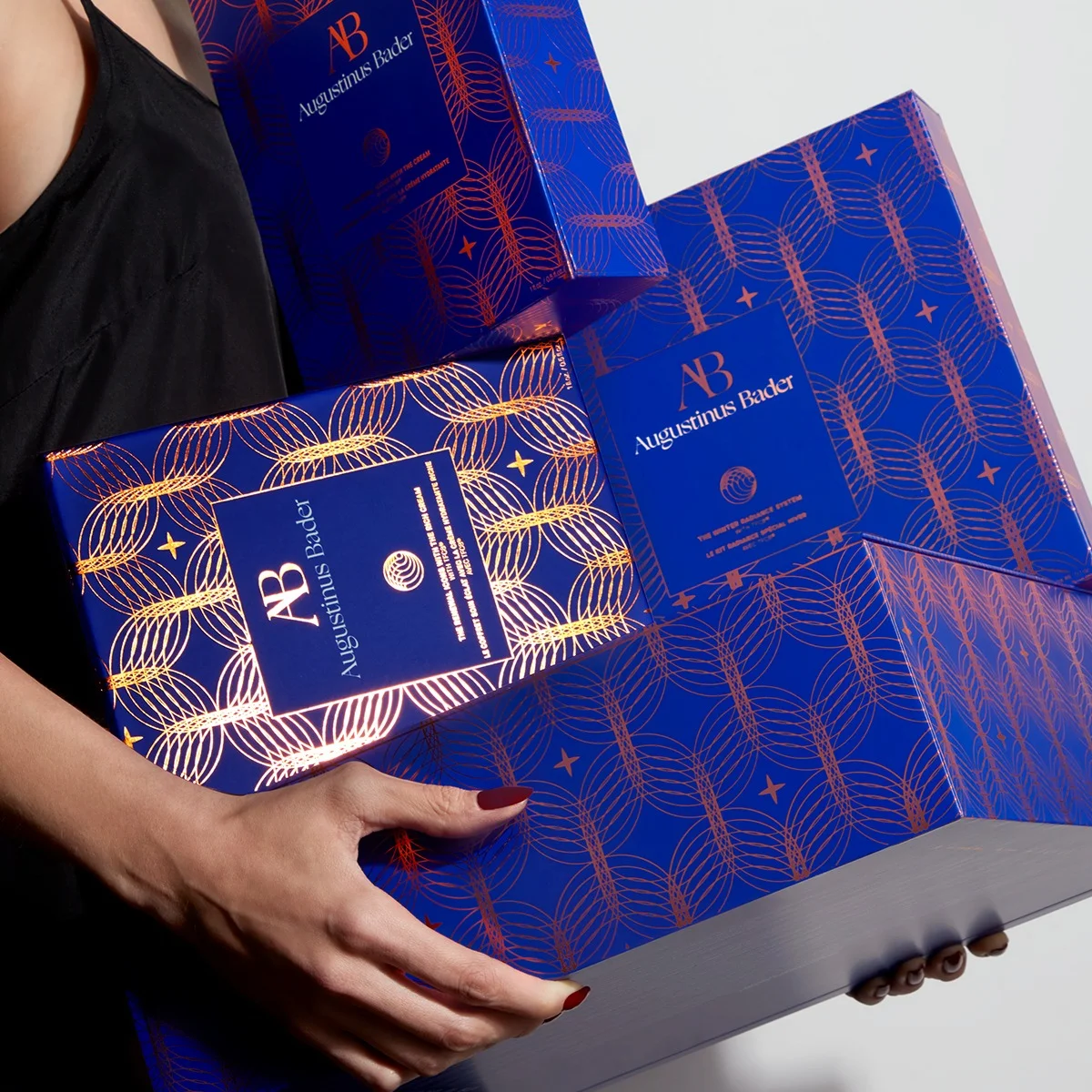
Three oversized boxes, cradled by a model in a black silk cami, royal-blue boxes printed with a copper-foil guilloché pattern, cropped hard by the frame, on white. No copy beyond the "AB" on the packaging. 110 days, the newest ad in this group.
Why it works: For a $300 cream, the packaging is the product experience, and shooting the boxes like jewelry says more about price than a price would. Cobalt plus copper is a two-color system.
Clone it: Chocolate, tea, fragrance, anything with a strong box. Oversize it, crop it, add nothing. More luxury skincare ad examples run the same play. Library page.
10. The Ridge — a wallet as an art object
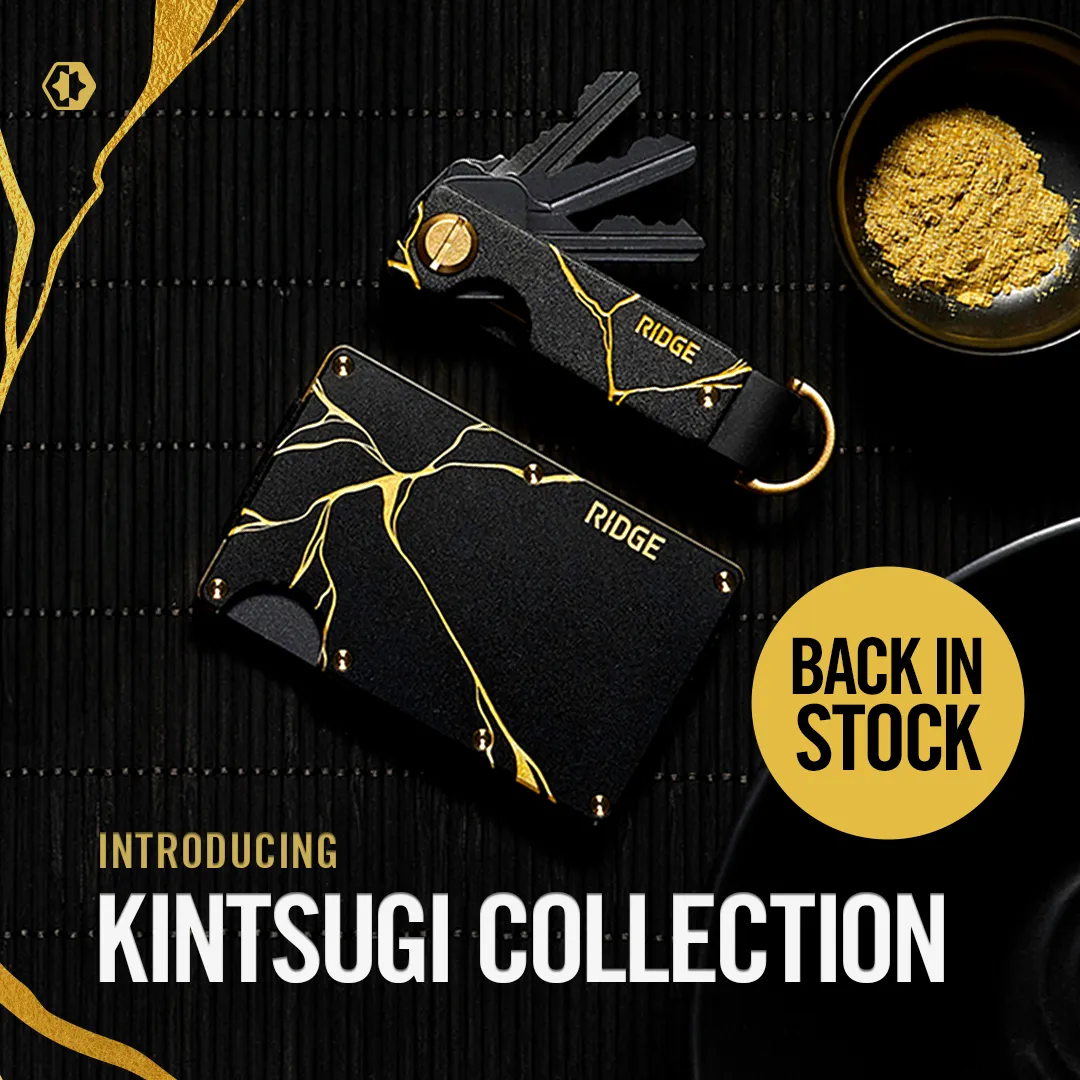
A black aluminum wallet and key organizer with a gold-crack kintsugi pattern on a black bamboo mat, a bowl of gold pigment top-right, and gold veins bleeding into the frame edges. "INTRODUCING" in gold condensed caps, "KINTSUGI COLLECTION" in white, a gold "BACK IN STOCK" badge. 396 days.
Why it works: A limited colorway presented as craft, with the material prop (the pigment bowl) explaining the finish without a sentence. "Back in stock" is scarcity without a countdown.
Clone it: Any limited edition. Dark textured surface, one material prop, a scarcity badge instead of a button. Library page.
Editorial lifestyle and a wordmark. The house campaign still, transplanted to a feed: one model, one location, the name, and nothing else.
11. Reiss — a man, a balustrade, a name
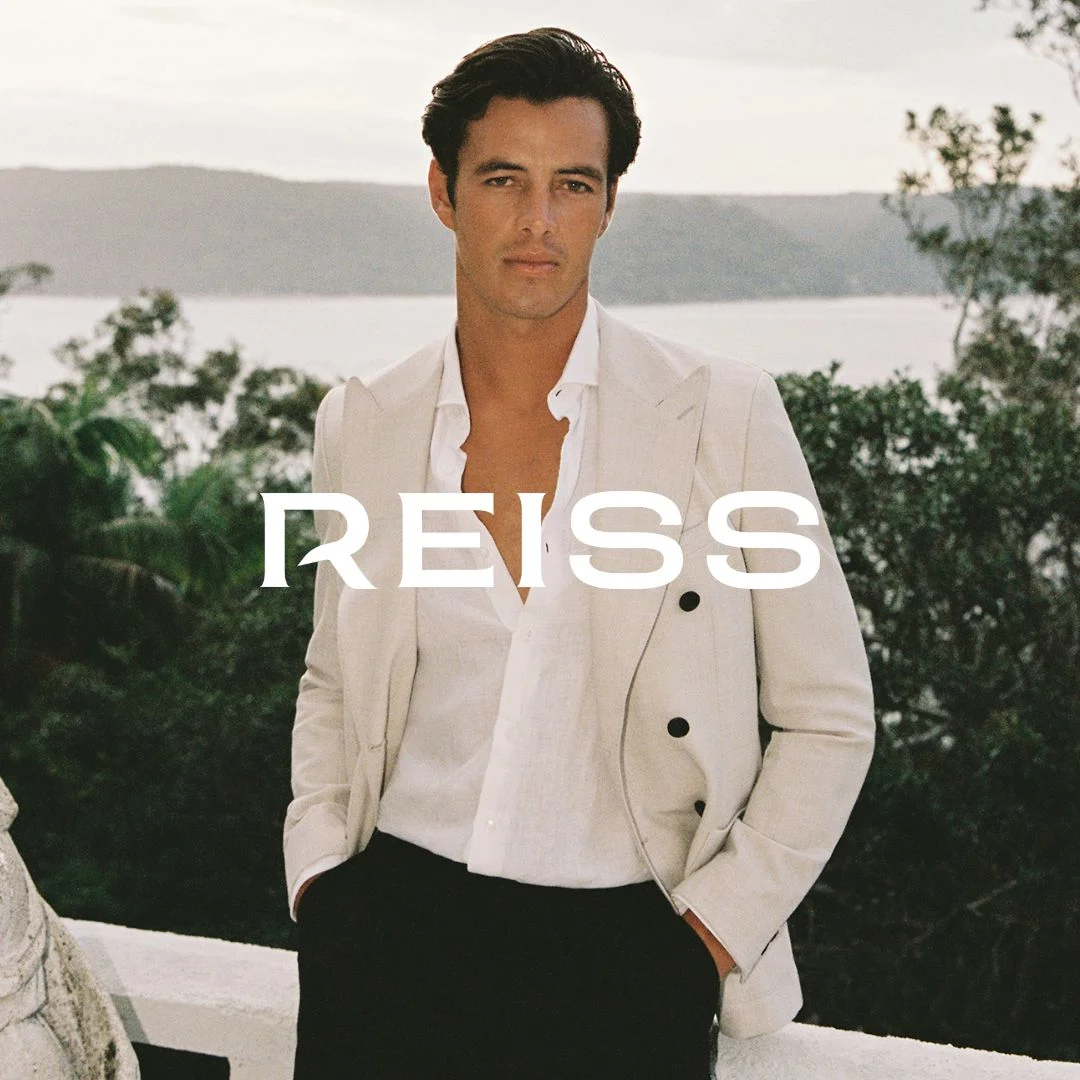
One male model in a cream double-breasted linen blazer and black trousers, hands in pockets, at a stone balustrade with a bay and hills behind under overcast light. "REISS" centered at chest height in white wide geometric sans. Nothing else. 414 days, the longest-running Instagram ad in the fashion group.
Why it works: A campaign still with a logo on it. Nothing to reject, nothing to expire, so it runs until the media buyer gets bored.
Clone it: Apparel, eyewear, watches. One model, one location, one wordmark, and the discipline not to add a line. Library page.
12. Reiss — the same balustrade, the women's line
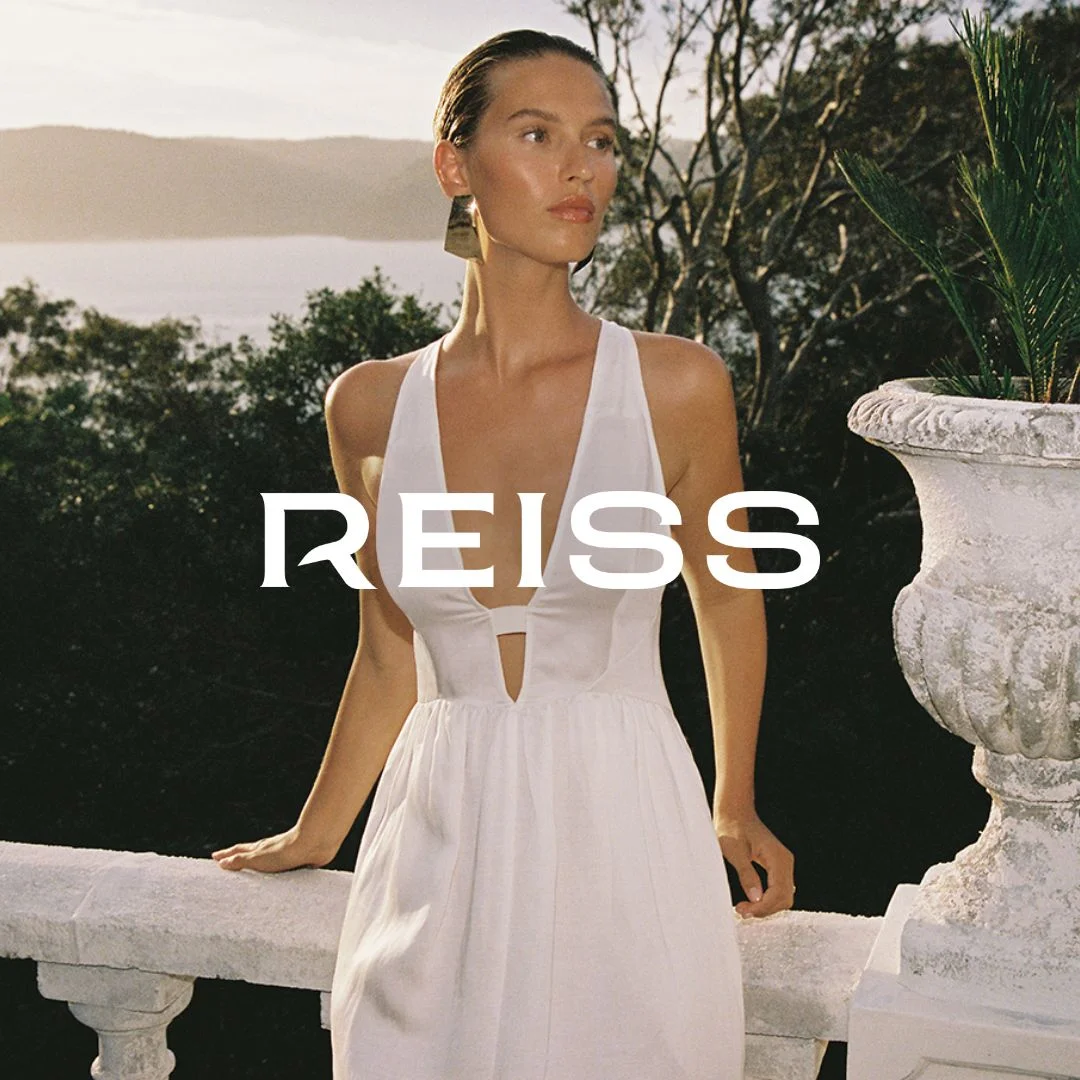
A model in a white plunge-neck sundress and gold drop earrings, hand on the same balustrade, a stone urn and palm to the right, warmer light. Wordmark centered. 412 days.
Why it works: Identical template to the men's ad, shot in the same session, so Reiss got two 400-day ads out of one afternoon. Series beat one-offs across this whole set.
Clone it: Shoot men's and women's, or two colorways, at one location and keep the frame identical. Library page.
13. Boll & Branch — 1,794 days of one sentence
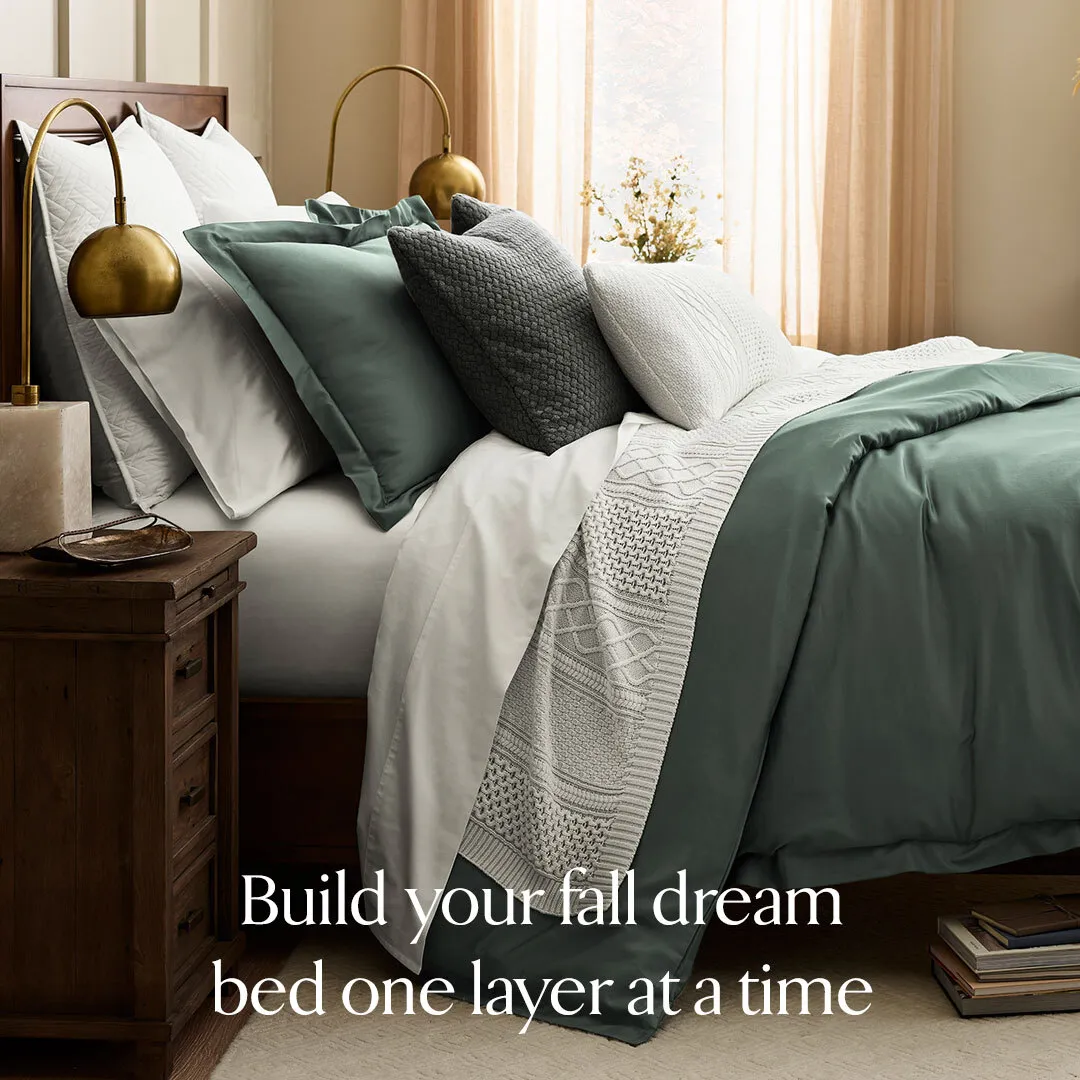
The bed, side-on: white sheets, a sage duvet and shams, a charcoal knit pillow, a cable-knit throw, brass arc lamps, a walnut nightstand, sheer curtains with window light. Ten words in a light white serif at the bottom: "Build your fall dream bed one layer at a time." 1,794 days.
Why it works: A catalog-quality room, a soft sentence, and no ask. This is the ad from the first paragraph. Sage, white, walnut, and brass is a four-tone palette from one photograph.
Clone it: Any home textile or furniture. Style the room, put one serif line at the bottom, and leave it alone for years. Library page.
14. Cozy Earth — the only button in the set
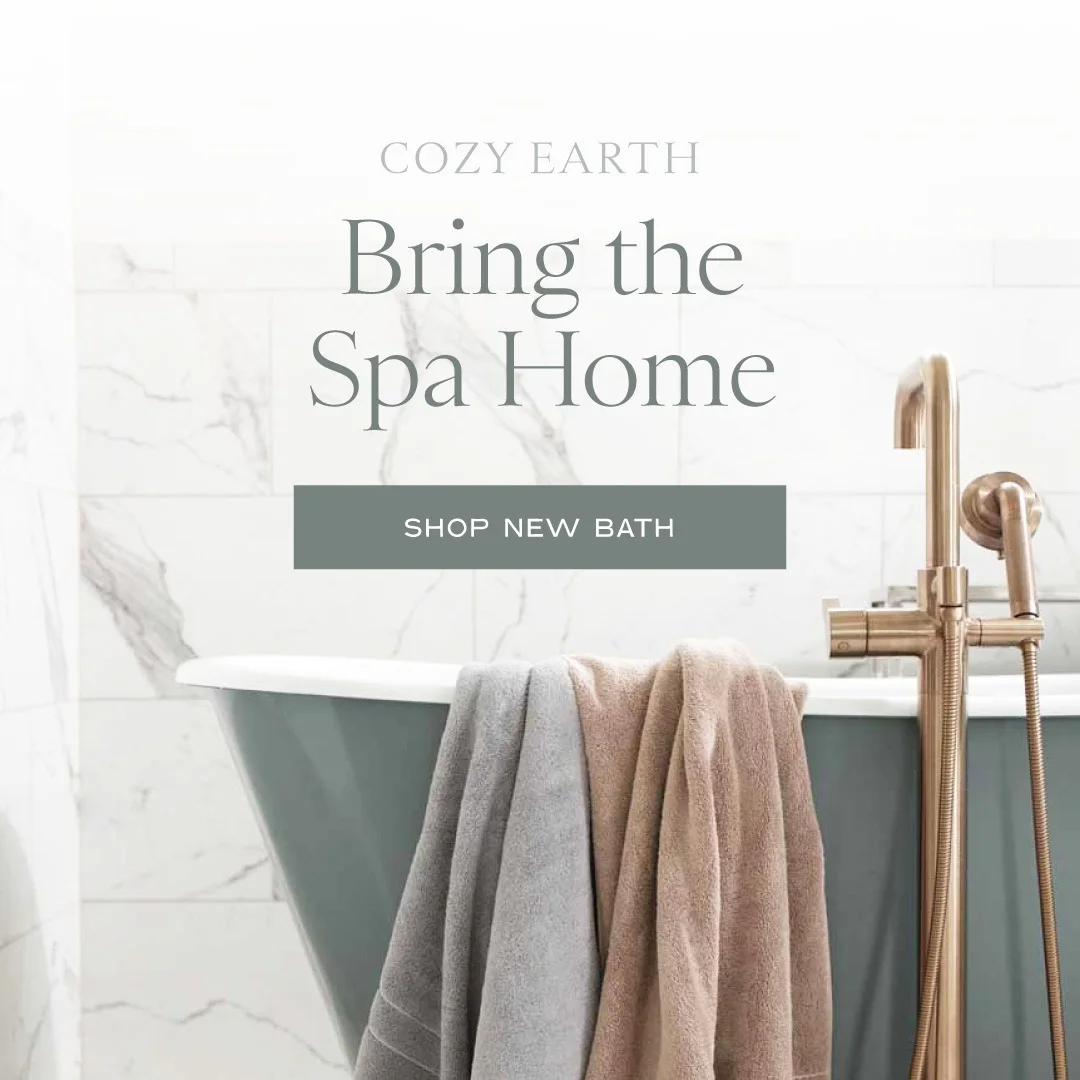
A sage clawfoot tub cropped to the bottom third, gray and dusty-rose towels over the rim, a brushed-brass floor tap, Carrara marble walls. The top half is near-white marble with "COZY EARTH" in spaced small caps, "Bring the Spa Home" in a light serif, and a sage rectangle reading "SHOP NEW BATH." 259 days.
Why it works: Twenty-seven of these 28 ads have no button. This one does, and it is the same color as the tub, so it reads as part of the room rather than as an interruption. Top-half whitespace, bottom-third product.
Clone it: Bath and bedding. Product in situ, whitespace above, and if you must have a button, match it to the product. Library page.
15. Everlane and Alo Yoga — cropped bodies, quiet claims
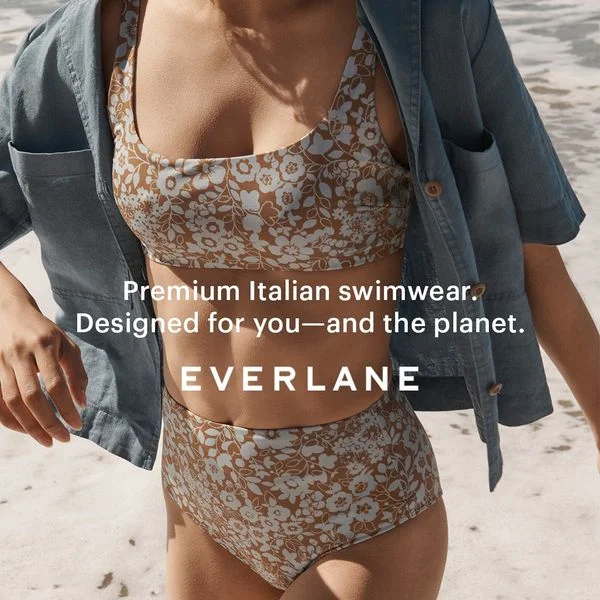
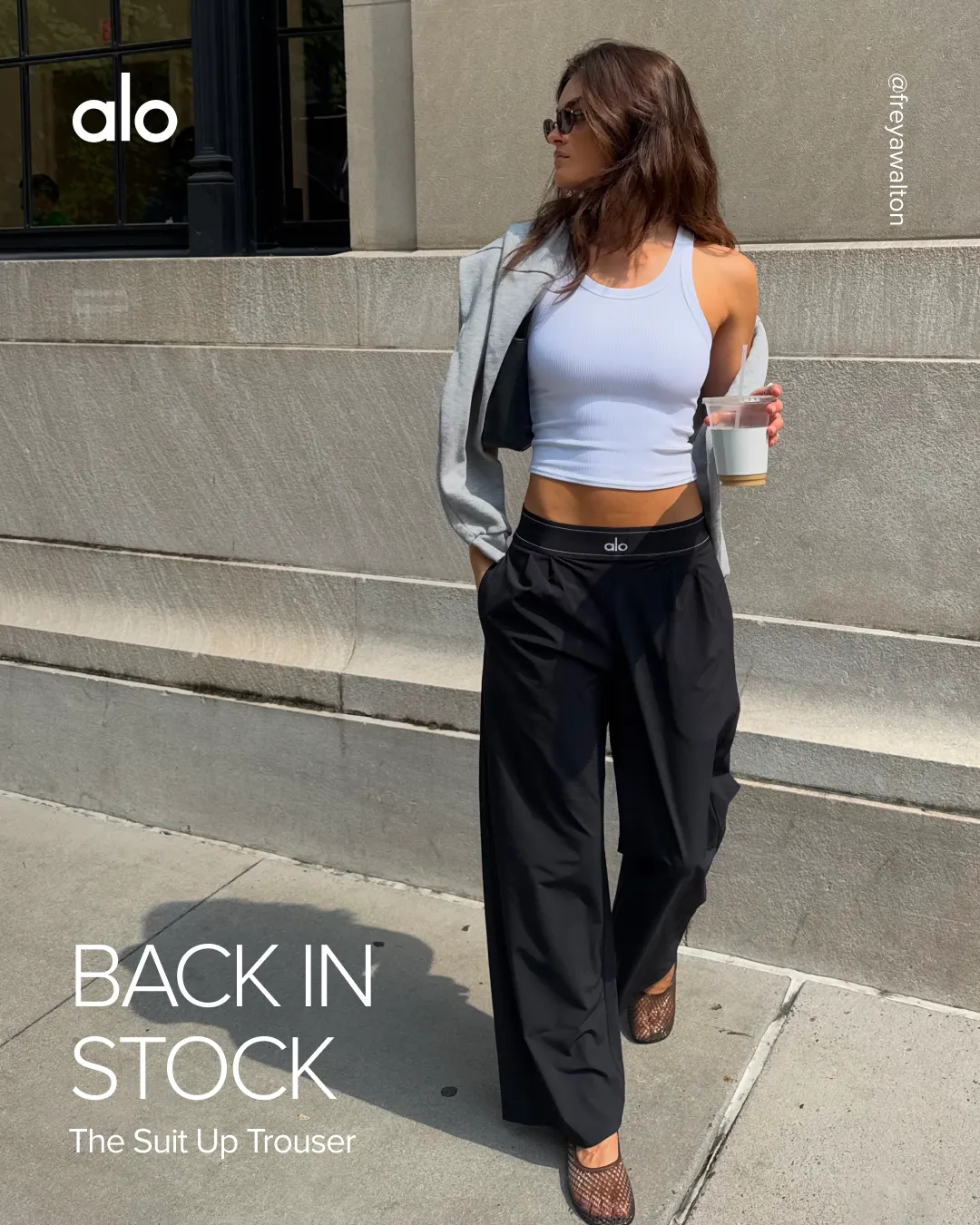
Everlane crops the model to the torso, a tan floral bikini under an open chambray shirt on wet sand, and centres two lines over the midriff: "Premium Italian swimwear." "Designed for you—and the planet." 258 days. Alo Yoga puts a creator in black wide-leg trousers and a white tank past a limestone building, her handle running vertically up the right edge, and "BACK IN STOCK / The Suit Up Trouser" bottom-left in light caps. 386 days.
Why they work: Cropping out the face makes the fabric the subject, and "Italian" is a craft cue that costs one word. Alo's restock line is scarcity with no countdown, and the creator handle is the one concession to proof in the fashion group.
Clone them: Swim, underwear, activewear. Crop to the garment; for a restock, full-body shot plus "BACK IN STOCK" plus the product name. Library pages: Everlane, Alo Yoga.
A serif and one soft sentence. Seven of the 20 ads with copy set it in a serif, and the Iseki study's "luxurious typeface" effect is what they are cashing.
16. Holden — two metals, ten rings, zero clutter
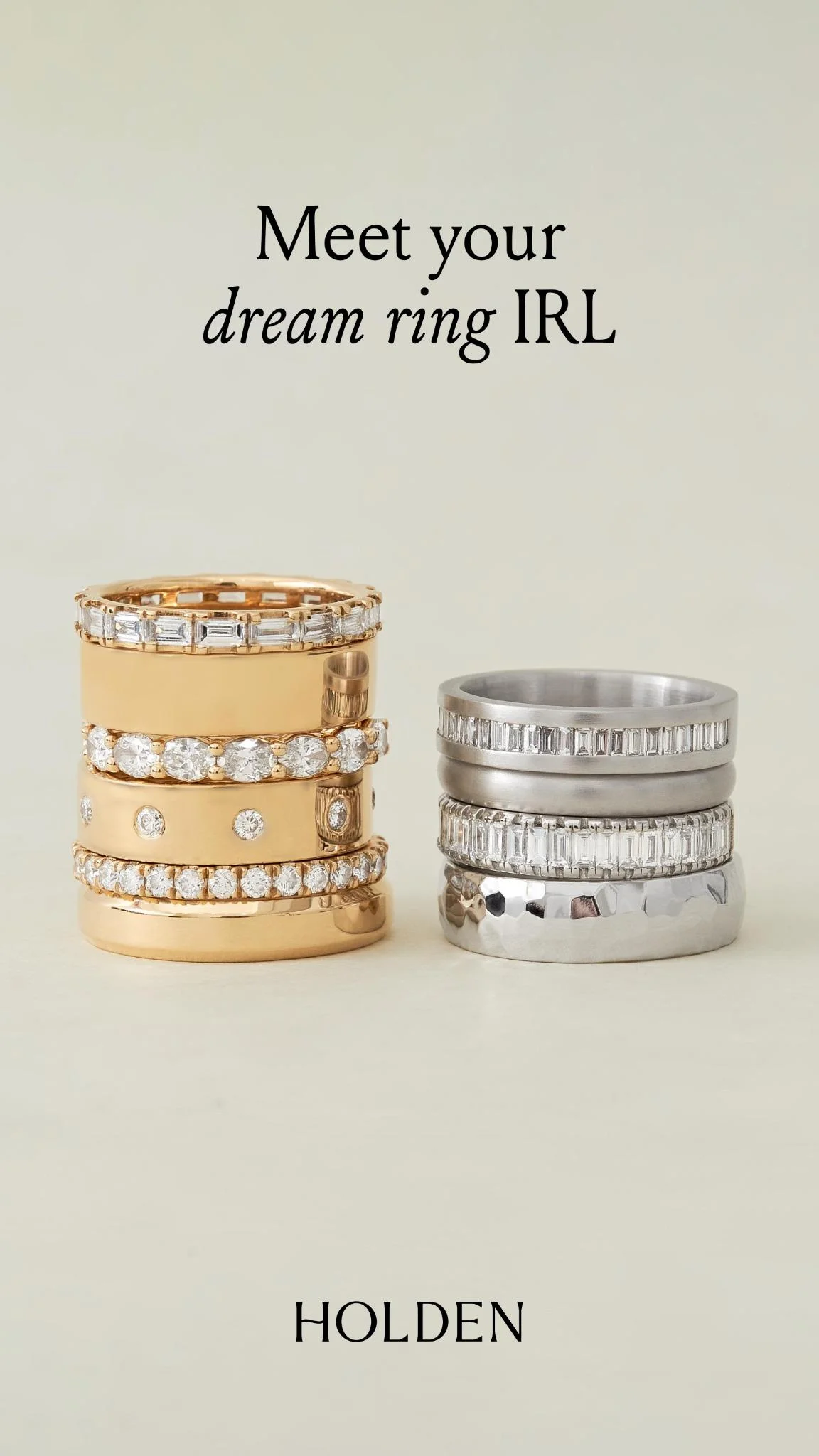
Two ring stacks on warm ivory: gold on the left (baguette eternity, oval, bezel, pavé, plain), platinum on the right (channel-set, plain, baguette, hammered). "Meet your dream ring IRL," with "dream ring" in italic, set in a high-contrast serif at the top; a modern-serif wordmark at the bottom. 180 days.
Why it works: Ten styles and two metals with no grid and no labels, because stacking is the label. The italic on two words is the only emphasis in the frame, and the hammered band at the base is a craft cue you can feel from the photo.
Clone it: Anything sold in metal or color variants. One stack per variant, one serif line. Library page.
17. Tatcha — a spoonful and one award
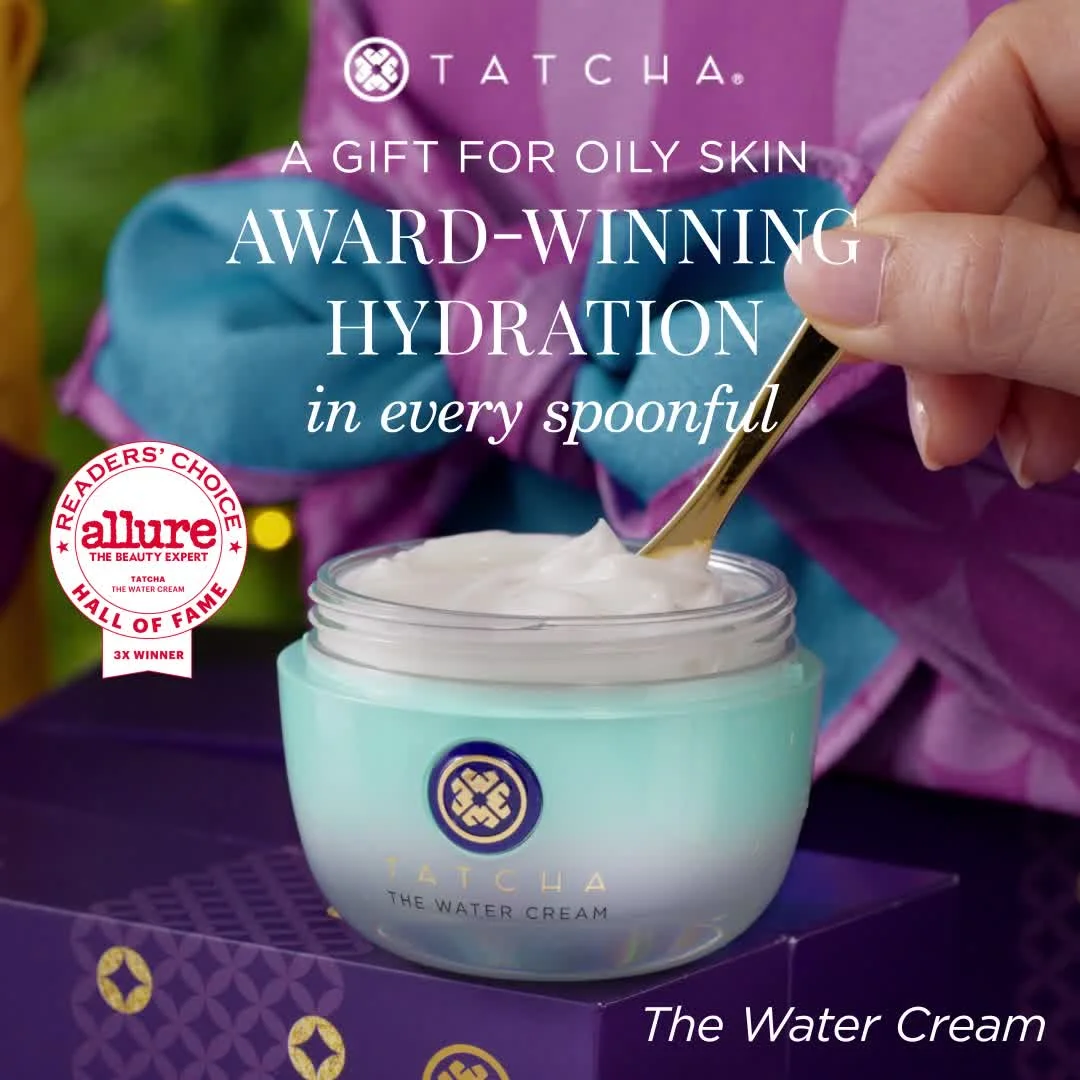
A mint-blue jar, lid off, a gold spatula mid-scoop, a hand entering top-right, the jar on a purple gift box with gold seals, a silk bow blurred behind. "A GIFT FOR OILY SKIN" as a kicker, "AWARD-WINNING HYDRATION / in every spoonful" in a white high-contrast serif with an italic sub, and an Allure Readers' Choice badge. 134 days, seasonal.
Why it works: A texture shot plus one third-party seal. Nobody scoops $70 cream with their fingers, and the gold spatula says so without saying it.
Clone it: Any cream or balm. Open jar, tool mid-scoop, one award at most. Library page.
18. Snif and Koio — one color, one serif
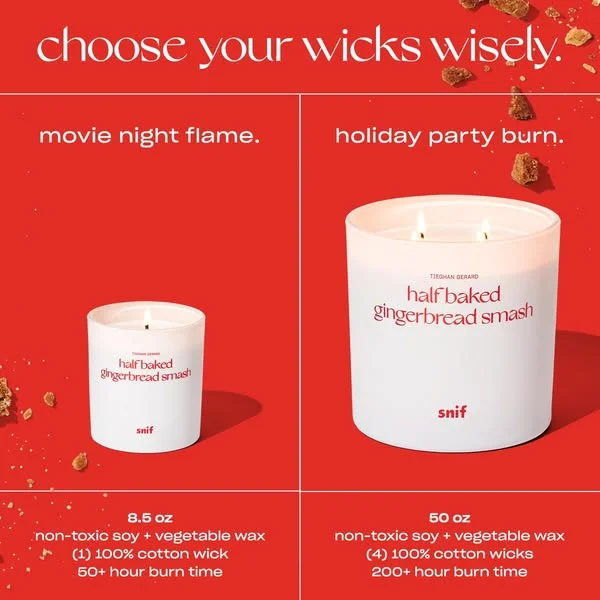
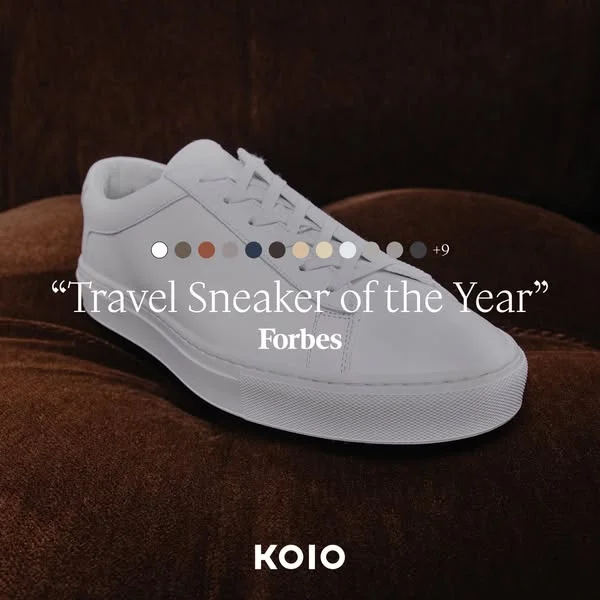
Snif puts two lit gingerbread candles, a small one and a four-wick giant, on flat tomato red with a scatter of crumbs and a lowercase serif headline, "choose your wicks wisely.", then specs under each in a rounded sans. 180 days. Koio floats a white leather low-top over a chocolate-brown velvet sofa with "Travel Sneaker of the Year" in italic white serif across the shoe, the Forbes mark beneath, and a row of eleven color dots. 90 days, the newest in this group.
Why they work: Snif is a size upsell disguised as a spec sheet, in one color; the serif lowercase keeps it from reading as a table. Koio's white on brown velvet is the highest-contrast palette in the set and still only two tones; the press quote carries the claim so the brand does not have to.
Clone them: Two sizes of anything on one flat color; or one product on a contrasting textile with a quote over it. Library pages: Snif, Koio.
19. Sol de Janeiro — the longest-running Instagram ad here
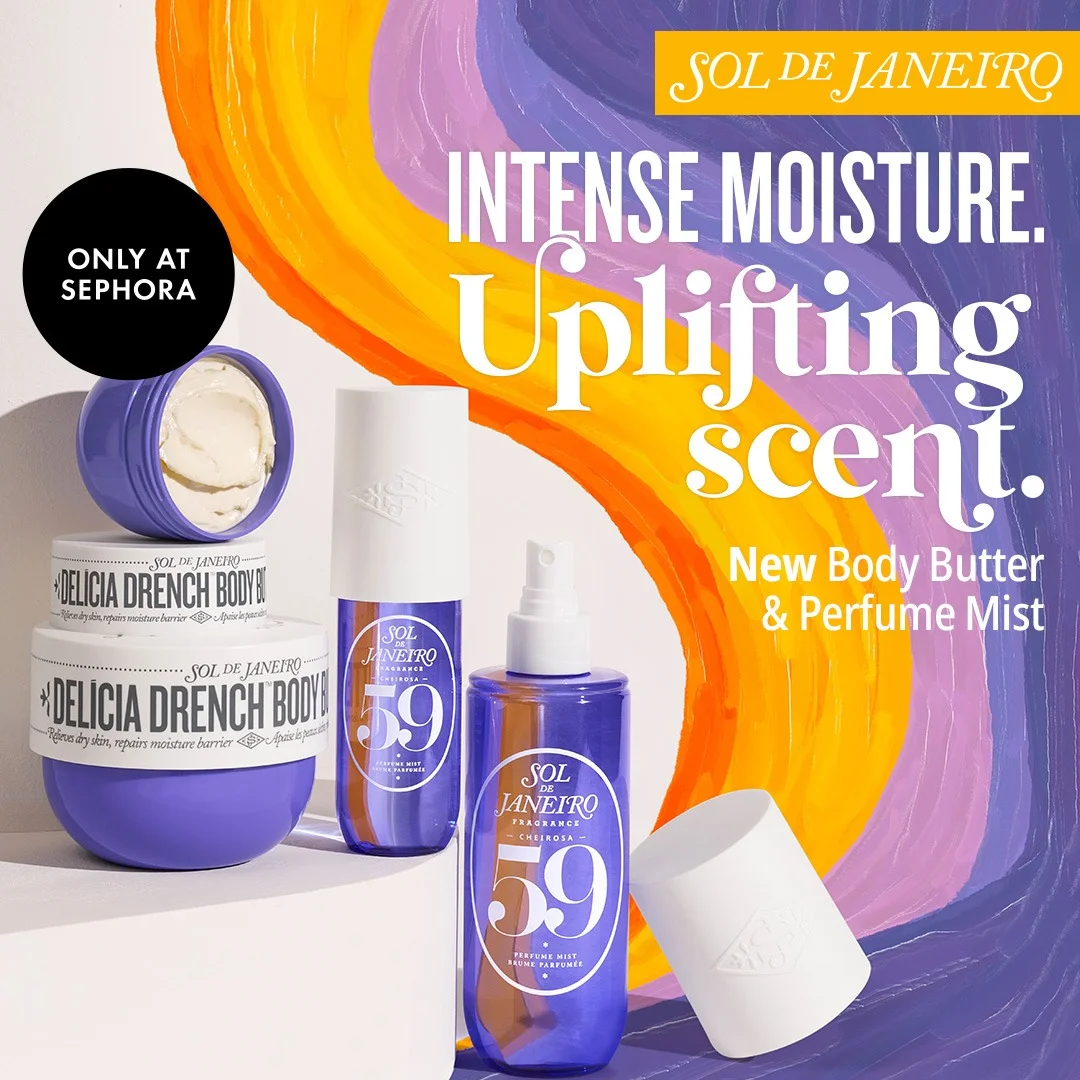
One lavender body-butter tub, open, stacked on two more; two perfume mists, one cap off, on a white ledge; the right half a painted orange-yellow-pink-purple swirl. "INTENSE MOISTURE." in condensed caps, "Uplifting scent." in a large italic serif, "New Body Butter & Perfume Mist" beneath, an "ONLY AT SEPHORA" roundel. 421 days.
Why it works: The exception to the tonal-palette rule, and it ran longer than any other Instagram ad in the set. The swirl is Sol de Janeiro's brand system, recognizable from across a Sephora floor, so the saturation reads as the brand rather than as a campaign.
Clone it: Colorful packaging. Let the pack color set the palette, add one texture reveal (the open tub), and keep the serif for the soft line. Library page.
The accessible end borrows proof. Rimowa, Reiss, Louboutin, and Boll & Branch borrow nothing. The brands a tier down use a press quote, a review, or a badge, and it costs them nothing in run-length. Honest count: about 20 of the 28 read as fully house-coded; the five in this group, plus the two rule-breakers after it, show how far the codes stretch downmarket before they snap, which is where most readers' products sit.
20. Caraway — an unboxing with no words
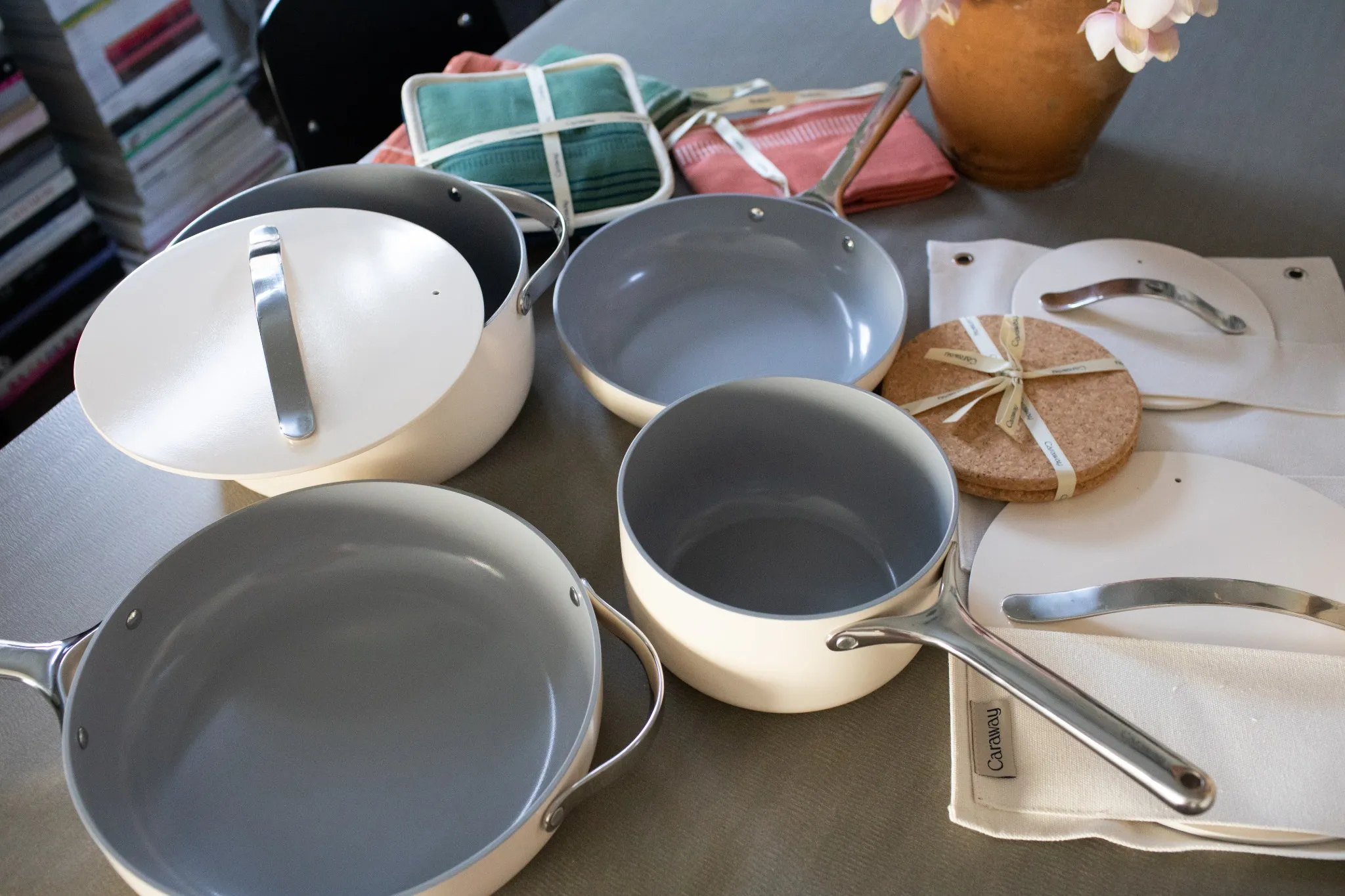
Shot from above, phone-style: a cream ceramic cookware set with gray interiors, cork trivets tied with ribbon, canvas lid holders, two folded tea towels, and a terracotta pot of flowers on a gray table, cookbooks behind. No copy at all. 1,916 days.
Why it works: It reads as a customer's unboxing rather than an ad, and it has run for more than five years. The snapshot lighting is the one lo-fi note.
Clone it: Any multi-piece set. Unbox it on a real table, shoot from above, write nothing. Library page.
21. HexClad — a compliance claim on a sticky note
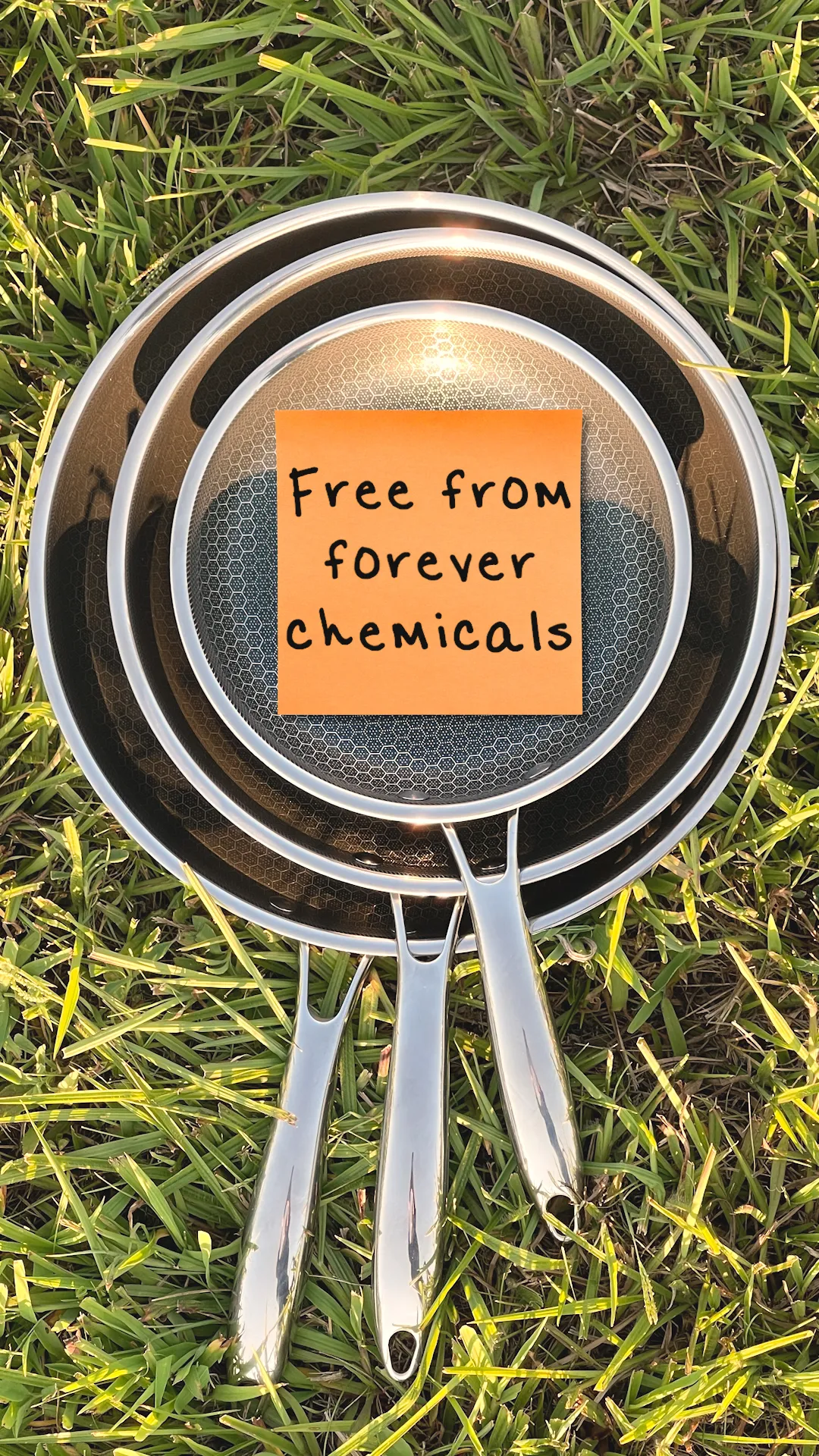
Three nested hexagon-etched pans lying on grass in low sun, shot top-down, an orange Post-it in the smallest pan reading, in handwriting, "Free from forever chemicals." Four words. 279 days.
Why it works: A regulatory claim delivered like a note from a friend. Green, steel, and one orange accent; the pan's texture is the product story and the note is the only copy.
Clone it: Any product with one ingredient or safety claim. Product outdoors, note on top, nothing else. Library page.
22. Away, Original Grain, Vuori — borrowed proof
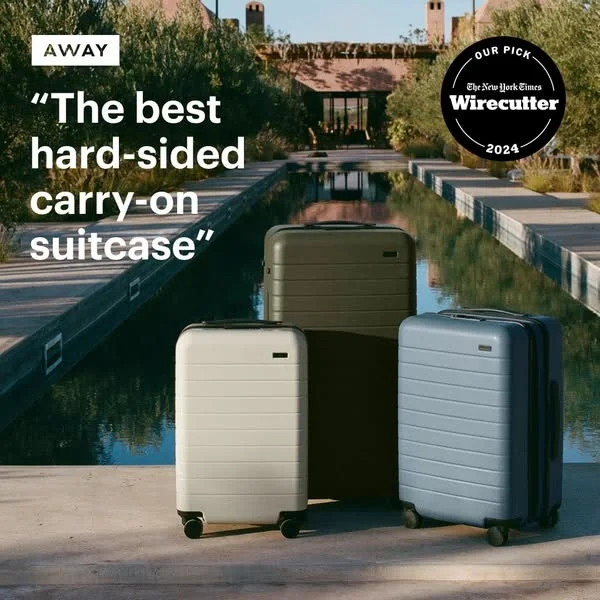
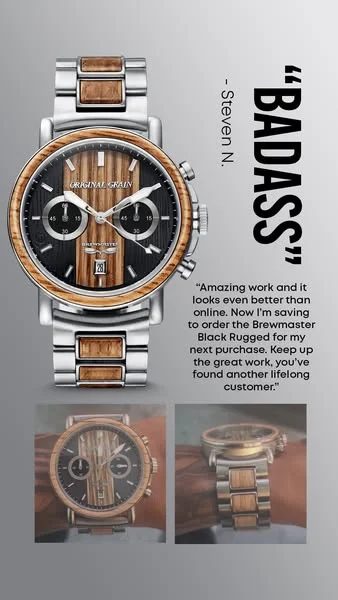
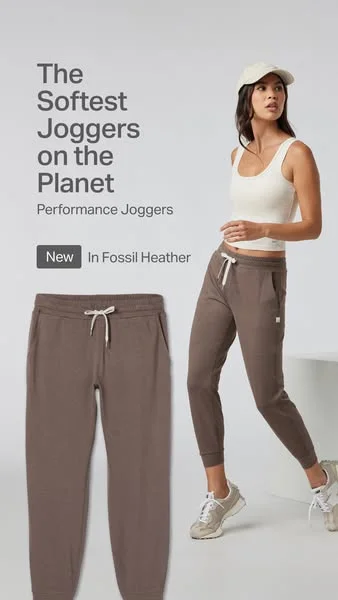
Away sets three carry-ons in sage, olive, and slate on a stone terrace by a reflecting pool at golden hour, with Wirecutter's "The best hard-sided carry-on suitcase" as the headline and the badge as a seal (90 days, newer). Original Grain puts a whisky-barrel-wood chronograph on a gray gradient with a one-word customer review, "BADASS," rotated down the right edge and the full paragraph beside it in small type (180 days). Vuori splits gray seamless between a flat-lay of taupe joggers and a model mid-stride, under "The Softest Joggers on the Planet" (180 days).
Why they work: The press quote makes the claim so the brand does not; the one-word review is the headline and the paragraph is for people who already stopped; and one colorway on one background keeps a superlative from feeling loud. None of the three shows a price.
Clone them: Product trio in a real setting with a quote as headline; any product with a punchy one-word review, rotated; flat-lay left, on-body right. Library pages: Away, Original Grain, Vuori.
Two that break the rules and still ran. Both were kept on purpose.
23. Away — "SAVE," for 2,062 days
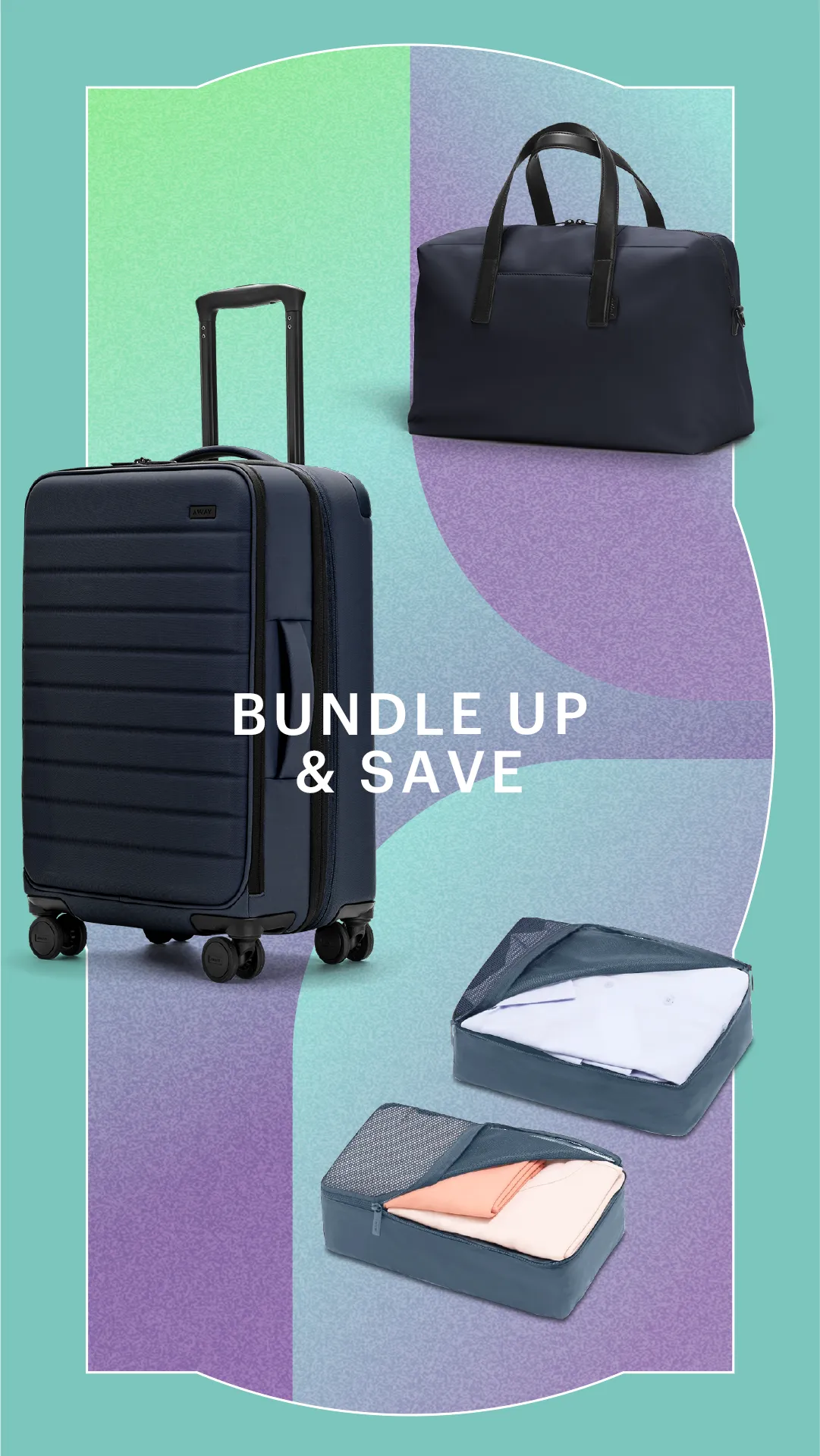
A navy carry-on, a weekender, and two packing cubes as cutouts on a grainy lime-to-lavender-to-teal gradient inside a curved frame, "BUNDLE UP & SAVE" centered in white wide-tracked caps. No number, no percentage, no expiry. 2,062 days, the longest-running ad in this post.
Why it works: A discount cue with no discount attached cannot go stale. The gradient is what dates it and what moves it downmarket; the copy discipline is what kept it running for five and a half years.
Clone it: Any three-or-four-SKU bundle. Swap the gradient for a flat tone and it moves up a tier. Library page.
24. Ring Concierge — the one price in the set
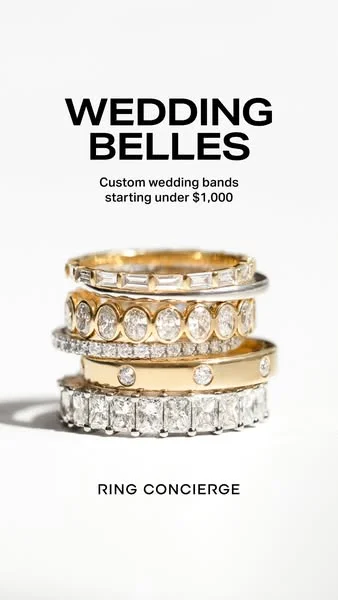
Five diamond bands stacked vertically on pure white with a soft shadow: baguette, oval, bezel, pavé, princess. "WEDDING BELLES" in heavy black caps, "Custom wedding bands starting under $1,000" beneath, the wordmark in wide-tracked caps at the bottom. 180 days.
Why it works: The only price in 28 ads, and it is an entry price on a luxury category, which removes the "can I afford it" hesitation without discounting anything. The composition is pure luxury: negative space, one stack, two tones.
Clone it: Any stackable or collectable product where the reader assumes it is out of reach. Stack it, anchor the entry price, keep everything else quiet. Library page.
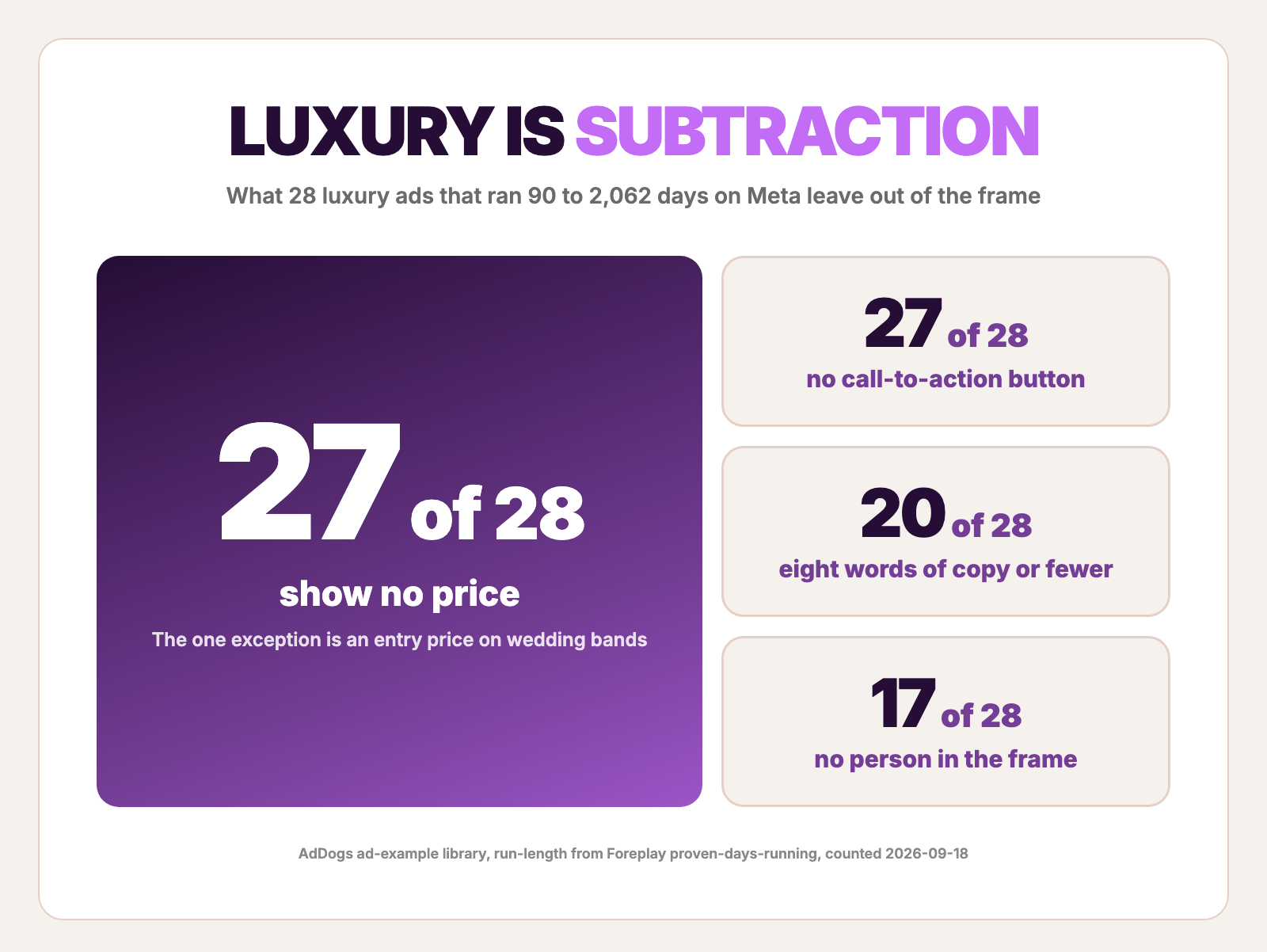
That is 24 numbered cards covering all 28 ads. Counted across the full set:
| Pattern | Count | The exceptions |
|---|---|---|
| No price in the frame | 27 of 28 | Ring Concierge, "under $1,000" |
| No discount or "save" cue | 27 of 28 | Away bundle, which ran 2,062 days anyway |
| No call-to-action button | 27 of 28 | Cozy Earth, tone-on-tone with the tub |
| Eight words of copy or fewer (excluding wordmarks) | 20 of 28 | Everlane, Vuori, Original Grain, Sol de Janeiro, Snif, Tatcha, Boll & Branch, Oura dark |
| Zero copy, wordmark or nothing | 8 of 28 | Both Rimowa splits, both Reiss, Bader, Caraway, Oura ice, Louboutin |
| Tonal palette (neutrals plus at most one accent) | 22 of 28 | Away bundle, Sol de Janeiro, Snif, Tatcha, Bader, HexClad, four of them brand-color systems |
| No person in the frame | 17 of 28 | Two more show only hands; nine show a model, and four of those crop out the face |
| Third-party proof (quote, review, badge, creator) | 5 of 28 | All at the accessible end; none of Rimowa, Reiss, Louboutin, Boll & Branch |
| Ran 365 days or more | 12 of 28 | The three longest (Away, Caraway, Boll & Branch) are all Facebook, all ten words or fewer |
The Rimowa splits and the Reiss stills are each one template with the scene swapped, and every half of each pair has run more than 400 days. Build the frame once, re-shoot the panel, and you have a system instead of an ad. Browse the rest of the fashion, jewelry, and home decor ad examples in the library for the ones that did not make the cut.

Create your own fashion product ads
Create your ad
Luxury marketing strategy: seven rules the ads follow
Luxury is subtraction. Every rule below is something luxury ads don't do, and each one has a count from the 28 statics and a reason from the research.
1. Leave the price out of the frame. 27 of 28 do. Hermès does not run promotions and gates its most wanted bag behind a purchase history; BCG's 10,000 luxury consumers say 70% have walked away from a price they could not justify, which means the price needs an argument, and an argument belongs on the product page, not on a still. Put the price in the caption if you must. Ring Concierge is the exception that shows the one acceptable form: an entry price on a category the reader assumes is out of reach.
2. No button drawn into the creative. 27 of 28. Cozy Earth's sage rectangle on a sage tub is the only one, and it reads as furniture. The "Shop now" button Meta places under the ad is a different thing: it sits outside the image, and it is where the click happens. Kapferer's anti-law 15 is "do not sell"; a small brand can't afford that literally, so it moves the selling to the primary text and the landing page and leaves the image to do what Chanel's does.
3. Eight words or fewer. 20 of 28, and 8 carry nothing but a wordmark. Patek Philippe is the canon's reminder that one sentence can carry 30 years, but only if it is the only sentence.
4. One object, or one person with the face cropped. 17 of 28 show no person at all and two more show only hands; of the nine that show a model, four crop the face (Everlane, Mejuri, Bader, Louboutin). A face makes the viewer read an expression. A product with room around it makes the viewer read the product. Iseki's experiment found that empty space alone raised perceived luxury and perceived quality with nothing but a logo on the pack.
5. A tonal palette, or your own brand system. 22 of 28 use neutrals plus one accent. The six that do not are Sol de Janeiro, Snif, Tatcha, Bader, HexClad, and the Away gradient, and four of those are brand-color systems the shopper already recognizes. Saturation reads as luxury when the shopper already knows it as your brand.
6. A small logo, or none. Logo visibility ranked last among purchase drivers in BCG's 2026 survey; Han, Nunes, and Drèze found the wealthy buyers with the least need for status pay more for goods only insiders recognize. Louboutin ran 190 days with no wordmark at all. If you don't have a signature the reader knows, keep the wordmark and keep it thin.
7. Build the frame once, swap the scene. The Rimowa and Reiss pairs are the same template with a different photo in one panel, 400+ days each. A system produces the second ad for the cost of a photograph, and the third for the cost of a product swap.
How to make your ad look expensive without the budget
Every luxury advertising guide on the first page of Google answers this question in one paragraph with no example. The worked version, using the library above:
Start with a reference that already runs on the codes. The Rimowa stacked hero (rule 1, 3, 5, 6) or the Boll & Branch bed (rules 1 through 5) are the safest starting points because they have each run more than 400 days and contain nothing that dates. Open it in AdDogs and clone it with your product: upload your product photo, and in seconds the AI rebuilds the composition around your object, with your brand colors extracted from your logo. Skip the logo. Basic has no logo option, Pro and Ultimate have an "Add your logo" switch that stays off until you flip it, and rule 6 says the buyer you want doesn't need it. Pick the dimension the placement needs; each render is one credit, and Pro and Ultimate unlock all 14 aspect-ratio options.
The selling goes under the image, not on it. Meta will put its own "Shop now" button beneath the creative, and the primary text carries the price and the offer. For a $95 full-grain leather tote cloned into the Rimowa frame, the whole caption is three lines:
Then do the one thing the houses won't. Anti-law 20 is "do not test," and it is the structural advantage a $12/mo advertiser has over a €9.2B one. Generate three to five variants of the same luxury composition, run them as a creative test on a real budget, and let Meta pick. Thirty credits on Basic is 30 variants for $0.40 each.
Keep the product photo real and don't badge the output. The Journal of Advertising Research study "When AI Doesn't Sell Prada" found that disclosing AI-generated imagery costs luxury brands perceived effort and authenticity in a way it does not cost mainstream brands, and that strongly creative imagery offsets the penalty. The practical reading: the layout can be cloned, the product should be photographed, and the ad should be judged on whether it looks expensive rather than on how it was made.
Two boundaries. Cloning a layout is not copying a brand: the composition, the negative space, and the type hierarchy are conventions, and the wordmark, the spikes, and the panther are trademarks. The legal line for cloning an ad covers where it sits. And the library carries 13,500+ ad examples but no Gucci, Dior, or Chanel statics, because the houses' Meta ads rarely surface in the trackers the library draws from. If the ad you want to borrow is a house campaign you screenshotted, upload it; AdDogs clones any ad, not only the ones in the library. The walkthrough for recreating a winning static shows the upload path end to end.
The cost sheet: Chanel spent $33M on one film. Boll & Branch spent one photograph and ten words on an ad that has run 1,794 days. On AdDogs Basic, $12/mo buys 30 finished ads at $0.40 each; Pro is $33 for 100, Ultimate $63 for 212.
Methodology
Library statics: the AdDogs production library held 14,168 public ad examples on September 18, 2026, of which 1,056 carried a luxury or premium signal in their AI description or vibe tag. From those we pulled 130 candidates from a list of premium and accessible-luxury advertisers and chose 28 by lane coverage (luggage, fashion, jewelry, fragrance and beauty, home, wearables, footwear), a maximum of three per brand, and run-length. Run-length is Foreplay's "proven days running," the days an ad had been live when Foreplay last checked it; for these 28 the checks fall between April 7 and August 31, 2026. It measures how long the advertiser kept paying and says nothing about return on spend. Any reader can verify a figure by searching the brand in the Meta Ad Library, filtering to active ads, and reading the "Started running on" date. Twenty-four of 28 had run at least 180 days; the four under (Away trio, Tatcha, Augustinus Bader, Koio) were kept for lane coverage and are marked. Copy was transcribed from each image, not from metadata. Heritage houses are absent from the library because they rarely run ads Foreplay can track; Christian Louboutin is the one exception. Library category paths in the links are the library's own, and a few are odd; they resolve.
Video canon: 14 campaigns, each YouTube ID verified live on September 18, 2026 through YouTube's oEmbed endpoint, with the title and channel recorded. Chanel, Tiffany, Patek Philippe, and Rolls-Royce are brand-official uploads; the rest are archive re-uploads because the brand deleted or never posted the film, and they are labeled as such. Archive copies can vanish; the IDs will be re-checked at publication.
Evidence: sources are tiered A (primary data, official documents, peer-reviewed research) through D (unverified or anecdotal), and nothing below C appears here. Platform-commissioned research (TikTok), vendor benchmarks (Dash Social), and press-reported figures with no company confirmation (Cartier's €4M) are labeled where cited. What we could not verify and therefore left out: Hermès's communication spend, any post-2018 breakdown of luxury ad budgets by channel, any luxury-specific Meta or TikTok conversion case study with published methodology, Cartier's "180 million viewers," and an exact Instagram count for the Jacquemus clip.
FAQ
What makes an ad look luxurious?
Mostly what it leaves out. Across 28 long-running luxury ads on Meta, 27 show no price, 27 have no button, 20 carry eight words or fewer, 17 show no person, and 22 use a tonal palette. A peer-reviewed experiment with 1,193 participants found that large white space and a luxurious typeface raised perceived luxury and perceived product quality with nothing but a logo on the pack.
How do luxury brands advertise differently from mass-market brands?
They sell standing rather than benefits. Kapferer and Bastien's anti-laws of luxury marketing include "the role of advertising is not to sell," "do not sell," and "do not test," and the ads obey: no price, no offer, no call to action, long takes and silence in video, one object with room around it in stills. LVMH spends more than €9.2B a year, about 11.4% of revenue, on advertising and promotion built that way.
Why don't luxury brands show prices in their ads?
Because the price is the argument, and the argument belongs on the product page. BCG's 2026 survey of 10,000+ luxury consumers found 70% had walked away from a purchase over pricing they could not justify; a still can't justify a price, so the houses keep it out. Hermès goes further, running no promotions and gating its Birkin behind a purchase history. Of 28 long-running luxury ads on Meta, one shows a price and one shows a "save" cue.
Do luxury brands run Facebook and Instagram ads?
Yes, and some run the same one for years. All 28 statics in this post are real Meta or Instagram ads; 12 ran for more than a year and the longest, an Away bundle, for 2,062 days. In a TikTok-commissioned study, two-thirds of first-time luxury buyers cited social as their entry point. The counter-signal is Bottega Veneta, which deleted its social accounts in 2021 and grew 19% in North America in Q1 2025 while its parent fell 14%.
What are the best luxury commercials of all time?
The ones that get studied are Chanel N°5 with Nicole Kidman (2004, $33M, the Guinness record), Patek Philippe's "Generations" (one sentence, running since 1996), Cartier's "L'Odyssée de Cartier" (2012, €4M press-reported), Louis Vuitton's "L'Invitation au Voyage" (its first TV ad, 2012), Burberry's "Open Spaces" (two Gold Lions, 2022), Porsche's "The Heist" (17.7M views, 2020), and Jacquemus's CGI bags (2023). All 14 in the canon above carry a source and a verdict.
Can a small brand copy a luxury ad's style legally?
Copy the composition, not the wordmark. Negative space, a tonal palette, a serif headline, a split-screen layout, and a stacked product shot are conventions nobody owns. A wordmark, a house signature like Louboutin's spikes, or a campaign's exact photograph are protected. Clone the composition with your own product photo and your own name, one credit on AdDogs, and the legal question mostly disappears; the specifics are in our post on whether it is legal to clone an ad.
How much does it cost to make a luxury-style ad?
Anywhere from $33M to $0.40. Chanel's 2004 N°5 film holds the Guinness record at £18M; Cartier's Odyssée was reported at €4M; Boll & Branch's 1,794-day Facebook ad cost one styled photograph and ten words. On AdDogs, cloning a luxury-coded reference with your product costs one credit, which is $0.40 on the $12/mo Basic plan and $0.33 on Pro.