AI-generated ads: what 2026's evidence actually shows


Human creative teams and generative models ran ads on the same network, across 500 million impressions. Result: a statistical tie. AI-generated ads pulled a 0.76% click-through rate against 0.65% for human-made work, and the gap dissolved under matched-pair controls (Columbia, Harvard, TUM, and CMU researchers on Taboola data). Only one group underperformed: ads the audience perceived as AI, whatever their true origin. That one finding explains most of what happened in advertising this year — the quiet wins, the four-day retractions, the brands now selling "human-made" as a feature. Below: 36 cataloged campaigns, the performance research, the rules, and what a small brand should do with an AI ad generator.
What counts as an AI-generated ad
An AI-generated ad is an ad whose creative — the imagery, video, voice, or copy — came out of a generative model rather than a camera, a design file, or a writer's draft. In practice the label covers a spectrum: a fully synthetic 60-second brand film sits at one end, a product photo with a model-swapped background at the other, and most working ads in 2026 live in between.
Brands use generation in eight distinct ways, and the split matters because the quiet uses bank the ROI while the loud ones carry the risk. Uses 2 through 6 below are largely invisible to consumers — which is exactly why they work. Uses 1 and 3 are the visible categories driving the backlash cataloged below.
| # | Use | Real example | Maturity | Where it breaks |
|---|---|---|---|---|
| 1 | Full spot generation (video) | Coca-Cola holiday spots; Kalshi NBA Finals | Emerging, volatile | Heritage-brand emotion; character consistency across shots |
| 2 | Product imagery and backgrounds | E-com standard: $30–$200/product shoots vs. ~$0–10/image | Mature — the quiet workhorse | Reflective products; label and pack text |
| 3 | Virtual models and avatar "UGC" | Mango Teen; avatar ad factories | Growing fast, ethically loaded | Close-ups; the FTC fake-testimonial line |
| 4 | Variant multiplication and resizing | Salomon: 1,600+ creatives in 8 weeks, zero shoots | Mature — where measurable ROI lives | Volume without a judgment layer; off-brand drift |
| 5 | Localization and versioning | British Council: 1,000+ assets, −70% production cost | Mature | Cultural nuance; text baked into imagery |
| 6 | Personalization / dynamic creative optimization (DCO) | Baseline for multi-segment performance teams | Mature, vendor-hyped numbers | Creative fatigue at the modular seams |
| 7 | Concepting and pre-visualization | Nike: 5,000+ Midjourney images before a human-made final | Mature and uncontroversial | Nothing — consumers never see it |
| 8 | Voice and music | TTS voiceovers, generated music beds | Capable, backlash-prone | Voice cloning triggers disclosure rules |
Usage examples per Superside's campaign roundup and Claid's product-photography cost data (vendor figures); the adoption scale behind the table comes from the IAB.
The state of AI-generated ads in 2026, in numbers
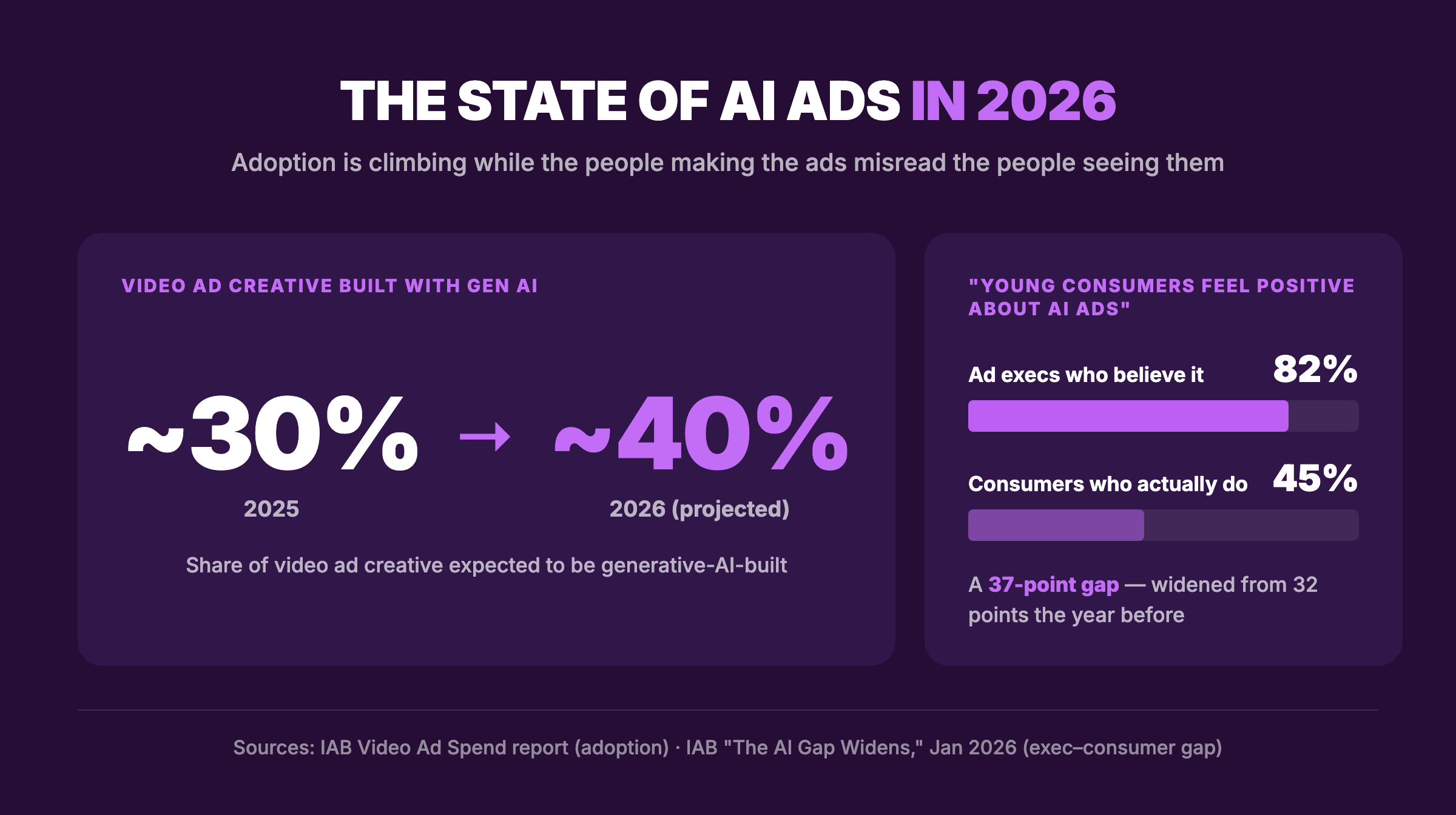
Adoption first: the IAB's Video Ad Spend report projects roughly 40% of video ad creative will be built with generative AI in 2026, up from about 30% in 2025, with 86% of video buyers already using it or planning to. Scope matters: that figure measures video creative, not all advertising.
Sentiment runs the other way. In the IAB's "The AI Gap Widens" study (505 Gen Z and millennial consumers plus a small arm of 104 executives), 82% of ad executives believe young consumers feel positive about AI-generated ads. Among those consumers, 45% actually do — a 37-point gap, widened from 32 points the year before. Within Gen Z, 39% are explicitly negative.
Zoom out to all US consumers and the picture hardens: Gartner's March 2026 survey (n=1,539) found 50% prefer to give their business to brands that don't use generative AI in consumer-facing content, and 68% frequently wonder whether the content they see is real.
Do AI-generated ads work? The performance evidence
Short answer: yes, until the audience notices. Every serious 2025–2026 measurement converges on that conditional.
The perception rule: no penalty until the audience notices
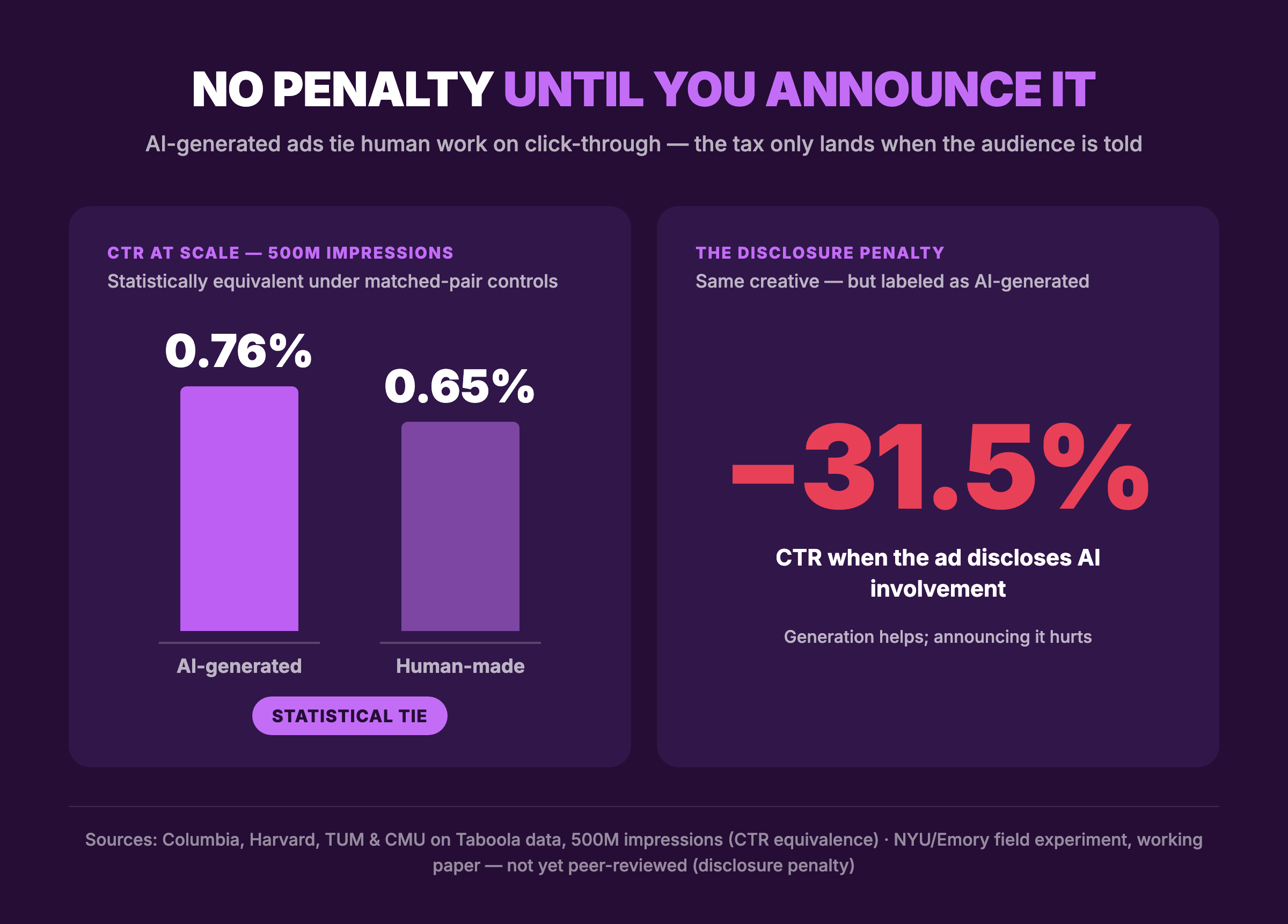
Start with the largest behavioral dataset, the Columbia-led study on Taboola's ad network: 500 million impressions, roughly 300,000 ads, 3 million clicks (data supplied by the platform). Raw CTR favored AI creative 0.76% to 0.65%, and matched-pair analysis called the two statistically equivalent. What moved performance was perception: only ads perceived as AI-made underperformed, regardless of who made them. About 50% of AI ads passed as human-made, and a large, clear human face was the strongest "human" cue.
A field experiment by NYU and Emory researchers points the same direction with a sharper edge: fully AI-generated display ads beat human-expert ads by 19% on CTR — a working paper, not yet peer-reviewed, so hold it loosely — while disclosing the AI involvement cut CTR by 31.5% in the same study. Generation helps; announcing it hurts.
Kantar's testing of hundreds of AI ads from its LINK database adds the creative-quality read: when the AI work is integrated well, over 40% of ads land in the top tier for branded cut-through. When the AI is obvious, scores drop notably.
Where AI ads lose: disclosure, luxury expectations, emotional storytelling
Disclosure is the first tax, and it isn't flat. Peer-reviewed work in the Journal of Advertising Research — the "When AI Doesn't Sell Prada" study — found the penalty concentrates on luxury and craft-expectation brands, mediated by perceived effort and authenticity: buyers punish AI hardest where they expected human hands. A separate Journal of Research in Interactive Marketing experiment (n=358, small) found disclosure cuts perceived ad credibility and purchase intent.
Emotional storytelling is the second. Kantar's finding that generative ads evoke stronger but often negative emotions pairs with System1's Super Bowl LX read: AI-product ads averaged 2.1 stars against a 2.7 overall average. And a NielsenIQ EEG study from late 2024 (older, small EEG arm) found even high-quality AI ads produced weaker memory encoding, with viewers calling them "annoying, boring, confusing."
| Claim | Figure | Source | Independent? |
|---|---|---|---|
| AI vs. human CTR at scale | 0.76% vs. 0.65% — statistically equivalent; only perceived-AI ads underperform | Columbia et al. × Taboola, 500M impressions | Independent academics; platform-supplied data |
| Fully-AI display ads | +19% CTR vs. human-expert ads | NYU/Emory field experiment (working paper) | Independent, not peer-reviewed |
| AI disclosure penalty | −31.5% CTR | Same paper | Independent, not peer-reviewed |
| Luxury-brand disclosure penalty | Negative response concentrates on luxury/craft brands | Journal of Advertising Research | Independent, peer-reviewed |
| Well-integrated AI creative | >40% land top-tier for branded cut-through; obvious AI scores worse | Kantar LINK | Independent testing firm |
Three things the evidence does not support. One: any unconditional "AI beats human" claim — the equivalence held under controls, and the +19% comes from one non-peer-reviewed paper that also found the −31.5% penalty. Two: platform lift claims as evidence — Meta's 14% lower cost per lead and TikTok's ">80% of test cases" are internal tests with unpublished methodology, citable only as what the platform claims. Three: surveys as behavior — stated-preference numbers measure attitudes under explicit AI framing, while the behavioral data shows no penalty when the AI goes unnoticed.
36 AI ad campaigns, stunts, and counter-signals, cataloged
Five years of famous-brand AI advertising examples, 2021 through August 2026, every entry re-verified against live sources on August 31, 2026 (method below). Type distinguishes actual AI-generated campaigns from the stunts, platform incidents, and counter-signals that define the category's edges. To see what's running right now rather than what made headlines, the Meta Ad Library guide shows how to pull any brand's live ads.
| # | Brand / campaign | Date | Type | What AI did | Verdict | Strongest number |
|---|---|---|---|---|---|---|
| 1 | Cadbury × Shah Rukh Khan | Oct 2021 | AI campaign | Face/voice synthesis personalized ads per local store | Success | 2,000+ SMBs, 500+ pincodes; Cannes Titanium |
| 2 | Heinz "Draw Ketchup" | 2022 | AI campaign | DALL-E 2 drew "ketchup," rendered Heinz | Success | 850M–1.15B earned impressions; +38% engagement |
| 3 | Coca-Cola "Create Real Magic" | Mar 2023 | AI campaign | Fan co-creation platform on licensed brand assets | Success | Content at ~1/10 cost; 30 creators to Academy |
| 4 | Stradivarius "STRAD (A.I.) VARIUS" | Mar 2023 | AI campaign | Virtual models in garments that don't exist; "(A.I.)" in the copy | Contested | 9,463 likes; "put real humans" comments |
| 5 | Levi's × Lalaland.ai | Mar 2023 | AI campaign | AI-generated "diverse" fashion models (test) | Failure (walked back) | Backlash forced "won't replace real shoots" |
| 6 | Casablanca "Futuro Optimisto" | Apr 2023 | AI campaign | Midjourney campaign stills by Luke Nugent, disclosed in captions | Success | 11,433 likes on launch post; no labor objection |
| 7 | Selkie Valentine's capsule | Jan 2024 | AI campaign | Midjourney-derived print artwork; AI disclosed in a comment, not the caption | Failure | 795 comments; "too many toes"; founder swore off AI |
| 8 | Etro "Nowhere" | Jan 2024 | AI campaign | Synthetic cast and sets; prompt artist credited in every caption | Success | 5,638 likes; no backlash found |
| 9 | Under Armour × Anthony Joshua | Mar 2024 | AI campaign | Mixed AI/licensed-footage brand film | Contested | Industry plagiarism backlash; made in 3 weeks |
| 10 | Klarna AI marketing factory | 2024 | AI campaign | Org-wide AI image and copy production | Success | ~$10M/yr saved (self-reported) |
| 11 | Dove "The Code" pledge | Apr 2024 | Counter-signal | Pledge never to use AI to create or distort women in ads | Success | 33,000+-respondent study across 20 countries |
| 12 | Toys "R" Us Sora film | Jun 2024 | AI campaign | First brand film made with Sora | Failure | Negative sentiment 13.5%→53.4% in 30 days |
| 13 | Mango Teen "Sunset Dream" | Jul 2024 | AI campaign | Fully AI campaign imagery for teen line | Contested | Ran in 95 markets; "false advertising" criticism |
| 14 | Coca-Cola "Holidays Are Coming" (yr 1) | Nov 2024 | AI campaign | Full AI remake of the 1995 trucks spot | Contested | System1 5.9/5.9 vs. viral "soulless" backlash |
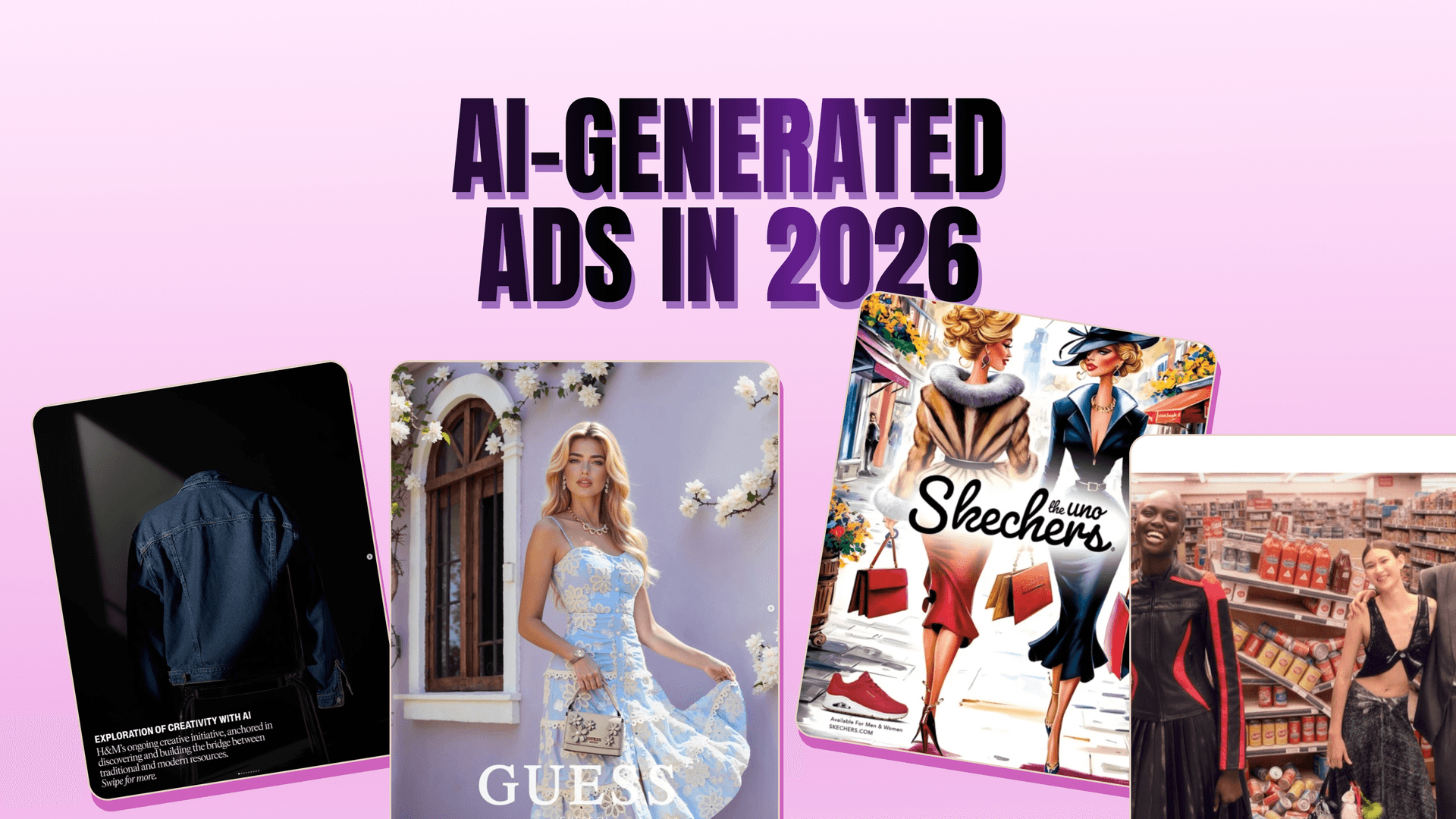
| 15 | Skechers Vogue print ad | Dec 2024 | AI campaign | AI-generated full-page print artwork | Failure | Viral teardown; "now I hate you" quote |
| 16 | Zalando editorial imagery | Q4 2024→2025 | AI campaign | AI-generated catalog/editorial images at scale | Success | ~70% of editorial images AI; −90% cost (self-reported) |
| 17 | Volvo Saudi Arabia "Come Back Stronger" | Mar 2025 | AI campaign | First AI-generated Volvo brand film | Failure (pulled) | Pulled by HQ; zero cars shown |
| 18 | H&M digital-twin models | Mar–Jul 2025 | AI campaign | Consented, paid, watermarked model twins | Contested | 30 models twinned; Model Alliance objection |
| 19 | Kalshi NBA Finals spot | Jun 2025 | AI campaign | Fully AI-generated Veo 3 primetime spot | Success | $2,000, ~48 hours, national primetime |
| 20 | Guess AI models in Vogue | Aug 2025 | AI campaign | AI models with tiny-print disclosure | Failure | CNN/Forbes "reader fury" coverage |
| 21 | Friend AI subway takeover | Sep 2025 | Stunt/context | Out-of-home ads about an AI product | Contested | 11,000 car cards defaced en masse |
| 22 | Estée Lauder / Too Faced × Firefly | Oct 2025 | AI campaign | Firefly trained on brand's own imagery | Success | Campaign in 16 days; zero backlash |
| 23 | Aerie "100% Aerie Real" | Oct 2025 | Counter-signal | No-AI, no-retouching pledge; Pamela Anderson film Mar 2026 | Success | 45.7K likes; Q4 comps +23% (brand-wide) |
| 24 | Mondelez GenAI production tool | Oct 2025 | AI campaign | Brand-locked proprietary content tool | Success | $40M invested; 30–50% cost cut (self-reported) |
| 25 | Unilever digital product twins | 2025 | AI campaign | Pixel-perfect product twins, no synthetic humans | Success | Up to 55% savings; 2× CTR (self-reported) |
| 26 | Coca-Cola "Holidays Are Coming" (yr 2) | Nov 2025 | AI campaign | Second consecutive AI holiday spot | Contested | CARMA positive 23.8%→10.2%; System1 max 5.9 |
| 27 | Meta "AI granny" / True Classic | Nov–Dec 2025 | Stunt/context | Platform silently swapped ad for AI creative | Failure (platform-side) | Off-target AI ad ran 3 days unapproved |
| 28 | McDonald's Netherlands holiday spot | Dec 2025 | AI campaign | AI-generated anti-holiday TV spot | Failure (pulled) | Pulled within 4 days |
| 29 | Valentino DeVain project | Dec 2025 | AI campaign | Labeled AI stills and reels by nine digital artists | Contested | "Cheap," "lazy" reactions (Glossy) |
| 30 | Zara AI re-dressing | Dec 2025 | Stunt/context | Real models re-dressed by AI without a new shoot; paid as for a shoot | Context | Not synthetic models, despite headlines |
| 31 | Svedka "Shake Your Bots Off" | Feb 2026 | AI campaign | First primarily-AI Super Bowl spot | Failure | EDO rank #60 of 66; Engagement Index (EI) 57 |
| 32 | Super Bowl LX AI wave | Feb 2026 | Stunt/context | 15 of 66 spots AI-linked (mostly as subject) | Success (as subject) | ai.com EI 910 — 9.1× median |
| 33 | Gucci "Primavera" teasers | Feb 2026 | AI campaign | Four AI stills; "Created with AI" on X, no label on Instagram | Failure | 3.2M X views; 1,006 replies vs. 633 likes |
| 34 | Claude "Ads Are Coming to AI" | Feb–Jun 2026 | Counter-signal | Human-made ads about AI restraint | Success | Cannes Film Grand Prix; EDO EI 280/279 |
| 35 | Diesel SS26 campaign | Mar 2026 | AI campaign | AI-generated surreal scenes behind real talent | Success (early read) | No backlash found as of Aug 2026 |
| 36 | AI-UGC tier (Arcads) | 2025–2026 | Stunt/context | Category note: AI-actor ad factories | Context | $16M seed; ~100K videos/mo |
Nine cases below, grouped by what decided them.
The wins locked the AI to what the brand owned
Heinz, 2022. Agency Rethink fed DALL-E 2 generic "ketchup" prompts, and the model kept drawing Heinz's bottle — brand equity confirmed by a machine trained on the internet. Result: 850M–1.15B earned impressions (sources disagree on the top end) and +38% engagement over prior campaigns (Adweek, Latana). Nobody called it slop, because the AI's output was the brand's own equity reflected back.
Zalando, Q4 2024 onward. About 70% of the retailer's editorial campaign images were AI-generated in Q4 2024, with costs down roughly 90% and turnaround cut from 6–8 weeks to 3–4 days — self-reported figures, carried by Reuters. Zalando's framing was unusually honest: the win is speed to micro-trends, "not because AI content is better than human-created content." Catalog imagery, no synthetic celebrities, no backlash found.
Estée Lauder's Too Faced, October 2025. First fully-AI Too Faced campaign, built on Adobe Firefly trained on the brand's own product imagery — swatches, textures, finishes (Adobe, Retail Brew). Most of the campaign came together in about 16 days. An edit that once took 4 days took 1. Zero backlash. Train the model on what you own, ship without a sentiment event — the enterprise template.
Kalshi, June 2025. A fully AI-generated 30-second spot aired during the NBA Finals: $2,000 and about 48 hours of work, against the seven figures and months a comparable spot costs (Ad Age). Filmmaker PJ Accetturo generated 300–400 Veo 3 clips and used 15. Deliberate absurdist chaos: the AI look was the joke, and a challenger brand had no heritage for it to violate.
The failures share one moment: the audience noticed
Toys "R" Us, June 2024. First brand film made with OpenAI's Sora, premiered at Cannes. Sentiment tracking recorded the cleanest collapse in this catalog: positive mentions fell 12.2% to 3.4% and negative rose 13.5% to 53.4% within 30 days (Marketing-Interactive). A nostalgic founder origin story was precisely the wrong brief to hand a video model.
Skechers, December 2024. A full-page AI print ad in Vogue — disintegrating garments, gibberish awning text, faceless background figures — drew a frame-by-frame TikTok teardown and produced the defining consumer quote of the slop-tax era: "You actually didn't save any money because now I hate you" (Fortune).
McDonald's Netherlands, December 2025. An AI-generated holiday spot went live December 6; McDonald's pulled it within 4 days, after backlash hit both the visual quality and the cynical anti-holiday tone (NBC News). McDonald's apologized, citing guest feedback, and set the official upload to private — the spot now survives only in news coverage. That 4-day window is the current velocity benchmark for an audience-forced retraction.
Svedka, February 2026. First "primarily AI-generated" Super Bowl spot. EDO ranked it #60 of 66 with an Engagement Index of 57 — 43% below the median ad. Same game: ai.com's spot about AI scored 910, the most effective ad of the night. Audiences engaged with ads about AI and punished the one ad that looked like it.
The Coca-Cola paradox: both readings are true
Both of Coca-Cola's AI remakes of "Holidays Are Coming" scored the maximum 5.9 stars on System1's Test Your Ad panel — respondents, blind to provenance, rated year one "exceptional," and year two repeated the 5.9 with 97% distinctiveness (The Grocer). Meanwhile CARMA's social monitoring watched the positive share of conversation fall from 23.8% to 10.2% after the 2025 launch, while the negative share barely moved (31.4% to 32.0%). Read it precisely: positivity collapsed into neutrality and mockery rather than hostility. Effectiveness panels blind to provenance and social sentiment saturated with it are measuring different realities now. Two years, same ad property, same split — wider gap. Watch both years back to back and judge for yourself.
Static AI ads: where most of the volume actually runs
The headline cases above are video. The volume is stills. The IAB's 40% figure measures video creative; product imagery, social statics, catalog pages, and print are where uses 2 through 5 in the first table live, and where a small advertiser's AI output actually ships. Stills also make the perception rule less forgiving, because a static is one frame the viewer can study for as long as they like, and every artifact stays put.
Fashion ran the public experiment first, on Instagram, from spring 2023. The brands' own posts are embedded below wherever the account allows it; every permalink was opened and checked against the verified account on September 9, 2026, and like counts are as observed that day.
Disclosed as art direction, with no synthetic humans to defend
Casablanca, April 2023. The Paris label's SS23 "Futuro Optimisto" campaign was generated in Midjourney by AI artist Luke Nugent, art-directed by Steve Grimes, and disclosed in the captions as "AI powered by human emotion" (Hypebeast). Hyperreal-painting Mexican landscapes, space cowboys, a painterly rather than photoreal look: the launch post drew 11,433 likes and no labor objection surfaced, because it read as art direction rather than cost-cutting.
Etro, January 2024. The SS24 "Nowhere" campaign used a synthetic cast in synthetic gardens, and every caption carried the same asterisk: "Digital artist Silvia Badalotti used AI as a tool to reproduce her and Marco De Vincenzo's creative input" (FashionUnited). A luxury house credited the prompt artist by name, so the disclosure reads as authorship rather than confession. No backlash coverage found.
Diesel, March 2026. Photographer Mark Peckmezian shot real models, then Diesel placed them in front of AI-generated "everyday debacles": a sinking yacht, a supermarket shelf avalanche. The caption says so outright, "gleefully posing in front of a series of AI-generated fiascos," and the same wording sits on diesel.com. Six months of trade coverage, no backlash found. The AI is confined to the joke; real people carry the frame.
Virtual models: the line the audience polices
Stradivarius, March 2023. The earliest verified Inditex AI static, sixteen months before Mango: virtual models wearing garments that do not exist, "an exaggeration of the real collection," with "(A.I.)" written into the copy (Apparel Resources). 9,463 likes, and the top visible comment is a demand for real humans.
Mango, 2024. Mango's first fully AI-generated campaign, "Sunset Dream" for the Teen line, ran in 95 markets; the brand trained its own model on photographs of the real garments, then its art team retouched the output (Mango). The disclosed posts carry a caption line, in Spanish, that AI helped make the images. Criticism ran to "false advertising" for selling real clothes on synthetic bodies, and Mango repeated the format on later Teen drops anyway (Expansión). No sentiment or sales data published either way.
H&M, July 2025. The most rights-careful version so far: digital twins of consenting professional models, who keep the rights to their double and are paid per use, each still labeled "DIGITAL TWIN" in the corner of the image (H&M Group, FashionUnited). The Model Alliance objected anyway, on consent and compensation grounds. The embed opens on the title card; the twins are the third, fourth, and sixth slides.
Guess, August 2025. Two AI models by London agency Seraphinne Vallora, in a double-page Vogue ad with the disclosure in small print in one corner. The BBC reported the agency shows clients ten draft models and charges "up to low six figures" for a client like Guess (BBC); a TikTok teardown reached 2.7 million views, and Vogue's defense was that it was an advert, not an editorial decision (CNN via KRDO, ABC). Guess never posted the creative on its own account. The agency did, which is the post embedded here.
The pattern across four brands: the audience did not object to AI in the frame. It objected to a synthetic person standing in for a paid one, and it objected hardest where the disclosure was smallest. New York has since written that line into law, covered in the rules below.
The stills that got caught
Selkie, January 2024. A small DTC label put Midjourney-derived puppy and kitten artwork, hand-painted over by the founder, on a $249 Valentine's puff dress, and disclosed the AI in a comment rather than the caption (TechCrunch). The post drew 9,085 likes and 795 comments, and the comment that traveled was "One of the puppies has too many toes. This is embarrassing." The founder said she would not use AI imagery in future collections. Small-brand version of the Skechers teardown: the artifact was the tell, and the tell was in a still anyone could zoom.
Gucci, February 2026. Four AI-generated stills teasing Demna's debut show: a Milanese grandmother in a fur coat striding through a wood-paneled restaurant, and three more. On X the post was labeled "Created with AI" and drew 3.2 million views, 1,006 replies, and 633 likes; the Instagram version carried no AI wording in the caption at all. The BBC's summary of the reaction: "Bleak days when Gucci can't find a real human Milanese grandmother to wear an outfit from 1976," and "AI slop" (BBC via AOL). Gucci and Kering did not comment. It is the freshest illustration of the luxury penalty the Prada study predicted: the label on X did not soften it, and the Instagram post dropped the label.
Skechers, for the record, kept going after the Vogue page: a billboard in August 2025 and New York subway cards in April 2026 with the same generative look (Creative Bloq). Whether that is a strategy or a habit, nobody at Skechers has said.
The counter-signal, with sales numbers attached
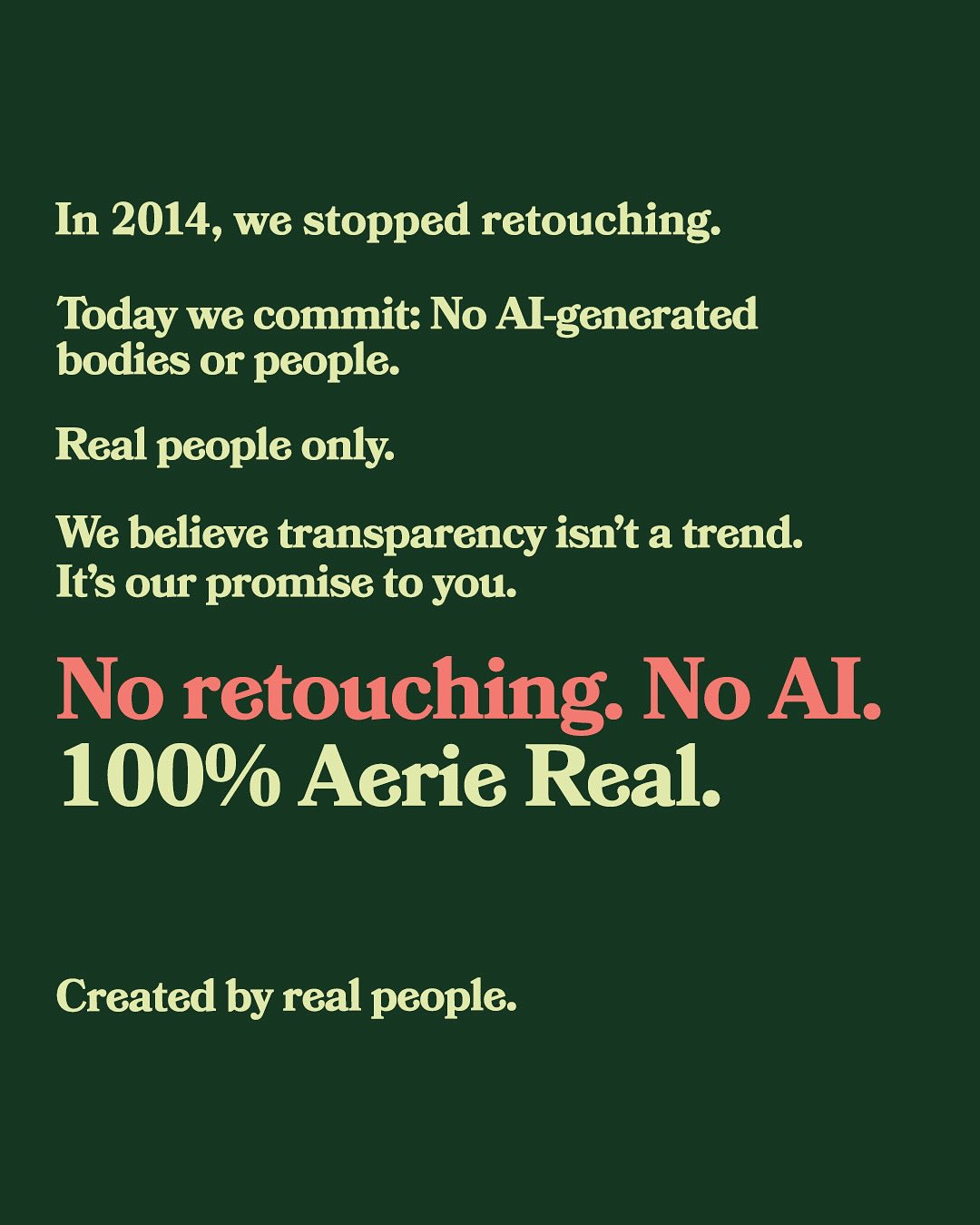
Aerie, October 2025 onward. On October 9, 2025 Aerie posted a plain typographic pledge: no AI-generated bodies or people, no retouching, "100% Aerie Real." As of September 2026 it sits at 45.7K likes and 796 comments; Business Insider reported it as the brand's most popular post of the year, with Instagram engagement up about 75% in the two weeks after (Business Insider via AOL). Aerie's CMO then reported Q4 2025 comparable sales up 23% and brand awareness up 21 points over the quarter, and followed with a Pamela Anderson film in March 2026 titled "You can't prompt this" (Marketing Dive). The comps are brand-wide and not isolated to the pledge, so read them as correlation. The account blocks embeds, so the graphic is reproduced here from the post.
Dove got there first, in April 2024, with a pledge never to use AI to create or distort women in its advertising, backed by a 20-country study of more than 33,000 respondents (NBC News), and the film that carried the pledge used AI output only to show what generators produce when asked for "beautiful."
What a small advertiser takes from the stills is the same three moves the video winners made. Keep synthetic humans out of the frame unless you are prepared to disclose them in the caption, not the corner. Put the AI to work on the background, the scene, and the product, where Diesel and Casablanca put it. And treat disclosure as a credit line, the way Etro did, rather than fine print, the way Guess did. That is also the workflow this study recommends for a small advertiser: a real product photo, a proven layout, and the model constrained to the composition.

Create your own static product ads
Create your ad
The backlash — and the brands selling "human-made"
Gartner's 50%-prefer-AI-free finding above is the demand signal; the trust math explains it. In a Klaviyo and Datalily survey of 8,000 consumers across eight countries (vendor-commissioned), 7% said visibly AI-generated marketing makes them trust a brand more. For 31%, it cuts trust. A 4-to-1 downside ratio on the visible stuff.
Marketers responded by productizing the opposite. CNN called 2026 "the year of anti-AI marketing", citing iHeartMedia's "guaranteed human" audio, backed by its own commissioned research finding 90% of listeners want media made by real people. Adweek's tally adds Almond Breeze's "The Pitch — No AI Needed" with the Jonas Brothers in January 2026, Equinox's New Year campaign (real human portraits set against deliberately fake AI imagery; Equinox pulled one of those images in July after a backlash), and Aerie's pledge, covered above. Anti-AI is now an aesthetic — film grain, handwriting, "NO AI" disclaimers in the corner of the frame.
Meanwhile the detection game moved. What marked an ad as AI in 2024 mostly doesn't anymore; what marks it in 2026 is subtler (artifact analysis grounded in arXiv 2411.13842):
| Old tell (mostly fixed) | 2026 tell (still live) |
|---|---|
| Six fingers | Hand-object contact — grips that melt into cups and handles |
| All text gibberish | Incidental background text: shop signs and shelf labels as letter-shaped noise |
| Uncanny eyes and faces | Consistency across shots — the same "person" drifting between frames |
| Plastic skin | Over-smooth gradients; reflections and lighting that don't match the composited product |
Audiences that can't articulate those tells still feel them — and per Gartner, 68% are already primed to ask whether what they see is real. Disclosed, deliberate AI-ness dodges the trap from the other side: Diesel's SS26 campaign, above, put AI-generated disaster scenes behind real talent and drew no backlash.
The rules: disclosure, platforms, and law
Regulation is narrower than the discourse suggests. What's mandatory:
| Rule | What it requires | Since |
|---|---|---|
| Meta — political/social-issue ads | Disclose photorealistic AI-created or altered media in political/social ads; automated detection from June 1, 2026 | Early 2024 |
| Meta — ordinary commercial ads | No blanket disclosure mandate | — |
| TikTok | Realistic AI-generated content (AIGC) must be labeled; Ads Manager has a dedicated AI disclaimer; undisclosed realistic AIGC gets rejected | Policy since 2023 |
| Google Ads — election ads | Clear disclosure for synthetic content that inauthentically depicts real people or events | Nov 2023 |
| Google Ads — ordinary commercial ads | No blanket AI-disclosure rule; standard misrepresentation policies apply | — |
| YouTube | Disclose realistic altered/synthetic content (real people saying things they didn't, fake realistic events) | Mar 2024 |
| EU AI Act, Article 50 | Synthetic media must be machine-readable-marked as AI-generated (provider duty); deep fakes must be disclosed (deployer duty) | Aug 2, 2026 |
| FTC — fake reviews and testimonials | AI-generated fake reviews and testimonials banned; civil penalties up to $51,744 per violation | Oct 21, 2024 |
| New York Fashion Workers Act | Models must give separate, explicit written consent before a digital replica is created or used, covering scope, purpose, pay, and duration | June 19, 2025 |
| New York synthetic performer disclosure law (GBL § 396-b) | Any ad, in any medium, must conspicuously disclose an AI-generated human performer; $1,000 for a first violation, $5,000 for each after | June 9, 2026 |
Get three facts exactly right. First, federal disclosure mandates are narrow: no US federal rule requires labeling an ordinary AI-generated product ad, and the platform mandates cover political ads and realistic-deceptive content. The exception is state law. Since June 9, 2026, New York requires a conspicuous disclosure whenever an ad uses an AI-generated human performer, at $1,000 for a first violation and $5,000 for each after, and its Fashion Workers Act requires a model's separate written consent before a digital replica is used. Product imagery with no synthetic person in it falls outside both. Second, the EU AI Act's Article 50 transparency obligations apply from August 2, 2026, so EU-visible synthetic creative now carries a machine-readable marking duty. Third, AI-generated testimonials are already illegal: an AI avatar scripted as a satisfied customer is a fake testimonial under the FTC rule, at up to $51,744 per violation. Product imagery is not a testimonial. Cloning a competitor's layout raises a different question, covered in is it legal to clone an ad.
What this means if you're not Coca-Cola
Small brands are not waiting for permission. Per the IAB, small and mid-tier brands are adopting generative creative faster than the largest brands — the inverse of the usual ad-tech adoption curve. Big brands take the public beatings; small ones quietly bank the volume economics.
One honest caveat: no public CTR or ROAS dataset segments AI-creative performance by advertiser size. Platforms have that data and don't publish it; academics haven't run it. Any vendor telling you "the data shows AI ads work for small brands" is quoting numbers that don't exist.
What the evidence does support is a mechanism that favors you. For a brand nobody recognizes, the Columbia finding is the operative one — zero measurable penalty as long as the ad doesn't read as AI — and the Prada study shows the disclosure tax lands on luxury and craft-expectation brands, a baseline you don't have to defend. Your documented failure mode is different: tail creative. AppsFlyer measured the top 2% of creatives absorbing 43–53% of ad spend across $2.4B; average AI output lands in the long, cheap, ignored tail. That's a direction-and-testing problem, and it's solvable with ad creative testing on a real budget.
One more risk enters through the buying platform itself. True Classic, a men's apparel brand targeting 30-to-45-year-old men, had its top-performing Meta ad silently replaced by an AI-generated cheerful grandmother in an armchair — it ran 3 days before customers flagged it, and the Advantage+ settings to prevent it kept re-enabling (Business Insider via AOL). Same coverage cites Tracksuit's November 2025 survey of 6,000+ US consumers: net sentiment toward AI-generated advertising, negative at 39%. Lesson: you approve the creative before it spends, or the platform will approve it for you.
Handed an AI ad generator, the practical choice for a small brand is not whether to use the model but what to anchor it to. Start from a reference — a real product photo and a layout that has already run — rather than a blank prompt, and let the model vary inside that frame. That is the pattern the craft evidence above points to, and it is the workflow AdDogs is built around.
That workflow is open to anyone: clone a proven ad with your product, and the reference does the creative direction for you.
How to make AI-generated ads that don't read as AI
Six patterns separate the catalog's wins from its failures, and they're all direction decisions.
Anchor to a reference, not a blank prompt. Practitioner guidance converges here: start from a real product shot or a real winning layout and constrain the model, rather than describing an ad from nothing (Typeface, MindStudio). Blank-prompt generation is what agencies call the prompt lottery — the one route with no proven frame to fall back on.
Lock the brand as a system, not with a prompt. Hex codes in every generation, brand assets structured before prompt libraries, explicit rules for what the model may and may not change (Launchcodex). Heinz, Too Faced, Mondelez, and Unilever all won by locking generation to owned assets.
Bound your variants. Generate 3–5 variations per concept and compare, per Adobe's marketer prompting guide — unbounded generation produces the tail creative the spend power law ignores.
Keep a human review gate. Over 70% of marketers have hit an AI output issue, yet fewer than 35% plan to increase brand-governance investment, per ad-tech vendor StackAdapt's survey. Skipped review is how wrong brand colors and thumbnail-invisible artifacts ship. True Classic's swapped ad is what no gate looks like.
Use the hybrid ladder. Nike ran 5,000+ Midjourney images in pre-production and finished with human VFX; Google Creative Lab hands Veo storyboards to human directors (Superside). AI upstream, human judgment downstream.
Prompt like a photographer. Camera and light language — "bright, minimal product scene, primary brand color as accent" — with explicit negative guidance beats "product photo" every time (Adobe).
Slop is a direction problem, not a model problem — Coke and Kalshi used the same class of tech, and direction decided the outcome. Tool choice matters less than the reference you anchor to: the best AI ad generators compared covers the tool question, and the Nano Banana 2 production test and GPT Image 2 tested on real ad briefs cover the models. Or start where the craft evidence points: browse the ad examples library, pick a proven layout, and generate against it.
Methodology
Catalog method: leads came from an unshipped 2025 internal draft plus fresh 2026 searches, and we independently re-verified every entry via live web fetch on August 31, 2026 — no claim carried over without a freshly fetched source. Sources are tiered A (primary data, official documents, peer-reviewed research) through D (unverified or vendor-anecdotal); Tier D never appears here as evidence, which is why we excluded vendor DTC case studies claiming specific ROAS lifts. Self-reported corporate numbers (Klarna, Zalando, Unilever, Mondelez) are flagged as self-reported wherever they appear.
What we could not verify, disclosed: the NYU/Emory working paper's impression count (SSRN blocks fetching; we confirmed the +19% and −31.5% figures via NYU Stern); TikTok's policy wording, quoted from secondary summaries because its primary policy pages resist automated fetching; and any public dataset of small-brand AI-creative performance, because none exists. Where sources disagreed — Heinz's earned impressions (850M vs. 1.15B), McDonald's NL's retraction window — the study carries the range or the better-documented figure. Embedded creatives are the platforms' official embeds of the original uploads, or of stable ad-archive uploads where the brand deleted the original (both Coca-Cola holiday spots and the Heinz case film). Static campaign posts were opened in a real browser on September 9, 2026 to confirm the verified account and the image before embedding; like and comment counts are as observed that day. Guess never posted its AI campaign, so the embedded post is the agency's; Aerie's account blocks embeds, so its pledge graphic is reproduced from the post.
FAQ
Do AI-generated ads perform as well as human-made ads?
At scale, yes — the Columbia-led analysis of 500 million Taboola impressions found AI and human ads statistically equivalent on CTR (0.76% vs. 0.65% raw). Performance drops only when the audience perceives the ad as AI-made, and Kantar's testing shows well-integrated AI creative landing top-tier for branded cut-through in over 40% of cases.
Can people tell when an ad is AI-generated?
Roughly half the time they can't: about 50% of AI-generated ads in the Columbia study were perceived as human-made. A large, clear human face was the strongest cue pushing an ad into the "human" bucket, and misjudged provenance cut both ways — some human ads read as AI and underperformed too.
Do you have to disclose that an ad is AI-generated?
In the US, only narrowly: political and social-issue ads on Meta and Google require disclosure, realistic synthetic media must be labeled on TikTok and YouTube, and the FTC bans AI-generated fake testimonials outright ($51,744 per violation). No federal rule requires labeling an ordinary AI-generated product ad, but New York's synthetic performer disclosure law, in force since June 9, 2026, requires a conspicuous disclosure when an ad uses an AI-generated human, at $1,000 for a first violation. In the EU, Article 50 of the AI Act applies from August 2, 2026, requiring machine-readable marking of synthetic media.
What percentage of ads are AI-generated in 2026?
For video specifically, the IAB projects roughly 40% of video ad creative will be built with generative AI in 2026, up from about 30% in 2025. No equivalent measured figure exists for all ad formats combined — display and static adoption is widespread but not centrally tracked.
Which famous brands have run AI-generated ads?
Coca-Cola (two AI holiday spots), Heinz, Cadbury, Klarna, Zalando, Toys "R" Us, Skechers, Volvo, H&M, Guess, Mango, Gucci, Casablanca, Etro, Kalshi, Svedka, McDonald's Netherlands, Estée Lauder's Too Faced, Mondelez, Unilever, and Diesel, among others — 36 documented cases sit in the catalog above. Verdicts split roughly half clean successes, with the failures concentrated where audiences detected the AI.
How much does it cost to make an AI-generated ad?
Verified costs span a wide range: Kalshi's fully AI national TV spot cost $2,000 against seven figures for a traditional production, and Klarna self-reports ~$10M a year saved from AI marketing production. For a static product ad, AdDogs runs $12/mo for 30 credits on Basic — $0.40 per finished ad, 1 credit per render in the dimension you pick.