Best Instagram ad formats for beauty products in 2026


Every beauty feed looks the same, and you're expected to out-produce all of it with one product photo and no designer. The five Instagram ad formats — Reels, Stories, carousel, single image, and collection — each win a different beauty goal, and betting the budget on the wrong one burns money fast in a vertical that already runs above-average CPMs. Beauty and skincare is the third most-purchased category on Instagram at 28.3%, and US social commerce clears $100 billion in 2026, so the format question is not academic. But format knowledge is not the real villain. The production gap is: guides name the winning format, then abandon you at the hardest part — making it.
Pick the right format for the right goal — then produce every one without a film crew or a designer queue.
The 5 Instagram ad formats, and what each wins
Before you argue about which format is "best," get clear on what each one is for. No single format wins beauty. Each one fits a different goal, funnel stage, and the creative you can ship this week.
| Format | Best for | Why it works for beauty | Spec (one line) |
|---|---|---|---|
| Reels | Reach and discovery | Motion sells texture, application, and before/after in a way a still cannot | 9:16 vertical |
| Stories | Offers, launches, urgency | Full-screen and time-boxed — one swipe from the tap to the product page | 9:16 vertical |
| Carousel | Educating before the sale | Room for routine steps, shade ranges, ingredient proof, and reviews | 1:1 or 4:5 |
| Single image | Retargeting and hero products | A clean swatch or texture macro still out-engages video in this one vertical | 4:5 feed, 1:1 accepted |
| Collection | SKU-heavy ranges | Turns a tap into a shoppable storefront under a hero cover | 4:5 cover plus catalog |
Specs are one line each on purpose. Format choice, not pixel math, is the job here — for the full dimension sheet across every placement, use the exact Instagram ad sizes and specs breakdown and keep this table for the strategy.
These five are the creative formats you build. Instagram runs three more delivery formats that a beauty brand should know — Explore ads, shopping and product-tagged ads, and reminder ads — plus one that quietly retired, AR try-on. All four are covered below, after the core five.
Reels ads — the default for beauty reach
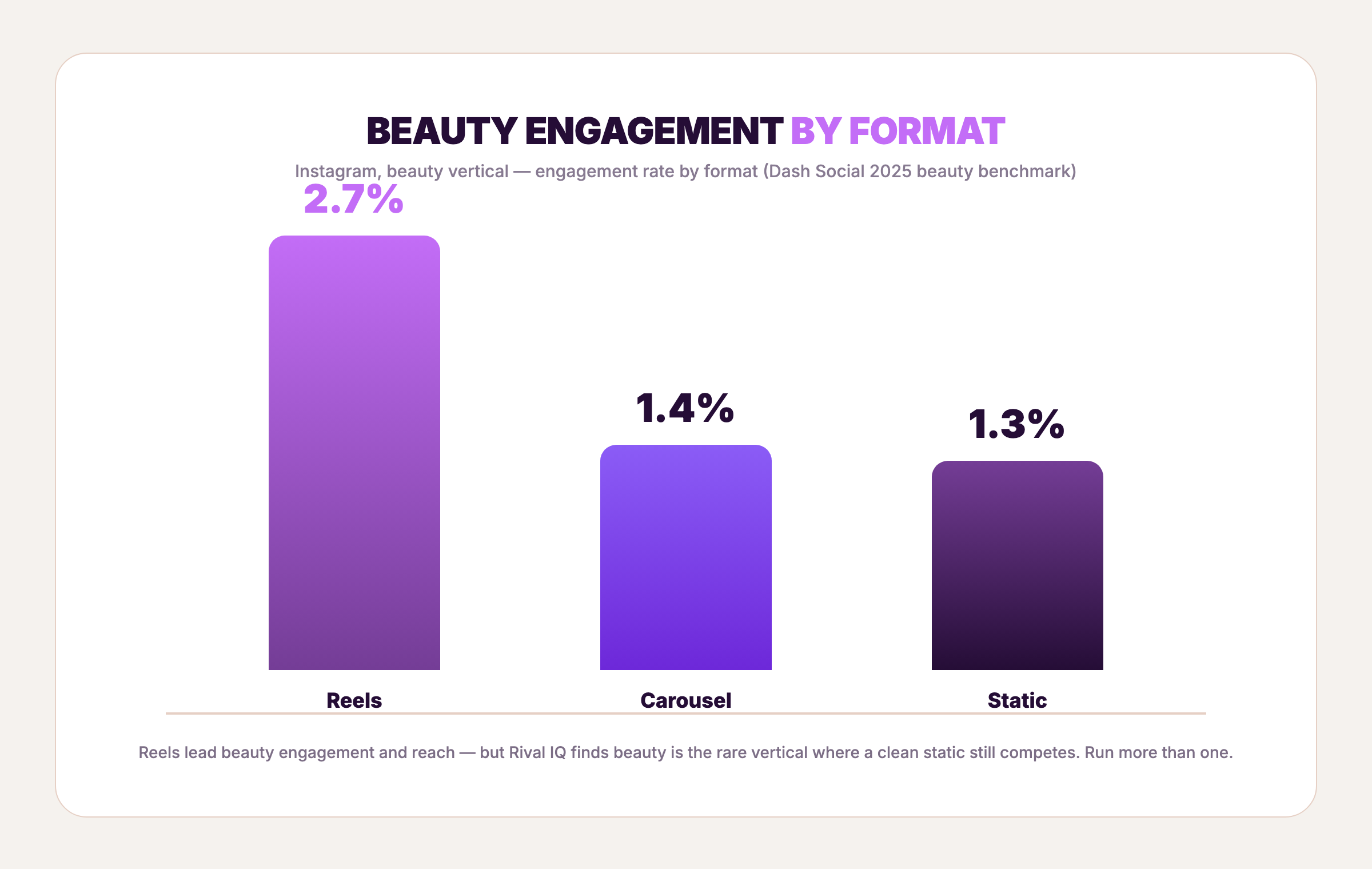
If the goal is to get in front of new people, Reels is where beauty lives. On Dash Social's 2025 beauty benchmark, beauty Reels lead engagement at 2.7% against 1.4% for carousels and 1.3% for static, and short-form video is the single biggest lever for reach in the category. Motion is the point: you can show a cream melting into skin, a lipstick swatch dragged across a wrist, or a face at second zero and second thirty. A still cannot do that.
When Reels win, and how to shoot them
Reels win when the product does something you need to see happen. Keep the hook in the first two seconds, get the product in-frame before the caption loads, and shoot 9:16 vertical, full-screen — Meta recommends 9:16 for full-screen placements like Reels and Stories, and 4:5 for the feed. Nano-creators and unpolished, first-person footage tend to beat glossy studio spots here, because beauty buyers are skeptical of aspiration and sold by proof. If you're still deciding whether to lead with motion or a still, static vs video for beauty covers the tradeoff. Six sub-types do most of the work in beauty — each answers a different buyer objection.
GRWM and full-routine demos
A get-ready-with-me Reel sells a whole kit by showing a real face use it in sequence. Lauren Graham walks through a five-minute MERIT morning routine on camera, product by product, so the viewer watches a finished look come together instead of reading a claim. Rebuild it for a multi-SKU line: open on the bare-face hook, apply in order, and end on the finished result. Routines also earn longer watch time, which feeds reach.
Single-product application demos
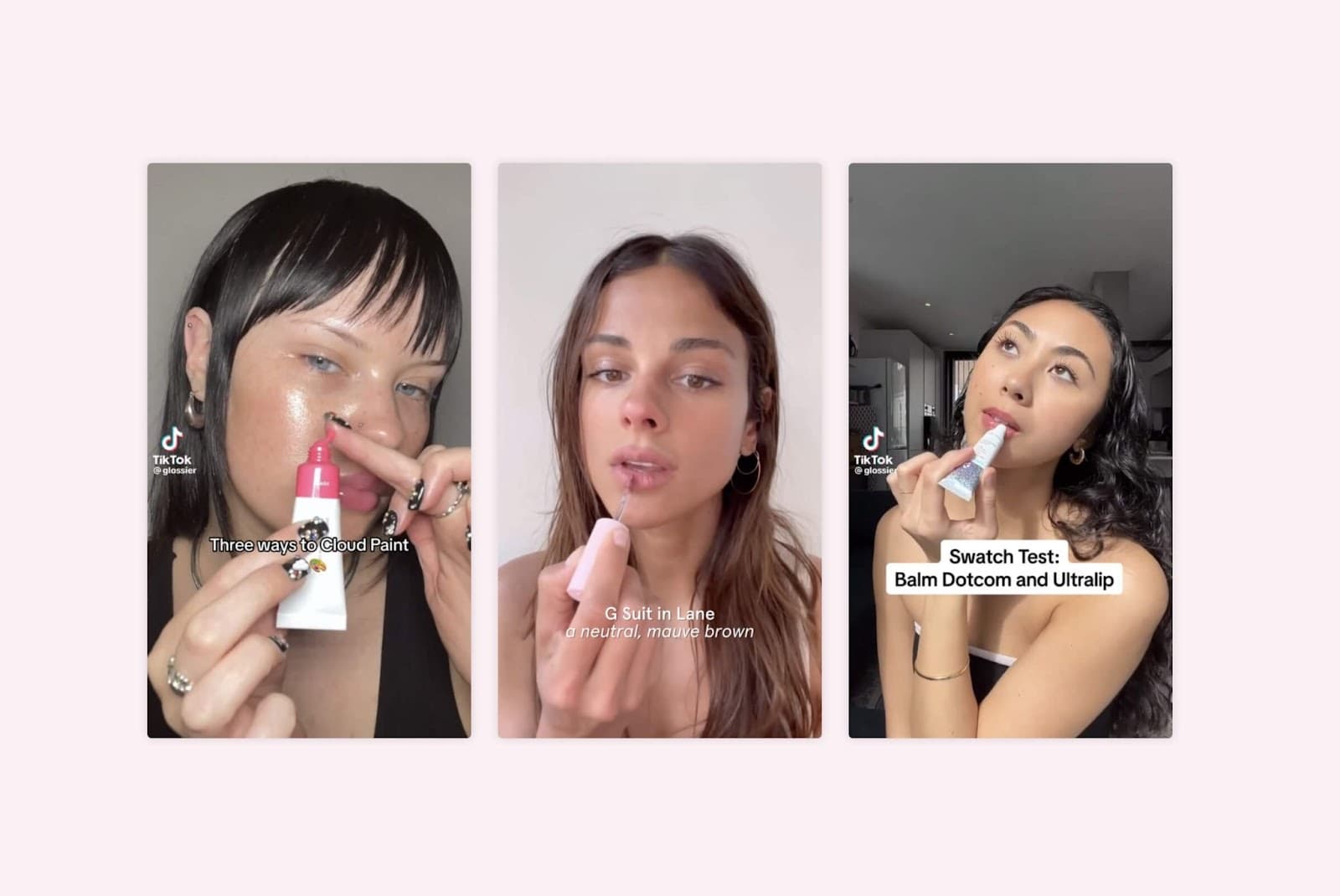
When the product is a single hero, the application demo is the ad. Glossier's Balm Dotcom Reel shows a store artist personalizing and applying the balm, so the texture, the shine, and the payoff all land on camera in the first seconds. For a one-product push, put the product on skin immediately and skip the intro. A tight, single-product demo is the cheapest Reel to shoot and the easiest to re-cut for volume.
Shade-match close-ups
Shade range is the coverage question every beauty buyer asks, and a close-up shade-match Reel answers it head-on. A creator matches Fenty Beauty's We're Even concealer to her skin on camera, so the viewer watches the blend disappear in real time. Clone this when inclusivity or coverage is the selling point: shoot tight on the skin, show the before edge and the blended result, and name the shade on screen.
Texture and formula, the sensory hook
Beauty buyers want to feel a formula before they buy it, and texture is the one thing a still cannot deliver. Topicals leans all the way in with its Slather Reel — an ASMR-style slather of the body serum, all surface and sensation. The sensory hook works for anything with a distinctive texture, a whip or a gel or an oil: shoot macro, cut the voiceover, and keep the frame on the formula.
Before-and-after transformations
The transformation arc is the most persuasive structure in skincare because it answers the only question that matters: will this work on me. Creator @marvella__ documents fading hyperpigmentation with Topicals Faded serum across a real timeline. Clone it honestly — same lighting, same angle, dated frames — because a credible before-and-after outperforms any polished claim. The payoff frame doubles as your thumbnail and your retargeting still.
Educational how-to routines
An educational Reel wins the consideration stage by teaching a routine the product happens to anchor. Glow Recipe walks through a three-step watermelon glass-skin routine, so the viewer leaves with a method they can repeat. The play for regimen brands: number the steps on screen, keep each beat under a few seconds, and end on the finished skin. Teaching earns the save, and saves feed reach back into the algorithm.
Story ads — offers, launches, urgency
Stories is the format you run when there is a reason to act now. It's full-screen, vertical, and time-boxed, which makes it the natural home for a launch, a limited discount, a bundle, or a restock. Meta builds the whole unit around a single swipe from creative to product page, so the creative should carry one message and one action — not a routine, not five shades, one offer.
When Stories win, and Reels vs Stories
Reels vs Stories is a funnel question. Reels is a discovery engine that keeps working in the Feed and the Reels tab for days. A Story ad is a fast, disposable placement for people already close to a decision. Run Reels to fill the top of the funnel with reach; run Stories to push a specific offer to warm audiences and retargeting pools. Spec-wise they share the same 9:16 canvas, so a single vertical concept can serve both — one built for discovery, one trimmed to a single call to action.
The common Story mistake is treating it like a mini Feed post: three shades, a routine, a paragraph of copy. A Story has one job. Lead with the offer in the top third, keep the middle clear of critical text so the swipe-up and the profile bar do not cover it, and give the viewer exactly one thing to tap. Launch, discount, bundle, restock — pick one and design the whole frame around it.
A live Story ad cannot be permalinked, but the vertical clip below shows the exact urgency angle Stories are built for: one message, "biggest sale ends today," and a single tap to act.
Carousel ads — educate before you sell
Treat carousel as a serious beauty format, not the Reels understudy. Across industries, Socialinsider's 2026 Instagram benchmarks put carousel engagement at 0.55%, ahead of Reels at 0.50–0.52% and single images at 0.35–0.37%. Beauty is an education-heavy purchase — routines, ingredients, shade matching — and carousel is the only feed format that gives you room to teach across several frames before you ask for the sale.
The problem-to-review sequence
A carousel that converts in beauty usually follows a spine: problem, solution, ingredient or mechanism, then proof. Frame one names the concern. Frame two puts the product against it. Frame three does the work — the active ingredient, the formula, the why. Close on proof: a review or a before/after. The first frame is the whole carousel's thumbnail — it decides whether anyone swipes. Pull structures from the skincare ad examples to clone library, and for the proof frame study review-driven beauty creative that leads with the customer, not the brand.
Shade-range and range carousels
When a product comes in a range, the carousel is the format that shows all of it. Tower 28 gives every GetSet Powder Blush shade its own slide across six frames, so a shopper swipes straight to the shade that is theirs. The play for a shade launch: one SKU per slide, identical framing, the shade name burned into each frame. The same structure works for a routine sold as separate steps.
Education and comparison carousels
Carousels also settle the comparison a shopper is already running in their head. Rhode's "ask rhode: peptide lip boost vs peptide lip treatment" carousel puts two similar products side by side and explains which is for what. When your own catalog confuses people, name the two products, split the use cases across frames, and end on how to choose. Answering the comparison inside the ad keeps the shopper from bouncing to a search tab, where a rival brand can catch them.
Single image (static) ads — retargeting and hero products
On Instagram, Health and Beauty is the one industry where photo posts still out-engage Reels (Rival IQ, 2025) — yet beauty brands post roughly twice as many Reels as photos, so effort is flowing away from the format that actually wins.
Why beauty static still converts
A clean static ad is the workhorse for retargeting and hero-product moments — the one vertical where photos still out-engage video. Static earns its slot in beauty because the payoff is visual and specific: a texture macro that shows the whip of a cream, a swatch that shows the true shade, an ingredient callout that answers the one doubt a shopper has left. It loads instantly and costs a fraction of a video shoot to iterate, which is why static is where a beauty brand should test the most variants. Look at how Glossier builds their ads — a single product, a soft background, one line of copy — and the discipline of that format becomes obvious.
The hero and the inclusivity claim
A single image can land one big claim harder than any video. Fenty Beauty's Pro Filt'r launch static did it with a grid of 40 foundation shades and almost nothing else — the range is the message, and it reads in a single scroll. When one differentiator defines you, show it as a grid or a lineup and drop the copy to a few words. The visual makes the argument.
The clean swatch
The swatch is the static that shows the actual product doing the actual thing. Summer Fridays lines up Lip Butter Balm swatches so the color, the sheen, and the finish are visible before anyone clicks. For retargeting, shoot the swatch on skin or on white and keep the background quiet. One tidy swatch static can be re-shot in a dozen colorways for the cost of a single video.

Create your own skincare product ads
Create your ad
Collection ads — turn a feed into a storefront
Collection is the format for ranges, not single heroes. It pairs a hero cover image or video with a grid of shoppable products underneath, so a tap opens an Instant Experience instead of bouncing to a slow mobile site. For a beauty brand with a real catalog — a full shade lineup, a routine sold as separate steps, a gift set — collection turns the ad itself into a storefront. Treat this one as directional rather than benchmarked: clean per-format performance data for beauty collection ads is thin, so use it where the SKU count justifies it and measure it against your own carousel and Reels rather than an external number. To see the hero-plus-grid mechanic in detail, Meta's official collection ad format page walks through the cover and the shoppable Instant Experience underneath.
Explore ads — the discovery grid
Explore ads run inside the Instagram Explore browsing experience, the grid people open when they are hunting for something new with no specific account in mind. That mindset is the whole appeal for beauty: Explore users are in active discovery mode, which suits impulse finds — a new shade, a trending serum, a launch they have not heard of yet. One caveat trips people up: Explore is less a standalone Instagram ad format than a delivery placement. The ad has to also run in the Instagram Feed to be eligible, and it is on by default under Advantage+ placements, so you rarely opt into it directly. Meta's Explore ads documentation has the setup detail.
Shopping and product-tagged ads — one tap to the SKU
Product tagging is less an Instagram ad format than a shoppable layer you add to Reels, carousel, or feed creative. A product-tagged ad links a spot in the creative to a specific SKU, and a tap opens an in-app product page without the viewer ever leaving Instagram. You can promote an existing shoppable organic post as an ad, so a tutorial or GRWM that already tags its products becomes a shoppable ad with those tags intact. The plumbing is a single Commerce Manager catalog, which powers organic product tags and Advantage+ catalog ads across Feed, Stories, Reels, and Explore at once. For beauty this compresses discovery to purchase into one tap — the right fit for tutorial and GRWM content, where viewers want the exact products used on camera, not a scavenger hunt through your grid. Meta's shopping ads documentation covers catalog setup.
Reminder ads — for launches and drops
The reminder ad is the one Instagram ad format built around a launch date. A viewer taps "Remind me" to opt into notifications for an upcoming launch or drop, and opted-in users then receive three notifications leading up to the moment. Meta added direct creative upload in Ads Manager and extended reminder ads to Instagram Stories in October 2023, so the format now spans both feed and full-screen. Beauty runs on hype-driven limited drops — a shade collab, a restock, a holiday set — and reminder ads capture launch-day intent so buyers do not miss the window. Pair one with a Story ad on launch morning and you catch both the planners and the impulse crowd. Meta's reminder ads documentation has the eligibility rules.
A note on AR try-on ads, the format that left
If an older guide tells you to build a virtual lipstick try-on filter as an Instagram ad, skip it. Branded AR try-on filters on Instagram ran on Meta Spark, and Meta shut Spark down on January 14, 2025, removing third-party branded AR effects platform-wide. The history is worth knowing, because AR try-on genuinely worked: Michael Kors was the platform's first AR try-on advertiser in 2018 and reported a 14% lift in incremental conversions, and in 2021 L'Oréal brought ModiFace virtual try-on to Instagram Shops on the same, now-retired stack. Try-on now lives on brand-owned surfaces — ModiFace and Perfect Corp powering virtual try-on on a brand's own site or app — not as an Instagram ad format. Treat this as a correction, not a recommendation: the tactic moved off-platform, and the closest live substitute for "see it on me" is a before-and-after or shade-match Reel.
The recommended Instagram ad format mix for beauty
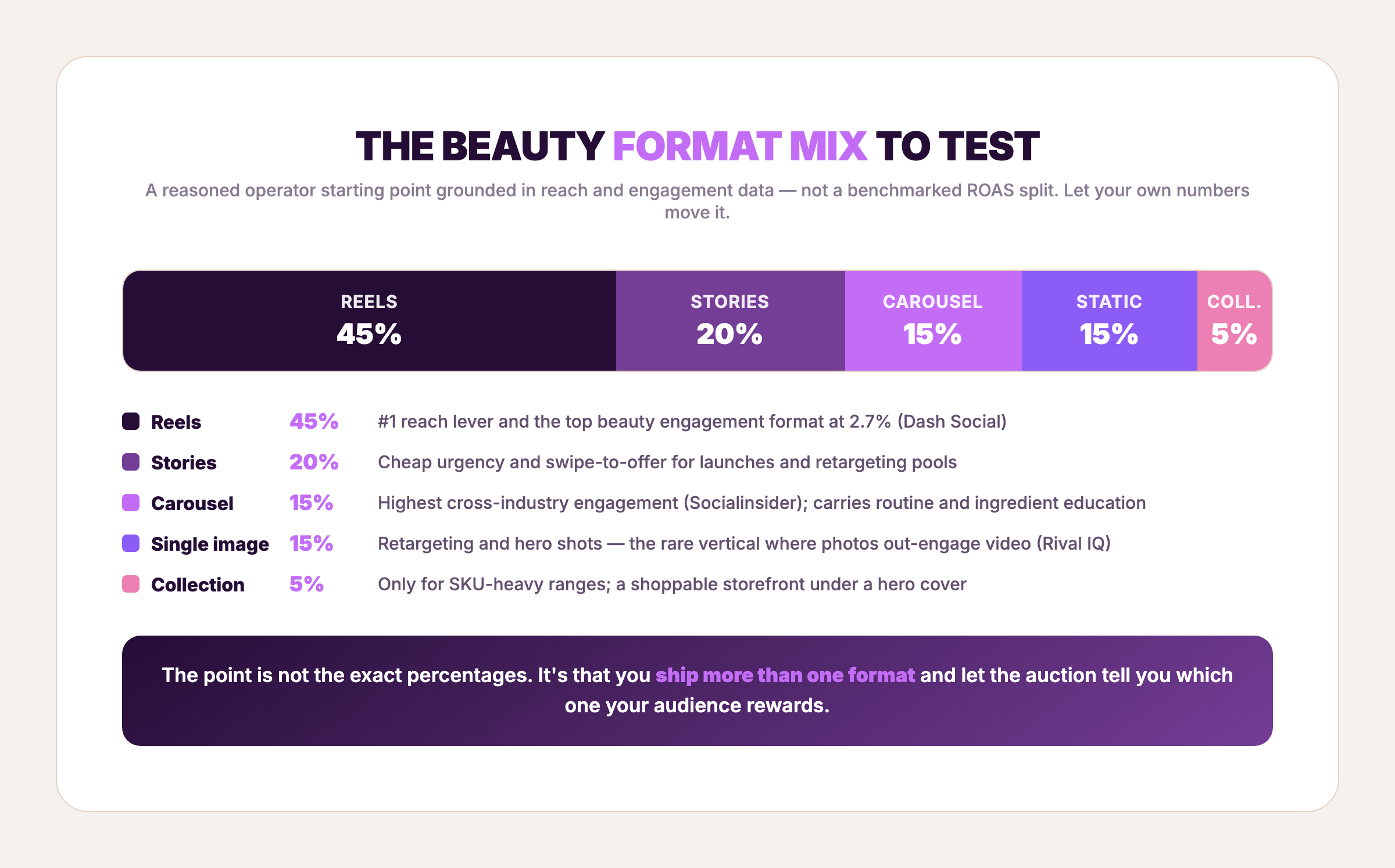
No credible within-beauty ROAS-by-format split exists — the CPM and conversion cut that would settle "best format" simply is not published. So this is a reasoned operator starting point grounded in the engagement and reach data above, not a benchmarked budget. Top beauty brands post around five times a week on Instagram and lean on short-form video as the biggest reach lever, which is why Reels anchors the mix. Use this as an allocation to test against, then let your own numbers move it.
| Format | Share of your output | Why this share (grounded in the data) |
|---|---|---|
| Reels | 45% | #1 reach lever and the top beauty engagement format at 2.7% (Dash Social) |
| Stories | 20% | Cheap urgency and swipe-to-offer for launches and retargeting pools |
| Carousel | 15% | Highest cross-industry engagement (Socialinsider); carries routine and ingredient education |
| Single image | 15% | Retargeting and hero shots — the rare vertical where photos out-engage video (Rival IQ) |
| Collection | 5% | Only for SKU-heavy ranges; shoppable storefront under a hero cover |
What matters is not the exact percentages. It's that you ship more than one format and let the auction tell you which one your audience rewards — impossible if you can only produce a single creative a week.
Browse 545+ real beauty ads from Glossier, ILIA Beauty, Jones Road Beauty, The Ordinary, Fenty Beauty, and MERIT, pick the layout that already works, and clone it into your own product.
Make every Instagram ad format fast, no designer
Studying winning ads is not shipping winning ads. The reason most beauty brands run one format is not strategy — it is that a designer, an agency, or a shoot stands between the idea and the finished creative, and every format needs its own dimension. That is the production gap this whole guide keeps naming, and it is the part AdDogs closes.
One workflow covers every static-image format on this list. AdDogs' library is image-based, so this is where it earns its keep: the feed single image, each carousel frame, a full-screen Story card, a collection cover, the hero still you retarget with. Pick a proven beauty ad from the library — a Glossier hero still, an ILIA Beauty carousel frame, a The Ordinary ingredient callout. Upload your product photo. AdDogs clones the layout, swaps in your product, and pulls your brand colors and logo automatically, then exports at the dimension the placement needs: 9:16 for the Story canvas, 4:5 for the feed, 1:1 for a carousel frame. One reference becomes a feed static, a carousel set, and a Story card without a re-shoot — and it gives your video-first Reels a matching thumbnail and end card. AdDogs does not shoot the Reel itself — it produces the static creative every campaign still needs around it. If your winner is a still, recreate a winning static ad breaks down the mechanics of rebuilding it, and AI ad generator built for this covers the broader tooling landscape.
The math is what makes format-testing possible in a high-CPM vertical. 1 credit = 1 ad in the selected dimension. Pro and Ultimate unlock all 14 aspect-ratio options — pick the dimension per generation, 1 credit per render. Basic is $12 a month for 30 credits across three formats with no logo. Pro is $33 a month for 100 credits with all 14 formats and logo extraction. Ultimate is $63 a month for 212 credits. Annual billing gets you 2 months free (~16.7% off). Testing every format across a beauty catalog stops being a budget decision.
Clone a winning beauty ad into your product, pick the format's dimension, and ship it in seconds.
FAQ
What format should an Instagram ad be?
For beauty, match the format to the goal: 9:16 vertical Reels for reach, 9:16 Stories for offers and launches, 1:1 or 4:5 carousel for education, and 4:5 single image for feed retargeting. There is no universally correct format — Dash Social's beauty panel puts Reels first for engagement at 2.7%, but Rival IQ shows photos still out-engage video in Health and Beauty, so run at least two and test.
What are the 5 different types of Instagram ads?
The five core formats are Reels, Stories, carousel, single image, and collection. Instagram lists these as its main ad units, and each maps to a different beauty job: reach, urgency, education, retargeting, and shoppable ranges. A brand publishing all five from one cloned concept covers every placement without five separate shoots.
How do you promote beauty products on Instagram?
Lead with short-form video for reach, since it is the biggest reach lever in beauty, then layer in carousels for ingredient and routine education and static for retargeting. Beauty and personal care converts at 5.29% on Meta ads but costs $3.06 a click, so creative efficiency decides the outcome — test many creatives cheaply rather than betting on one polished spot.
Reels vs Stories: which is better for a beauty ad?
They serve different funnel stages, so run both. Reels is a discovery engine that keeps earning reach in the Feed and Reels tab for days, while a Story ad is a fast, full-screen placement for warm audiences and a specific offer. They share the same 9:16 canvas, so one vertical concept can serve discovery as a Reel and urgency as a Story.
What are the different types of Instagram ads?
Beyond the core five — Reels, Stories, carousel, single image, and collection — Instagram also runs Explore ads in the discovery grid (feed-eligible only), shopping or product-tagged ads that link creative to a specific SKU, and reminder ads that let people opt into launch notifications. AR try-on ads once ran on Meta Spark but retired on January 14, 2025. That leaves eight live formats for a beauty brand to mix.
Can you still do AR try-on ads on Instagram?
No. Meta shut down Meta Spark on January 14, 2025 and removed third-party branded AR effects platform-wide, so branded virtual try-on filters are no longer a live Instagram ad format. Virtual try-on now lives on brand-owned sites and apps through providers like ModiFace and Perfect Corp. For paid Instagram, a before-and-after or shade-match Reel covers the same "see it on me" job.
What are Instagram reminder ads?
Reminder ads let a viewer tap "Remind me" to opt into notifications for an upcoming launch or drop, then deliver three notifications in the run-up to the moment. Meta extended them to Instagram Stories in October 2023. For beauty's limited drops and restocks, they capture launch-day intent before the product goes live.
Do product tags help beauty ads?
Product tags link a spot in the creative to a specific SKU and open an in-app product page in one tap, which shortens the path from a tutorial or GRWM to checkout. A single Commerce Manager catalog powers those tags across Feed, Stories, Reels, and Explore. They are most useful on content where viewers want the exact products used on camera.