25 shoe ad examples that ran for months (and why they work)
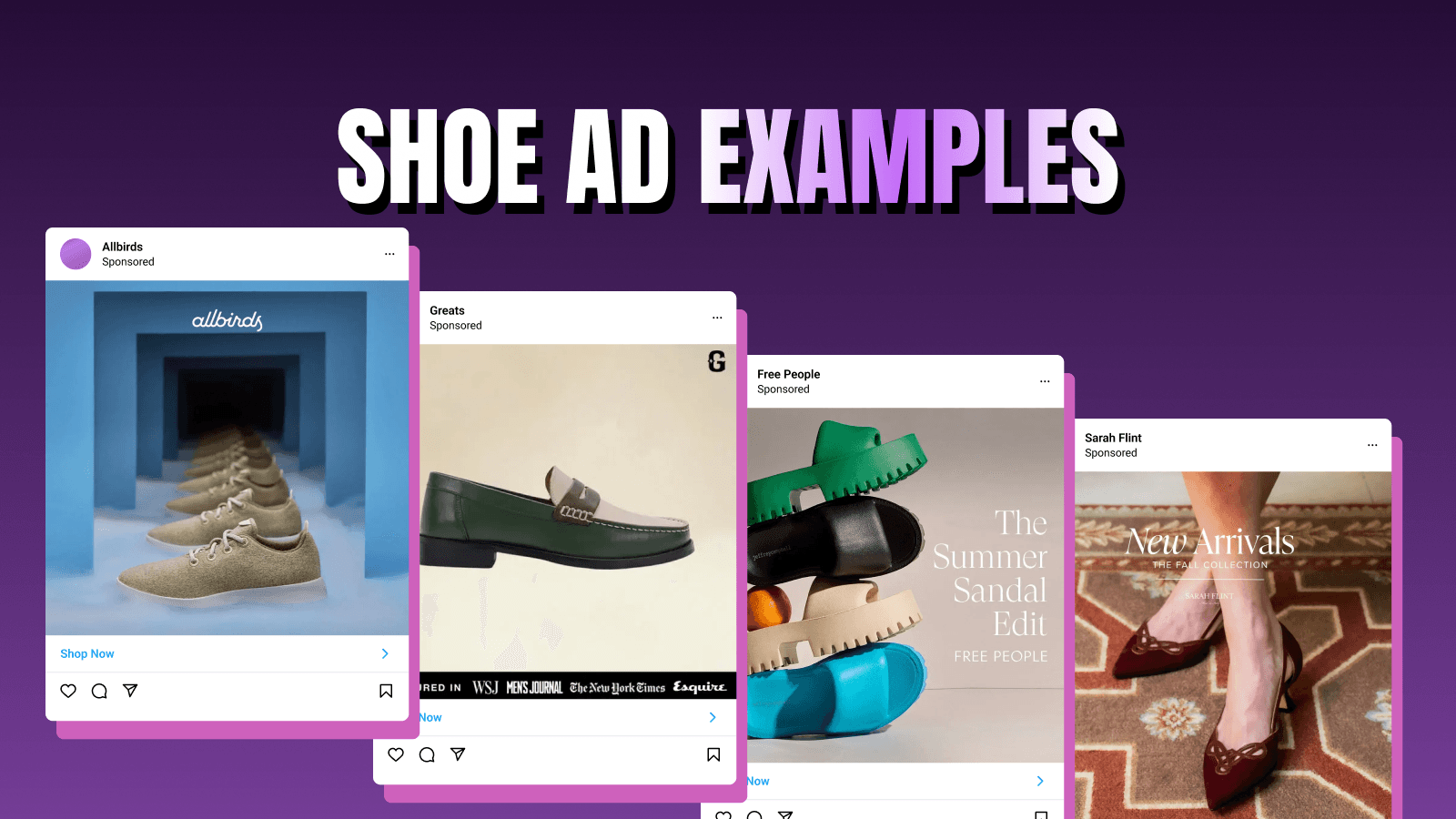


Nike ran a Greek-language Meta ad for 1,875 days: a pair of VaporMax sneakers mid-step, a Nike app icon with a red notification badge, and one promise, "only in the Nike app." Allbirds ran a tunnel of identical wool sneakers for 1,468 days without a single word of copy. Most lists of shoe ads start with Nike's 1988 "Spike & Mike" spot, which Complex ranked the best sneaker campaign of all time. Below are 25 shoe ad examples that ran on Meta for months, each with its run-length, and the claim rules that have already cost footwear brands $65 million. Jump to the 25 ads.
What makes a good shoe ad
Shoe ads split into two genres, and they barely overlap. Brand ads (Allbirds, Koio, Tecovas, Nisolo, Saucony) put the shoe on a foot or a plinth and say almost nothing. Comfort ads (Gravity Defyer, HIKE Footwear, Bronoir, Barestep) sell relief: pain claims, buy-one-get-one offers, and customer counts from 100,000 to "2M+." Across the 25 ads below, every pain claim and every discount sits in the comfort genre, and every ad with a dated run of more than a year sits in the brand genre.
Counted across the 25:
| Move | Count | Who does it |
|---|---|---|
| Shoe shown on a foot or leg | 10 of 25 | Nike, Allbirds, Nisolo, Tecovas, August, Saucony, Clove, Sarah Flint, Flux, NOBULL |
| No price, discount, or offer in the image | 21 of 25 | The four exceptions are HIKE (twice), Bronoir, and Barestep |
| A pain, health, or body claim | 6 of 25 | Gravity Defyer, HIKE (twice), Bronoir, Barestep (twice), all comfort brands |
| Third-party proof (review, press bar, seal, customer count) | 6 of 25 | Greats' press bar, OluKai's review, Gravity Defyer's seal, HIKE's "2M+ people," Barestep's counts |
| Feature callouts or a spec sheet | 6 of 25 | OluKai, Flux, NOBULL, HIKE, Barestep (twice) |
| The outsole turned toward the camera | 4 of 25 | Gravity Defyer, OluKai, Flux, Atoms |
| No copy beyond a wordmark | 4 of 25 | Both Allbirds ads, Koio's top-down pair, APL |
| Dated run of 365 days or more | 3 of 15 dated | Nike and both Allbirds ads, all zero-claim brand ads. The 10 banded ads can't be placed |
Cleanest finding: the three longest dated runs (1,875, 1,468, and 554 days) carry no claim and no price, and the longest-running comfort ad, Gravity Defyer's pain claim, had 245 days at its last check. Read that as a pattern in what advertisers kept paying for, not proof that quiet ads perform better: comfort brands may rotate creative faster. What it does show is the trade-off. Claims sell, and they also date, draw scrutiny, and need evidence. A shoe on a foot needs none of that.
25 shoe ads that ran for months
Every ad below is a real Meta or Instagram ad from the AdDogs footwear library, shown with its run-length. Fifteen carry an exact count of days live at the library's last check, taken from the Meta Ad Library or from Foreplay, the ad-tracking service the library sources from (checks between April 8 and October 12, 2026). Ten more came from an ad gallery that labels run-time in bands, so they're shown as ranges: "180+ days," "90 to 180 days," or "30 to 90 days," as of April 7, 2026. A long run proves the advertiser kept paying. It doesn't prove the ad was profitable. To check one yourself, search the brand in the Meta Ad Library with the "active" filter (for example, Allbirds' live ads) and read the "Started running on" date. Our Meta Ad Library guide walks through it.
Quiet product shots. One shoe or one pair, a considered background, and almost no words. Five brand ads.
1. Allbirds — a tunnel of wool runners, 1,468 days
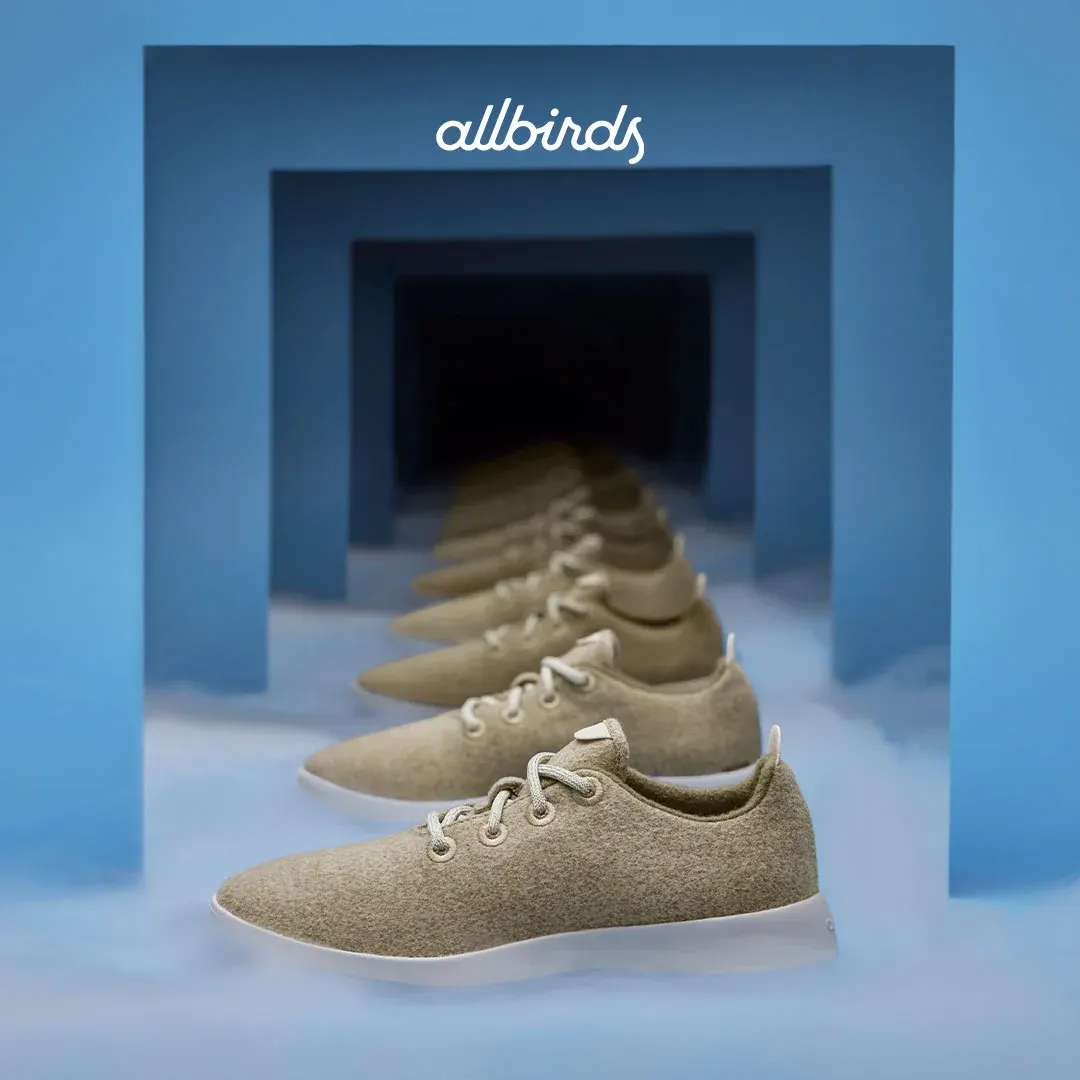
A line of identical olive wool runners recedes through a tunnel of nested blue frames, fog at floor level, the Allbirds script logo at the top. No headline, no button, no price. 1,468 days.
Why it works: Repetition reads as a product line and as depth at once, and the fog makes a wool shoe look soft before anyone touches it. With no copy, nothing in it ages.
Clone it: Any shoe with a strong side profile. Repeat it into the distance, one color, one logo.
2. Koio — the pair from above, 253 days
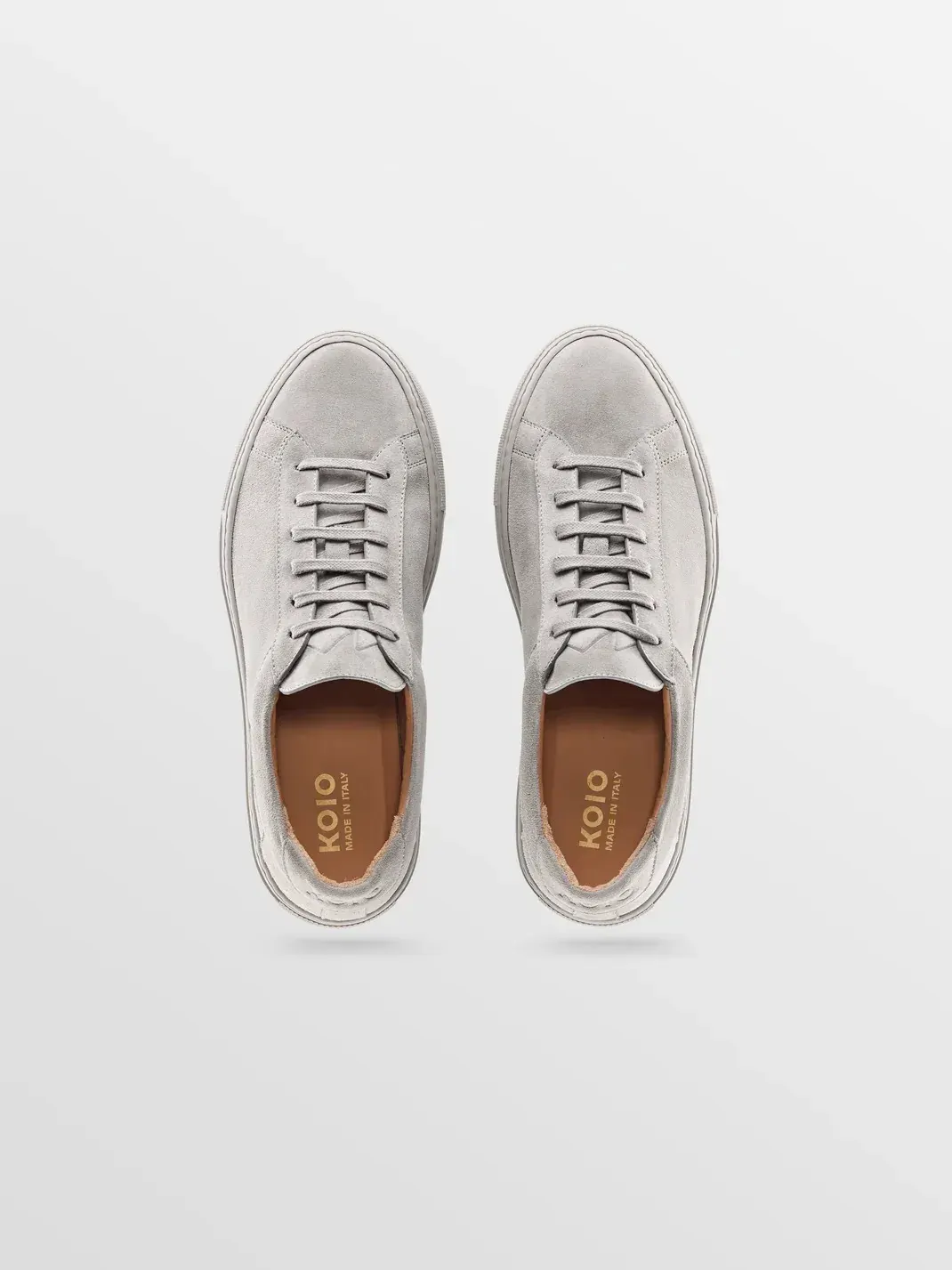
A pair of gray suede low-tops shot from directly above on a pale gray gradient, laces loose, tan leather insoles stamped "KOIO, Made in Italy" facing the camera. No other copy. 253 days.
Why it works: Top-down is the one angle that shows the insole, and the insole carries the origin claim, so the shoe makes its own case.
Clone it: Any shoe with a branded footbed. Shoot it from above, laces relaxed, and let the insole talk.
3. APL — a pair balanced on the logo, 139 days
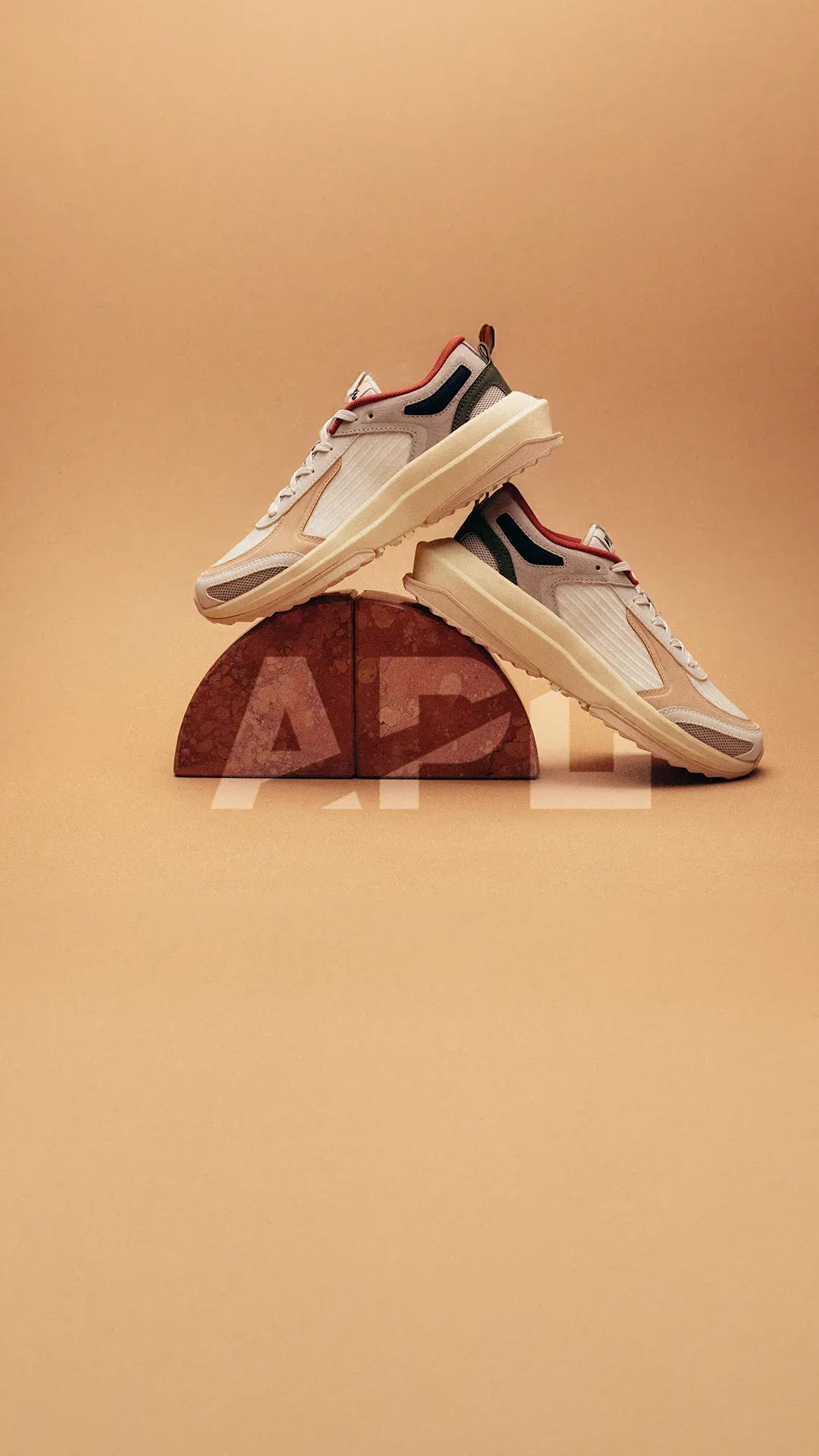
A pair of cream-and-rust running sneakers balanced on a half-round block cut from the APL letterform, centered low on a warm peach backdrop. Nothing else in the frame. 139 days.
Why it works: A plinth made of the logo means the brand lands without a wordmark. Huge negative space makes a sneaker read like a gallery object, the same move luxury ads make.
Clone it: Turn your logo into a prop, set the pair on it, and leave two-thirds of the frame empty.
4. Greats — a loafer and a press bar, 180+ days
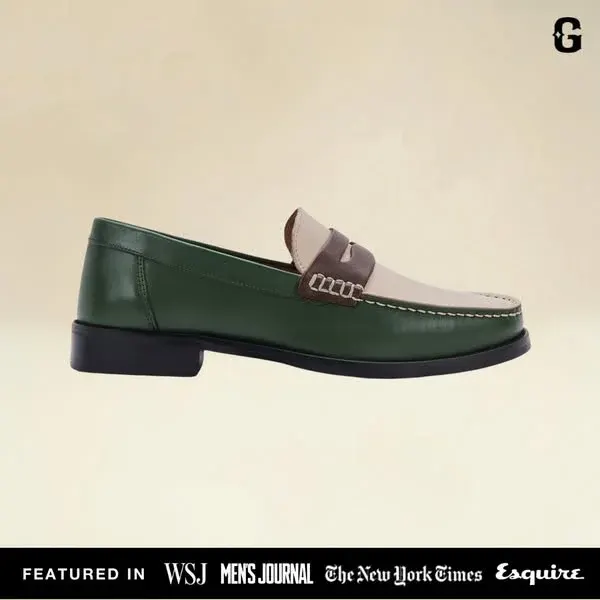
A green leather penny loafer with a cream saddle, side-on, floating on warm beige, a "G" monogram in the corner. A black strip at the bottom: "FEATURED IN WSJ, MEN'S JOURNAL, The New York Times, Esquire." 180+ days.
Why it works: Four mastheads do the convincing so the shoe can stay silent. A press bar is the cheapest premium signal there is, and it never needs updating.
Clone it: Any shoe with press coverage. Product side-on, one press strip, nothing else.
5. Free People — a stack of sandals, 32 days
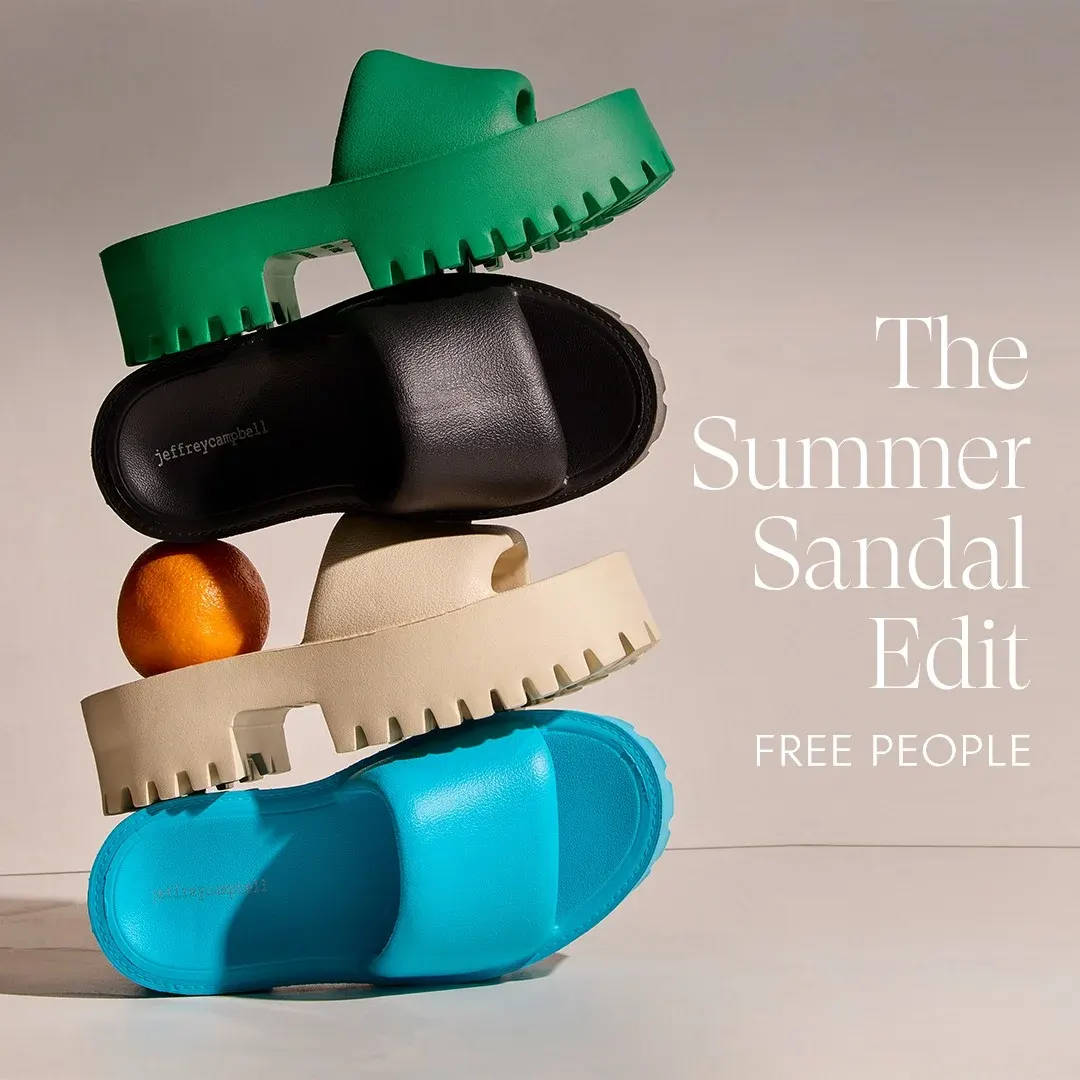
Four chunky lug-sole slides (green, black, cream, bright blue) stacked into a tower with an orange wedged between two of them, on gray. "The Summer Sandal Edit" in a light serif and "FREE PEOPLE" beneath. Its soles read "jeffreycampbell," so this is a retailer selling another brand's shoe. 32 days, the shortest exact run in this post.
Why it works: Stacking turns four colorways into one sculpture, and the orange is the summer cue. A retailer's edit headline sells the season, not the product.
Clone it: Any range of colorways. Stack them, add one seasonal prop, name the edit.
On the foot. Ten of the 25 put the shoe on a body. A shoe on a foot answers fit, scale, and style in one frame.
6. Nike — "only in the Nike app," 1,875 days
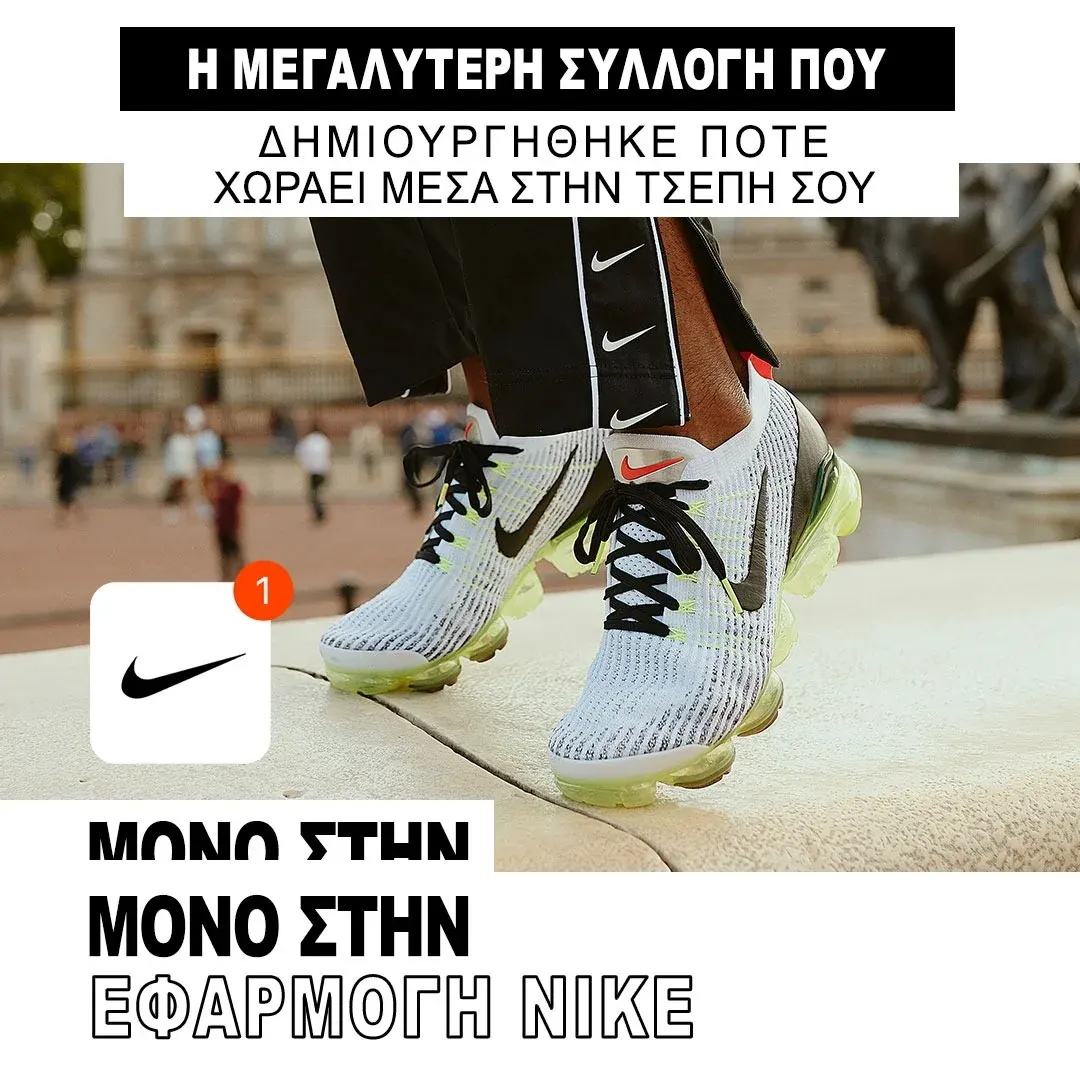
White Nike Air VaporMax sneakers mid-step on a stone ledge in front of a palace square, black Nike-taped track pants above. A Nike app icon with a red "1" notification badge sits left. Greek copy: at the top, "The biggest collection ever created fits in your pocket," and at the bottom, "Only in the Nike app." 1,875 days, the longest dated run in this post.
Why it works: It sells the channel, not the shoe. Its notification badge is a UI element everyone's thumb knows, and the sneaker is shot mid-stride so it looks worn, not merchandised.
Clone it: If you have an app or a members' store, put your shoe and your app icon in one frame, with the badge.
7. Allbirds — a stride on asphalt, 554 days
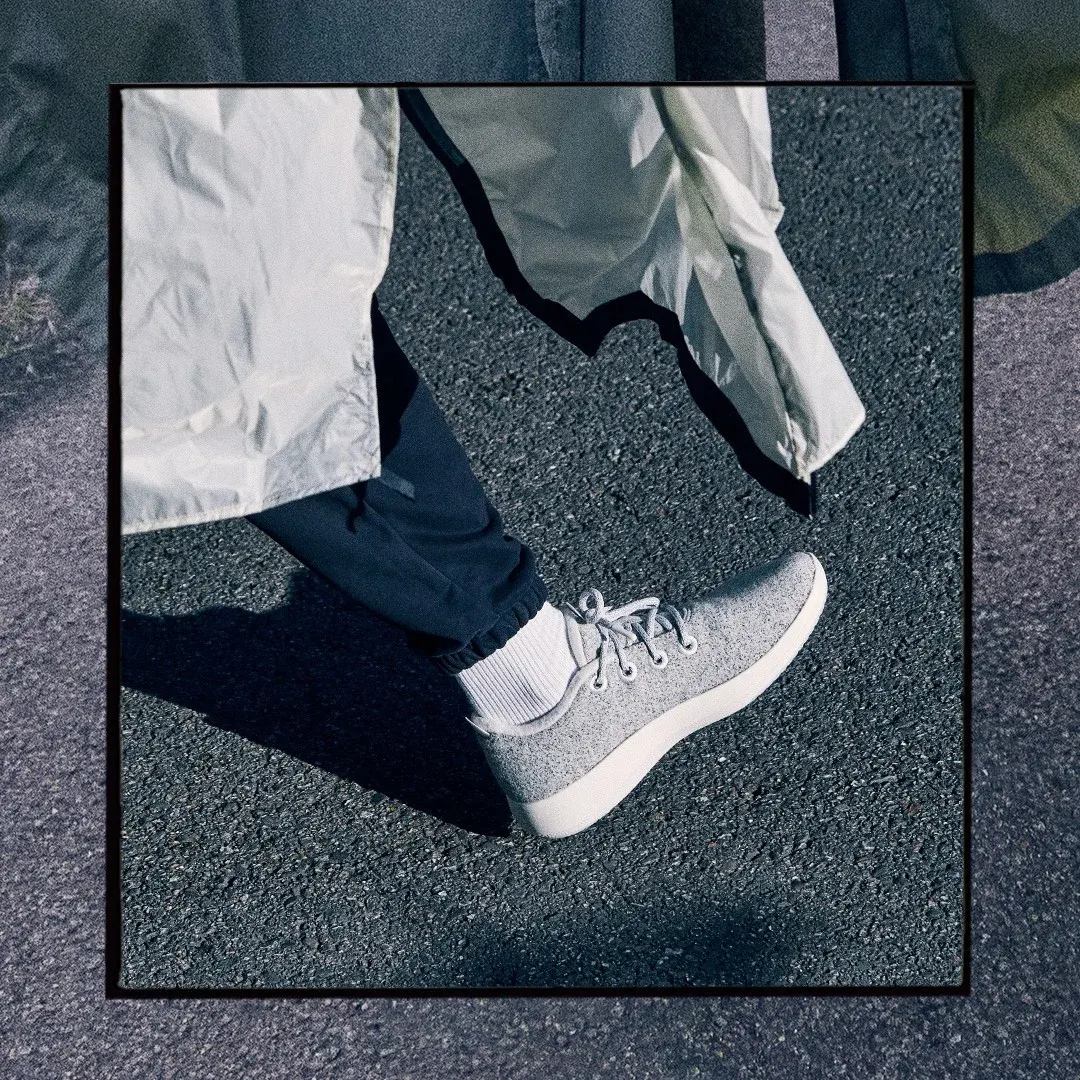
A gray wool runner and a white sock mid-stride on dark asphalt, the hem of a crinkled white trench coat above, the whole photo cropped inside a thin black frame. No copy at all. 554 days.
Why it works: A street-style crop makes the ad read as an editorial still, not an ad. Gray wool on gray asphalt sells the shoe as an everyday default.
Clone it: Crop to calf height, catch the stride, frame the photo, write nothing.
8. Nisolo — the leg kick plus three colorways, 180+ days
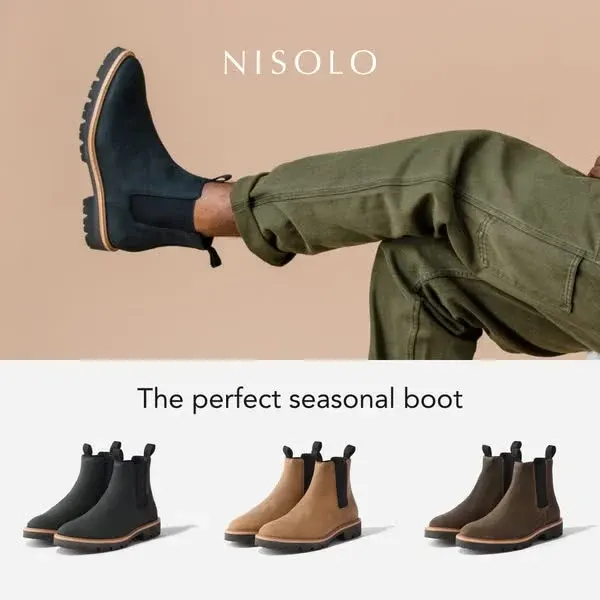
Top half: a leg in olive work trousers kicks up a dark suede Chelsea boot against peach, "NISOLO" in spaced caps. Bottom half: "The perfect seasonal boot" over the same boot in black, tan, and brown. 180+ days.
Why it works: Its top half sells the attitude and its bottom half sells the choice. One ad covers both "how does it look on" and "what colors does it come in."
Clone it: Any boot or shoe in three colorways. Lifestyle shot on top, a row of pairs below, one plain headline.
9. Tecovas — the boot's name and its color, 142 days
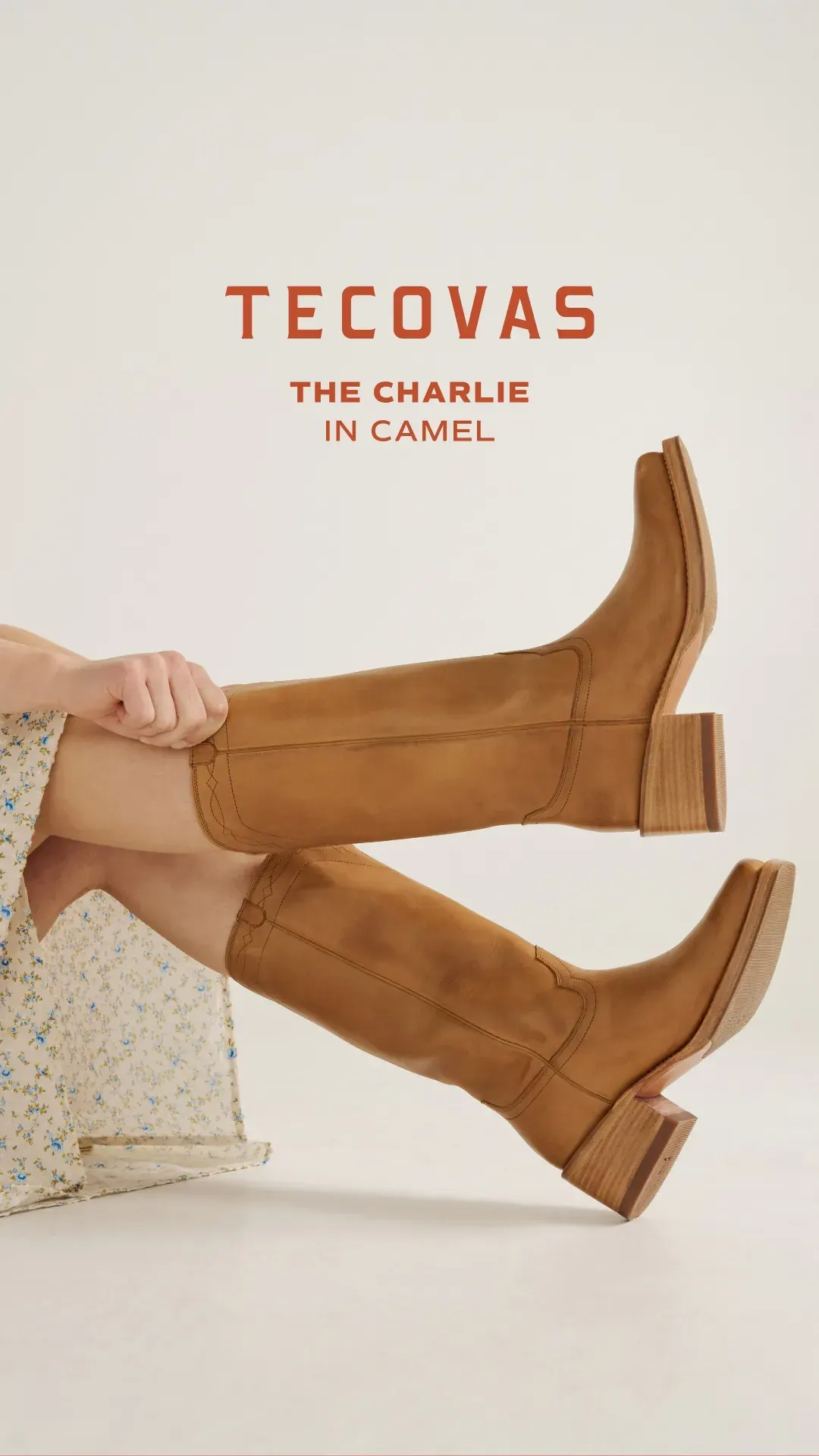
Two legs in camel suede knee-high boots, crossed at the ankle, one hand gripping a boot shaft, a floral hem at the edge, on a pale backdrop. "TECOVAS" in orange caps, "THE CHARLIE IN CAMEL" beneath. 142 days.
Why it works: Naming the model and the color makes the ad a product page in one line. A hand on the shaft shows how soft the suede is.
Clone it: Any boot. Legs crossed, one hand on the leather, the model name and the color as the only copy.
10. August — two pairs on a floorboard, 133 days
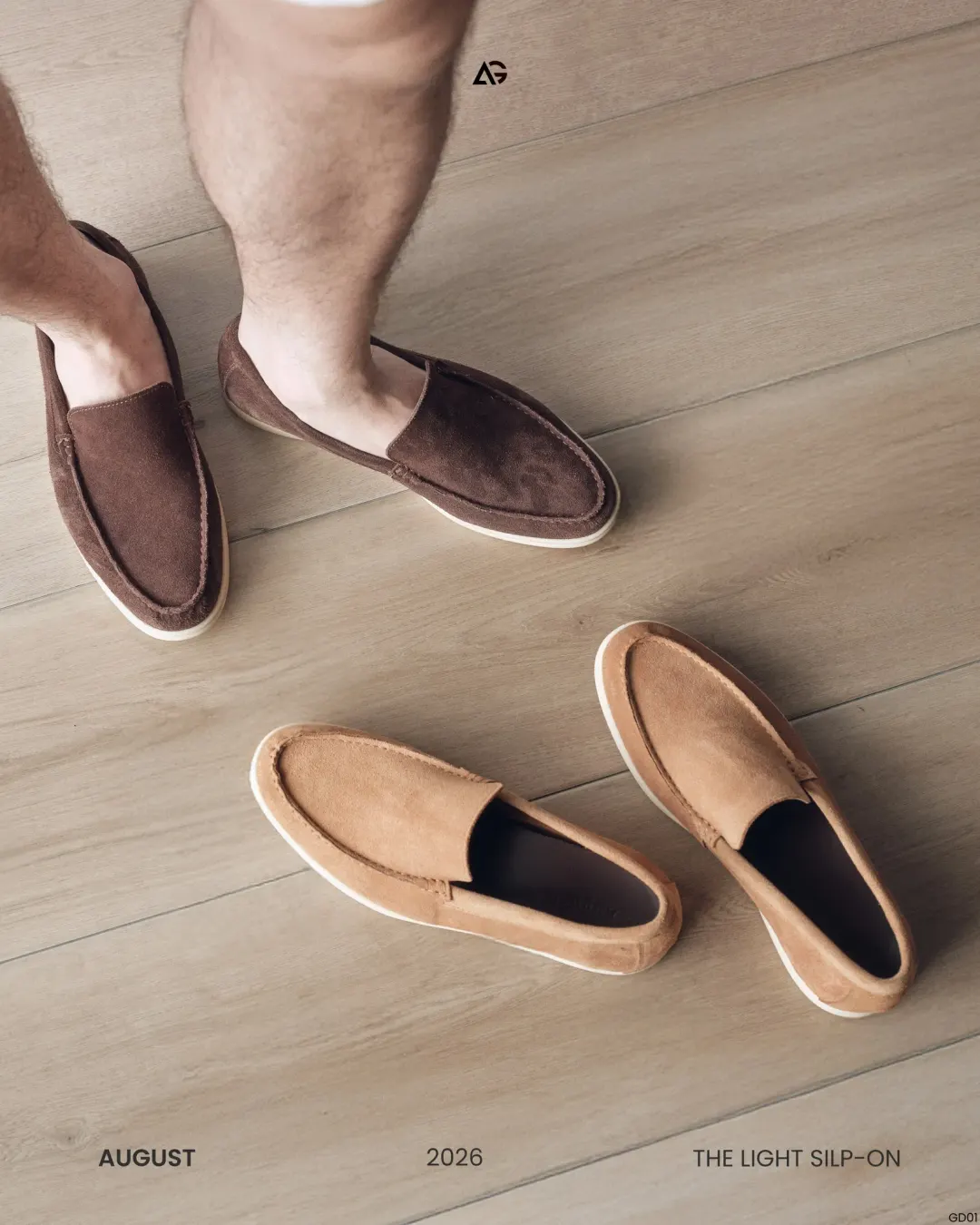
Shot from above: a man's bare ankles in brown suede slip-ons, and a tan pair sitting empty below him on light oak boards. A small logo at the top, and a catalog-style footer: "AUGUST," "2026," and the product name, which the ad misspells "THE LIGHT SILP-ON." 133 days.
Why it works: One pair worn and one pair empty shows fit and silhouette at once. It looks like a lookbook page, typo included, and it still ran four months.
Clone it: Any slip-on or loafer. One pair on, one pair off, shot from above on wood.
11. Saucony — feet on the road line, 88 days
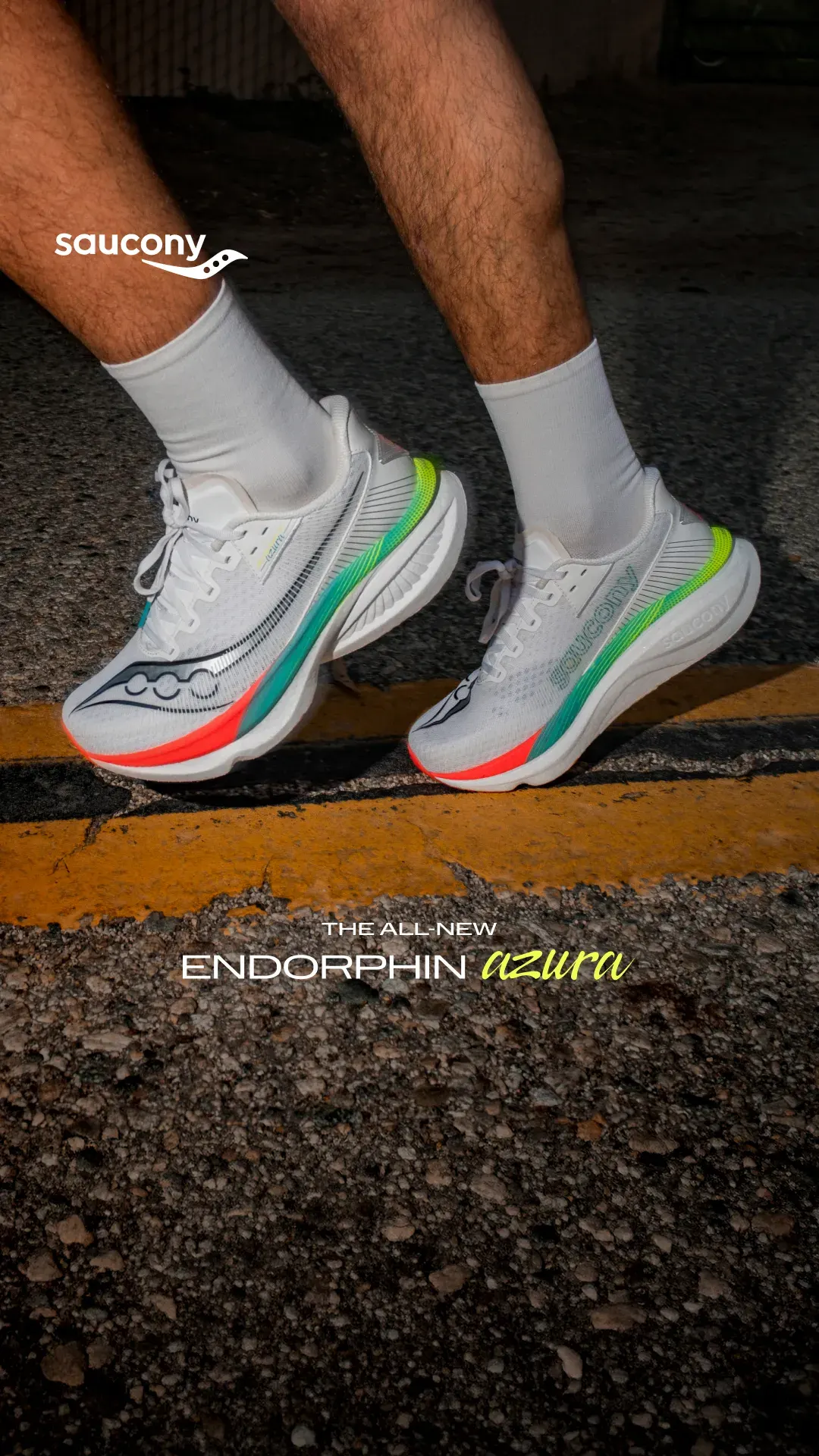
A runner's lower legs in white crew socks and white Endorphin running shoes with a mint and coral sole, mid-stride on dark asphalt over a yellow road line. "THE ALL-NEW ENDORPHIN azura" low in the frame. 88 days.
Why it works: A road line gives a performance shoe its context without a word about speed. A launch ad only needs the name and the shoe in motion.
Clone it: Running and training shoes. Ground-level angle, a road or track marking, the model name.
12. Clove — the scrubs say who it's for, 64 days
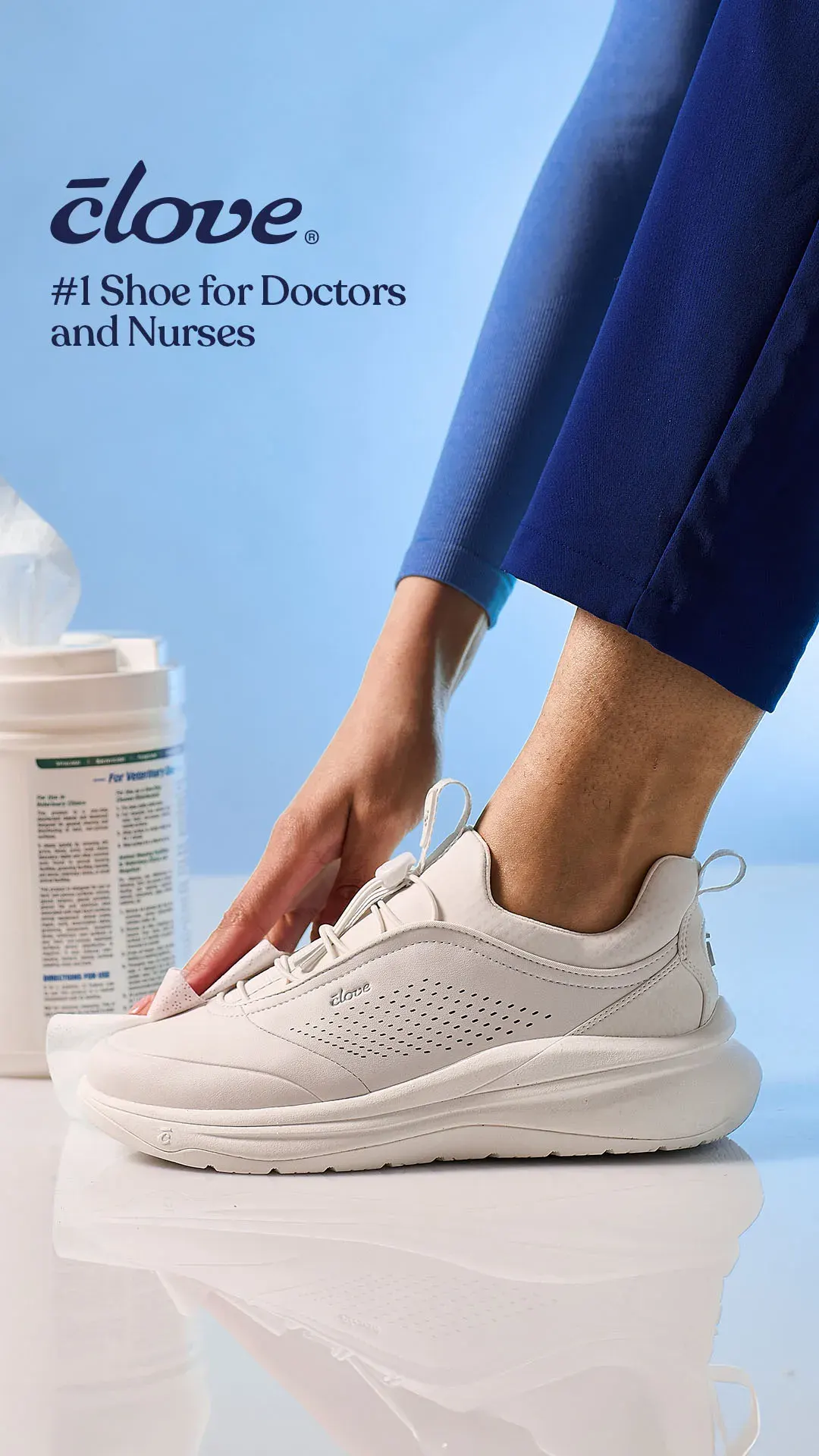
A hand adjusts the heel of a white sneaker on a leg in royal-blue scrubs, a tub of disinfectant wipes in the background, on a glossy white surface. "clove" and "#1 Shoe for Doctors and Nurses" top-left. 64 days.
Why it works: Scrubs and a wipes tub name the audience faster than the headline does, and a plain white shoe next to the wipes looks easy to keep clean. "#1" is a superlative that needs a basis behind it (see the rules section).
Clone it: Any job-specific shoe. Put the uniform in the frame and let it target the ad.
13. Sarah Flint — heels on a rug, 37 days
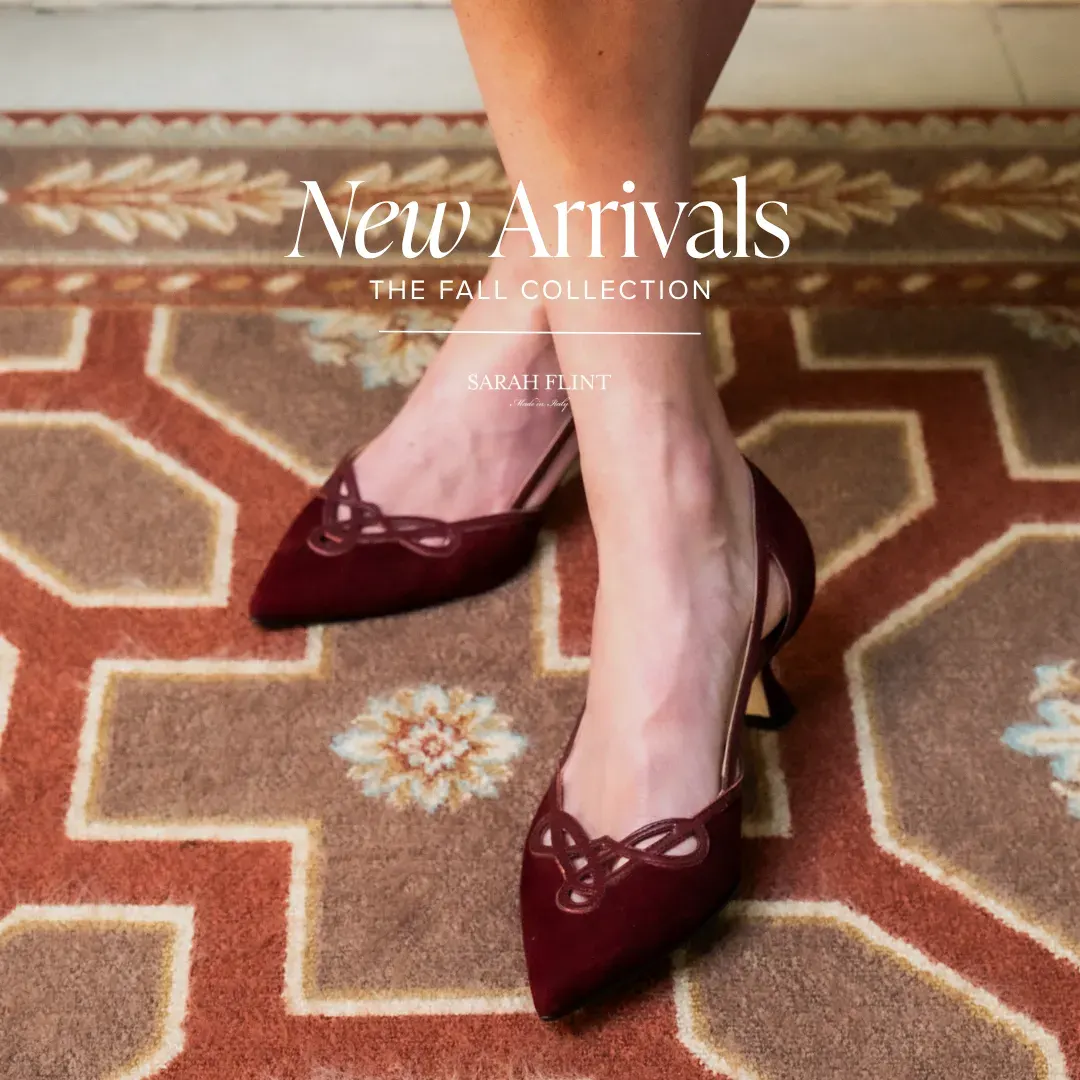
Feet in burgundy suede pointed kitten heels with cut-out vamps, standing on a red and cream patterned rug. "New Arrivals" in italic serif, "THE FALL COLLECTION" and a small wordmark beneath. 37 days.
Why it works: A rug is the art direction: it adds the warmth and pattern that a plain backdrop would need copy to supply. Burgundy on red reads as fall without saying it.
Clone it: Any seasonal drop. Pick a surface whose colors match the season, shoot feet only, "New Arrivals" as the headline.
Show the tech. Four ads turn the shoe over or label its parts. An outsole is the part buyers can't see in a store photo.
14. OluKai — four labels on a golf shoe, 180+ days
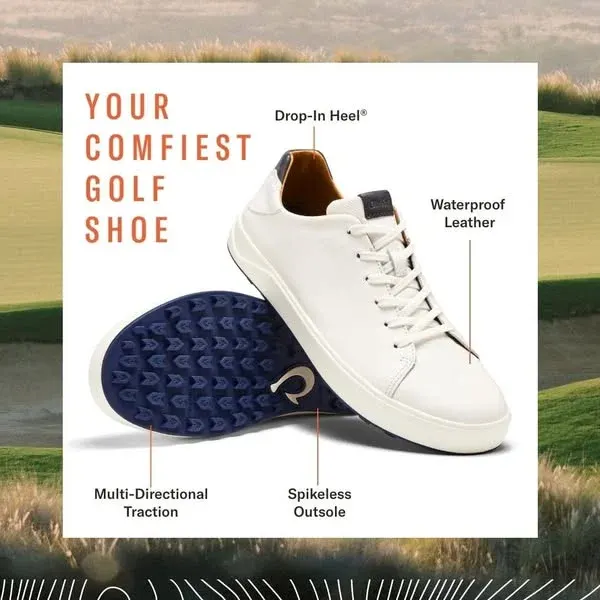
A white leather golf shoe and a second shoe turned to show its navy spikeless outsole, on a white card over a golf course. Four thin-line labels: "Drop-In Heel®," "Waterproof Leather," "Multi-Directional Traction," "Spikeless Outsole." Headline in spaced orange caps: "YOUR COMFIEST GOLF SHOE." 180+ days.
Why it works: Each label maps to a golfer's objection: walking 18 holes, wet grass, grip, wearing it off the course. An upturned sole proves the traction claim.
Clone it: Any technical shoe. Show the upper and the sole together, four labels, one comfort headline.
15. Flux — the grip in a magnifier, 30 to 90 days
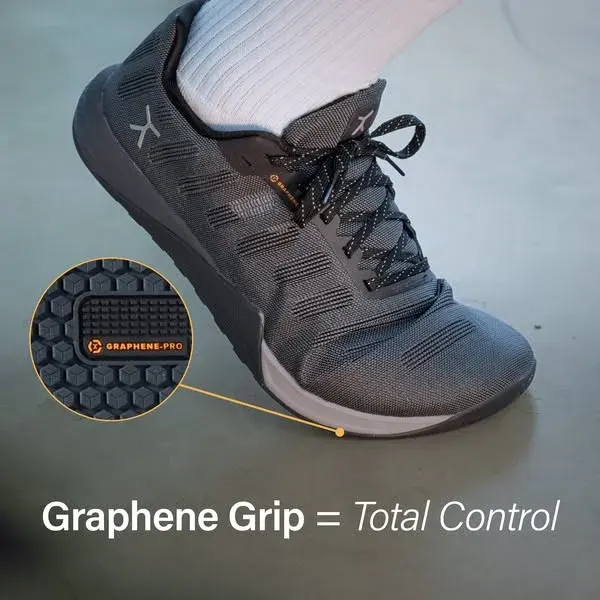
A gray knit trainer on a foot with a white sock, pressed onto a concrete floor, and a circular magnified inset of its hexagonal outsole marked "GRAPHENE-PRO." "Graphene Grip = Total Control" across the bottom. 30 to 90 days.
Why it works: A magnifier proves a material claim visually, and the equation-style headline says what the material does in four words.
Clone it: Any shoe with a material story. Foot in use, one circular zoom on the tech, an X = Y headline.
16. Atoms — four views of one shoe, 30 to 90 days
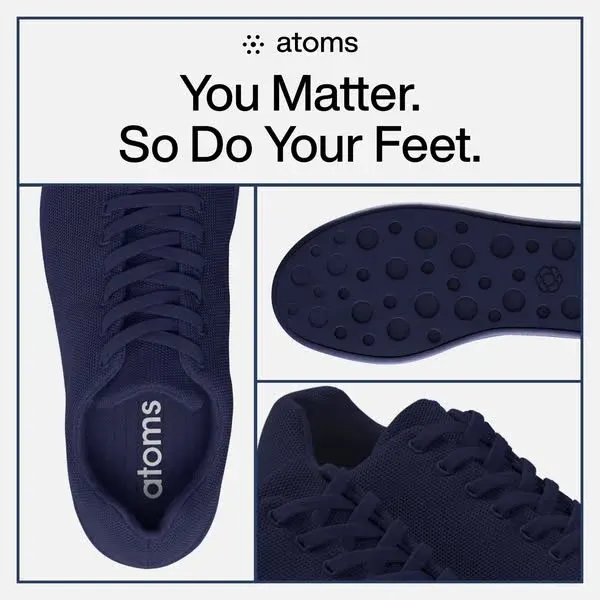
A thin-bordered grid: a navy knit shoe from above with "atoms" on the insole, a macro of the dotted outsole, and a macro of the knit upper. "You Matter. So Do Your Feet." in large sans at the top. 30 to 90 days.
Why it works: A grid is a product page compressed into one image: top, bottom, and texture. Its headline flatters the buyer, not the shoe.
Clone it: Any minimalist shoe. Three crops in a grid, one headline about the wearer.
17. NOBULL — a spec sheet in the margin, 30 to 90 days
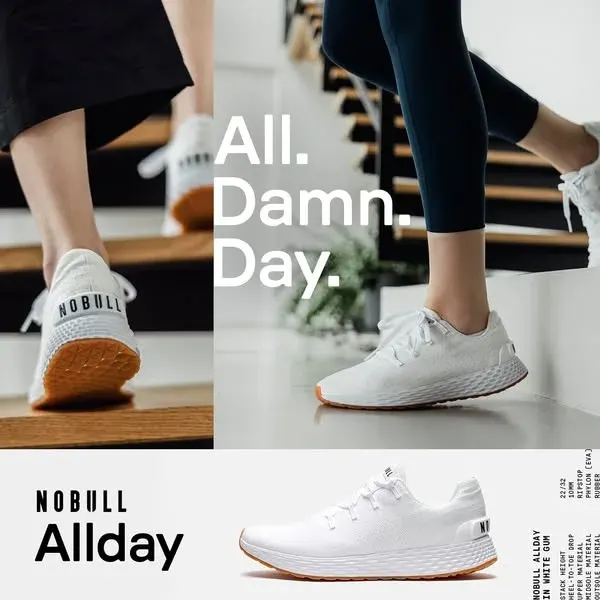
Two on-foot shots of white knit sneakers climbing wooden stairs, "All. Damn. Day." over them in white. Below, the NOBULL Allday in white and gum with a vertical spec block: stack height 22/32, 10mm heel-to-toe drop, ripstop upper, Phylon midsole, rubber outsole. 30 to 90 days.
Why it works: Its headline sells the feeling and the spec sheet reassures the buyer who checks drop and stack before buying. Both readers get what they came for.
Clone it: Any performance shoe. Lifestyle on top, product plus specs below, a three-word headline.
Proof it lasts. Two ads answer the durability and real-world objections with evidence.
18. Koio — Day 1 against Day 400, 30 to 90 days
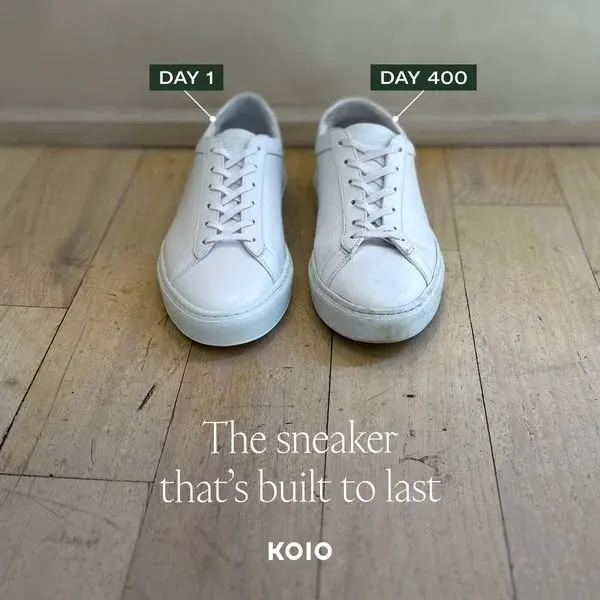
Two white leather sneakers side by side on worn floorboards, one crisp, one creased and scuffed, labeled "DAY 1" and "DAY 400." "The sneaker that's built to last" in a light serif and "KOIO" beneath. 30 to 90 days.
Why it works: It's a before-and-after for a premium sneaker, and the worn pair still looks good, which is the claim. Our library tags this format under comparison ads.
Clone it: Any premium shoe. Photograph a real worn pair next to a new one and label the days.
19. OluKai — a five-star line in the mountains, 90 to 180 days
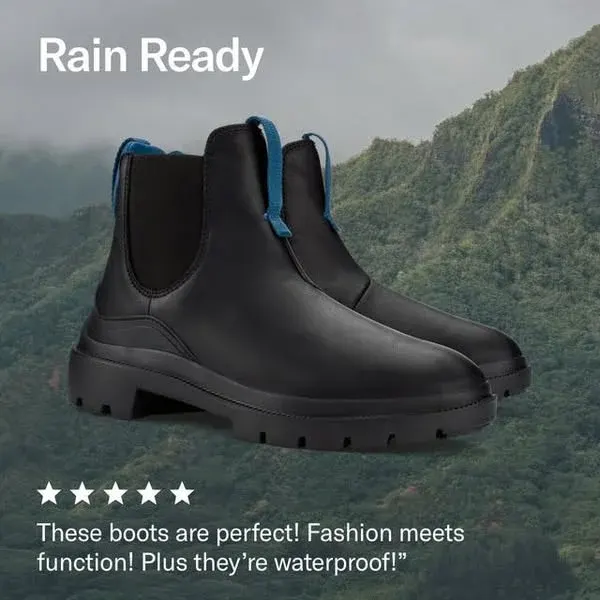
A black leather Chelsea boot with blue pull tabs over misty green mountains. "Rain Ready" at the top, five stars at the bottom, and a customer line: "These boots are perfect! Fashion meets function! Plus they're waterproof!" 90 to 180 days.
Why it works: Its headline makes the claim and the review confirms it in a customer's words. Wet mountains do the rest.
Clone it: Any weather-proof shoe. Put it in the weather, two words up top, one review at the bottom. More formats live in the testimonial ad examples.
Comfort and pain claims. Six ads sell relief. All six come from comfort or barefoot-shoe brands, and they carry the claims regulators have already acted on.
20. Gravity Defyer — a pain claim and a seal, 245 days
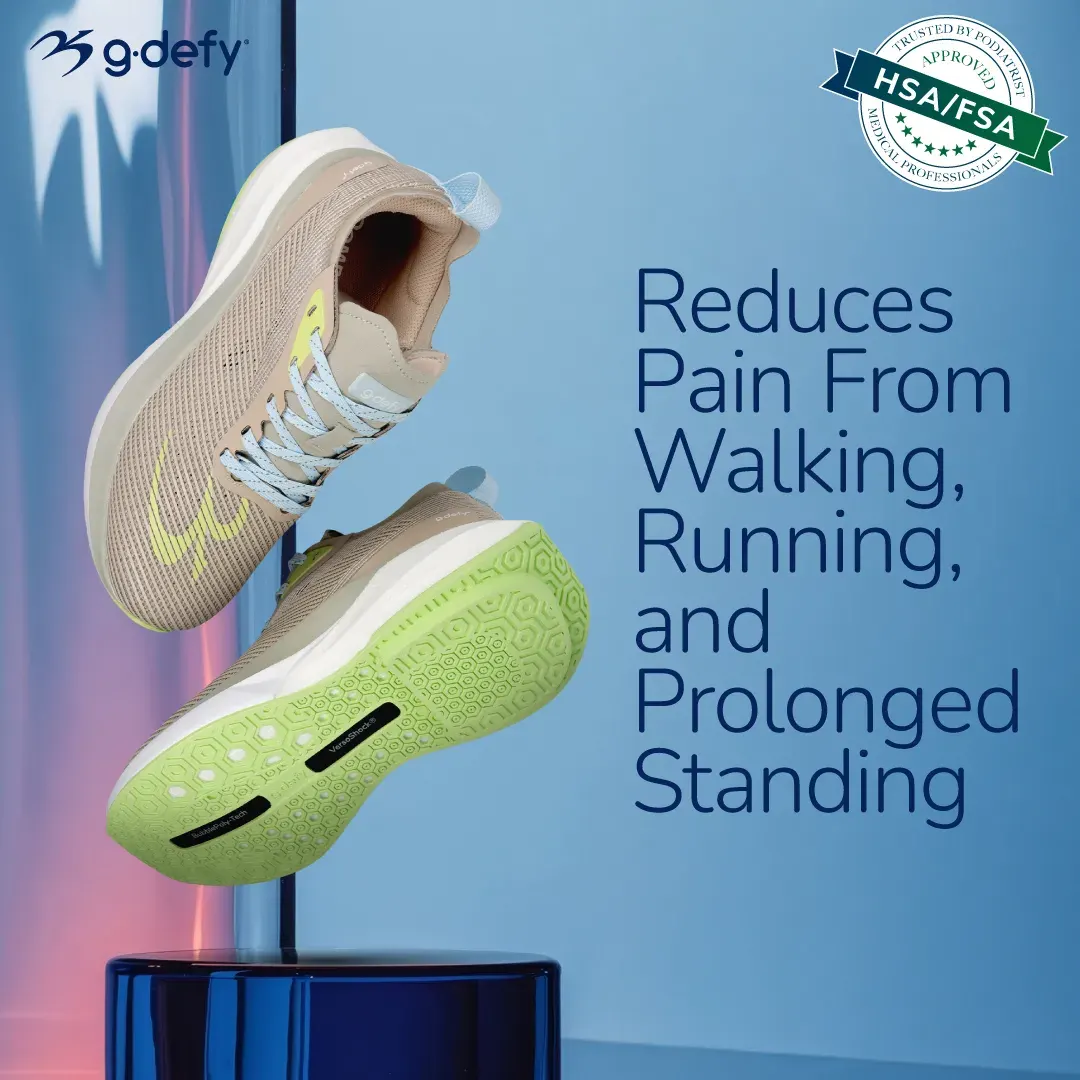
Two sneakers float above a blue plinth, one turned to show a lime-green sole, on a blue-to-pink backdrop. "Reduces Pain From Walking, Running, and Prolonged Standing" in large navy type, and a green ribbon seal reading "HSA/FSA," ringed with small text about podiatrists and medical professionals. 245 days, the longest-running comfort ad here.
Why it works: It names three situations buyers recognize, and the seal implies medical backing. Both elements are claims that need evidence on file.
Clone it: Only with substantiation. A floating pair, one clear comfort benefit, a seal you can document.
21. HIKE Footwear — a ring of colorways at $33, 235 days
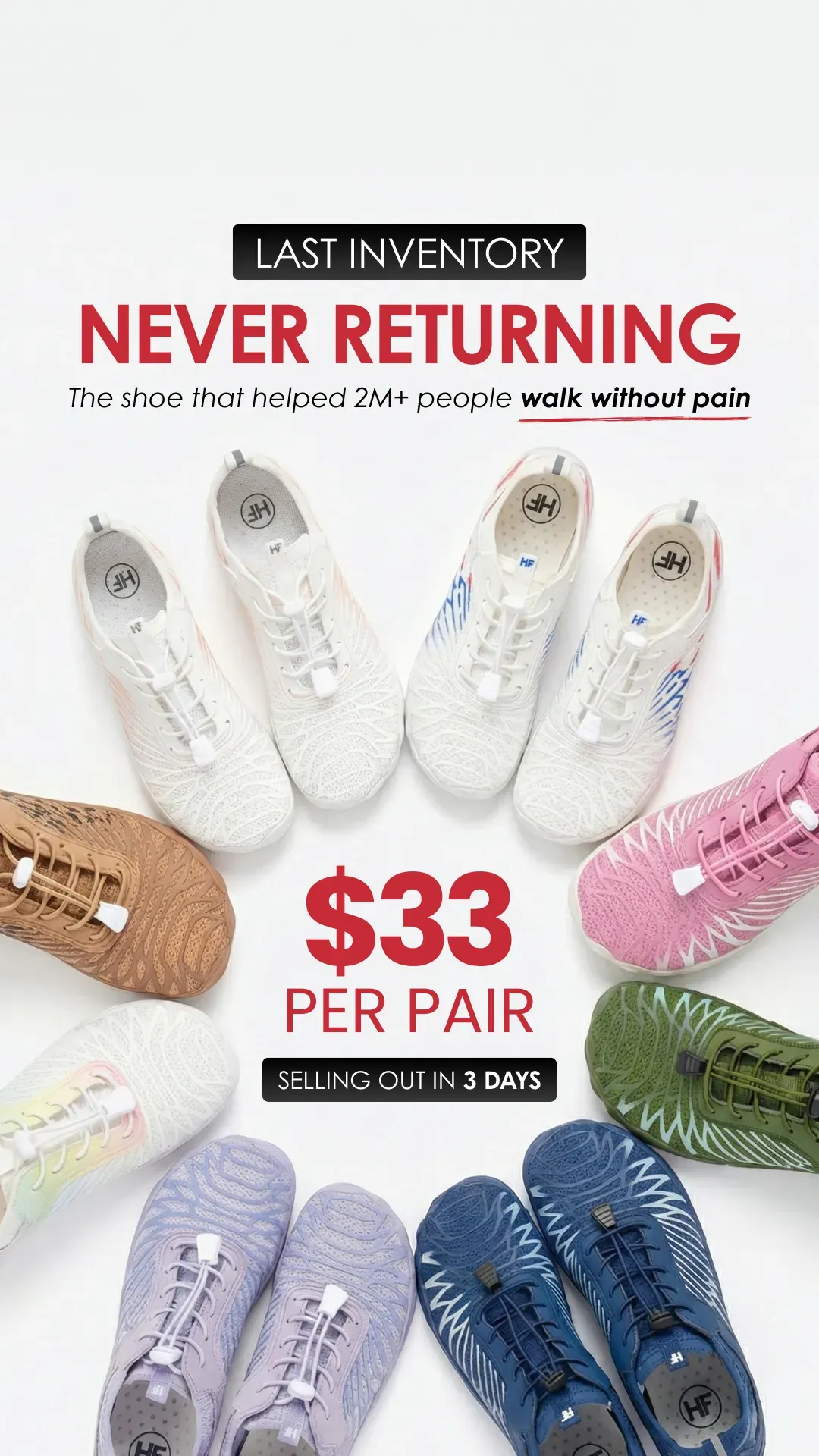
A ring of barefoot-style shoes in white, pink, green, navy, lilac, and tan, toes pointed inward around "$33 PER PAIR" and "SELLING OUT IN 3 DAYS." Above: "LAST INVENTORY," "NEVER RETURNING," and "The shoe that helped 2M+ people walk without pain." 235 days.
Why it works: A ring shows every colorway, the price is the headline, and the customer count does the proof. "Selling out in 3 days" on an ad that ran 235 days is the part to skip, because urgency claims need to be true.
Clone it: Any multi-color shoe. Arrange pairs in a ring, put a true price in the middle.
22. HIKE Footwear — prevents, relieves, restores, 108 days
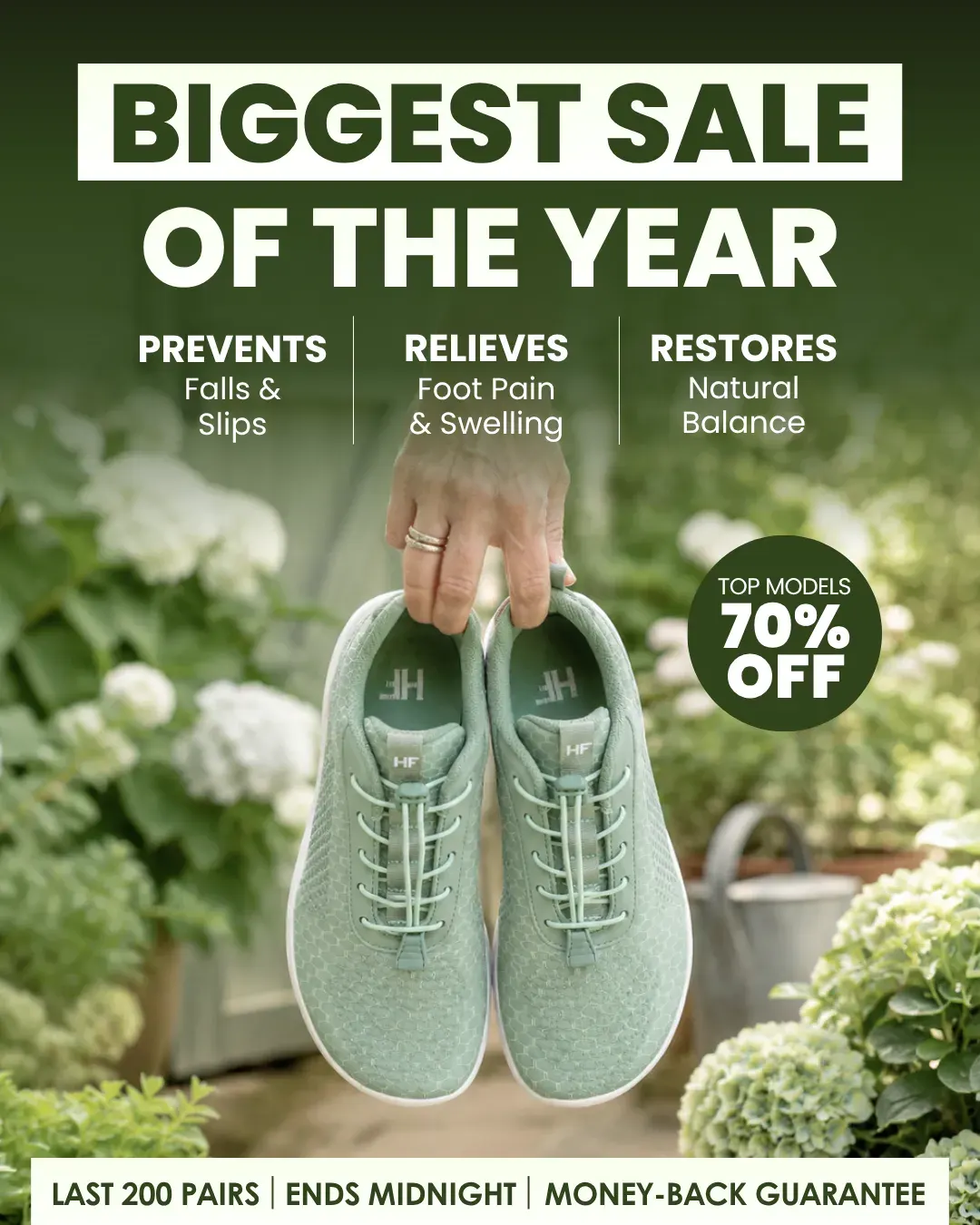
A hand holds a pair of sage knit shoes by the heels in a garden of white hydrangeas. "BIGGEST SALE OF THE YEAR," three columns ("PREVENTS Falls & Slips," "RELIEVES Foot Pain & Swelling," "RESTORES Natural Balance"), a "TOP MODELS 70% OFF" roundel, and a footer: "LAST 200 PAIRS | ENDS MIDNIGHT | MONEY-BACK GUARANTEE." 108 days.
Why it works: A garden setting targets the buyer, and the three verbs promise outcomes. "Prevents falls" is a health claim aimed at an older audience, which raises the bar for evidence.
Clone it: Keep the layout (hand-held pair, three columns, guarantee strip) and fill the columns with features you can prove: grip, width, weight.
23. Bronoir — the customer's problem as the headline, 183 days
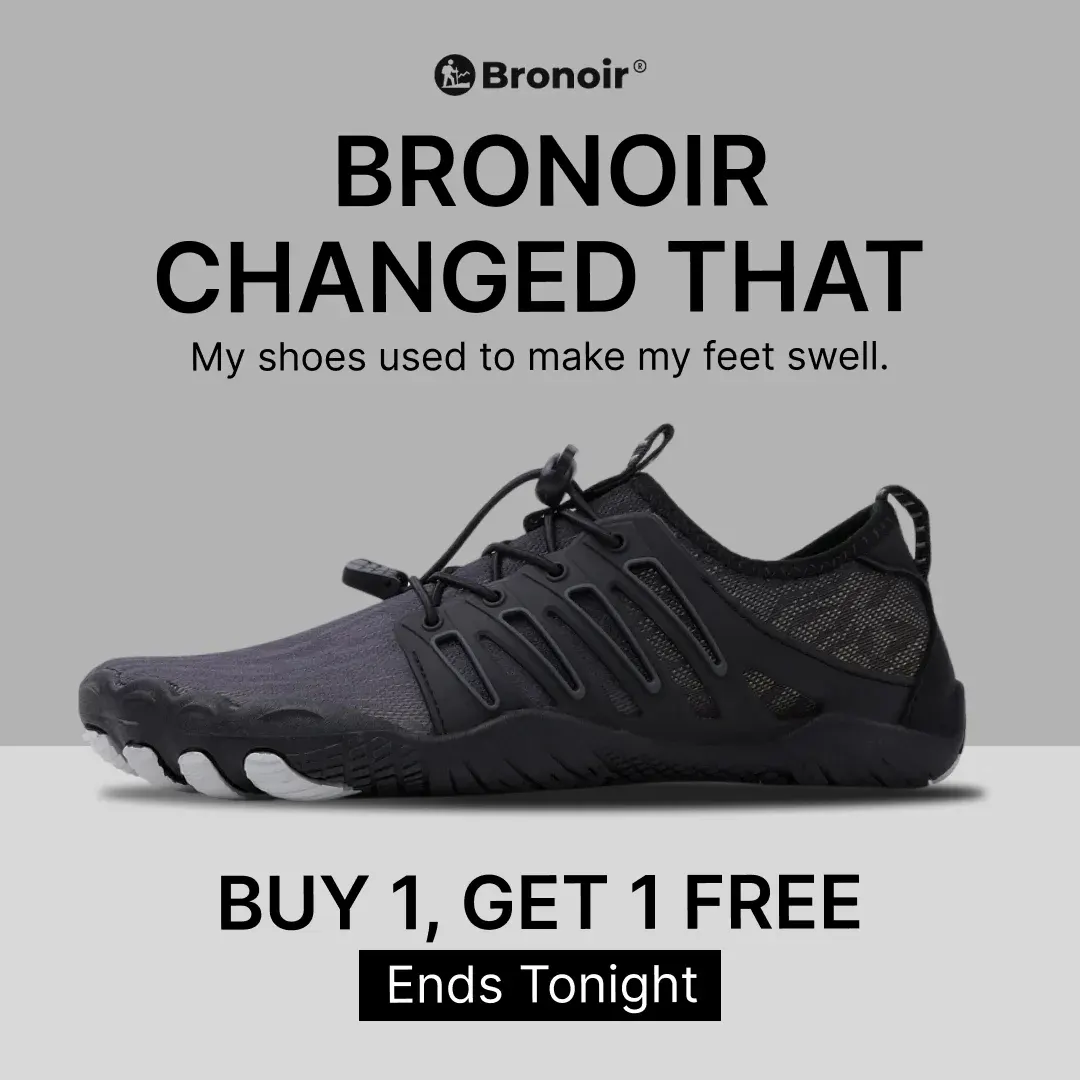
A black barefoot-style shoe with a white toe bumper on a two-tone gray background. "BRONOIR CHANGED THAT" in heavy caps over a smaller line, "My shoes used to make my feet swell." Below: "BUY 1, GET 1 FREE" and a black "Ends Tonight" tag. 183 days.
Why it works: Its problem line is written as a customer's voice, so the headline reads as a testimonial. A BOGO and "ends tonight" close it, though, as with HIKE, a daily deadline on a six-month ad isn't a real deadline.
Clone it: One customer problem, quoted, then your brand as the fix. Keep the offer honest.
24. Barestep — guaranteed relief in 14 days, 90 to 180 days
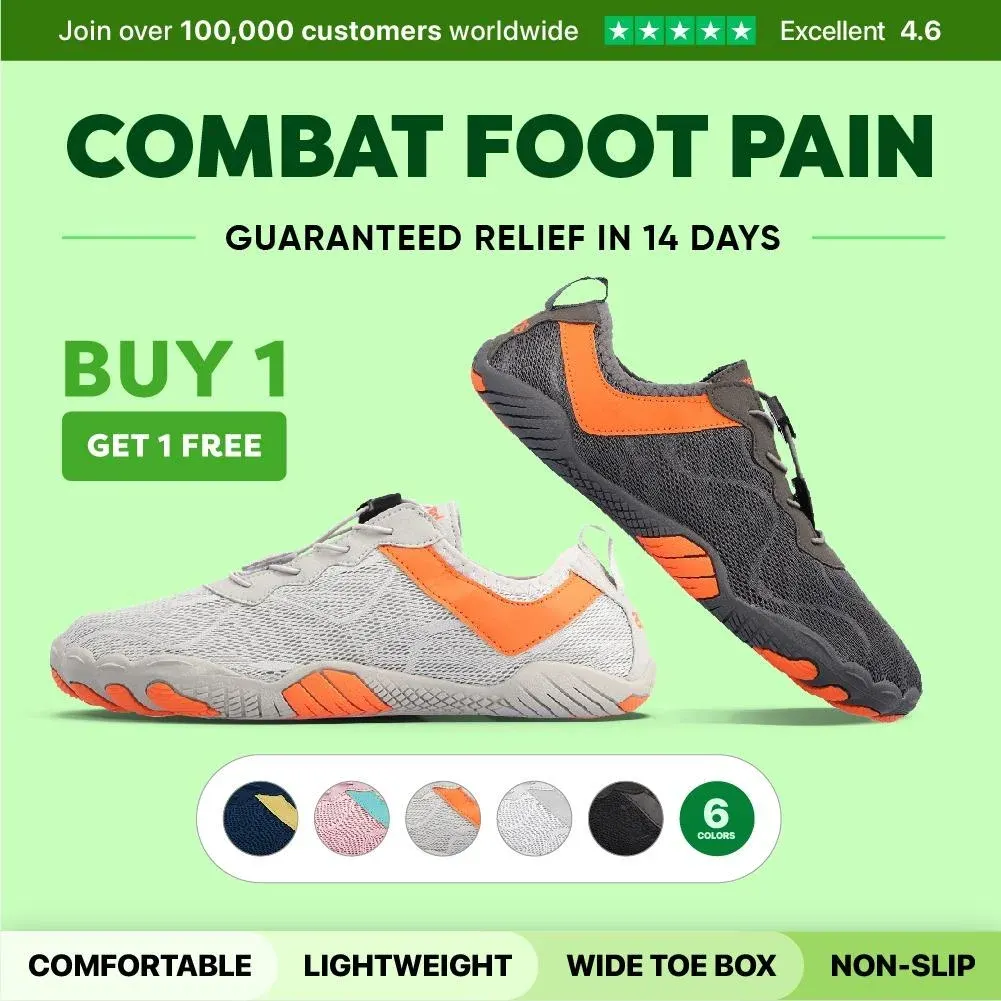
Two barefoot-style shoes in gray and orange on mint green, six color dots below. "COMBAT FOOT PAIN," "GUARANTEED RELIEF IN 14 DAYS," "BUY 1 GET 1 FREE," a top strip with "Join over 100,000 customers worldwide" and an "Excellent 4.6" star rating, and a feature bar: "COMFORTABLE, LIGHTWEIGHT, WIDE TOE BOX, NON-SLIP." 90 to 180 days.
Why it works: It stacks every direct-response device in one frame: a problem, a timed promise, an offer, a rating, a customer count, and a color range. A timed relief guarantee is also a specific efficacy claim.
Clone it: A feature bar and color dots transfer to any shoe. A 14-day relief promise only transfers with evidence.
25. Barestep — a bone density testimonial, 30 to 90 days
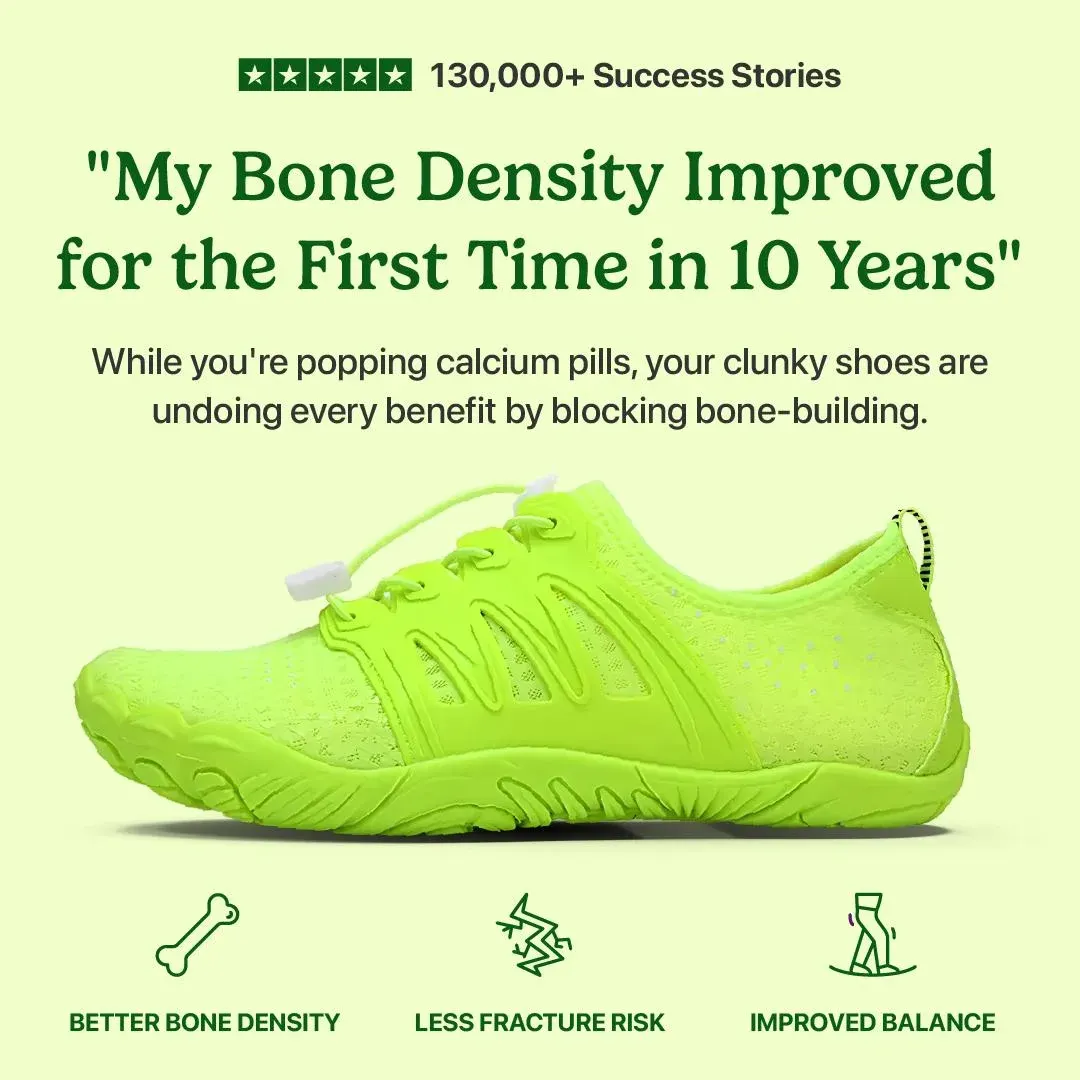
A neon-yellow barefoot-style shoe on pale green. A quoted headline: "My Bone Density Improved for the First Time in 10 Years," then "While you're popping calcium pills, your clunky shoes are undoing every benefit by blocking bone-building." Three icons: "BETTER BONE DENSITY," "LESS FRACTURE RISK," "IMPROVED BALANCE." "130,000+ Success Stories" at the top. 30 to 90 days.
Why it works: It ties the shoe to a fear the buyer already has. It's also the riskiest ad in this post: bone density and fracture risk are disease-adjacent claims, and a single testimonial doesn't substantiate them.
Clone it: Don't clone the claims. Keep the structure (a quoted headline, three icons, one hero shoe) and fill it with comfort facts.
That's 25 ads, one per card. Browse the rest of the footwear ad examples, or see the same moves in other categories in the Instagram static product ads post.

Create your own footwear product ads
Create your ad
What run-length proves and what it doesn't
A long run means someone kept paying for the ad week after week. It doesn't mean the ad was profitable. You see the survivors, not the variants switched off in week one, and a big brand can leave a weak ad on low spend for years. Nike's 1,875 days tell you Nike kept it live, not what it spent.
Read it as a filter. When a move keeps showing up among survivors (the on-foot crop, the upturned sole, the press bar), test that move first, then test it on your own budget.
Shoe ad rules that change the creative
Footwear advertising has a specific enforcement history, and it's the main reason to think twice before borrowing the comfort genre's claims. What follows is practical, not legal advice, and every link goes to the regulator's own page.
Toning and fitness claims have cost $65 million. In September 2011 the FTC announced that Reebok would pay $25 million in customer refunds over claims that EasyTone and RunTone shoes strengthen and tone leg and buttock muscles more than regular shoes. In May 2012 Skechers agreed to pay $40 million over claims that Shape-ups produced more weight loss and toning than regular fitness shoes. The FTC also alleged that Skechers didn't disclose that a chiropractor endorsing the shoes was married to a Skechers marketing executive. David Vladeck, then the FTC's consumer protection director, put the message to national advertisers bluntly: "shape up your substantiation or tone down your claims."
Health claims need human evidence. The FTC's Health Products Compliance Guidance says health benefit claims for any product need "competent and reliable scientific evidence," generally randomized controlled human trials. "Reduces pain," "prevents falls," "guaranteed relief in 14 days," and "better bone density" are all health claims. A customer quote doesn't substitute for a study.
A shoe sold to correct the body can be a medical device. FDA's regulation for a limb orthosis covers devices "intended for medical purposes" to support, correct, or prevent deformities, and lists "a corrective shoe" as an example. Words like "orthopedic," "corrective," or "treats plantar fasciitis" push a shoe toward that category and its rules. "Comfortable," "wide toe box," and "cushioned" don't.
"Made in USA" means all or virtually all. The FTC's Made in USA standard requires final assembly and all significant processing in the US, with "all or virtually all" components made and sourced domestically, and it applies to advertising and digital marketing, not only labels. A shoe with an imported sole can say "Assembled in USA" if its principal assembly happens here and is substantial, not a quick final step.
Endorsements and seals. The FTC's Endorsement Guides require that "an endorsement must reflect the honest opinion of the endorser" and that paid or gifted endorsers disclose the connection. "Podiatrist approved" is an expert endorsement and needs a real podiatrist's documented evaluation behind it.
| If your ad says… | What applies | Safer creative |
|---|---|---|
| "Reduces pain," "relieves swelling" | FTC health-claim substantiation | Name the feature: "wide toe box," "zero drop," "cushioned heel" |
| "Prevents falls," "better bone density" | FTC substantiation, disease-adjacent | Drop it, or show grip with an outsole close-up |
| "Corrective," "orthopedic," "treats" | FDA limb orthosis rules | "Supportive," "roomy," "built for long shifts" |
| "Made in USA" | FTC all-or-virtually-all standard | "Assembled in USA" if true, or skip origin |
| "Podiatrist approved," a seal | FTC Endorsement Guides | A named, documented expert, or no seal |
How to make a shoe ad from one of these
Pick the genre first. If your shoe sells on style, start from a quiet brand frame: Allbirds' tunnel, Koio's top-down pair, Nisolo's leg kick. If it sells on comfort, borrow the comfort genre's layouts (OluKai's labeled outsole, Barestep's feature bar and color dots) and fill them with features, not medical promises. Then swap in your shoe, your colorways, and your name.
AdDogs does the swap. Open any ad in the footwear library or upload one you screenshotted, add your product photo, and AdDogs rebuilds the ad with your shoe and your brand colors. One credit is one ad in the dimension you pick: Basic is $12/mo for 30 credits with 1:1, 9:16, and 16:9, and Pro and Ultimate include all 14 aspect-ratio options. If you need placement sizes, our Meta ad sizes guide lists them, and the walkthrough for recreating a winning static covers the rest.
Methodology
On October 25, 2026 the AdDogs library held 325 public ads in its footwear category, 179 of which had run at least 30 days and 28 at least 180 days at the last check. We added footwear ads filed under other categories by matching shoe, sneaker, boot, sandal, and loafer in their descriptions, reviewed every candidate at full size, dropped unbranded, low-resolution, and duplicate creatives and non-shoe products (socks, insoles, apparel), and chose 25 for coverage of creative moves, with at most two per brand. For the other 15, run-length is days live at the last check, from Meta Ad Library start dates or Foreplay's days-running count, between April 8 and October 12, 2026. Ten ads carry only a run-time band from an ad gallery's label as of April 7, 2026 (more than 180 days, 90 to 180, or 30 to 90), shown as ranges and kept out of the dated counts. Copy was transcribed from the images, and the Nike copy is our translation from Greek. Counts in the tables are our own reading of the 25 images. Our rules section cites FTC, FDA, and eCFR pages read on October 25, 2026.
FAQ
What makes a good shoe ad?
It matches its genre. Brand shoe ads show the shoe on a foot or a plinth and say almost nothing: the three longest dated runs here (1,875, 1,468, and 554 days) carry no claim and no price. Comfort shoe ads sell relief with a feature bar, an offer, and a customer count, and they need evidence for every health claim they make.
How do you advertise shoes on Facebook and Instagram?
Start from a format that has already run for months. Of 25 long-running shoe ads on Meta, 10 show the shoe on a foot, four turn the outsole toward the camera, and only four carry a price or an offer. Show the shoe in use, size it for the placement, and test three or four layouts against each other before scaling one.
What is the most famous shoe ad?
Complex's list of the 50 best sneaker ad campaigns ranks Nike's 1988 Air Jordan "Spike & Mike" campaign, made by Wieden + Kennedy, at number one. On Meta, the longest dated run in our footwear library is a Nike app ad at 1,875 days.
Can a shoe ad claim to relieve foot pain?
Only with competent and reliable scientific evidence, which the FTC says generally means randomized human trials. Reebok paid $25 million in 2011 and Skechers $40 million in 2012 over toning-shoe claims the FTC said were unsupported. Feature claims like "wide toe box" or "zero drop" need far less support than outcome claims like "reduces pain."
Can a shoe brand say its shoes are "Made in USA"?
Only if they are "all or virtually all" made in the US: final assembly and all significant processing here, with all or virtually all components made and sourced domestically. FTC policy applies that standard to ads and digital marketing as well as labels. A shoe with foreign components can say "Assembled in USA" if its principal, substantial assembly happens in the US.
Are orthopedic shoes regulated as medical devices?
A shoe intended for medical purposes, such as correcting a deformity, falls under FDA's limb orthosis regulation, which names "a corrective shoe" as an example. It's a Class I device, the lowest-risk category. Marketing a shoe as "orthopedic" or "corrective" moves it toward that category, while comfort and fit language doesn't.