32 food ad examples that ran for months (and why they work)


Liquid Death ran the same Meta ad for 1,957 days. Two cans of water on white, four words, a 7-Eleven logo: "Now available at." No flavor shot, no claim, no discount. Most lists of food ads hand you Chipotle's 2011 farm film and a McDonald's billboard, with no way to tell whether any of it sold. Below are 32 food ads from DTC snack, drink, and coffee brands, each with the number of days it ran, grouped by the creative move it makes. After them: the claim rules that decide what a food ad can say, and the research on why food photos make people hungry. Jump to the 32 ads.
What makes a good food ad
A good food ad does one of two jobs in the first second. It makes the viewer taste the product, or it gives them a reason to switch from what they already eat. Taste is the appetite shot: the broken bar, the pour, the melt. Switching is the claim: less sugar, four ingredients, cheaper than the café. Luxury ads win by leaving things out, and 27 of 28 show no price. Food ads that run for months put the argument in the frame.
Counted across the 32 ads below:
| Move | Count | Who does it |
|---|---|---|
| No price, discount, or offer in the image | 24 of 32 | The eight exceptions are offers, bundles, and price-per-serving math |
| Food shown out of its pack (broken, poured, cooked, raw) | 12 of 32 | Conscious Bar, Mid-Day Squares, SkinnyDipped, Roots, realsy, Sakuraco, Daily Harvest, Bold Bean, Momofuku, De Soi, Misfits, Hungryroot |
| A nutrition, ingredient, or "free-from" claim as the headline or callouts | 12 of 32 | Grams of sugar and protein, ingredient counts, "seed oil free," "no added sugar" |
| Names or shows the thing it replaces | 7 of 32 | The café cup, Blue Apron, "the other fish gummies," fake honey, candy |
| Third-party voice (review, customer quote, celebrity, Reddit) | 6 of 32 | Eight if you count first-person captions |
| A body-effect claim (energy, digestion, "no sugar crash") | 6 of 32 | The copy regulators watch hardest (see the claim rules) |
| Built to look like a post, a text, or a phone photo | 5 of 32 | Misfits, Hungryroot, Little Spoon, Spindrift, Craftmix |
| A real human face | 2 of 32 | Olipop's two diners and Jamie Oliver's headshot |
| Ran 365 days or more | 9 of 32 | Two Liquid Death ads, two Wandering Bear, Coca-Cola, Phizz, Bruvi, Misfits Market, Splendid Spoon |
Two findings stand out. Faces barely appear: the product, the food, or a hand carries the frame, which is the opposite of most testimonial ads. And no single move owns the long runs. Ranked by days, the top five are a can on white, a can in the Alps, a black screen of white type, a hand-drawn offer, and a tablet tube with a quote. What they share: nothing in them dates.
32 food ads that ran for months
Every ad below is a real Meta or Instagram ad from the AdDogs food and beverage library. "Days" is how long the ad had been live at the library's last check (April 7 to October 12, 2026, from the Meta Ad Library or Foreplay), so several have run longer since. Eight carry a tracker bucket instead of an exact count: "180+ days" means more than 180, and "between 90 and 180 days" (Manukora, PROMIX) is a range. A long run proves the advertiser kept paying, not that the ad was profitable (more on that below). To check one yourself, search the brand in the Meta Ad Library with the "active" filter (for example, Liquid Death's live ads) and read the "Started running on" date. Our Meta Ad Library guide walks through it.
One admission up front. Our library carries DTC and CPG food and drink advertisers, not the big-budget TV spots CPG brands are famous for, and not restaurants. If you sell a snack, a drink, a coffee, or a meal kit online, that's the useful set: these brands had to make a static ad sell a product in a pack.
Product as the ad. When the pack is distinctive enough, a pack on a background is the whole creative.
1. Liquid Death — four words and a retailer, 1,957 days
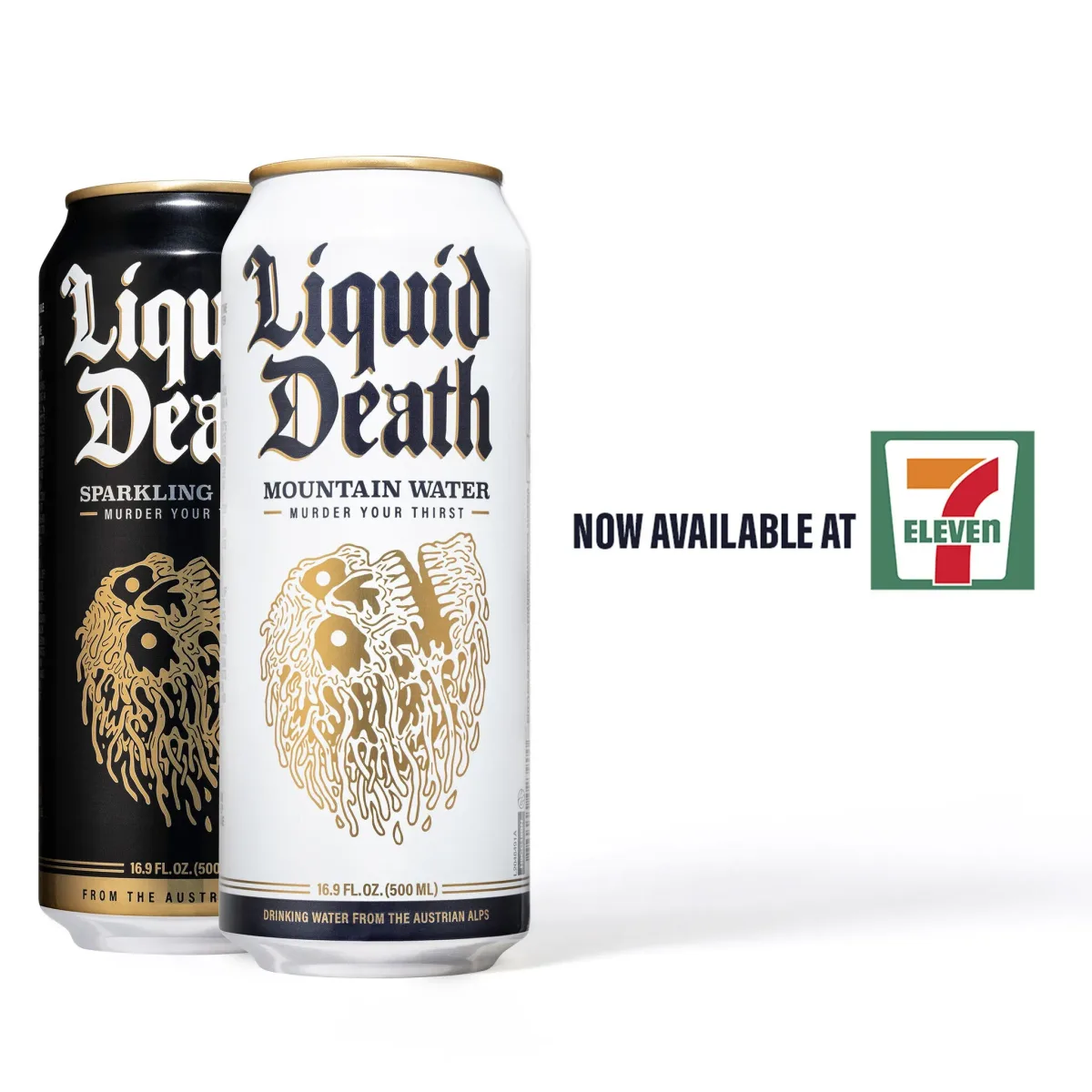
A black sparkling can and a white still can, overlapping, on pure white with a soft floor shadow. "NOW AVAILABLE AT" in condensed caps and the 7-Eleven logo. Nothing else. 1,957 days, the longest-running ad in this post.
Why it works: The can already says "water," "Austrian Alps," and "murder your thirst," so the ad only has to say where to buy it. A retail-availability ad stays true as long as the shelf exists.
Clone it: Any product with a pack that does its own talking and a new retailer to announce. Pack left, "Now at" and the logo right.
2. Liquid Death — a can in the Alps, zero words
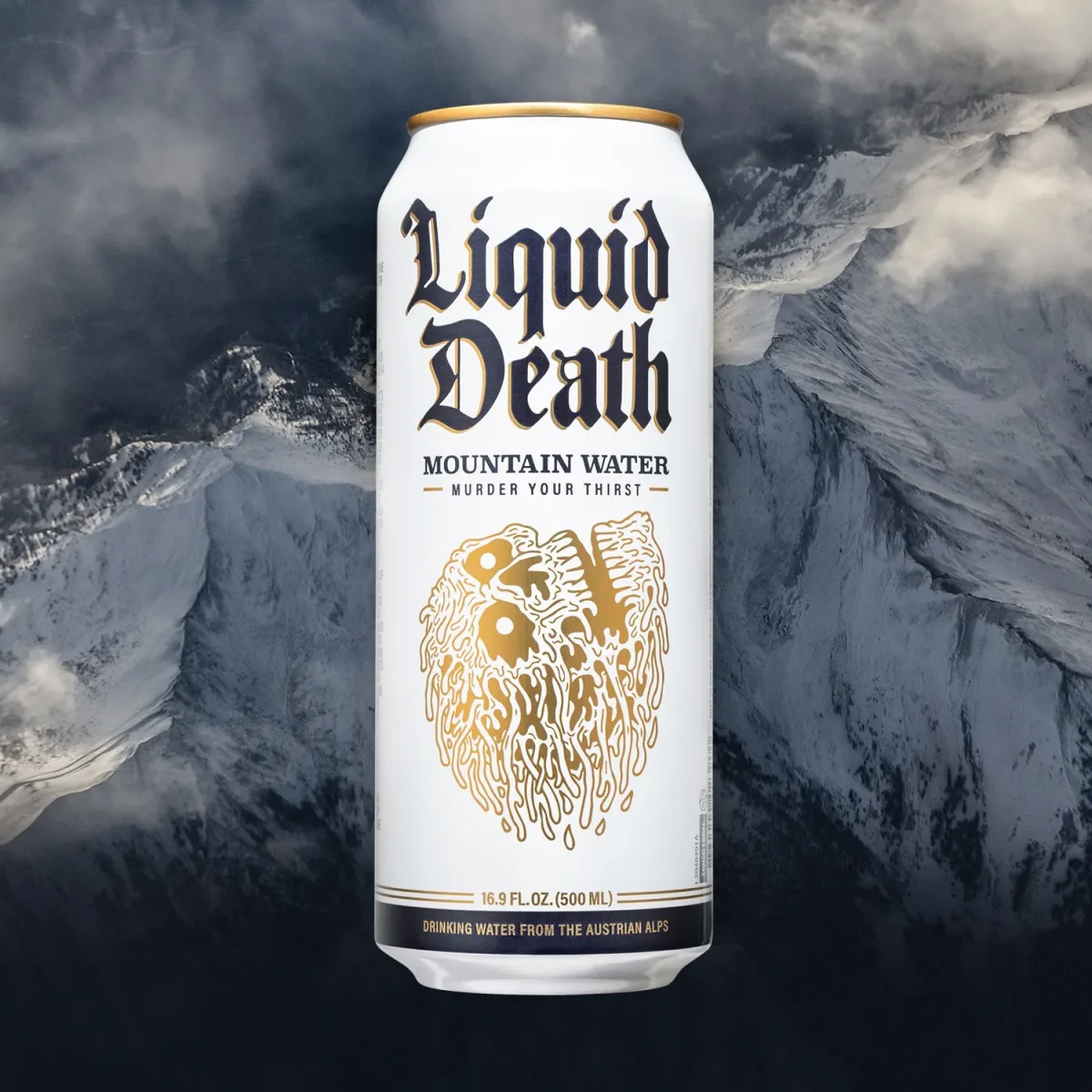
One white can, centered and upright, against a dark sweep of snow-covered peaks and cloud. No headline, no button, no offer. 1,747 days.
Why it works: The background makes the claim. "Drinking water from the Austrian Alps" is printed on the can, the photograph proves it, and the white can is the brightest thing in a dark frame.
Clone it: Put the product in front of where it comes from: the farm, the ocean, the mountain. Let the place carry the claim the copy would have made.
3. Rebel Creamery — the sugar count on every lid
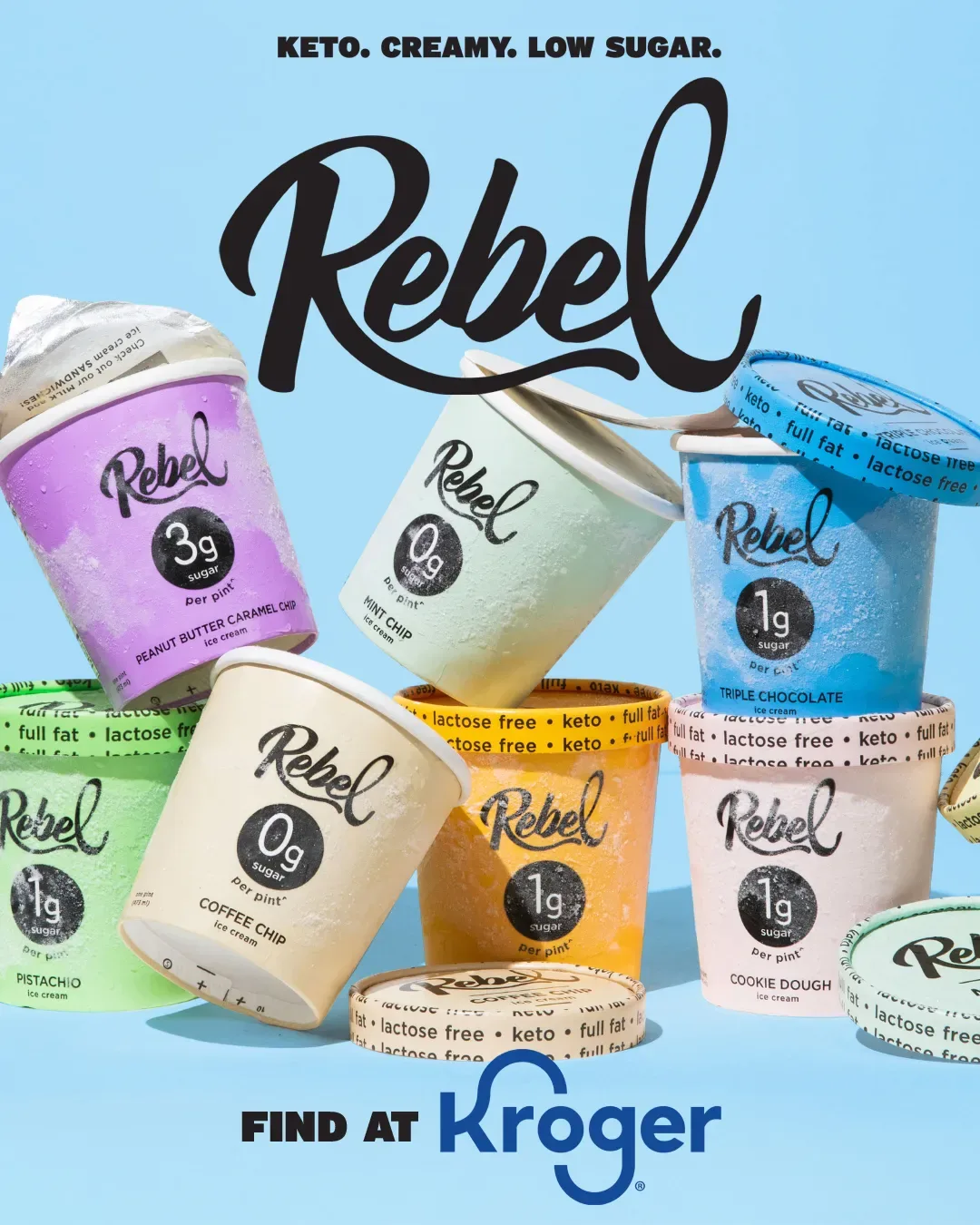
Eight pints tumble in a pile on sky blue, lids off and askew, each with a black badge reading "0g," "1g," or "3g sugar per pint." "KETO. CREAMY. LOW SUGAR." runs across the top, the script wordmark is huge, and "FIND AT Kroger" sits at the bottom. 350 days.
Why it works: The pack is the nutrition label. Repeating the badge on every pint means the eye lands on a number wherever it lands, and "creamy" is the one word that keeps a diet claim tasting like ice cream.
Clone it: Any range with one number that matters (sugar, protein, calories). Pile the SKUs, make the number the badge, name the retailer.
Food out of the pack. Break it, pour it, melt it, cook it. Thirteen of the 32 ads show the food itself, not only its packaging.
4. The Conscious Bar — chocolate melting over chocolate
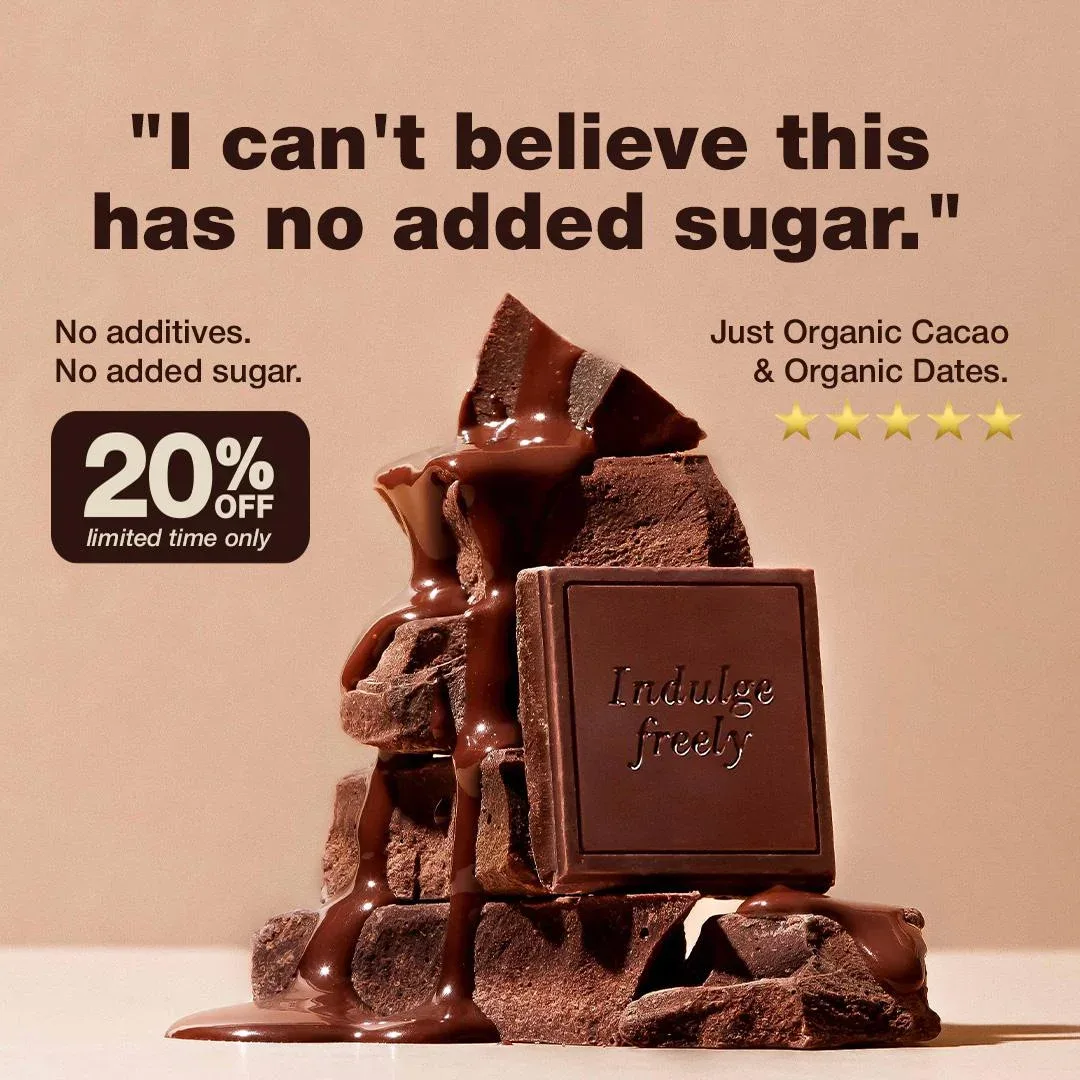
A chocolate square embossed "Indulge freely" leans on broken chunks while melted chocolate runs down the stack, on dusty pink. Its headline is a customer line in quote marks, "I can't believe this has no added sugar." "No additives. No added sugar." sits left, "Just Organic Cacao & Organic Dates" with five stars sits right, and a badge reads "20% off, limited time only." 180+ days.
Why it works: The melt does the tasting and the headline does the switching. A no-added-sugar claim is the hardest thing to make sound indulgent, so the image goes as indulgent as chocolate gets.
Clone it: Any better-for-you treat. Shoot it at its most decadent and let a customer-voiced headline carry the claim.
5. Mid-Day Squares — the claims printed on the bar
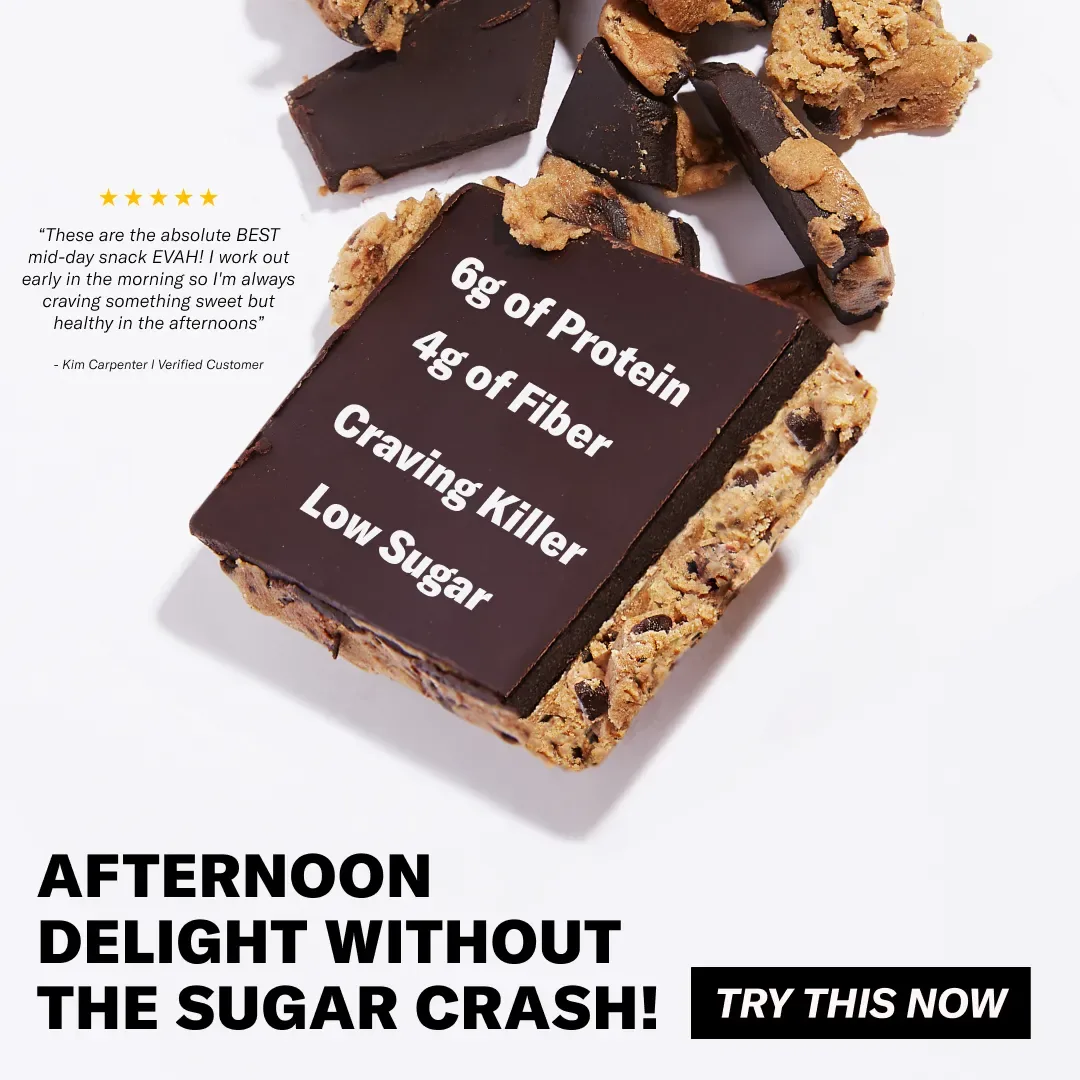
A cookie-dough bar with a chocolate top, angled on white, with broken pieces scattered above it. "6g of Protein / 4g of Fiber / Craving Killer / Low Sugar" is written across the chocolate. A five-star customer quote sits top-left, with "AFTERNOON DELIGHT WITHOUT THE SUGAR CRASH!" and a "TRY THIS NOW" button below. 300 days.
Why it works: The bar becomes the label, so claims and texture arrive in one glance. Broken pieces show the inside, the part a buyer wants to see.
Clone it: Any bar, cookie, or slab. Write the macros on the product, break one piece open, add one review.
6. SkinnyDipped — the cross-section
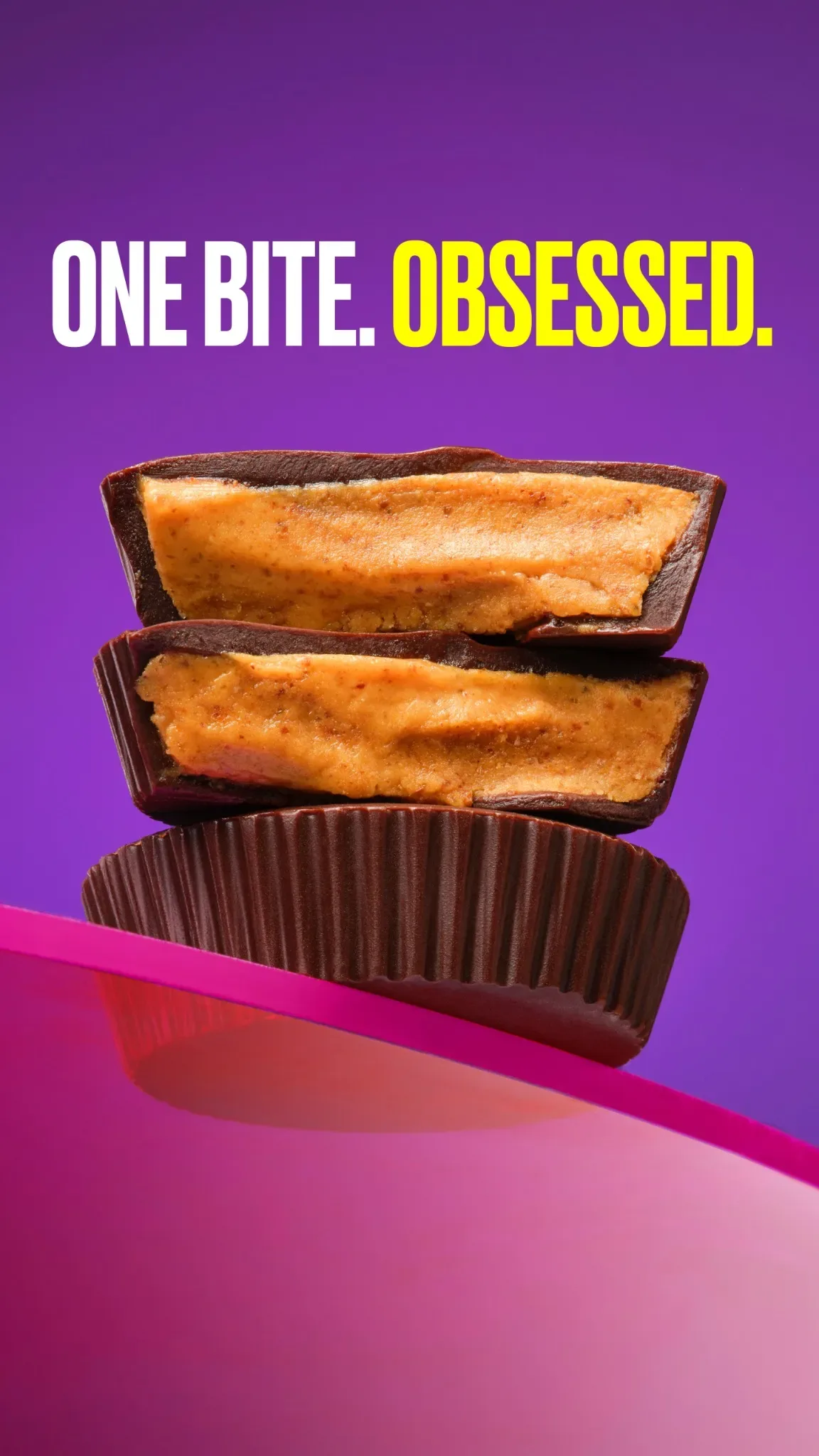
Two peanut butter cups sliced in half and stacked on a whole one, filling shown in profile, on a purple-to-magenta gradient. "ONE BITE." in white and "OBSESSED." in yellow. 168 days.
Why it works: Cutting the cup in half answers the one question a peanut butter cup buyer has: how much filling. Four words, one image, no claims.
Clone it: Anything with an inside: filled chocolate, dumplings, croissants, stuffed bites. Slice it, stack it, and write the reaction, not the description.
7. Roots Farm Fresh — a wall of croutons
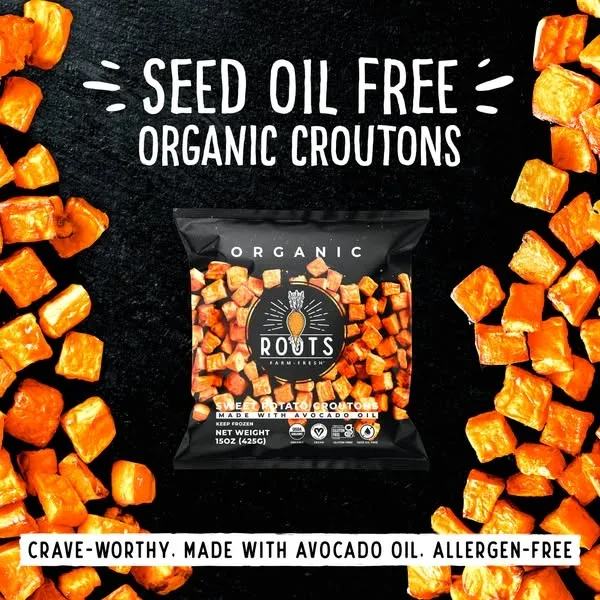
A black bag of organic sweet potato croutons in the center, surrounded edge to edge by bright orange croutons on black. "SEED OIL FREE / ORGANIC CROUTONS" in white condensed caps, and a white strip at the bottom: "CRAVE-WORTHY. MADE WITH AVOCADO OIL. ALLERGEN-FREE." 180+ days.
Why it works: Black makes orange look crisp, and filling the frame with product reads as abundance. Its headline leads with what the food leaves out, which is the switching argument for this buyer.
Clone it: Any small, colorful food (chips, nuts, gummies, berries). Black background, product to every edge, pack in the middle, the free-from line on top.
8. realsy — the ingredients explode out of the pack
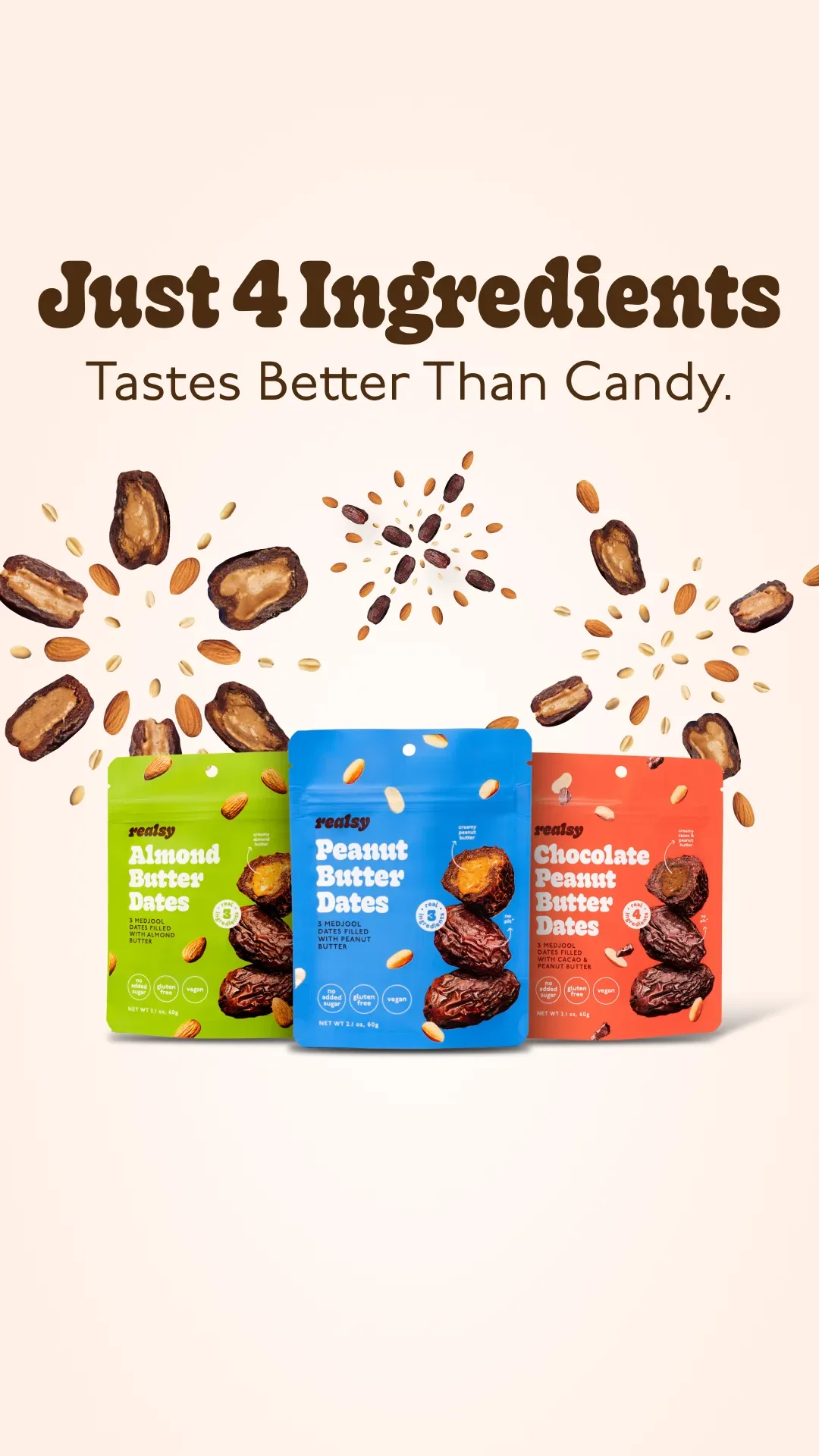
Three pouches of nut-butter-stuffed dates in green, blue, and orange, with dates, almonds, and cacao nibs bursting outward behind them on cream. "Just 4 Ingredients" in a chunky serif and "Tastes Better Than Candy." beneath. 331 days.
Why it works: The burst shows the ingredient list without printing it, and the motion makes a still feel fresh (more in the research section). "Better than candy" names the thing it replaces in three words.
Clone it: Any short-ingredient product. Pack in front, ingredients flying out, ingredient count as the headline.
9. Sakuraco — a grid of six treats
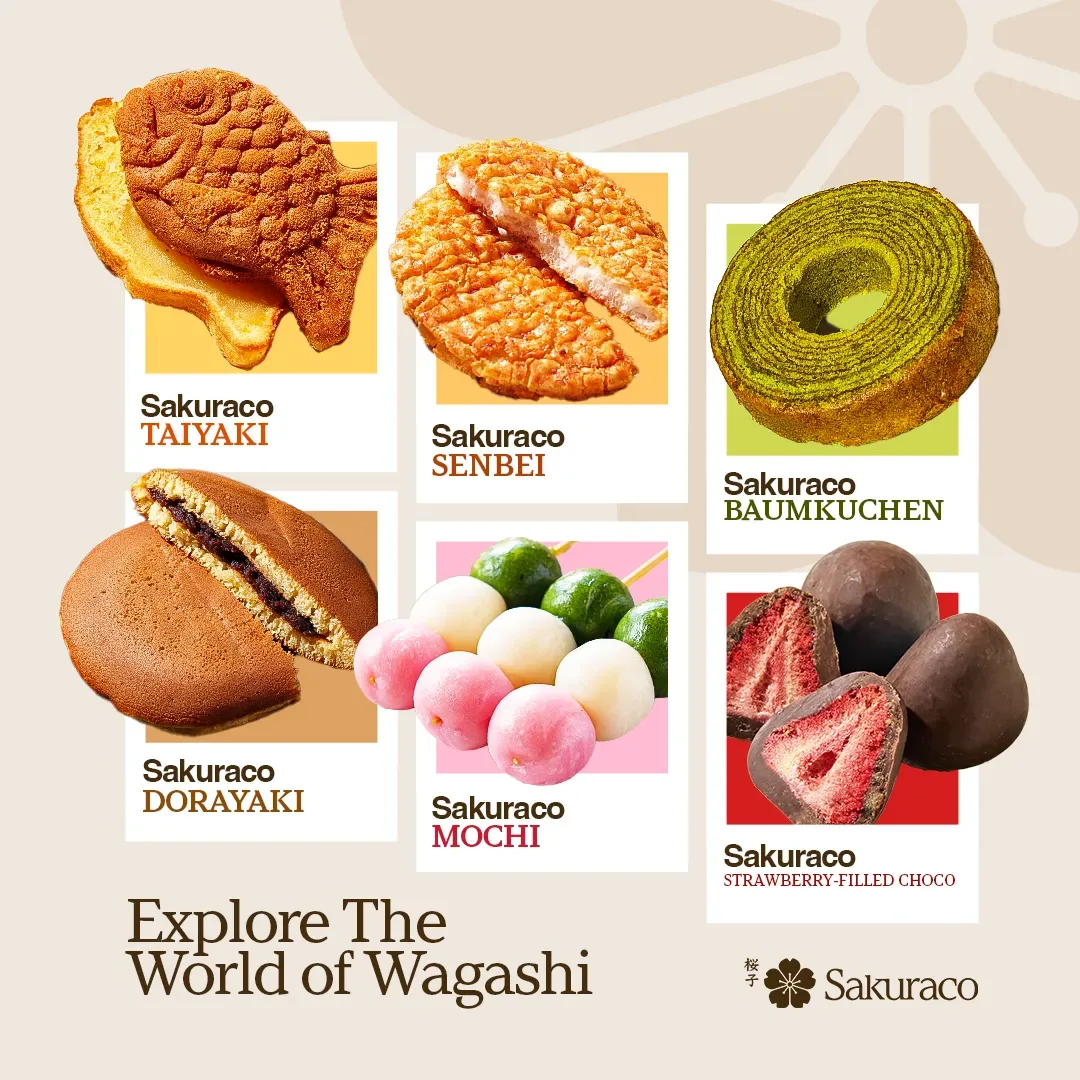
Six Japanese sweets cut out on colored tiles: taiyaki, senbei, baumkuchen, dorayaki, dango-style mochi, and halved strawberry-filled chocolates, each labeled "Sakuraco" plus its name. "Explore The World of Wagashi" in serif at the bottom. 257 days.
Why it works: A subscription box sells variety, and a grid shows variety faster than a box shot. Each tile is its own appetite shot, and the names teach the buyer six words they'll want to say.
Clone it: Any variety pack, sampler, or subscription. One tile per item, the real name under each, a one-line promise of discovery.
Callouts and claims. Product in the middle, arrows or lines pointing at what's good about it.
10. Daily Harvest — four arrows around a cup
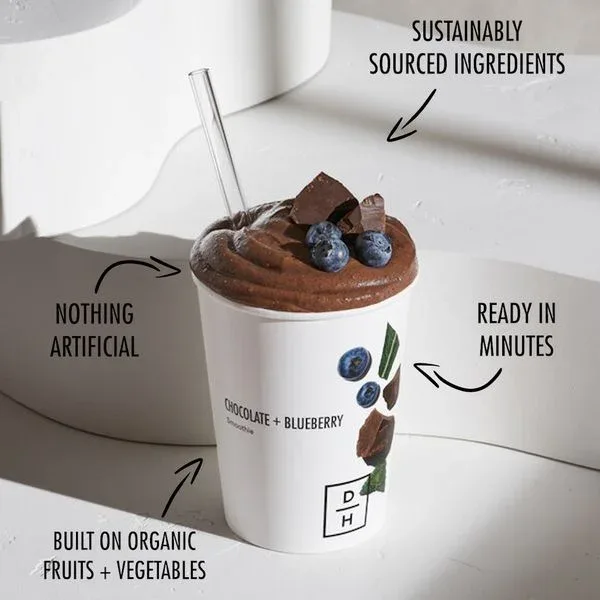
A chocolate and blueberry smoothie in a white cup, frosting-thick, topped with chocolate shards and blueberries, a glass straw, hard window light. Hand-drawn arrows point in from four handwritten labels: "SUSTAINABLY SOURCED INGREDIENTS," "NOTHING ARTIFICIAL," "READY IN MINUTES," "BUILT ON ORGANIC FRUITS + VEGETABLES." 301 days.
Why it works: The arrows feel like a friend annotating a photo. Every claim is about ingredients or convenience, none about the body, which keeps it on safe regulatory ground.
Clone it: Any single-serve product. One beauty shot, four handwritten callouts, no headline.
11. Four Sigmatic — a sister's habit and six labels
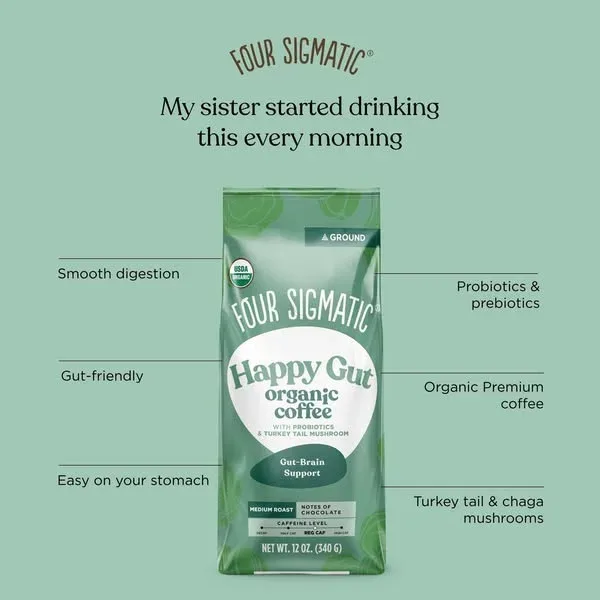
A green bag of Happy Gut organic coffee centered on sage green, thin lines running to six labels. Left: "Smooth digestion," "Gut-friendly," "Easy on your stomach." Right: "Probiotics & prebiotics," "Organic Premium coffee," "Turkey tail & chaga mushrooms." Headline in serif: "My sister started drinking this every morning." 180+ days.
Why it works: The headline is a recommendation, not a claim, and the callouts split cleanly into body effects on one side and ingredients on the other. Its left side is also the wording that needs evidence behind it under the FTC's health claim guidance.
Clone it: Any functional food or drink. Pack in the middle, benefits left, ingredients right, a first-person headline. Keep the benefits to what you can substantiate. More coffee ad examples live in the library.
12. Phizz — a quote, four ticks, a free tube
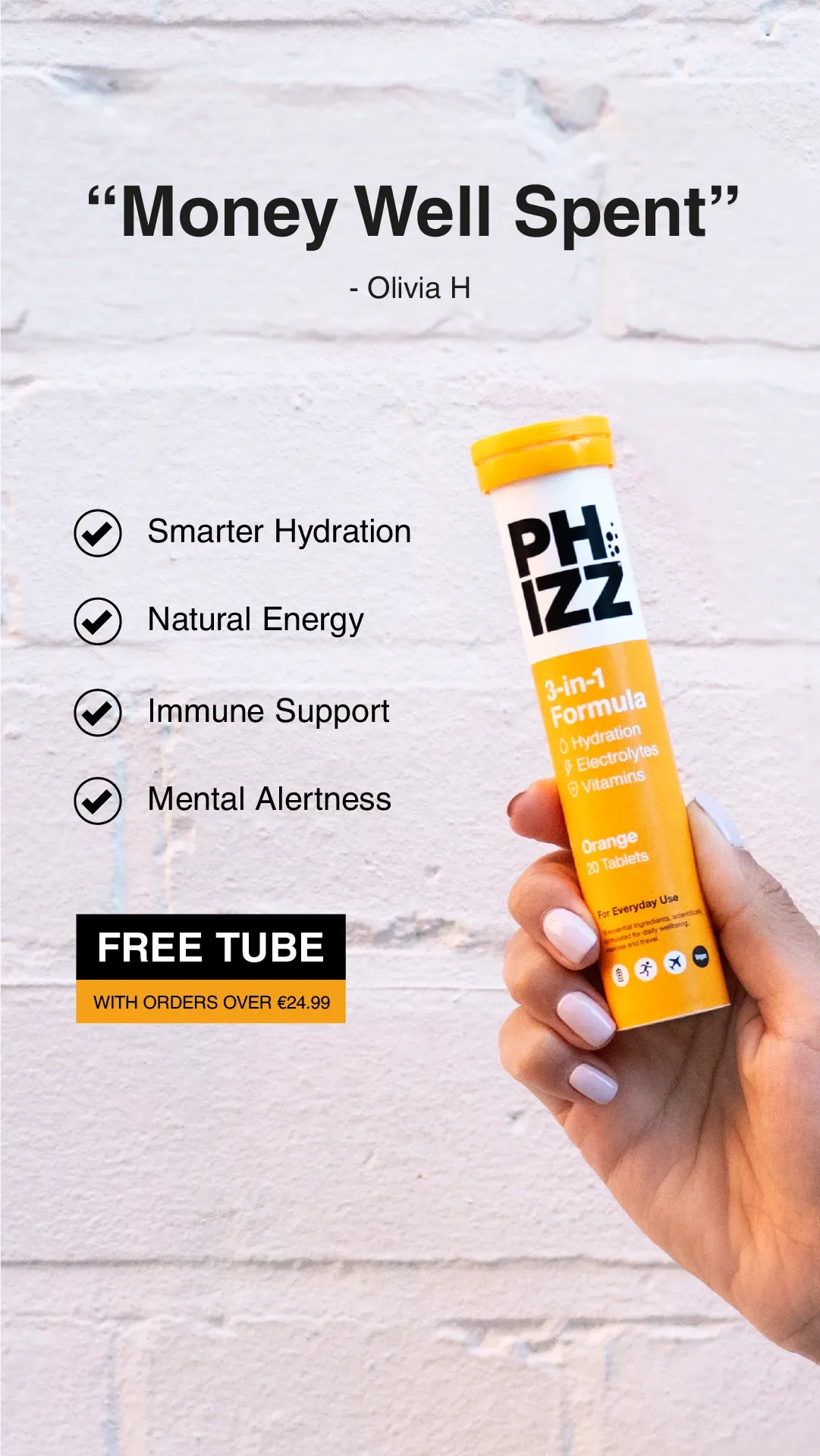
A hand holds an orange tube of effervescent hydration tablets against a whitewashed brick wall. "'Money Well Spent' - Olivia H" sits at the top, four checkmarks read "Smarter Hydration," "Natural Energy," "Immune Support," and "Mental Alertness," and a black-and-orange badge offers a "FREE TUBE with orders over €24.99." 884 days.
Why it works: A two-word review is the headline because it answers price before price comes up. Four ticks read as a checklist, and the free tube gives the click a reason today.
Clone it: Any consumable sold in packs. Hand plus product, a short customer quote, three or four ticks, a gift with purchase. If you sell supplements, the supplement ad examples cover the stricter claim territory.
13. Nuun — a chart nobody else would run
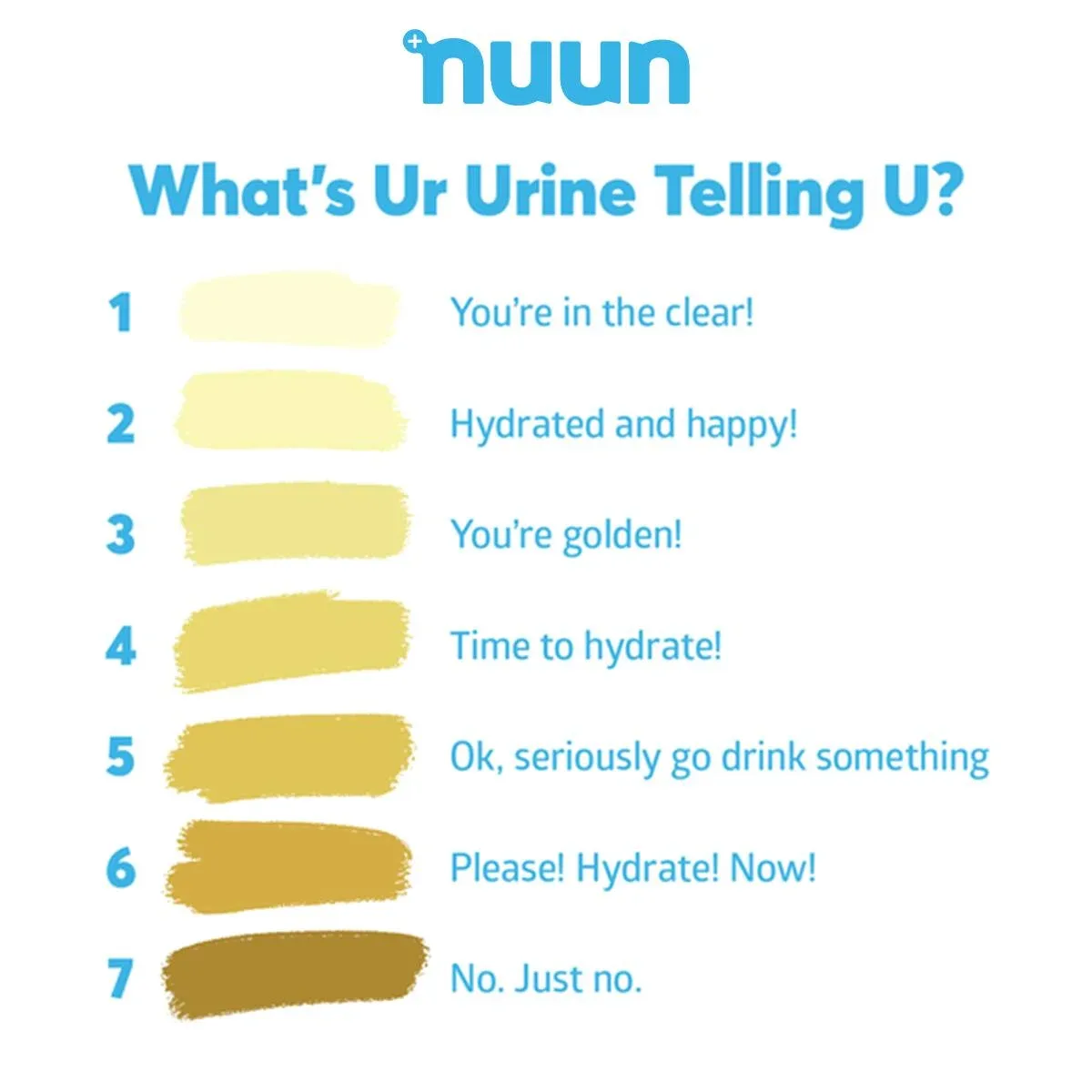
A urine color chart: seven painted swatches from pale cream to dark amber, numbered, each with a line in light blue, running from "You're in the clear!" through "Ok, seriously go drink something" to "No. Just no." Headline: "What's Ur Urine Telling U?" No product in the frame. 297 days.
Why it works: It's useful, a little gross, and shareable, and it makes the viewer check themselves against the chart. No product appears because the ad's job is to create the need.
Clone it: Any product that solves a problem people can self-diagnose. A simple scale, plain-language labels, the brand name, nothing to buy.
Comparison against the incumbent. Seven of the 32 name or show what the buyer eats or drinks today. Our library tags these as comparison ads.
14. Bruvi — the café cup, crossed out, 807 days
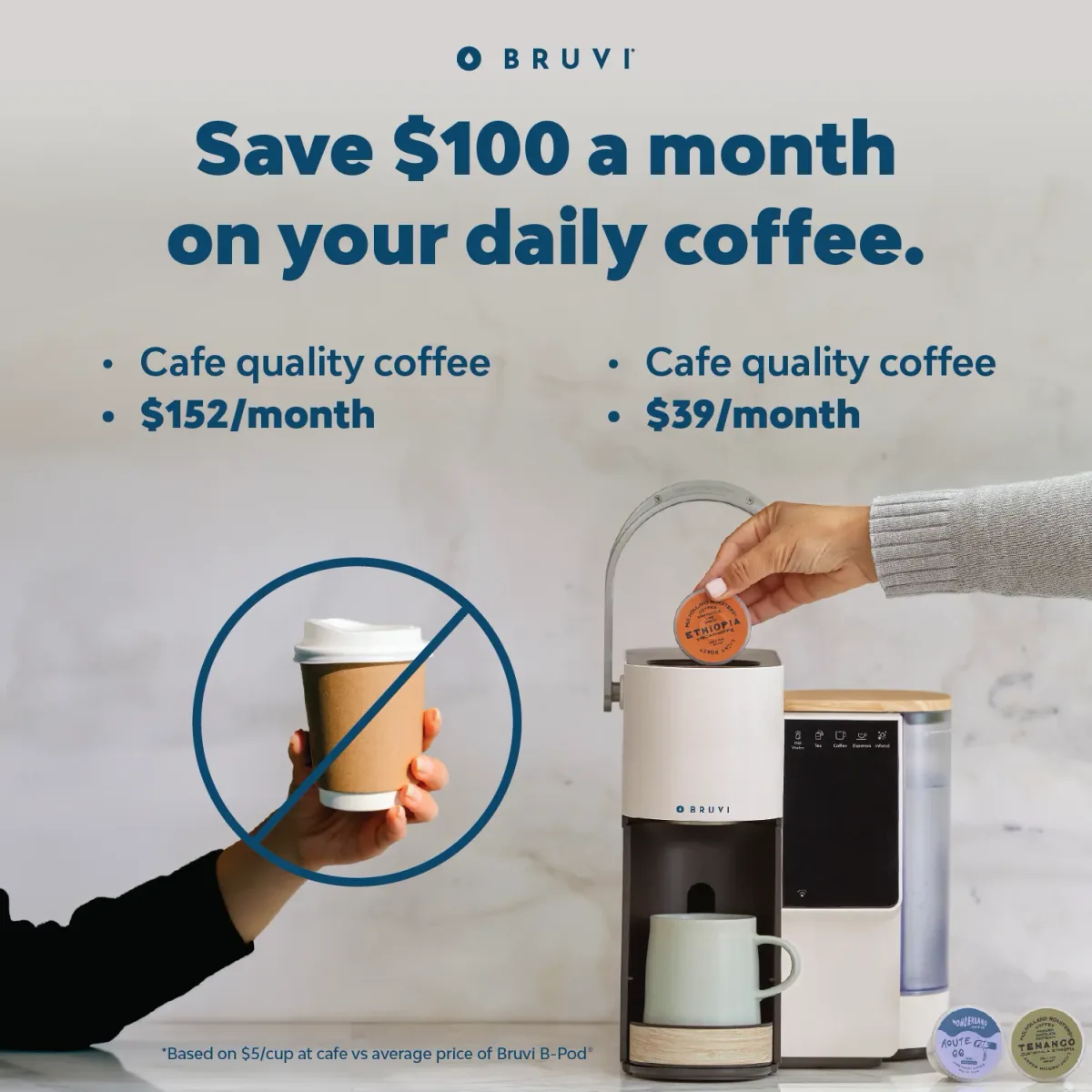
A hand holds a paper takeaway cup inside a blue crossed-out circle. On the right, another hand drops a pod into a white Bruvi brewer on marble. "Save $100 a month on your daily coffee." Two columns compare "Cafe quality coffee, $152/month" with "Cafe quality coffee, $39/month," and a footnote explains the math. 807 days.
Why it works: The rival is the café, not another machine, and the copy holds quality constant so the only variable is price. A footnote makes the number defensible.
Clone it: Any product that replaces a habit with a known price: coffee, lunch, takeout, energy drinks. Cross out the old habit, put the monthly math in two columns, footnote the assumptions.
15. Splendid Spoon — pumpkin spice, twice
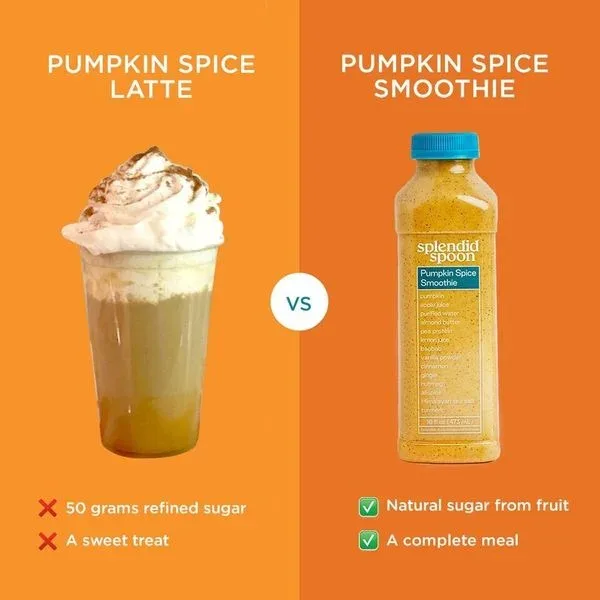
A split orange panel. Left: a pumpkin spice latte under whipped cream, "50 grams refined sugar" and "A sweet treat" marked with red crosses. Right: the brand's pumpkin spice smoothie bottle, "Natural sugar from fruit" and "A complete meal" marked with green ticks. A "VS" roundel sits between them. 396 days.
Why it works: It casts the best-known seasonal drink as the villain and offers a same-flavor swap. Splendid Spoon shoots the latte to look delicious, so the swap reads as a real choice, not a lecture.
Clone it: Pick the most famous version of your flavor, shoot both side by side, keep the claims to two lines each.
16. myChow — naming the competitor
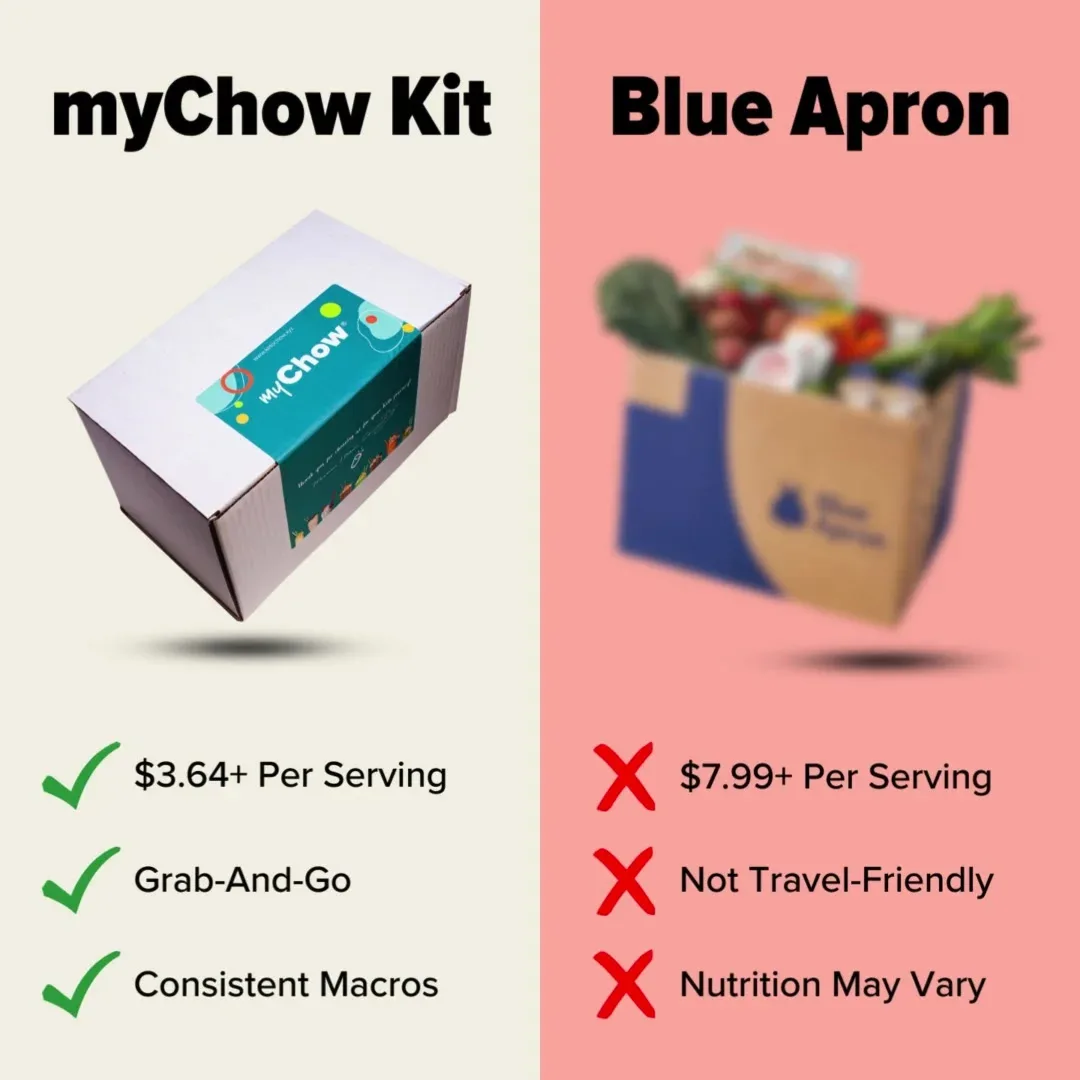
Two panels: "myChow Kit" on cream with a sharp product box, and "Blue Apron" on pink with a deliberately blurred box. Green ticks: "$3.64+ Per Serving," "Grab-And-Go," "Consistent Macros." Red crosses: "$7.99+ Per Serving," "Not Travel-Friendly," "Nutrition May Vary." 289 days.
Why it works: Naming a known brand borrows its recognition, and the blur makes the point before anyone reads. FTC policy on comparative advertising "encourages the naming of, or reference to competitors" as long as the comparison is clear and truthful, so the price numbers carry the risk.
Clone it: Only with numbers you can prove on the day the ad runs. Sharp you, blurred them, three matched rows.
17. SmartSweets — 4g against 38g
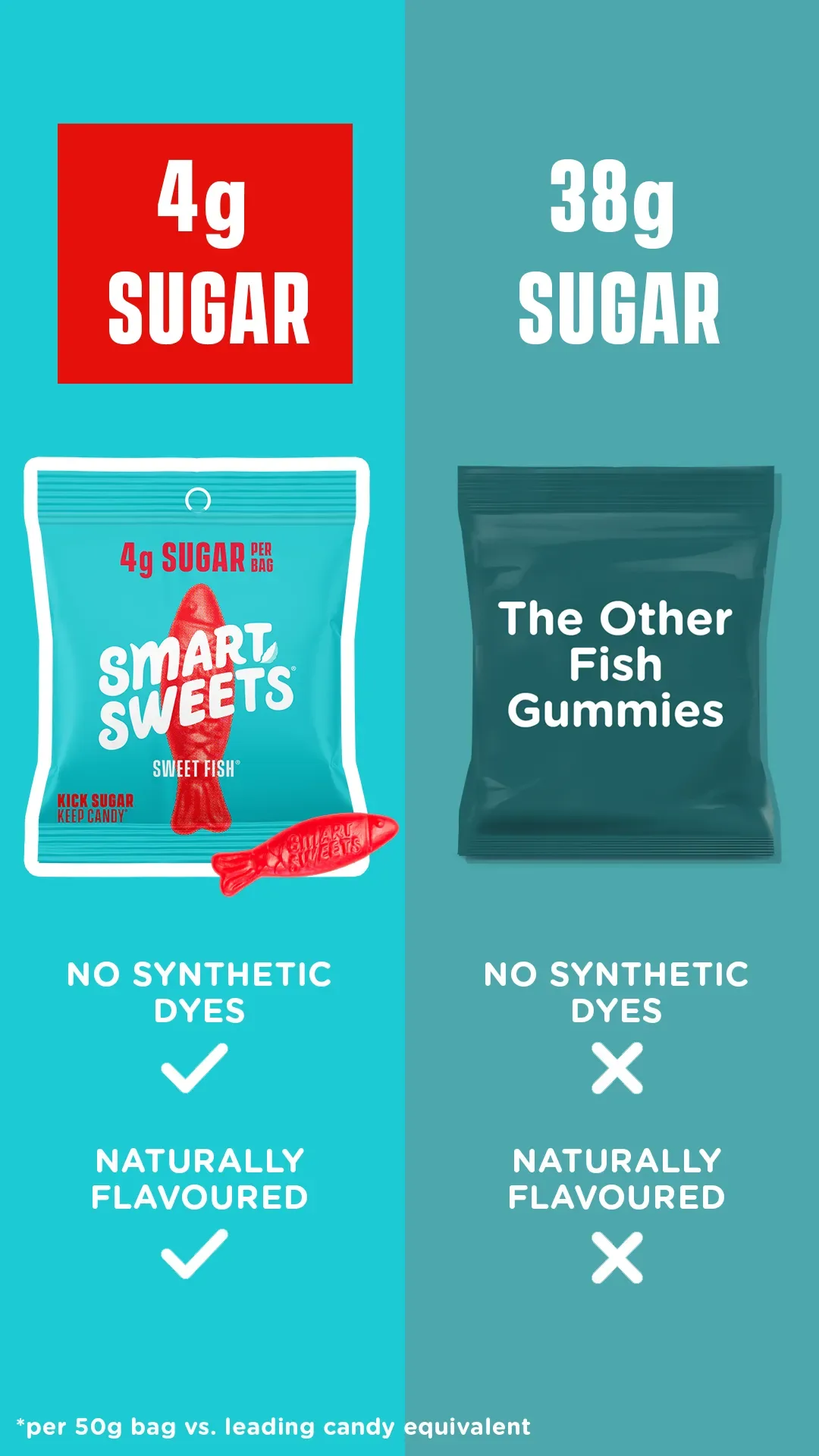
A split teal panel. Left: a red "4g SUGAR" box over a bag of Sweet Fish with a gummy fish breaking out of it. Right: "38g SUGAR" over a dark bag labeled "The Other Fish Gummies." Ticks and crosses for "No synthetic dyes" and "Naturally flavoured," and a footnote: "per 50g bag vs. leading candy equivalent." 208 days.
Why it works: Everyone knows which red fish the right side means, and the ad never has to say it. Two numbers do all the work, and the footnote defines exactly what's compared.
Clone it: One number, two columns, a generic stand-in for the competitor, and a footnote that defines the comparison.
18. Manukora — fake honey versus real honey
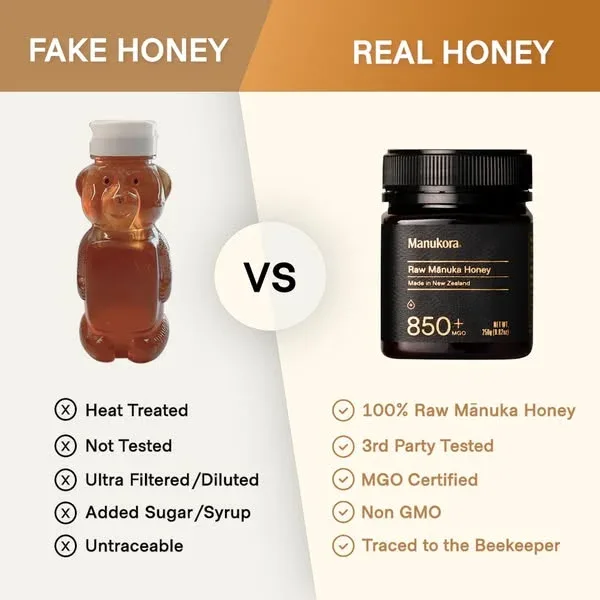
"FAKE HONEY" sits over a plastic honey bear with five crossed items: "Heat Treated," "Not Tested," "Ultra Filtered/Diluted," "Added Sugar/Syrup," "Untraceable." "REAL HONEY" sits over a black jar of raw manuka honey with five ticks: "100% Raw Mānuka Honey," "3rd Party Tested," "MGO Certified," "Non GMO," "Traced to the Beekeeper." Between 90 and 180 days.
Why it works: Everyone has seen the supermarket bear, and every tick on the right is a process claim (tested, certified, traced), not a health claim.
Clone it: Premium staples: honey, olive oil, coffee, salt. Everyday version left, yours right, five process facts each.
19. PROMIX — "PROMIX vs. THEM," 90 to 180 days
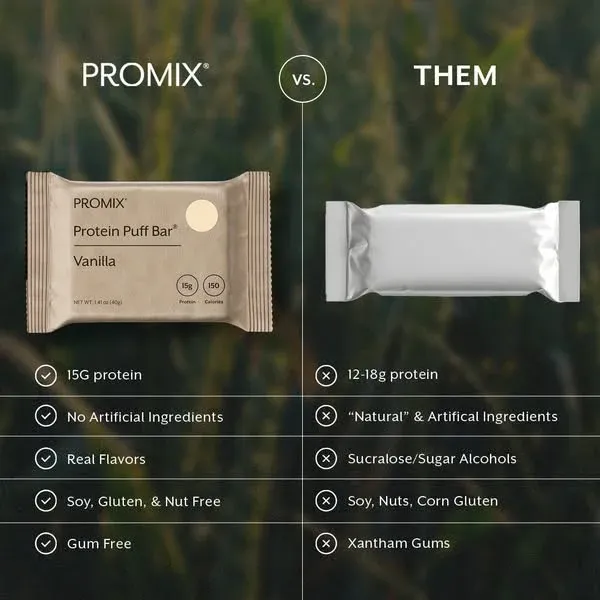
A split panel over a blurred field of grass: "PROMIX" left and "THEM" right with a "vs." roundel between. Left, a kraft-wrapped PROMIX Protein Puff Bar in vanilla over five ticks ("15G protein," "No Artificial Ingredients," "Real Flavors," "Soy, Gluten, & Nut Free," "Gum Free"). Right, a blank silver foil bar over five crosses ("12-18g protein," "'Natural' & Artifical Ingredients," "Sucralose/Sugar Alcohols," "Soy, Nuts, Corn Gluten," "Xantham Gums"). Between 90 and 180 days (tracker bucket).
Why it works: The rival is an unbranded foil wrapper, so every protein bar the buyer already eats becomes "them" without naming one. Five matched rows make it a checklist, and the ingredient rows do more work than the protein row.
Clone it: Any product sold on a cleaner ingredient list. Your pack against a blank one, five matched rows, ingredients over macros.
Native formats. Five of the 32 look like something other than an ad: a phone photo, a TikTok caption, a group text, a Reddit thread. Our library files these under UGC ads.
20. Misfits Market — the haul photo
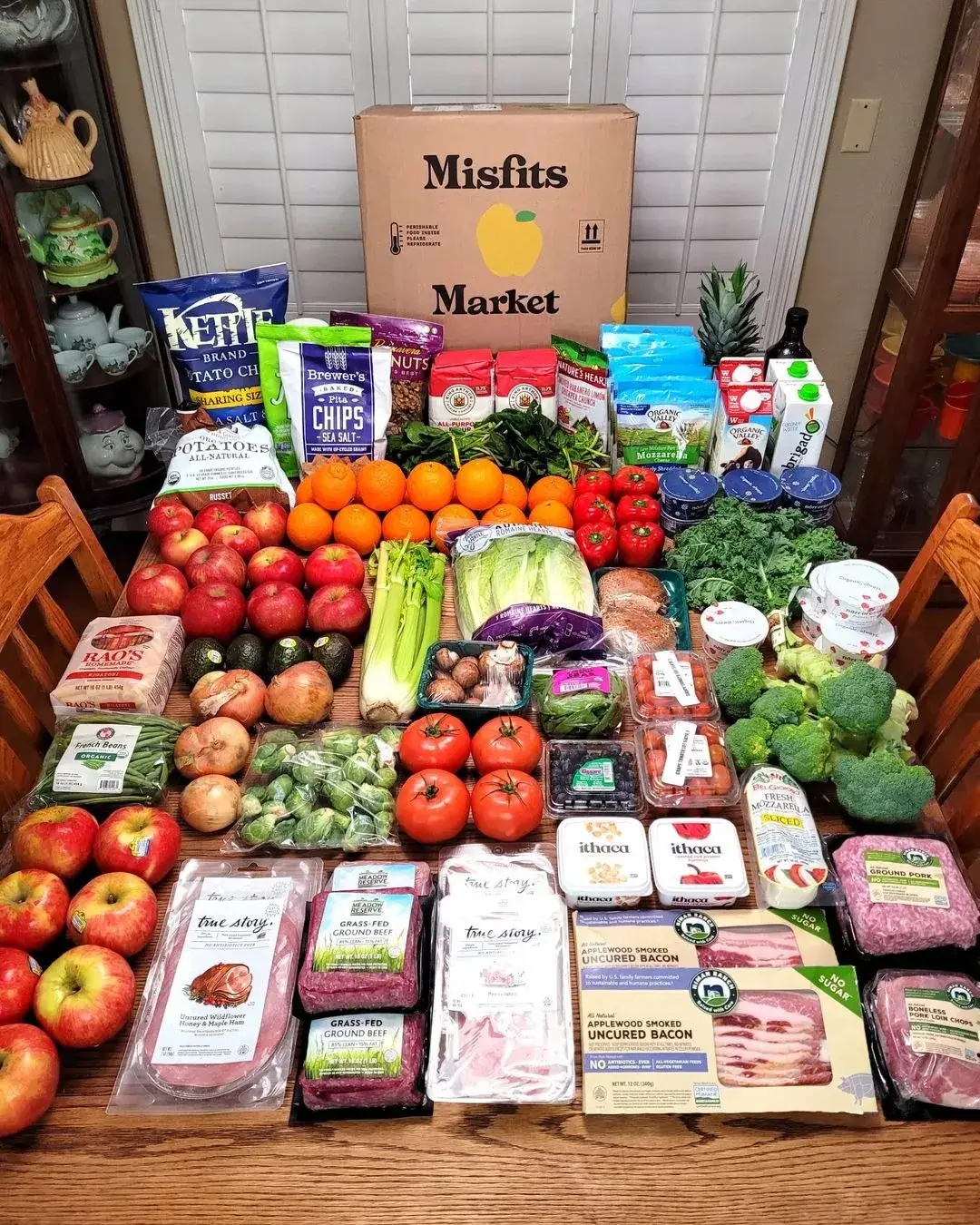
A phone photo of a dining table covered edge to edge with one delivery: apples, oranges, tomatoes, peppers, broccoli, celery, onions, packaged meat, bacon, chips, pasta sauce, and dairy, with the Misfits Market box behind. No copy at all. 596 days.
Why it works: It looks like a customer's post, and the volume answers "is it worth it" without a price. An ordinary room, blinds and a china cabinet, makes it believable.
Clone it: Any delivery or bundle. Unpack everything on a real table, shoot from above, write nothing.
21. Hungryroot — a fridge and a confession
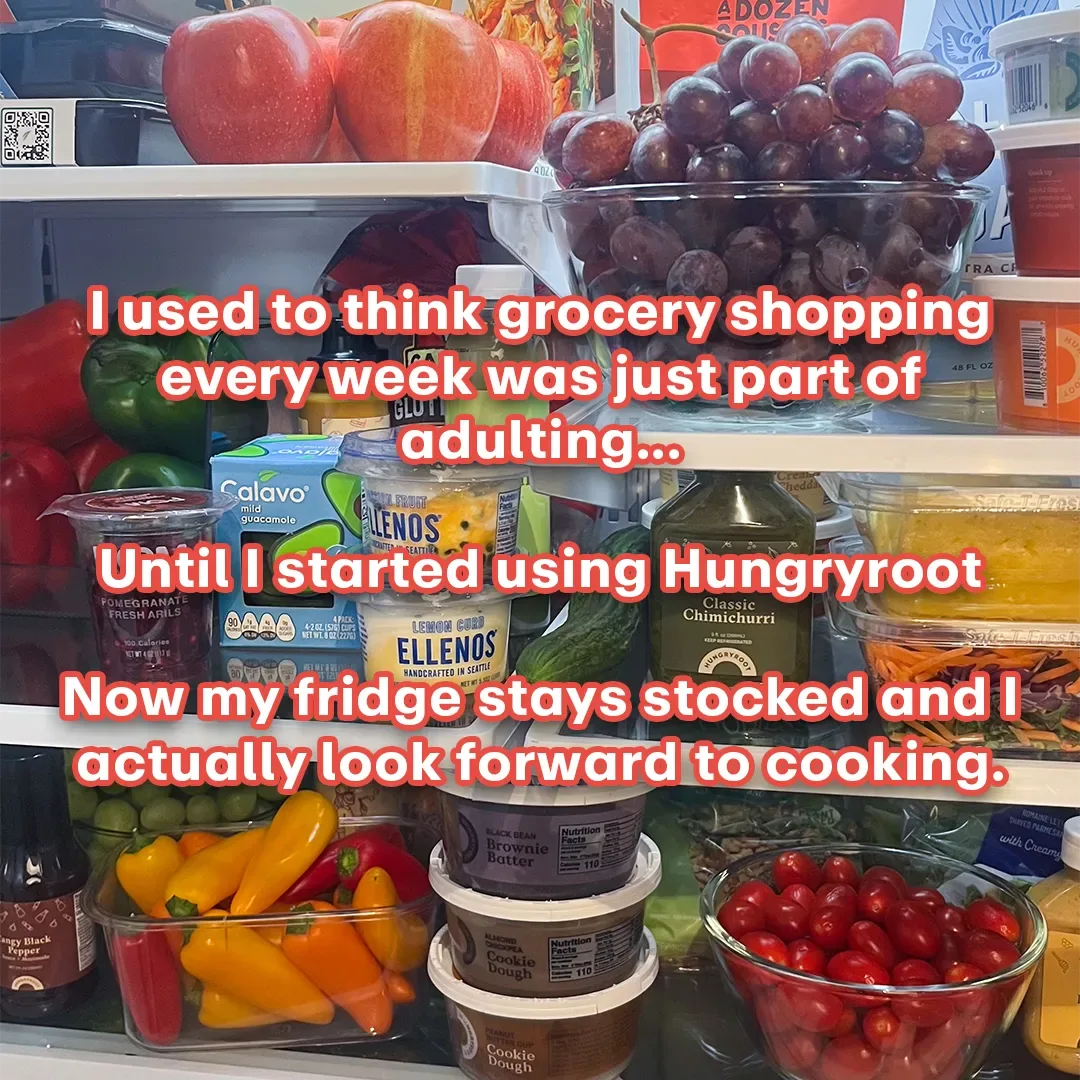
A packed fridge (grapes, apples, peppers, tomatoes, dips, guacamole, chimichurri) with a three-part TikTok-style text overlay in white with red outlines. Weekly grocery shopping used to feel like "just part of adulting," then Hungryroot arrived, and now the fridge "stays stocked." 327 days.
Why it works: The before-and-after happens in the copy, so the image only has to show the after. A fridge tour is a familiar TikTok and Reels format, and the ad borrows that genre's trust.
Clone it: Any routine product. Shoot the "after" in a real kitchen and write the change as a three-beat caption.
22. Little Spoon — a PSA in the fridge
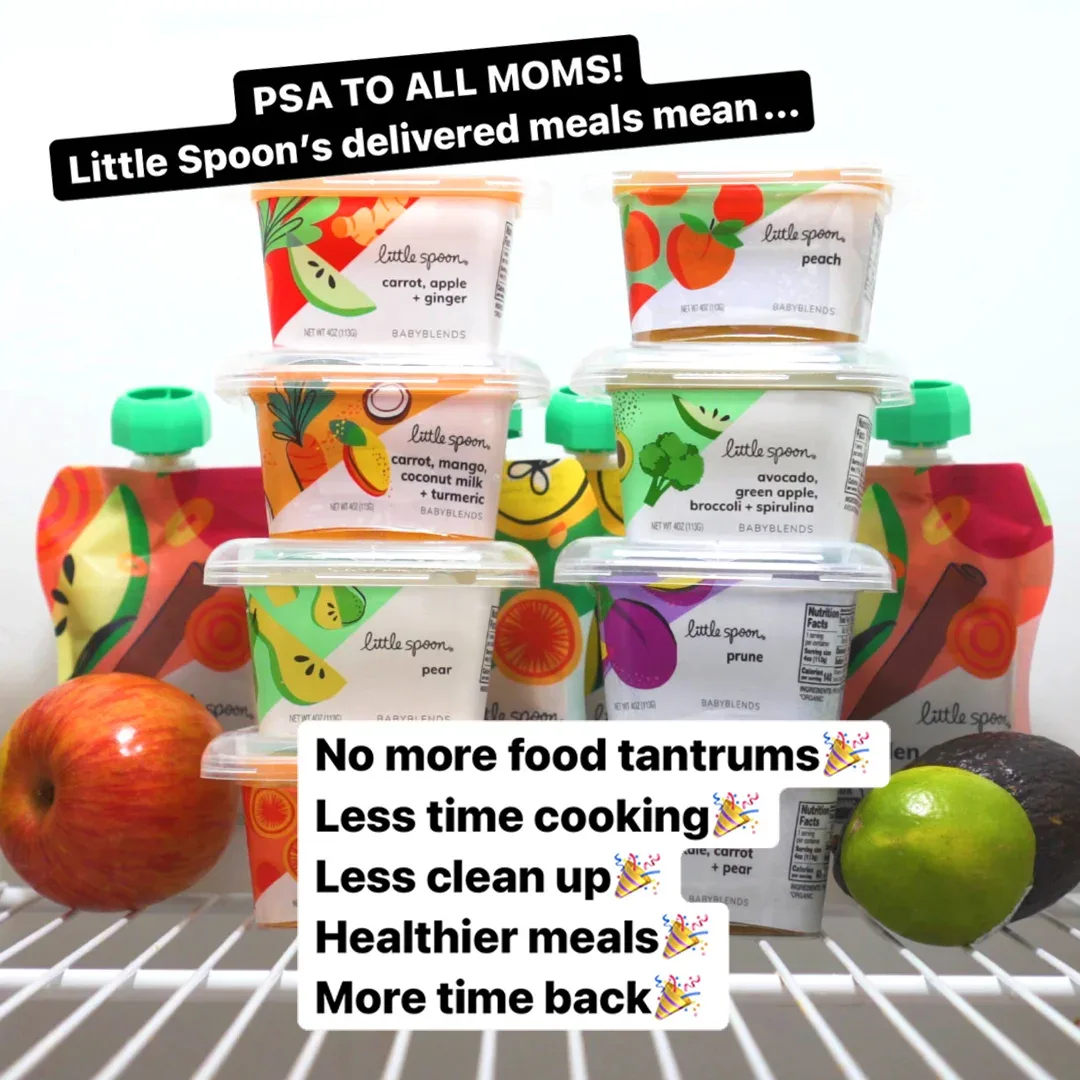
Stacked pots and pouches of baby food in a fridge with an apple and a lime. A tilted black label reads "PSA TO ALL MOMS! Little Spoon's delivered meals mean…" above five lines in white boxes, each with a party emoji: "No more food tantrums," "Less time cooking," "Less clean up," "Healthier meals," "More time back." 185 days.
Why it works: "PSA" is the language of a parent's own post, and every benefit is about the parent's day, not the food. It reads like advice from someone in the same group chat.
Clone it: Products one person buys for someone else. Address the buyer by role and list what changes for them.
23. Spindrift — a group chat
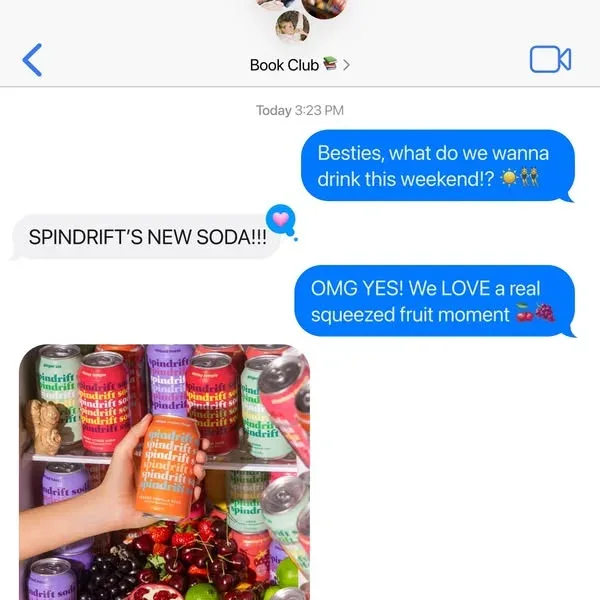
An iMessage screen titled "Book Club": "Besties, what do we wanna drink this weekend!?", a reply reading "SPINDRIFT'S NEW SODA!!!" with a heart reaction, then "OMG YES! We LOVE a real squeezed fruit moment," and a photo of a hand pulling a can from a fridge full of Spindrift and fresh fruit. 180+ days.
Why it works: The product claim, "real squeezed fruit," comes from a friend, inside an interface people read as a private chat, not an ad.
Clone it: Any social product: drinks, snacks, party food. Three messages, one photo, the claim in the friend's words.
24. Craftmix — a Reddit thread
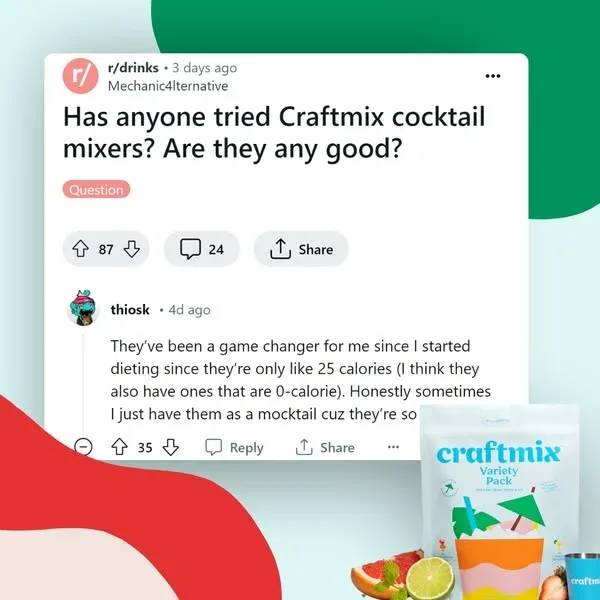
A Reddit card from r/drinks: "Has anyone tried Craftmix cocktail mixers? Are they any good?" with 87 upvotes and 24 comments, and a reply calling them "a game changer" because they're "only like 25 calories" and work as a mocktail too. A Craftmix variety pack and citrus sit in the corner. 180+ days.
Why it works: The question is the one every buyer has, and a stranger's answer reads as independent in a way brand copy can't.
Clone it: Find the question people ask about your category, mock it as a forum post, and answer it in a customer's words. Use a real, permissioned review and disclose any incentive, because the FTC's endorsement rules cover mocked-up reviews too.
Borrowed voice. Proof from someone other than the brand: a celebrity chef, 15,000 reviewers.
25. Bold Bean Co — Jamie Oliver on a pot of chickpeas
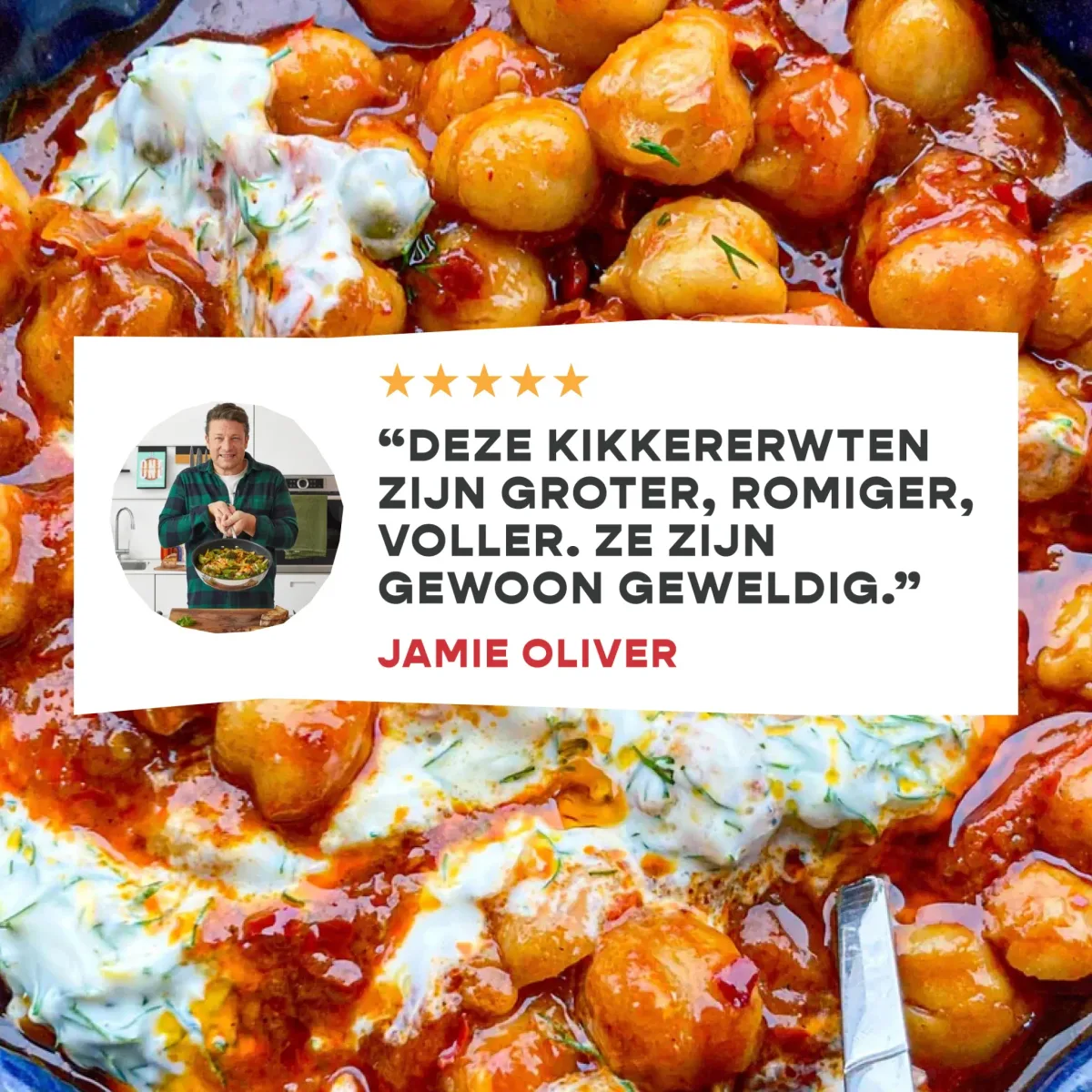
A tight overhead crop of chickpeas in a glossy tomato sauce with swirls of yogurt and dill, filling the frame. Across the middle, a white card with a Jamie Oliver headshot, five stars, and his quote in Dutch: "These chickpeas are bigger, creamier, fuller. They're simply great." 156 days.
Why it works: The dish is the appetite shot and the chef is the proof, and they arrive together. His quote is about texture ("creamier, fuller"), which is what a premium bean has to sell.
Clone it: Any ingredient brand with a credible fan. Cook the hero recipe, crop tight, run the quote across it. More formats live in the testimonial ad examples.
26. Wandering Bear — a zine drawing, 922 days
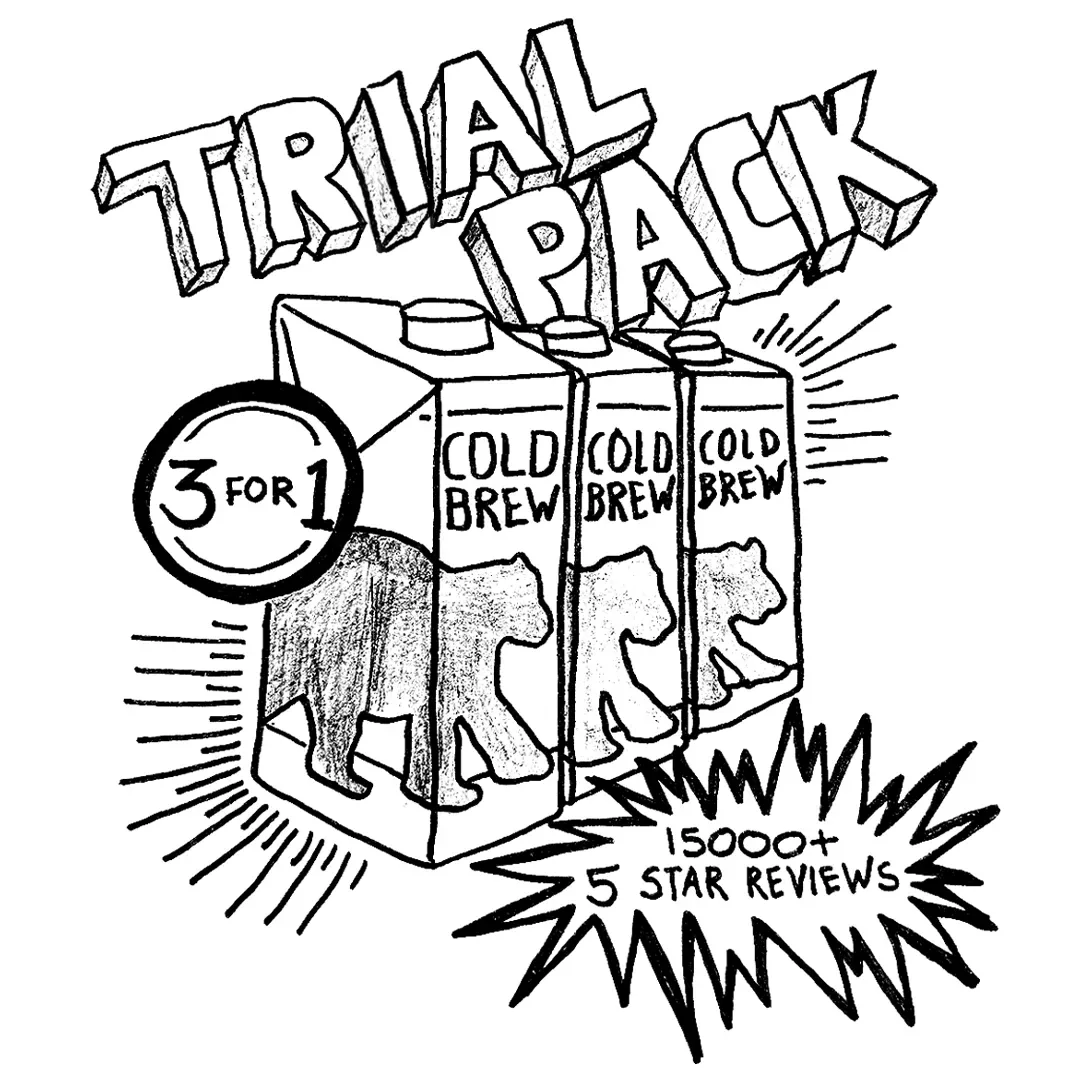
A black-and-white hand-drawn sketch: "TRIAL PACK" in hatched 3D letters, three cold brew cartons with bears, a "3 FOR 1" roundel, and a spiky burst reading "15000+ 5 STAR REVIEWS." No photograph and no color. 922 days.
Why it works: In a feed full of glossy product photos, a pen drawing breaks the pattern. A review count does the proof and an offer does the urgency, and both are drawn into the art.
Clone it: Any trial offer. Redraw your pack as a sketch and write the offer and the review count by hand.
Offers that held for months. Eight of the 32 carry a price, a discount, or a bundle. Three of them are built around one.
27. Wandering Bear — "selling out," for 612 days
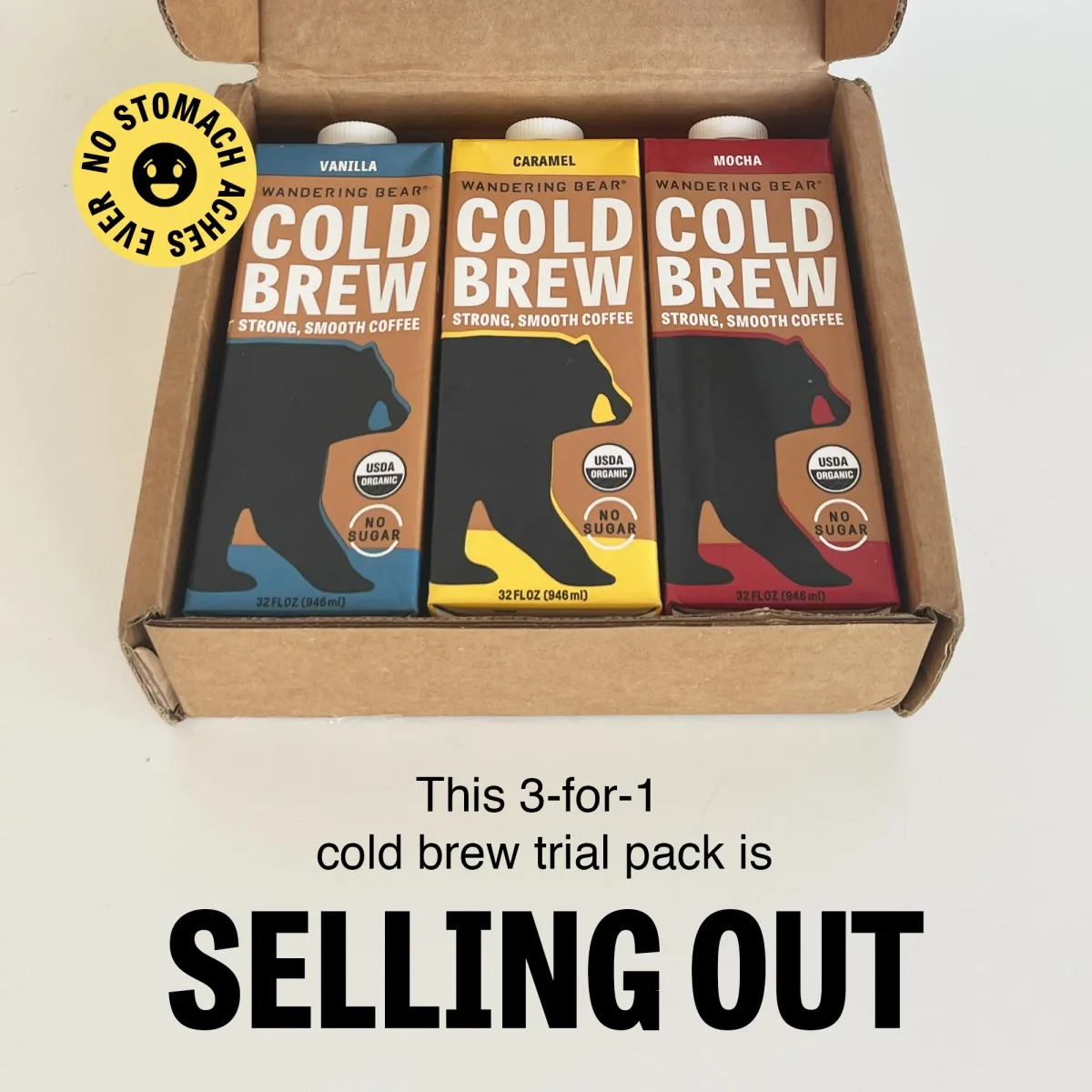
An open shipping box holding three cold brew cartons (vanilla, caramel, mocha) on off-white, a yellow "NO STOMACH ACHES EVER" sticker, and "This 3-for-1 cold brew trial pack is SELLING OUT" in heavy black caps. 612 days.
Why it works: Scarcity without a date never expires, so a "selling out" ad can run for 20 months. An open box is the unboxing moment, shot before the customer has it. Its sticker is the only body claim in the frame, and a strong one.
Clone it: Any trial or starter pack. Open box, products upright, one scarcity line. Make sure the scarcity is true when it runs.
28. Momofuku — "Our noodles aren't cheap"
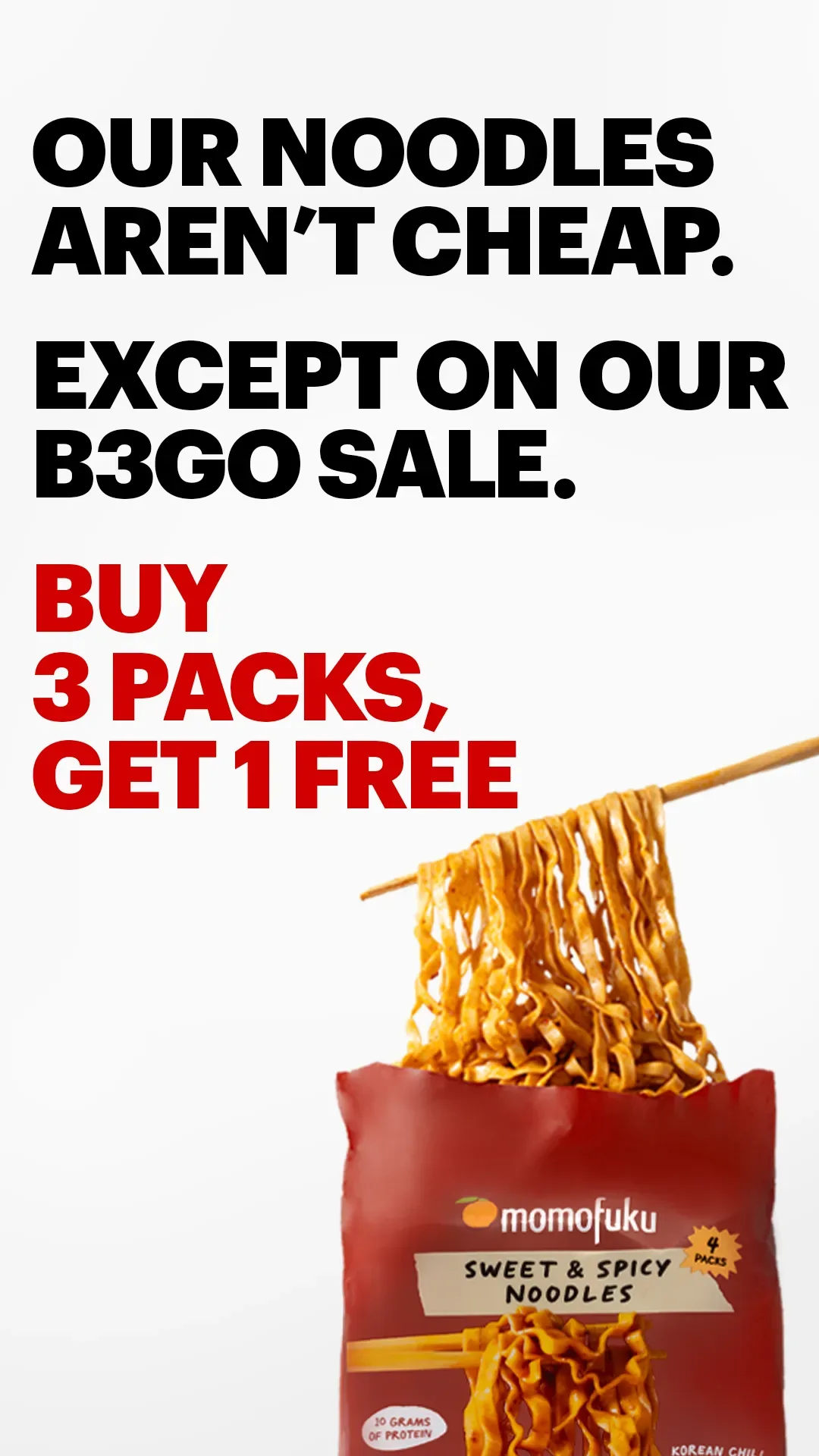
Chopsticks lift a tangle of noodles out of a red Sweet & Spicy pack on white. In black heavy sans: "OUR NOODLES AREN'T CHEAP. EXCEPT ON OUR B3GO SALE." In red: "BUY 3 PACKS, GET 1 FREE." 176 days.
Why it works: Admitting the price is high protects the premium while running a promotion. Lifted noodles give the appetite shot and the motion at once.
Clone it: Premium products on sale. Concede the price in the first line, then the offer, then one lifted, moving food shot.
29. Athletic Brewing — non-alcoholic, with a price drop
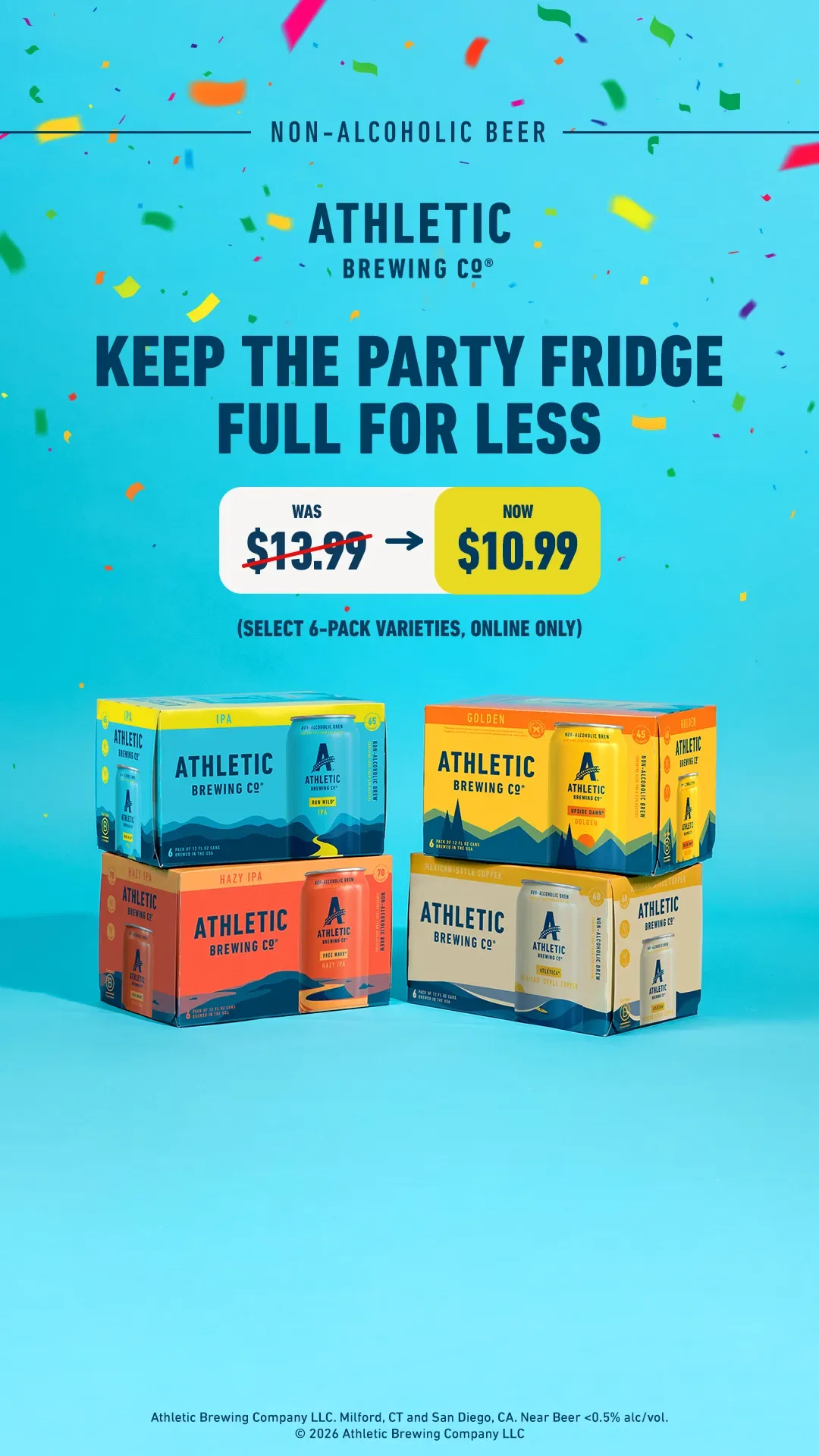
Four stacked six-pack boxes on bright blue with confetti. "NON-ALCOHOLIC BEER" as a kicker, "KEEP THE PARTY FRIDGE FULL FOR LESS," and a was-now price strip: "$13.99 → $10.99 (select 6-pack varieties, online only)." A legal line at the bottom states the beer is under 0.5% alcohol by volume. 104 days.
Why it works: The ad shows packs, not people drinking, and puts "non-alcoholic" at the top, which keeps a beer-shaped product inside the non-alcoholic carve-out in Meta's alcohol rules. A was-now strip is the simplest discount layout there is.
Clone it: Any multipack. Stack the boxes, a kicker for the category, a was-now price, the fine print in the footer.
Mood and meaning. Three ads that sell a feeling or a stance more than a product feature.
30. Olipop — the mocktail that takes you back
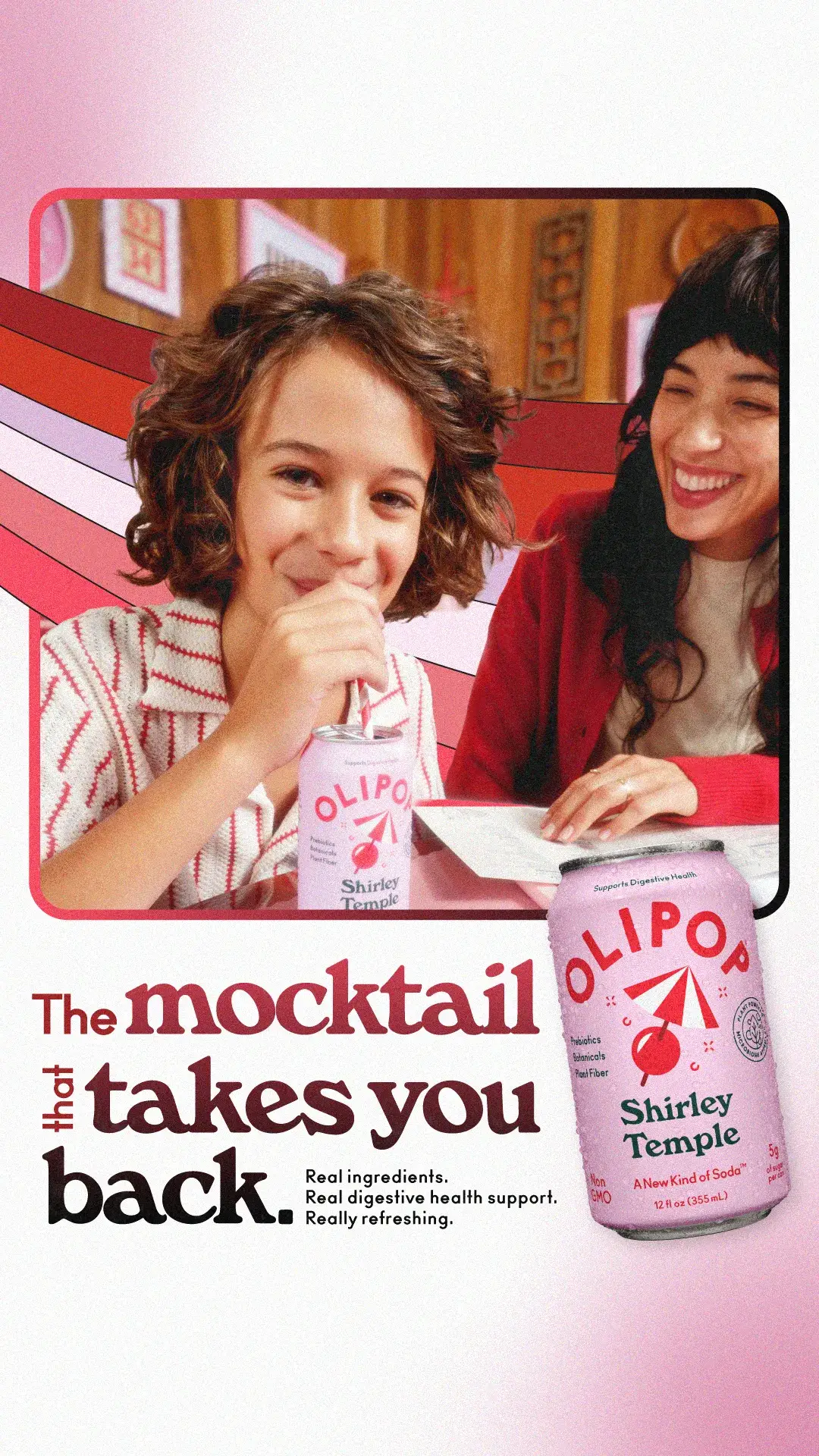
A girl sips a can of Shirley Temple soda through a straw while a woman laughs beside her in a retro diner booth, framed by pink-and-red stripes. "The mocktail that takes you back." in a heavy serif, a can at the bottom right, and three small lines: "Real ingredients. Real digestive health support. Really refreshing." 194 days.
Why it works: Nostalgia is the product. A Shirley Temple is a childhood drink, and the photo stages the memory. Its health line is small on purpose, because the feeling sells the flavor.
Clone it: Any flavor with a memory attached. Stage the memory, name it in the headline, keep the claims to fine print.
31. De Soi — the pour
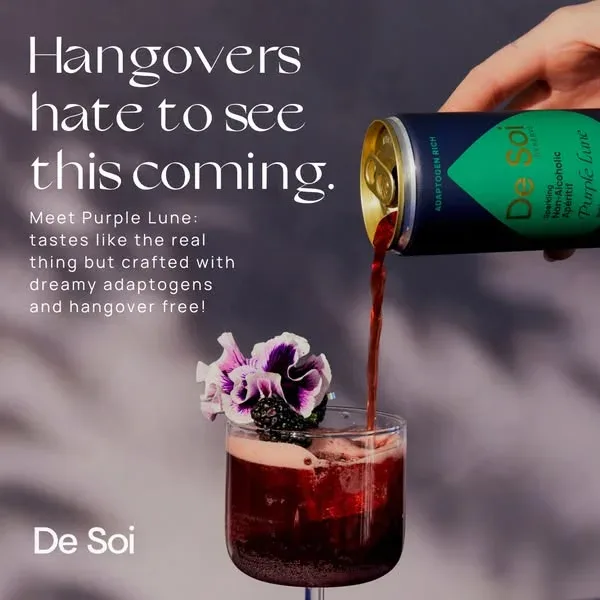
A hand tilts a can of Purple Lune, and a dark red stream pours into a coupe garnished with a violet flower and a blackberry, on soft gray. "Hangovers hate to see this coming." in a light serif, then "Meet Purple Lune: tastes like the real thing but crafted with dreamy adaptogens and hangover free!" 180+ days.
Why it works: The pour is the most appetizing frame a drink has, and the research below suggests motion makes it read as fresher. Its headline sells the absence of a consequence, which is the whole case for a non-alcoholic aperitif.
Clone it: Any drink. Can tilted, liquid mid-pour, glass garnished, one line about what the drinker avoids.
32. Coca-Cola — a stance in white type, 1,674 days
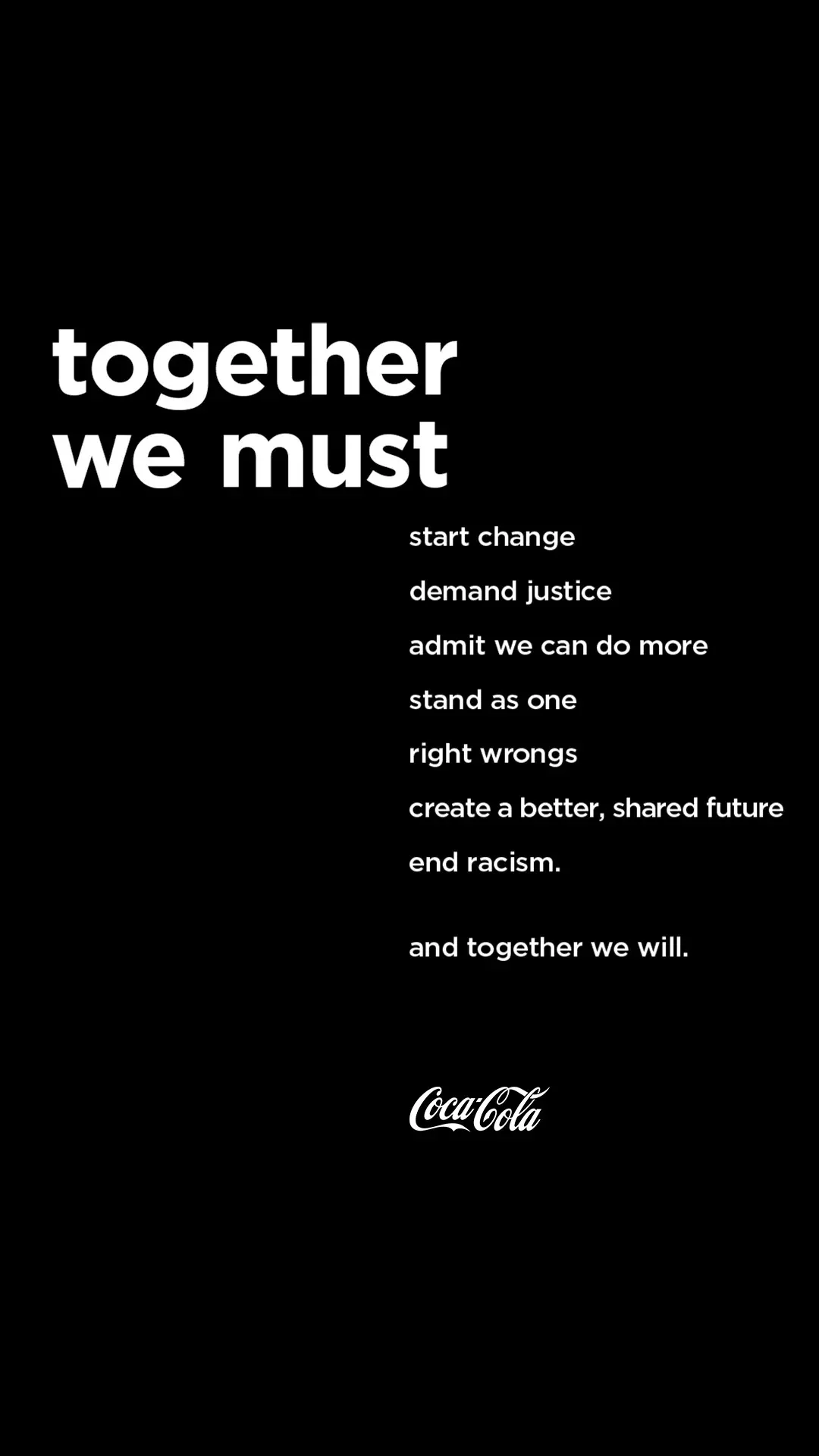
White sans type on solid black: "together we must" large at the top, then a column of short lines ("start change," "demand justice," "admit we can do more," "stand as one," "right wrongs," "create a better, shared future," "end racism."), "and together we will.," and the Coca-Cola script logo. No product, no bottle, no red. 1,674 days.
Why it works: The brand most associated with red and a bottle runs neither, which is the signal that it's a statement, not a promotion. Text on black reads like a public letter and has nothing in it that dates.
Clone it: Only for a position the company acts on and can document. Plain type, no product, the logo last.
That's 32 ads, one per card. Browse the rest of the food and beverage ad examples for the ones that didn't make the cut, or see the same moves in other categories in the Instagram static product ads and Facebook static ads posts.

Create your own food product ads
Create your ad
What run-length proves and what it doesn't
A run of 300 days means someone kept paying for the ad for ten months. That's real evidence. It isn't proof of profit, for three reasons.
Run-length is survivorship: you see the ads that stayed on, not the variants switched off in week one. A big brand can leave a mediocre ad on low spend for years, so the Liquid Death ad tells you Liquid Death kept it running, not how much it spent. And the tracker counts days live, not impressions or sales. Read it as "nobody killed this ad," a better filter than "a marketer liked it" and a worse one than a ROAS figure nobody publishes.
What it does tell you: when a move shows up again and again among the survivors (the out-of-pack food shot, the incumbent comparison, the claim as headline), test that move first. Then test it on your own budget, because your product and price will move the result more than the layout.
Food ad rules that change the creative
Food advertising faces more claim rules than most categories, and they shape the creative directly. What follows is practical, not legal advice. Every link goes to a regulator's own page, covering US rules plus Meta's global policies.
Who regulates what. The FDA regulates food labels, and the FTC regulates food ads. An FTC Enforcement Policy Statement on Food Advertising (1994) ties the two together: nutrient and health claims in ads are judged against FDA's labeling rules, and "comparative nutrient content claims that comply with FDA's regulations will generally comply with Section 5." In practice, if a claim couldn't go on your label, keep it out of your ad.
"Healthy" now has a definition. FDA's updated "healthy" claim, finalized in December 2024, requires a minimum amount of a food group (for example, half a cup of fruit or vegetables) and caps added sugars, sodium, and saturated fat. A fruit or vegetable product can carry at most 1 g of added sugar per serving to use the word. A Federal Register notice sets the compliance date at February 25, 2028, and brands can use the new definition now. None of the 32 ads uses "healthy" as a headline. Little Spoon's "Healthier meals" comes closest.
Body-effect claims need evidence. "Supports digestion" and "natural energy" are structure/function claims. For conventional foods, FDA says such claims must derive from the food's nutritive value, and a claim to treat or prevent a disease is a drug claim unless FDA has authorized it as a health claim. On the ad side, the FTC's Health Products Compliance Guidance (2022) applies to foods as well as supplements and says health benefits generally need "competent and reliable scientific evidence," usually randomized controlled human trials. Six of the 32 make a body-effect claim: Phizz, Four Sigmatic, Wandering Bear's sticker, Mid-Day Squares' "sugar crash," Olipop's "digestive health support," and De Soi's "hangover free." That copy carries the most risk in this post.
Reviews and quotes have rules too. The FTC's Endorsement Guides require that "an endorsement must reflect the honest opinion of the endorser" and that paid or gifted endorsers disclose the connection. A mocked-up Reddit thread or group chat like Craftmix's or Spindrift's should quote a real customer, with permission.
Meta's rules for food and drink. Meta's health and wellness policy requires ads for dietary, health, or weight-loss products to target people 18 and older, but exempts "general food products, including protein products." The same policy bans ads with "statements of inferiority about physical appearance," so a snack ad can't sell itself by attacking the viewer's body. Its alcohol policy sets the US minimum targeting age at 21 and lists non-alcoholic beverages among the products advertisers can promote "as long as they do not depict alcohol or consumption." Athletic Brewing's ad stays inside that line: boxes, not a toast.
| If your ad says… | What applies | Safer creative |
|---|---|---|
| "Healthy" | FDA's food-group and nutrient limits | Lead with the specific fact: "4g sugar," "just 4 ingredients" |
| "Supports digestion," "boosts energy" | FDA structure/function rules plus FTC substantiation | Ingredient callouts (probiotics, organic coffee) without the effect |
| "Less sugar than X" | FDA comparative claim rules | Footnote the comparison, as SmartSweets does |
| A customer quote or review | FTC Endorsement Guides | Real, permissioned quotes, with freebies disclosed |
| A weight-loss angle | Meta 18+ targeting and no negative self-image | Sell the taste or the convenience |
| Non-alcoholic beer or spirits | Meta's alcohol policy | Show the pack, not people drinking |
What the research says about food images
Four peer-reviewed findings map directly onto the ads above.
- Food pictures make people hungry. Charles Spence and colleagues' review in Brain and Cognition, "Eating with our eyes: From visual hunger to digital satiation" (2016), surveys the neuroscience on how viewing desirable food changes neural activity, physiological responses, and attention, most of all in a hungry brain. Spence's team calls it "visual hunger," and it's the case for the 13 ads that show food out of the pack.
- Motion reads as fresh. Several of the long runners freeze a movement mid-action: De Soi's pour, realsy's burst, and Momofuku's lifted noodles. We found no study on implied motion in food ads we were willing to cite, so treat this one as a pattern in the set, not a proven effect.
- Point the spoon at the viewer's hand. Elder and Krishna showed in the Journal of Consumer Research (2012) that orienting a product so it's easy to imagine picking up, a mug handle or a utensil toward the dominant hand, raised purchase intentions. Their effect reversed for products people disliked, so it amplifies a good shot and can't rescue a bad one.
- Multisensory copy tastes better. In an earlier Journal of Consumer Research study (2010), the same authors found ads describing several senses (texture, smell, sound) raised taste ratings over ads describing taste alone. "Creamy," "crave-worthy," and "bigger, creamier, fuller" do measurable work in the Rebel, Roots, and Bold Bean ads.
None of these studies tested Meta ads, and lab ratings aren't sales. They explain why the long-running ads look the way they do. They don't promise the same result for yours.
How to make a food ad from one of these
Pick the move that matches your argument. If your case is taste, start from an out-of-pack shot like Conscious Bar or SkinnyDipped. If it's a switch, start from a comparison like Bruvi or SmartSweets. If it's trust, start from a native format like Misfits or Spindrift. Then swap in your product, your claim, and your number, and keep every claim on the safe side of the table above.
AdDogs does the swap. Open any ad in the food library or upload one you screenshotted, add your product photo, and AdDogs rebuilds the ad with your product and your brand colors. One credit is one ad in the dimension you pick: Basic is $12/mo for 30 credits with 1:1, 9:16, and 16:9, and Pro and Ultimate include all 14 aspect-ratio options. Write your own claims, and see the walkthrough for recreating a winning static for the rest.
Methodology
On October 25, 2026 the AdDogs library held 1,976 public ads in its food and coffee categories, and 474 of them had run at least 60 days at the last check. Our food category also holds pet food, which we excluded, along with supplements and non-food advertisers the category tagger had swept in. From the remaining long-runners we reviewed every image at full size, dropped low-resolution and duplicate creatives, and chose 32 for coverage of creative moves, with at most two per brand. Run-length is days live at the last check (Meta Ad Library start dates or Foreplay's days-running count, between April 7 and October 12, 2026), and eight ads carry Foreplay's bucket label ("more than 180 days" or "90 to 180 days") rather than an exact figure. It measures how long the advertiser kept the ad live, not what it returned. Copy was transcribed from the images, not from metadata, and the Bold Bean quote is our translation from Dutch. Counts in the tables are our own reading of the 32 images. Our rules section cites FDA, FTC, Federal Register, and Meta pages read on October 25, 2026, and the research section cites only peer-reviewed papers.
FAQ
What makes a good food ad?
It does one of two jobs in the first second: makes the viewer taste the product, or gives them a reason to switch. Of 32 food and drink ads that ran for months on Meta, 13 show the food out of its pack (broken, poured, melted, cooked) and 12 lead with a nutrition or ingredient claim. Faces are rare: only two of the 32 show one.
What are some good food advertisement examples?
Liquid Death's "Now available at 7-Eleven" (1,957 days), Bruvi's "Save $100 a month on your daily coffee" (807 days), Misfits Market's grocery haul photo (596 days), Splendid Spoon's pumpkin spice latte versus smoothie (396 days), and Mid-Day Squares' bar with its macros written on the chocolate (300 days). All 32 in this post appear with their run-lengths and what makes each one work.
What techniques do food ads use to make food look appetizing?
Close-ups of texture, food shown out of the pack, and implied motion such as a pour or a lifted forkful. Peer-reviewed work backs two related moves: a utensil pointed toward the viewer's hand raises purchase intent, and copy describing texture and smell raises taste ratings. A 2016 review in Brain and Cognition calls the effect of food pictures on appetite "visual hunger."
Can a food ad call a product "healthy"?
Only if the food meets FDA's definition. FDA's rule, finalized in December 2024, requires a minimum amount of a food group and caps added sugars, sodium, and saturated fat. A fruit or vegetable product, for example, can have at most 1 g of added sugar per serving. Compliance is due February 25, 2028, and the FTC judges ad claims against the same FDA rules, so a specific fact like "4g sugar" is the safer route.
Can food and drink brands make health claims in Facebook and Instagram ads?
Yes, with limits. Under FTC guidance, body-effect claims like "supports digestion" need competent and reliable scientific evidence, usually human trials, whether the product is a food or a supplement. Meta requires dietary, health, and weight-loss product ads to target people 18 and older, exempts general food and protein products from that, and bans ads that attack the viewer's appearance.
Are non-alcoholic drink ads treated like alcohol ads on Meta?
Not if the image stays non-alcoholic. Meta's alcohol policy lists non-alcoholic beverages among the products advertisers can promote "as long as they do not depict alcohol or consumption." Alcohol ads themselves must target people 21 and older in the US. Athletic Brewing's 104-day ad shows stacked six-packs and a price, not people drinking.
How long should a food ad run before you replace it?
As long as the numbers hold. Of the 32 food ads here, 26 ran at least 180 days and nine ran more than a year, and the longest share one trait: nothing in them dates. Undated scarcity ("selling out"), retail availability, and plain product shots aged best, while seasonal flavors and limited-time discounts are built to be swapped.