26 makeup ad examples that ran on Meta (and the moves behind them)
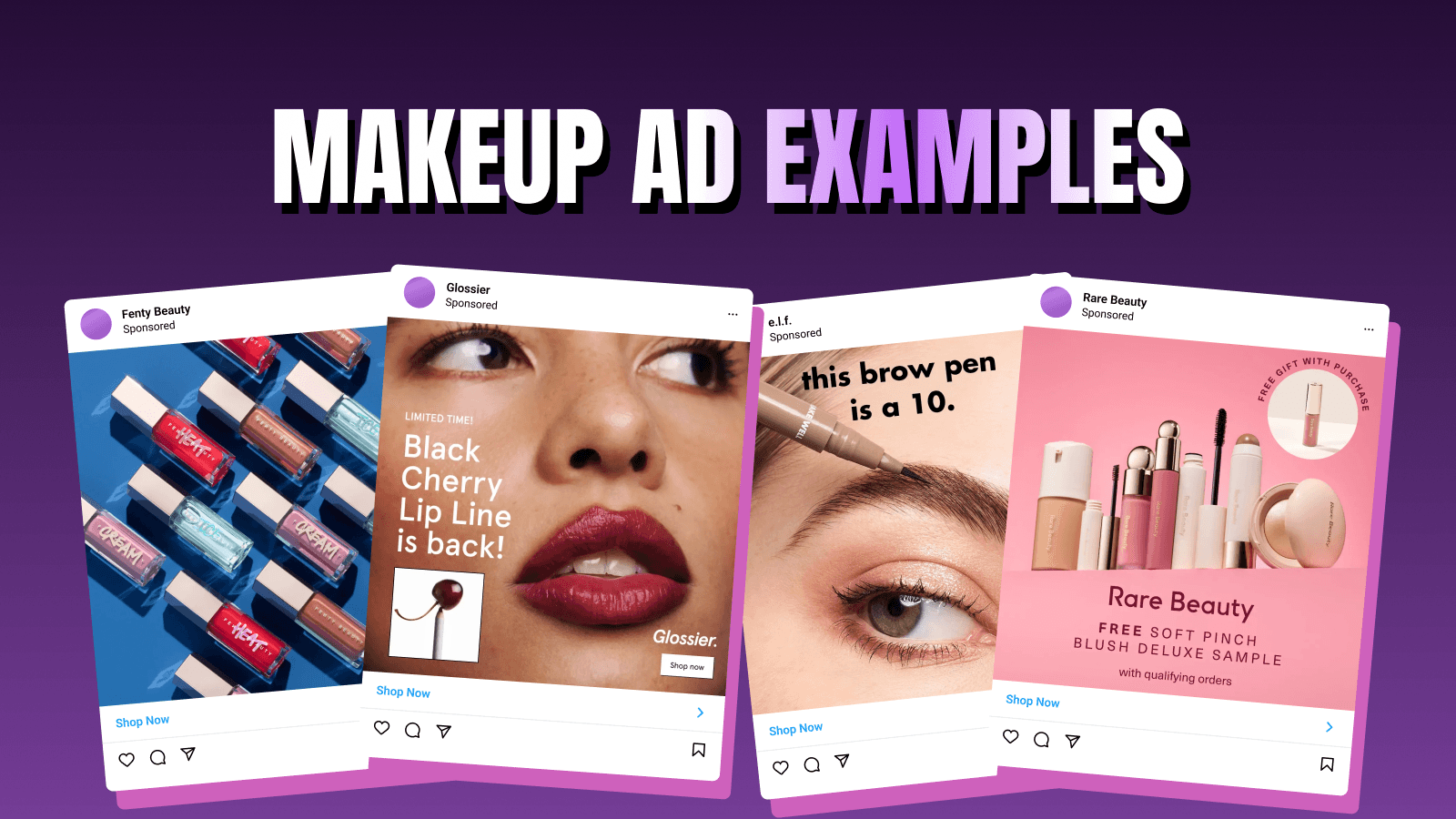


e.l.f. ran a Meta ad for 358 days that is one brown brow pen on lilac and one line: "holy-e.l.f. price: €9!" No model, no before-and-after, no review. That same company spent $399.8 million on marketing and digital in fiscal 2026, about 24% of net sales (e.l.f. Beauty 10-K), so the bare brow pen is a choice, not a budget limit. Most roundups of makeup ads show Maybelline TV spots and Fenty launch films, with no way to tell what kept running. Below are 26 makeup ad examples from e.l.f., Jones Road, Fenty Beauty, Milk Makeup, Rare Beauty, and 12 more brands, each with its run-length, grouped by creative move, then the FDA, FTC, and Meta rules that shape what a cosmetic ad can say. Jump to the 26 ads.
What makes a good makeup ad
A good makeup ad answers the question a static can't dodge: what will this look like on me? Makeup shows its result the second it's on, so makeup ads lean on shade, texture, or a face, and the best pick one and let it carry the frame.
Counted across the 26 ads below:
| Move | Count | Who does it |
|---|---|---|
| No price, discount, or gift in the image | 21 of 26 | The five exceptions are e.l.f.'s €9 brow pen and four offer ads |
| A face or facial feature in the frame (eyes, lips, skin) | 11 of 26 | Mostly mascara, brow, and lip products; foundation ads show the shade, not the face |
| The product out of the pack (swatch, smear, splash, stroke) | 8 of 26 | Jones Road, Milk Makeup, Danessa Myricks, M·A·C, Huda Beauty, e.l.f., IL MAKIAGE, Fièra |
| A performance claim in the copy (hours, coverage, "after 1 application") | 8 of 26 | The copy regulators read hardest (see the rules) |
| More than one shade in the frame | 6 of 26 | Jones Road, two Fenty Beauty, Milk Makeup, Danessa Myricks, IL MAKIAGE |
| Third-party voice (review, star rating, retailer ranking) | 4 of 26 | IL MAKIAGE, MoxieLash, Trinny London, ILIA |
| A before-and-after split | 2 of 26 | Jones Road and an unrecorded primer advertiser |
| No copy at all beyond the logo | 3 of 26 | Both Fenty Beauty grids and Sephora Collection |
| Ran 180 days or more | 11 of 26 | Three ran more than a year |
Two findings stand out. Foundation and concealer ads almost never show a full face. They show the shade range or an eye-area crop, because the buyer's real question is "is my shade here?" And proof stays small: a five-star row, one customer line, or a sourced retailer ranking. Nobody runs a wall of reviews.
26 makeup ads that ran on Meta
Every ad below is a real Meta or Instagram ad from the AdDogs beauty ad library. "Days" is how long it had been live at the last check (Meta Ad Library or Foreplay, April 8 to October 12, 2026). That proves the advertiser kept paying, not that the ad was profitable. Eleven ran at least 180 days and three ran more than a year. Ads marked "newer" launched shortly before their check and are here because they show a move nothing older does. To verify one, search the brand in the Meta Ad Library with the "active" filter (for example, Jones Road Beauty's live ads) and read "Started running on." Our Meta Ad Library guide walks through it.
One admission: the library is strongest on DTC makeup brands (e.l.f., Jones Road, Milk Makeup, MoxieLash, Fièra) and holds no Maybelline, L'Oréal Paris, or NARS ads, because the legacy houses' Meta ads rarely surface in trackers. If you sell online, that's the more useful set. Skincare has its own post, 30+ skincare ad examples, and nothing below repeats it.
Swatch and shade range. For complexion products and lip color, the range is the headline. Five ads show it and say almost nothing else.
1. Jones Road — 16 jars and an age
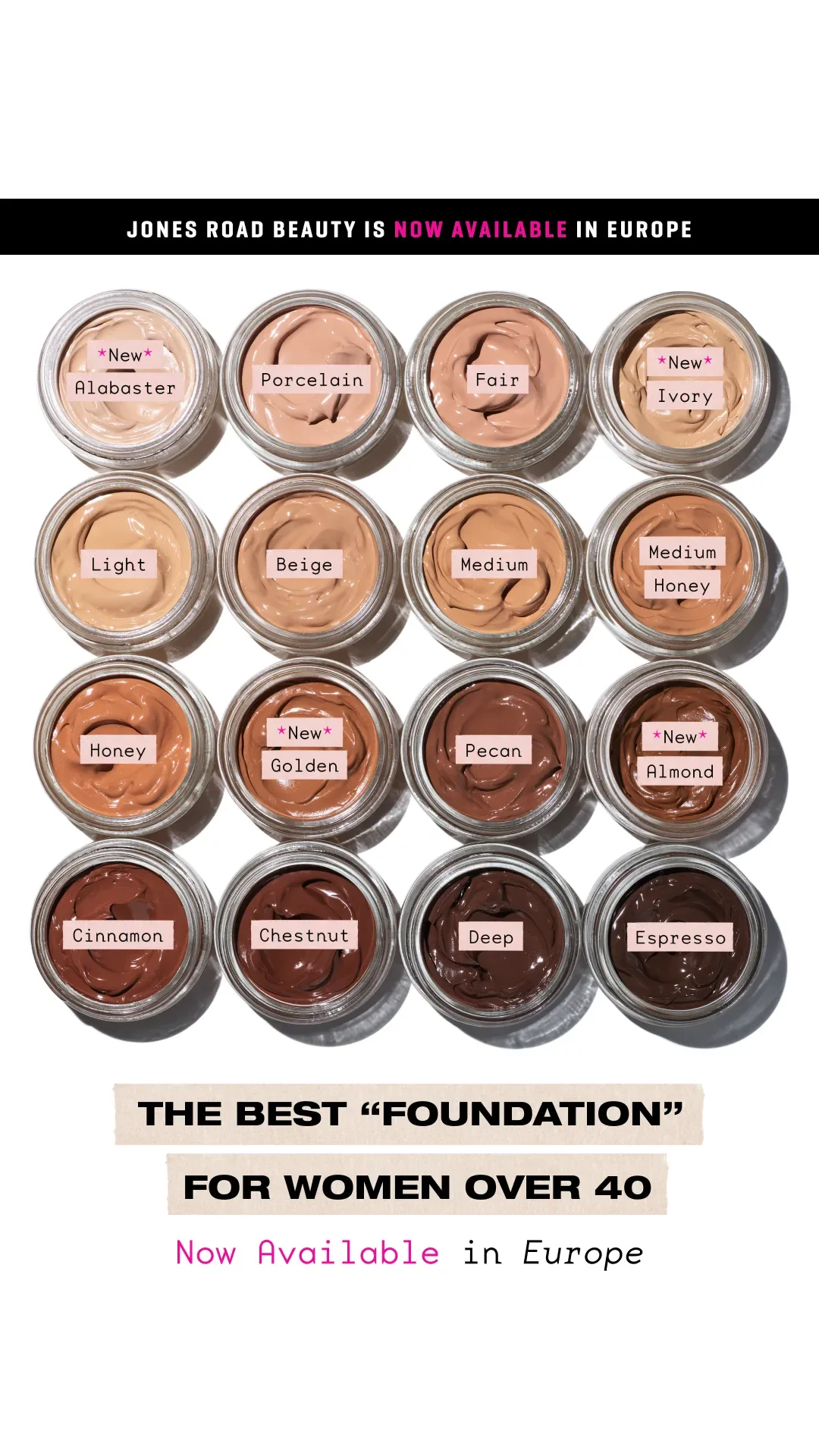
Sixteen open jars in a four-by-four grid, top-down, every shade labeled on a strip of tape from Alabaster through Porcelain, Honey, Pecan, and Chestnut to Espresso, a few tagged "New". A black bar on top: "JONES ROAD BEAUTY IS NOW AVAILABLE IN EUROPE." Beneath the grid, on two tape strips: "THE BEST "FOUNDATION" FOR WOMEN OVER 40." 390 days.
Why it works: A buyer finds her shade before she reads a word, and the open jars show the texture as well as the color. Its audience callout, women over 40, does targeting an ad set can't fully do.
Clone it: Any product sold in shades. Shoot every shade open, top-down, labeled, and put one audience line under the grid.
2. Fenty Beauty — gloss on cobalt, no words
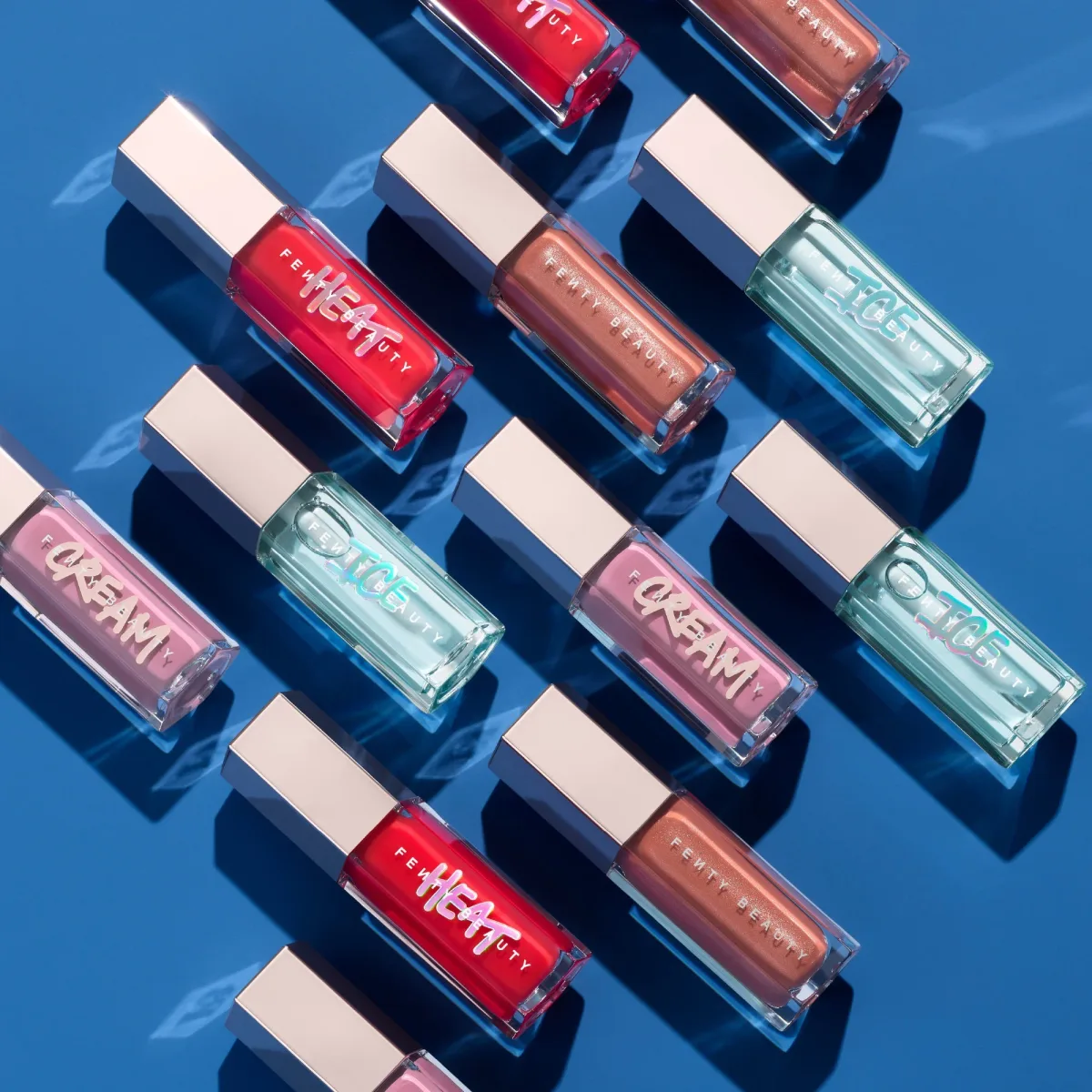
Diagonal rows of lip-gloss tubes with rose-gold caps on cobalt blue, hard light, long shadows. Each tube names itself in big type: Heat in red, Ice in mint, Cream in pink. No headline, no logo lockup, no button. 83 days.
Why it works: Packaging is the copy. Each finish names itself on the tube, so a range ad needs no text layer, and the blue is the complement of every shade on it.
Clone it: Any range with names printed on the pack. Lay the variants diagonally on a single color that contrasts with all of them.
3. Fenty Beauty — about 50 tubes, light to deep
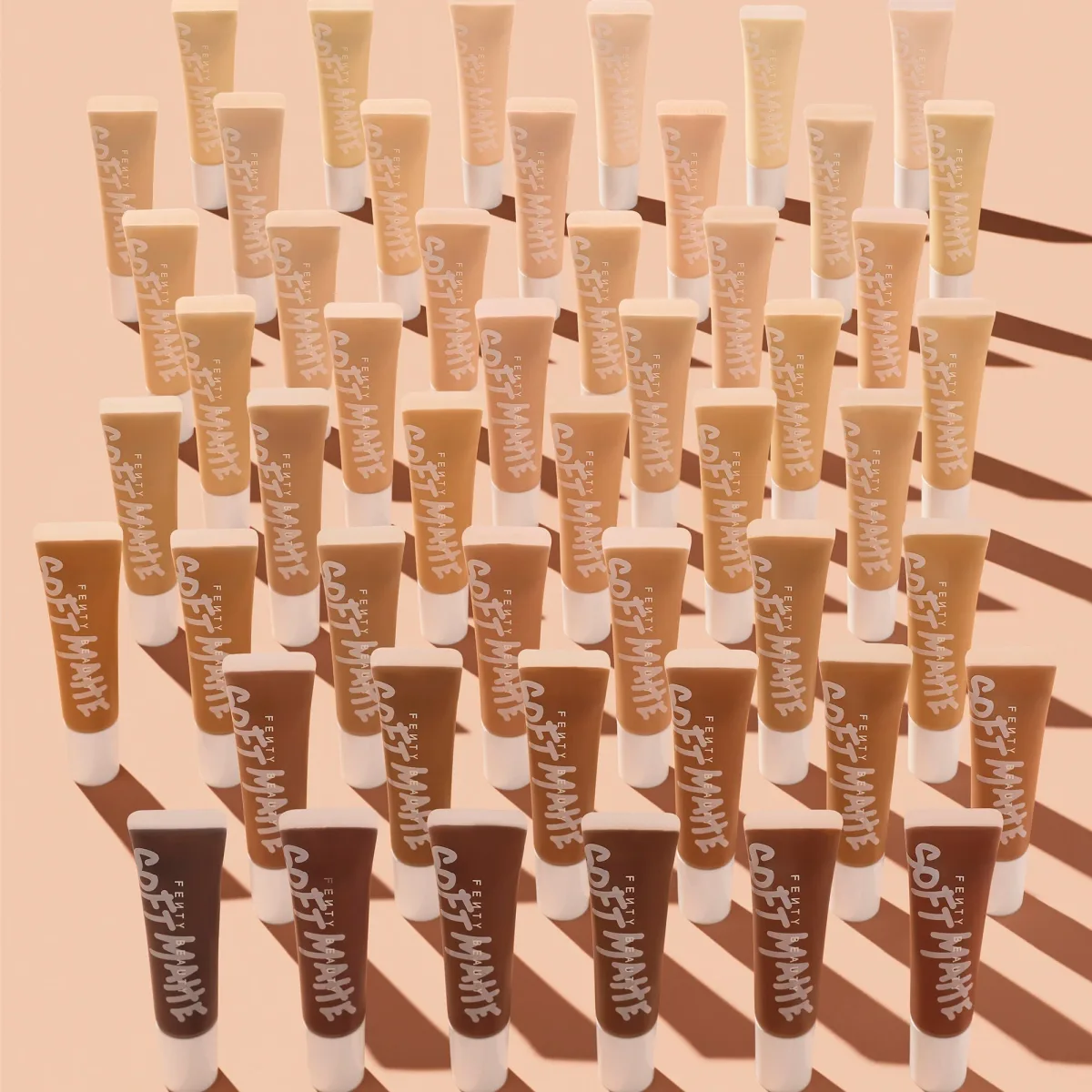
Roughly 50 squeeze tubes printed "SOFT MATTE" stand in staggered rows on a peach ground, ordered from the palest shade at the back to the deepest at the front, each casting a long diagonal shadow. No copy. 16 days, newer.
Why it works: Scale is the claim. Nobody counts the tubes. They register that their shade is in there, and the light-to-deep order keeps 50 objects from becoming noise.
Clone it: Only if your range is wide. Order it by tone, shoot it as a crowd, and let the shadow do the composition.
4. Milk Makeup — 15 shades as chips
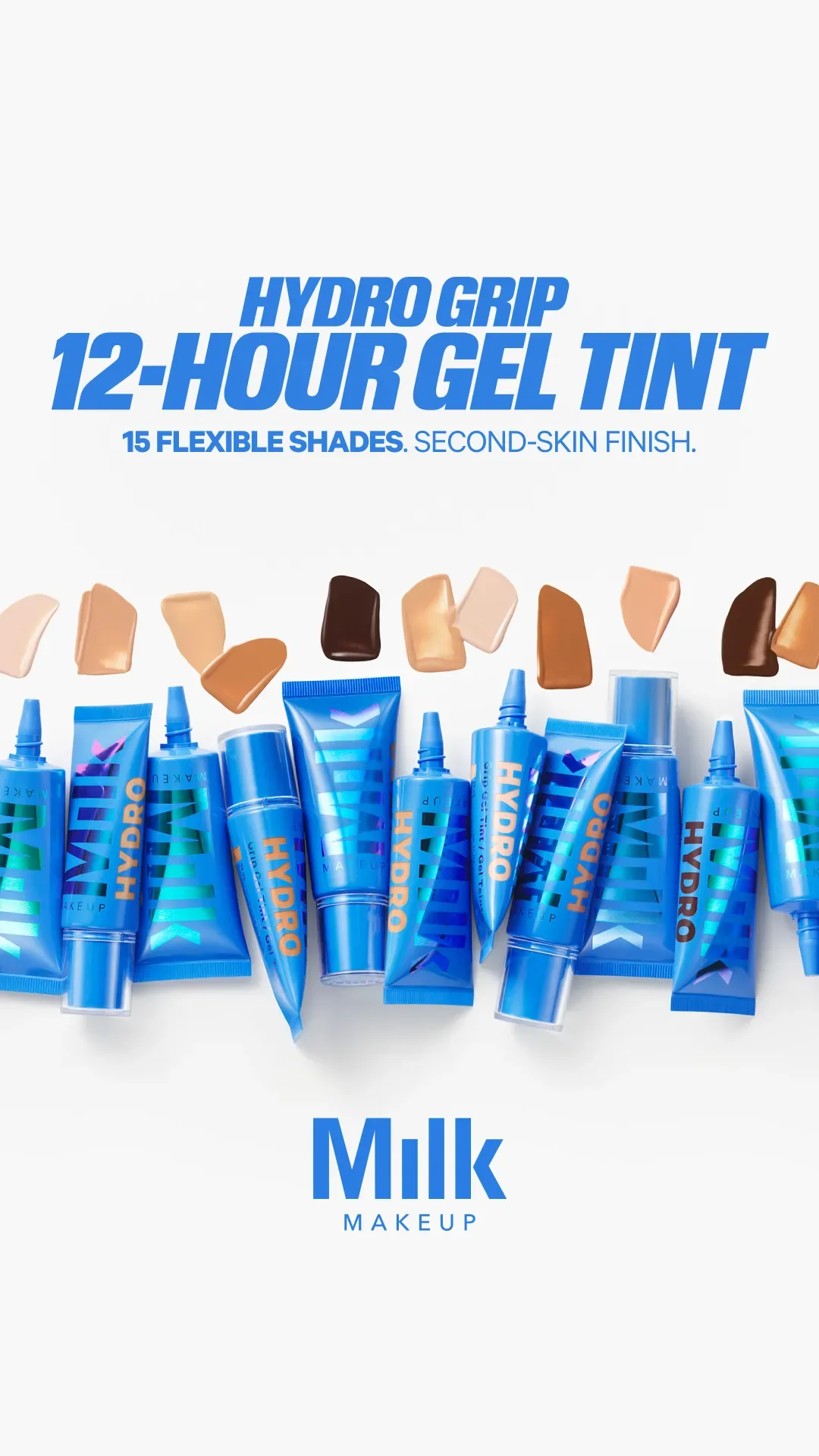
A row of cobalt-blue tubes lies across the middle of a white frame with a scatter of swatch chips, from porcelain to deep brown, floating above them. "HYDRO GRIP 12-HOUR GEL TINT" in condensed italic blue caps, "15 FLEXIBLE SHADES. SECOND-SKIN FINISH." beneath, the Milk logo at the bottom. 107 days.
Why it works: Packaging is one color for every shade, so the swatches carry the range the tubes can't. "12-hour" and "15" are both numbers, both in the first line read.
Clone it: Uniform packaging plus a shade range. Float the swatches above the product and lead with two numbers.
5. Danessa Myricks — 12 shades in smears
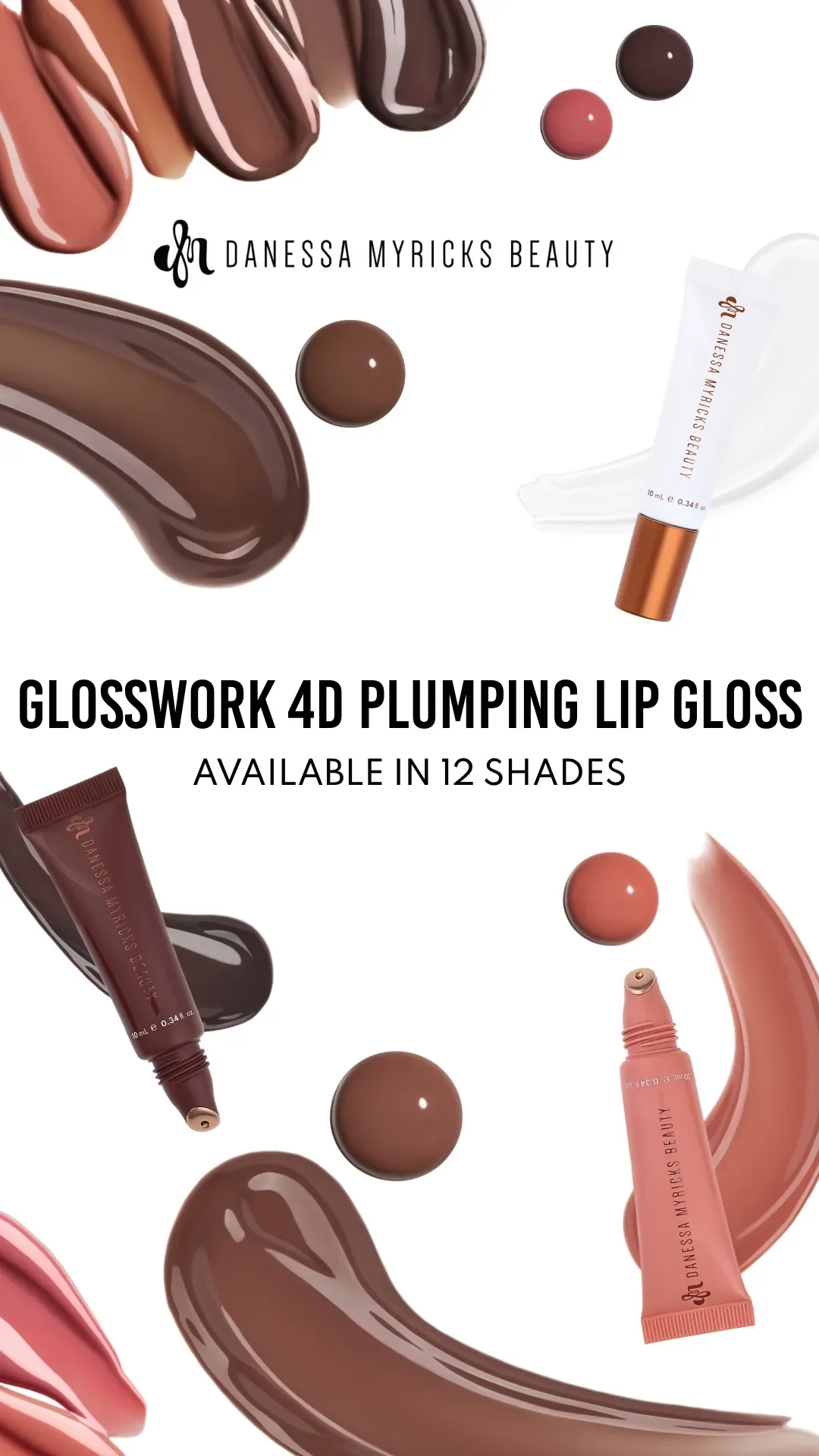
Wet smears and beads of gloss in chocolate, rose, and terracotta crowd the top and bottom of a white frame, two tubes tucked between them. A middle band carries the logo and "GLOSSWORK 4D PLUMPING LIP GLOSS / AVAILABLE IN 12 SHADES." 45 days, newer.
Why it works: Smears show finish and color at the same time, which a closed tube can't. "Plumping" is the claim to watch: it describes a temporary look, which keeps it a cosmetic claim, the line the FDA section below draws.
Clone it: Glosses, liquid lipsticks, liquid blush. Smear every shade on white, keep one clean band for the name.
Before and after. It's the move platforms police hardest. Both crop to a single feature.
6. Jones Road — "5 extra hours of sleep"
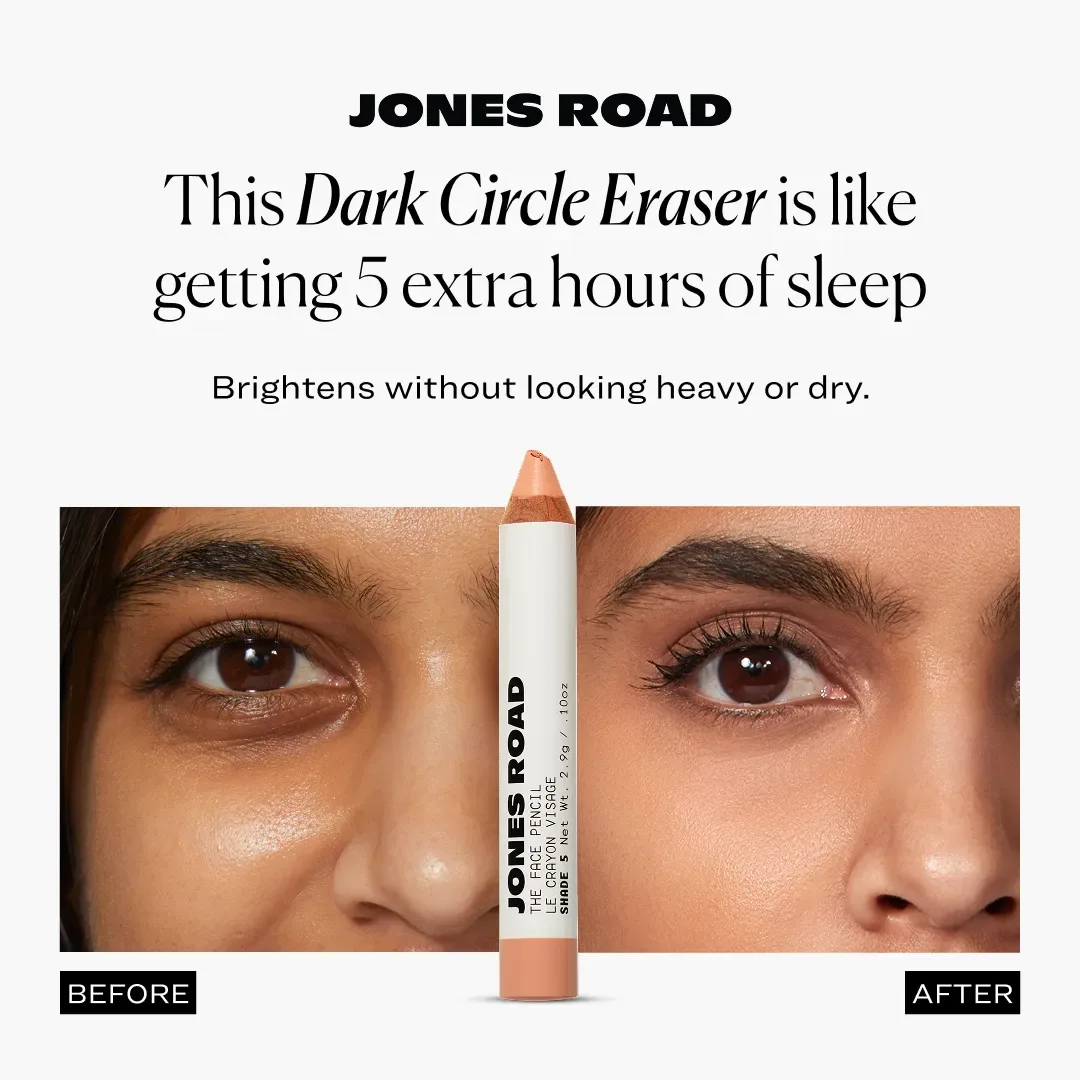
Two eye-area crops of the same face, the left labeled "BEFORE" with visible dark circles, the right "AFTER" brighter, a peach Dark Circle Eraser pencil standing upright on the seam. Above, in a serif with the product name italicized: "This Dark Circle Eraser is like getting 5 extra hours of sleep." Beneath, "Brightens without looking heavy or dry." 390 days.
Why it works: Its claim is a metaphor, not a measurement, so it promises a feeling, not a testable result. A pencil on the seam shows what made the difference.
Clone it: Any concealer, corrector, or brightener. Same face, same light, one feature, the product on the line between.
7. A pore primer — "after 1 application"
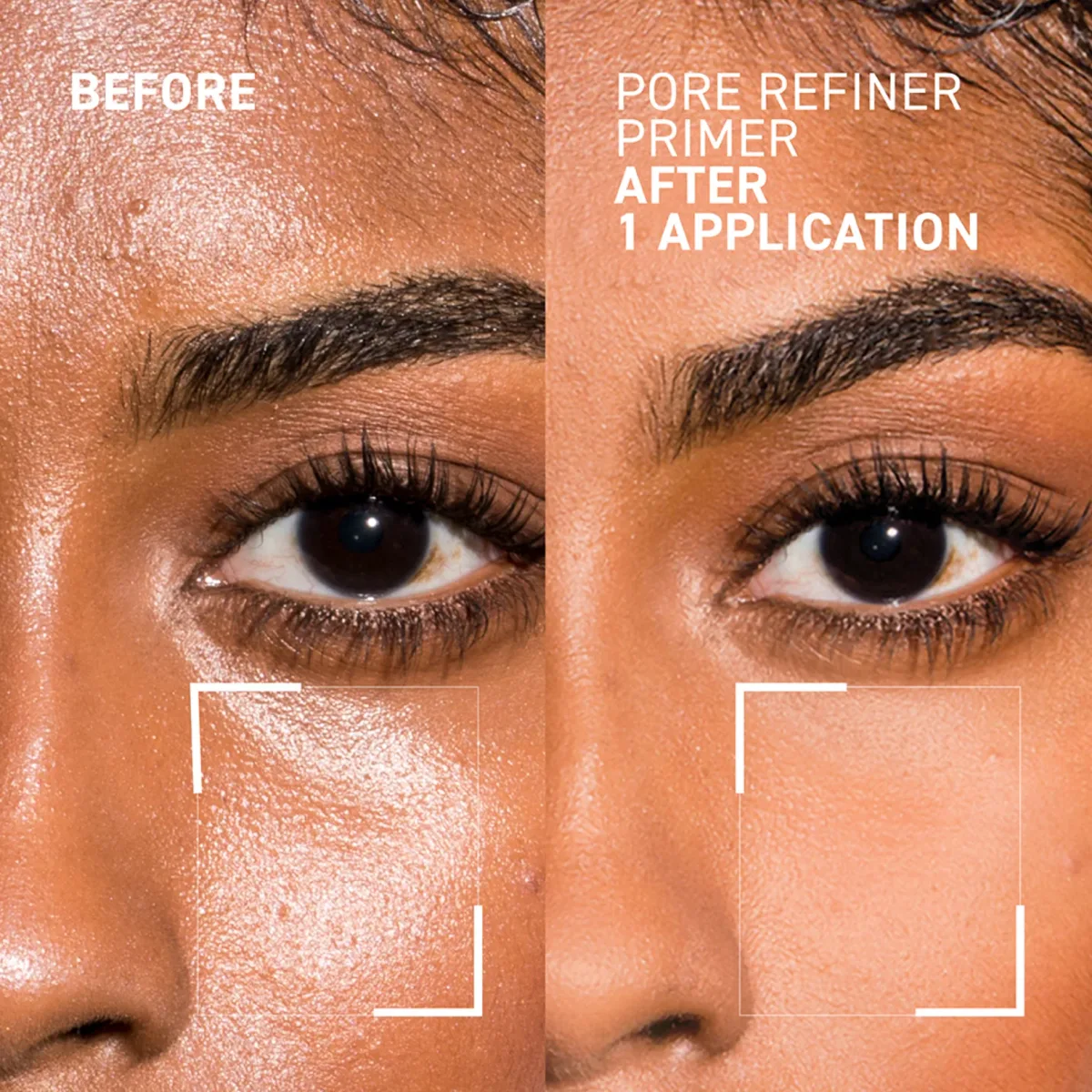
Two crops of the same eye and cheek on deep brown skin, white viewfinder brackets framing the same patch of skin in each. "BEFORE" on the left; "PORE REFINER PRIMER / AFTER 1 APPLICATION" on the right. Our library doesn't record the advertiser; the product name matches Dr. Brandt's primer in ad 16. 182 days.
Why it works: Brackets tell you where to look, so the viewer doesn't hunt. "After 1 application" is specific and testable, which is exactly why it has to be true.
Clone it: Primers, setting powders, blurring products. Bracket the area, state the number of applications, change nothing else between frames.
Texture macro. When the formula is the selling point, the frame goes inside the product.
8. M·A·C — a foundation splash and three claims
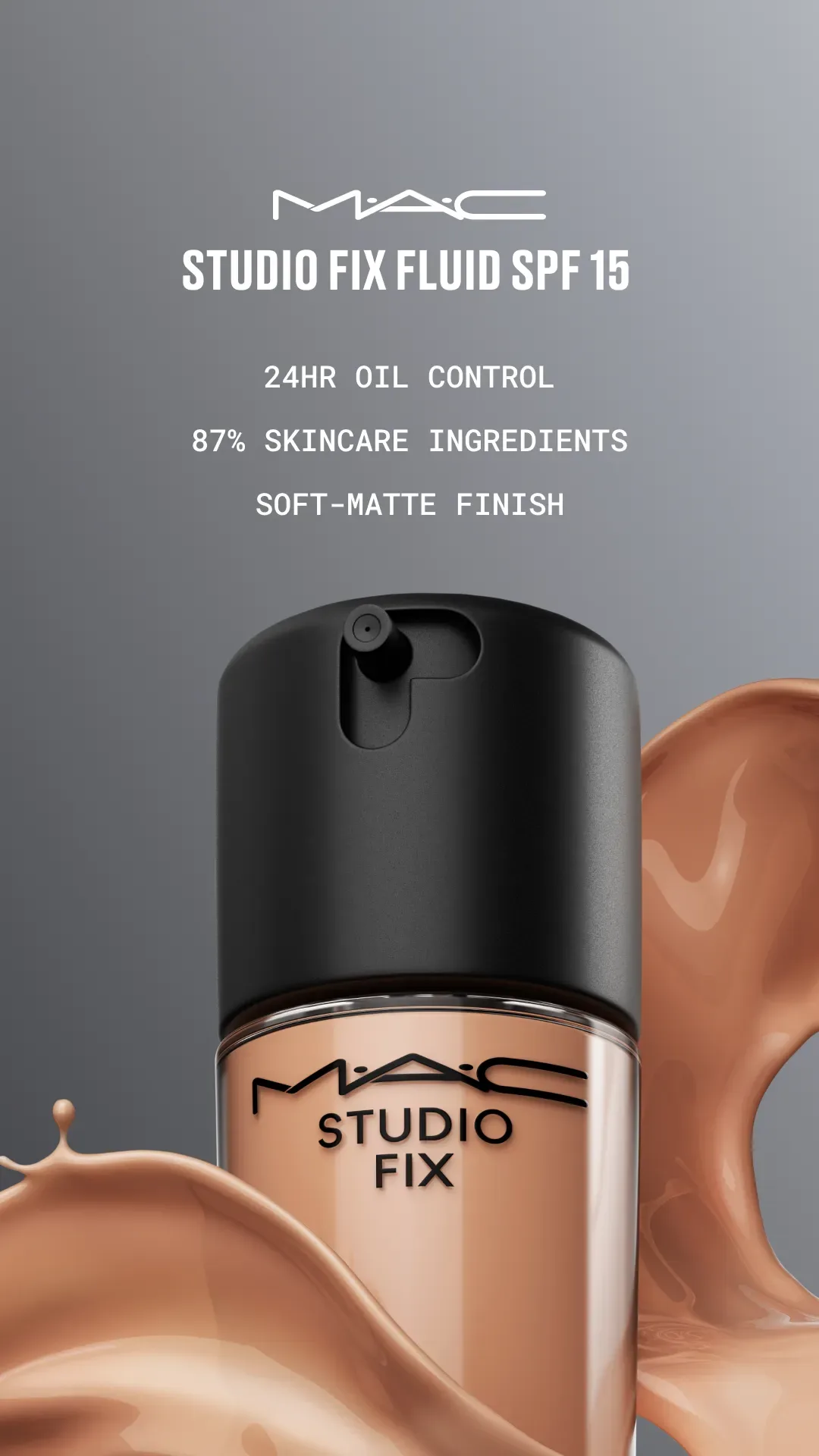
A Studio Fix Fluid bottle rises from the bottom of a gray gradient while a wave of beige foundation curls around it. Top: the M·A·C logo, "STUDIO FIX FLUID SPF 15," and three lines in a monospace face: "24HR OIL CONTROL," "87% SKINCARE INGREDIENTS," "SOFT-MATTE FINISH." 20 days, newer.
Why it works: A splash shows viscosity, the thing a buyer can't feel through a screen, and the three claims sit in a spec-sheet font that reads as fact rather than hype. "SPF 15" matters too: in the US it makes this foundation a cosmetic and a drug at once.
Clone it: Liquid foundation, tinted moisturizer, serum foundation. Product plus splash plus three specs, nothing else.
9. Huda Beauty — four panels of lips
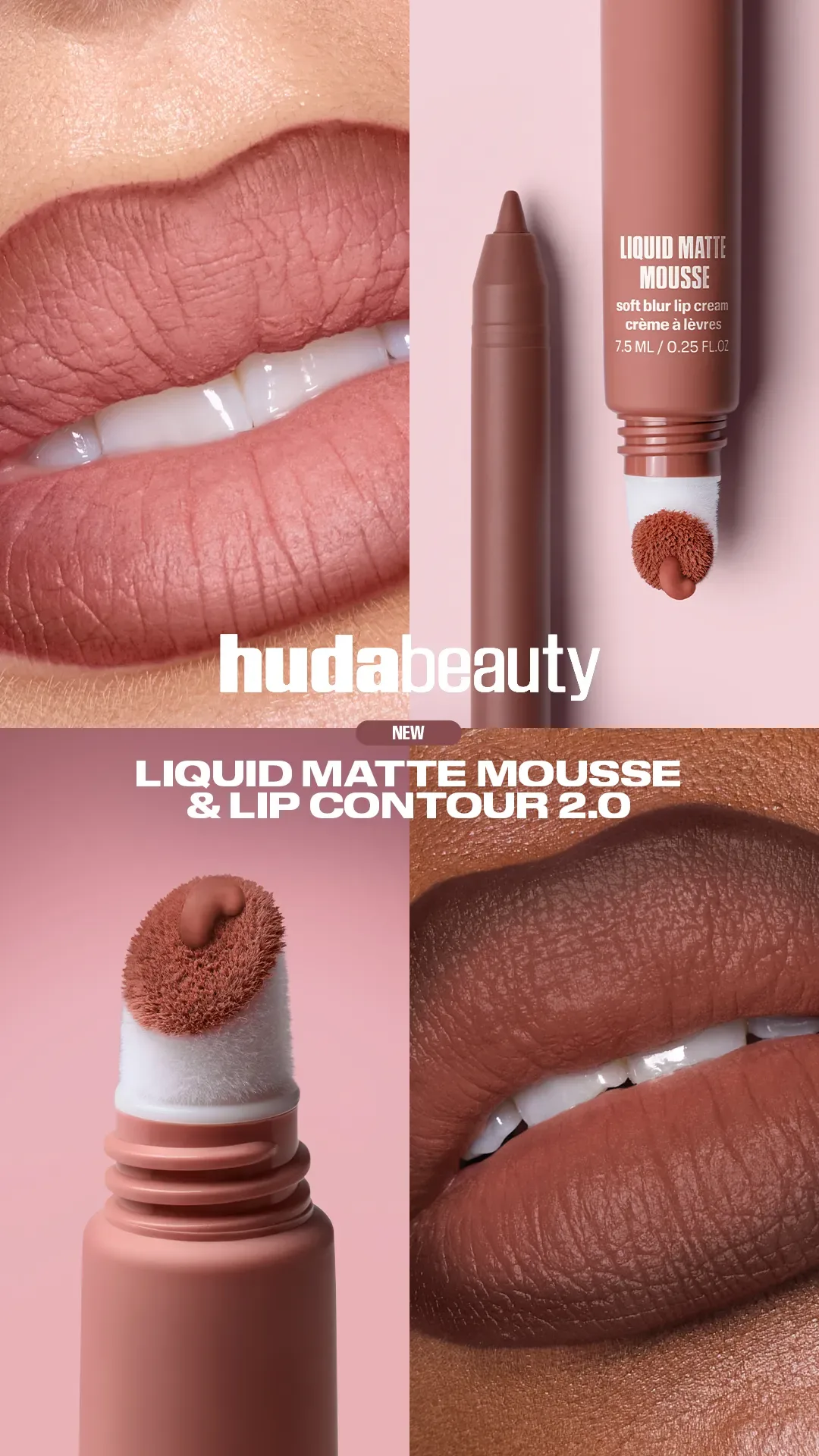
A two-by-two grid alternates texture and result: matte rose lips, then the tube and liner, then a cushion applicator heaped with mousse, then deeper lips in the same finish. A middle band carries the hudabeauty wordmark, a "NEW" pill, and "LIQUID MATTE MOUSSE & LIP CONTOUR 2.0." 61 days, newer.
Why it works: Applicator and result, twice. Its grid answers "what's the texture" and "what does it look like on" in one frame, on two skin tones.
Clone it: Any lip or cheek product with a distinctive applicator. Alternate macro of the applicator with macro of the result.
Model close-up and application. A face appears only where the product touches it.
10. Sephora Collection — 412 days of one wand
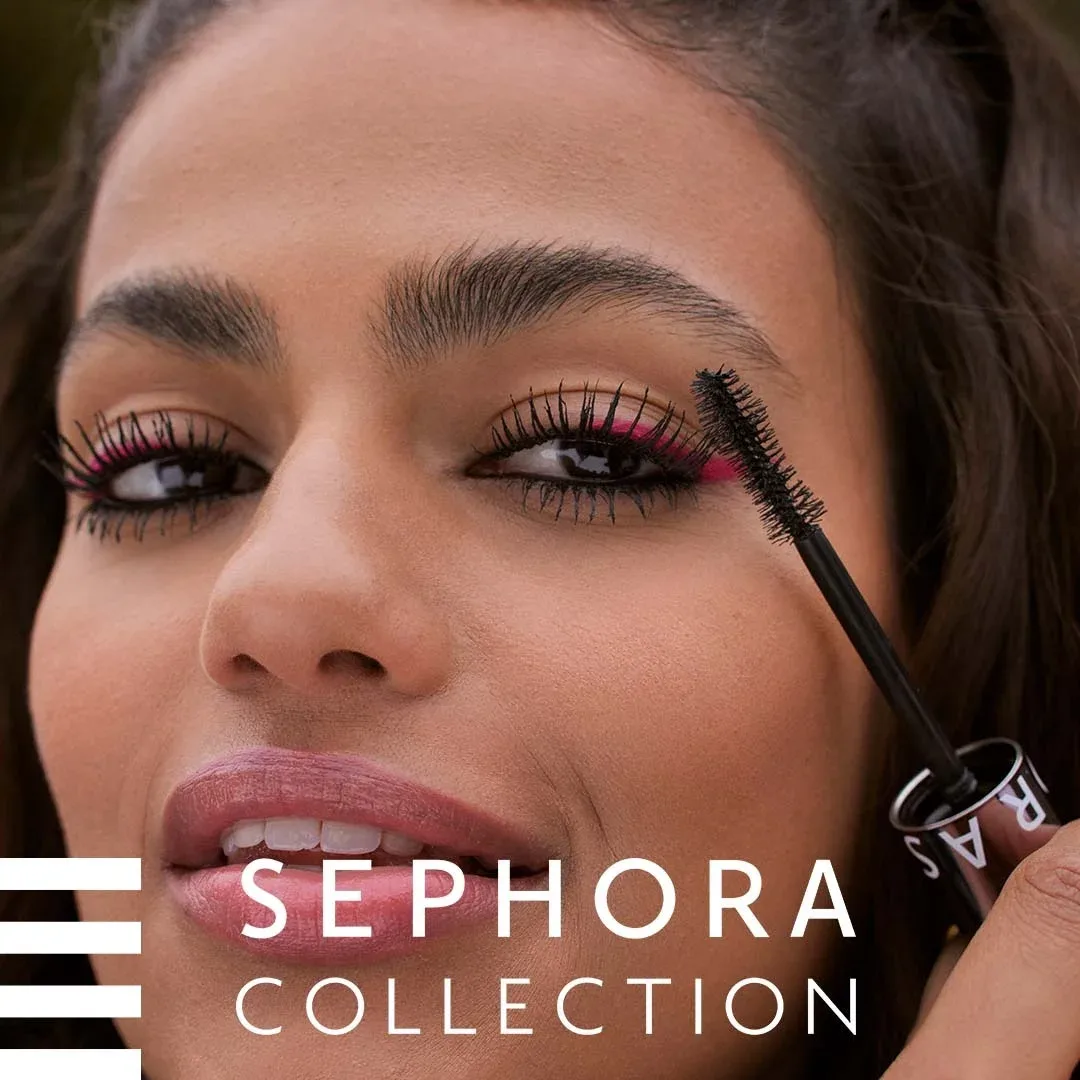
A model with a pink graphic liner flick and glossy pink lips mid-application, the mascara wand at her lashes, half-smiling at the camera. Sephora Collection's logo, with its striped mark, sits bottom-left. Nothing else. 412 days, the longest run in the set.
Why it works: An editorial frame with a logo and nothing that dates, the same reason house stills run for years in our luxury ad examples. A mid-application moment sells the ritual.
Clone it: Mascara, liner, lip. One model, one gesture, the product touching the face, your logo and nothing more.
11. Glossier — a lip liner that is back
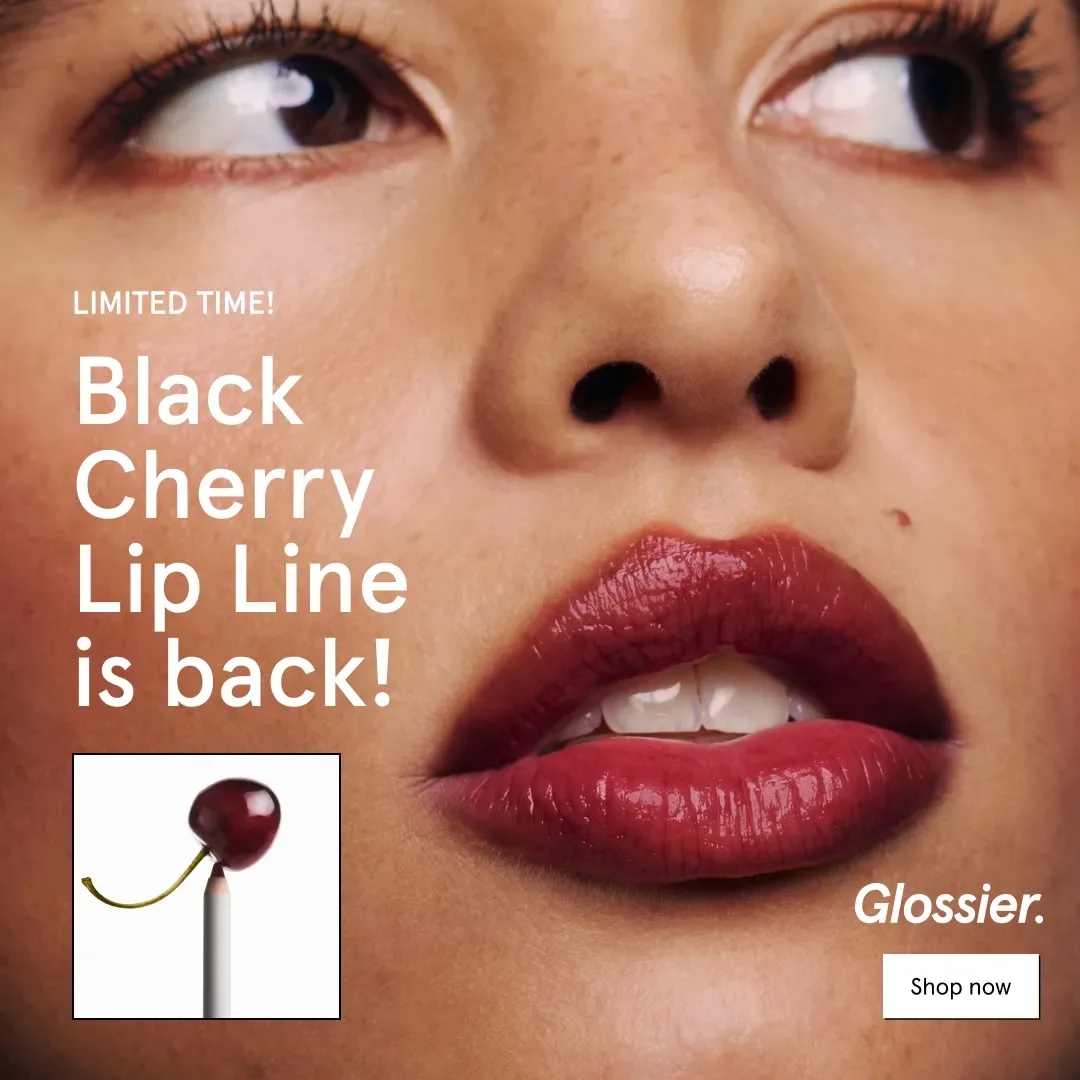
An extreme close-up from the eyes to the chin, freckles visible, lips in glossy black-cherry red. Left side: "LIMITED TIME!" and "Black Cherry Lip Line is back!" in white, with an inset of a white liner topped with a real cherry. "Glossier." and a drawn-in "Shop now" button at the bottom right. 340 days.
Why it works: Freckles and pores are left in, Glossier's house style and a quiet answer to the retouching rules below. "Back" is scarcity with no date, which is how a "limited time" ad ran 340 days. Glossier's broader playbook is in our Glossier ads teardown.
Clone it: A returning or seasonal shade. Crop tight, keep real skin, inset the product, say "is back."
12. Rare Beauty — the dots on the cheek
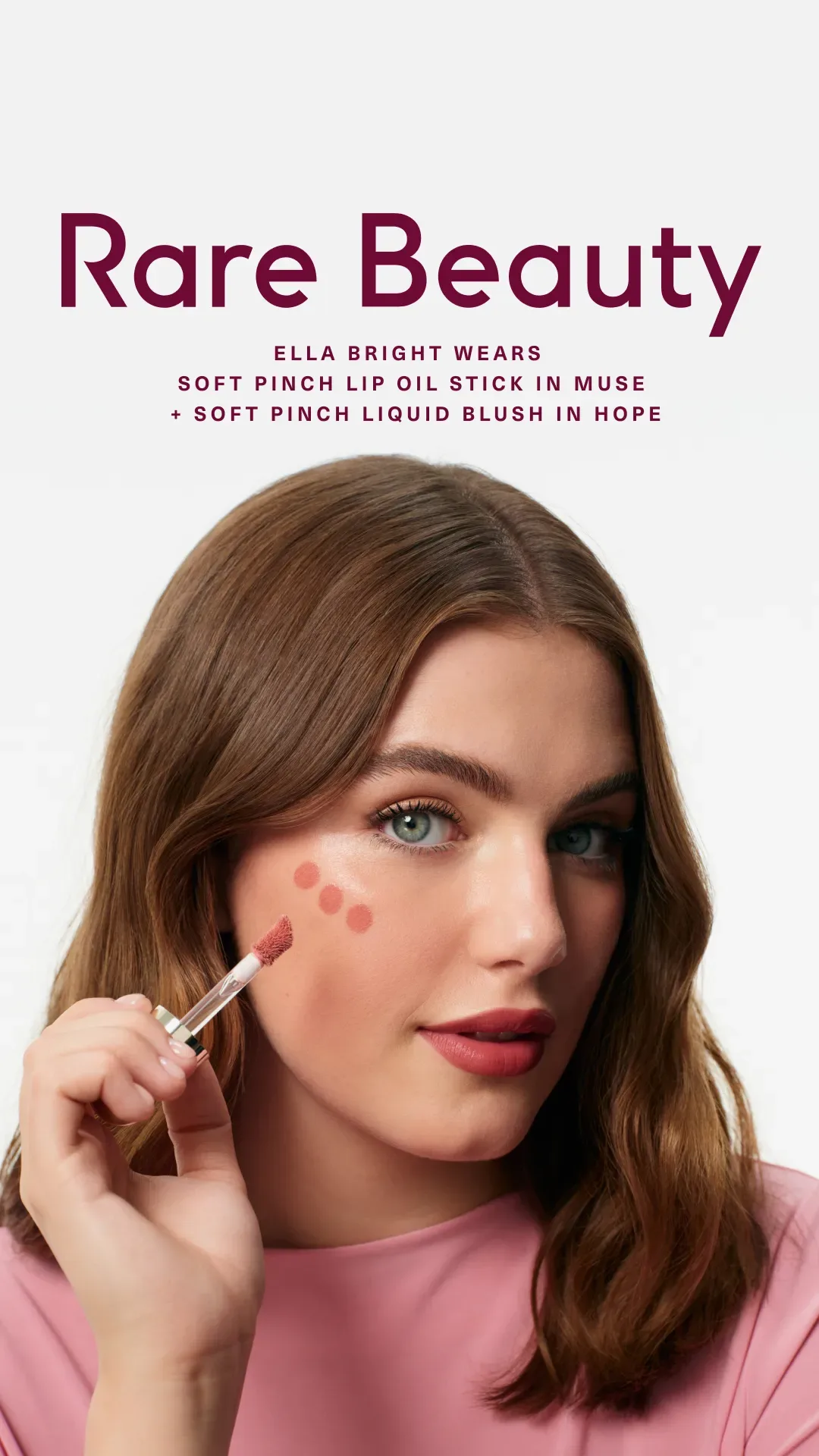
A model on white holds a Soft Pinch applicator by her face after dotting three spots of rose blush on her cheekbone. "Rare Beauty" in deep plum at the top, then in spaced caps: "ELLA BRIGHT WEARS / SOFT PINCH LIP OIL STICK IN MUSE / + SOFT PINCH LIQUID BLUSH IN HOPE." 21 days, newer.
Why it works: Three dots are the how-to: they show how little product you need without a word of instruction. A credit line names the wearer and both shades, like a magazine caption.
Clone it: Any product applied in a pattern. Shoot the moment after application but before blending, and credit the shade.
13. Kosas — a mascara that claims to be three things
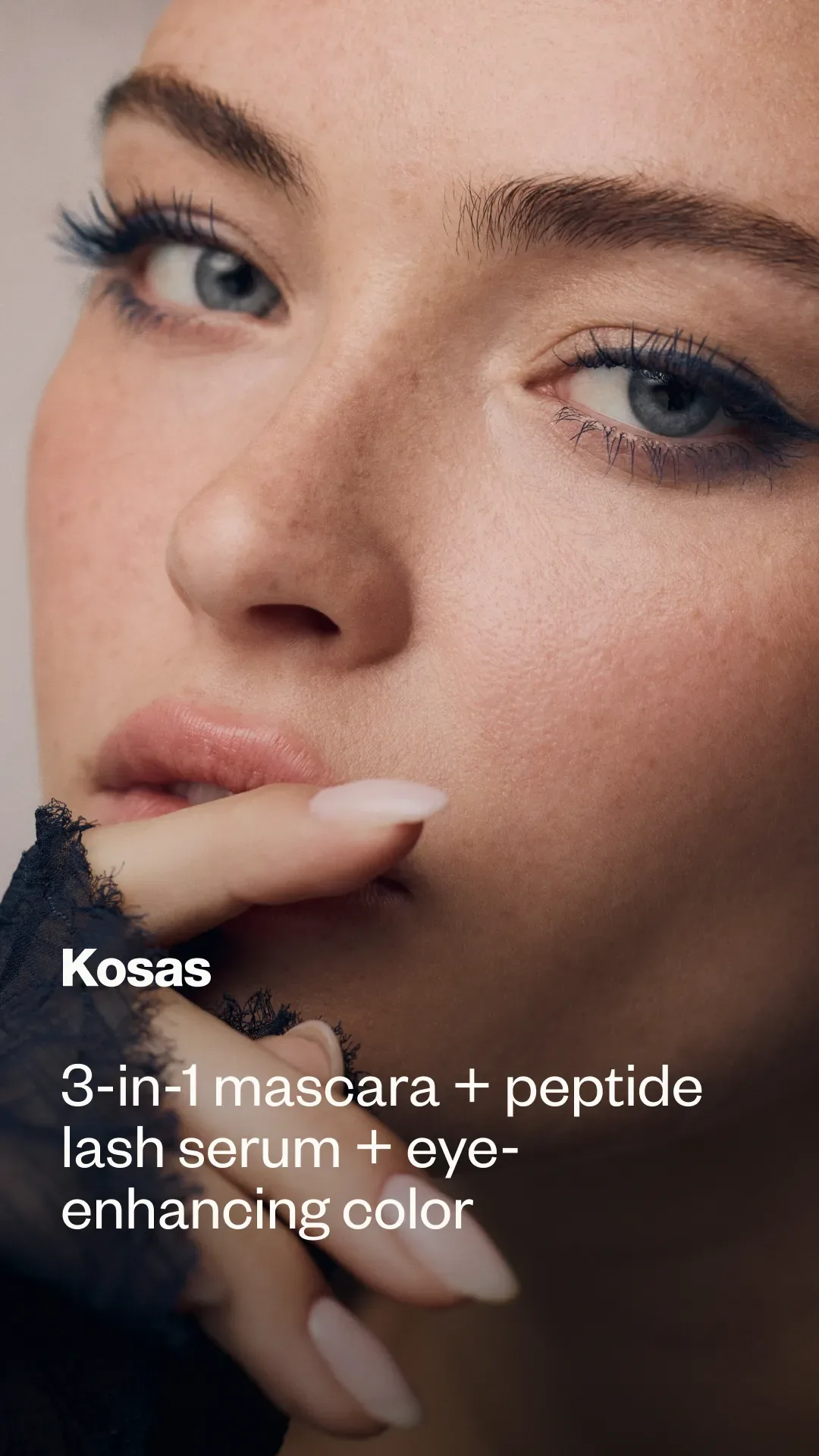
A close portrait in warm light, blue-gray eyes lined in navy, a fingertip resting on the lower lip, black lace at the edge of the frame. Bottom-left in white: "Kosas / 3-in-1 mascara + peptide lash serum + eye-enhancing color." 19 days, newer.
Why it works: Editorial portrait, spec-sheet copy. "Lash serum" names an ingredient category without saying it grows lashes, and that distinction matters (see the FDA note below).
Clone it: A multi-benefit product. Moody portrait, benefits joined with plus signs, no adjectives.
14. e.l.f. — "this brow pen is a 10."
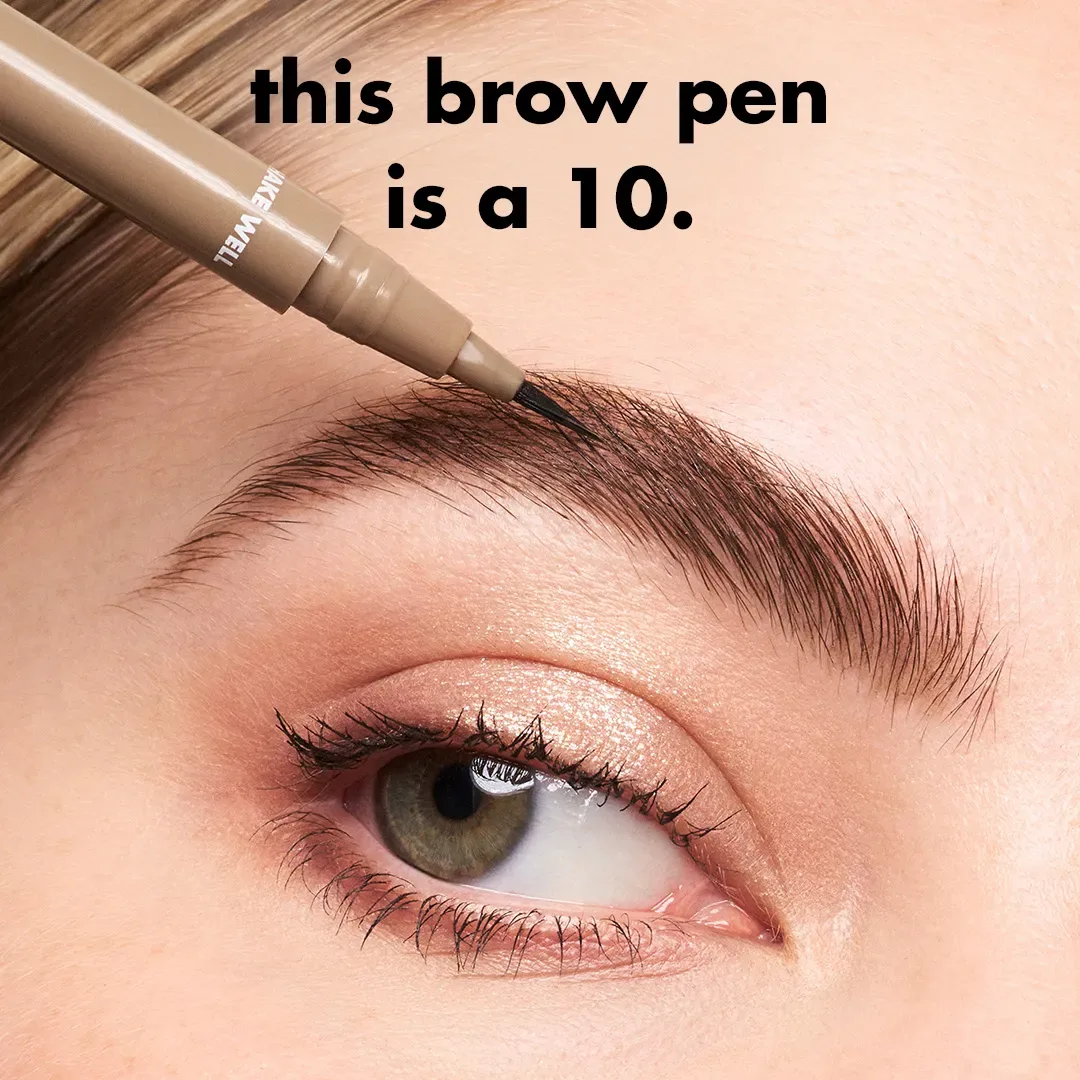
A macro of one eye and brow, the felt tip of a taupe pen mid-stroke drawing individual hairs, champagne shimmer on the lid. "this brow pen is a 10." in lowercase black at the top. 358 days.
Why it works: A rating is the headline, in the voice people use online, and the macro proves it: you can see single hair strokes. With the next ad, e.l.f. ran one product on two arguments for 358 days each.
Clone it: Any precision product. Macro of the tool mid-stroke, one lowercase line in the voice of a friend.
Dupe, price, and comparison. Makeup is a category where the buyer already owns something. Two ads name the alternative or undercut it.
15. e.l.f. — the price is the headline
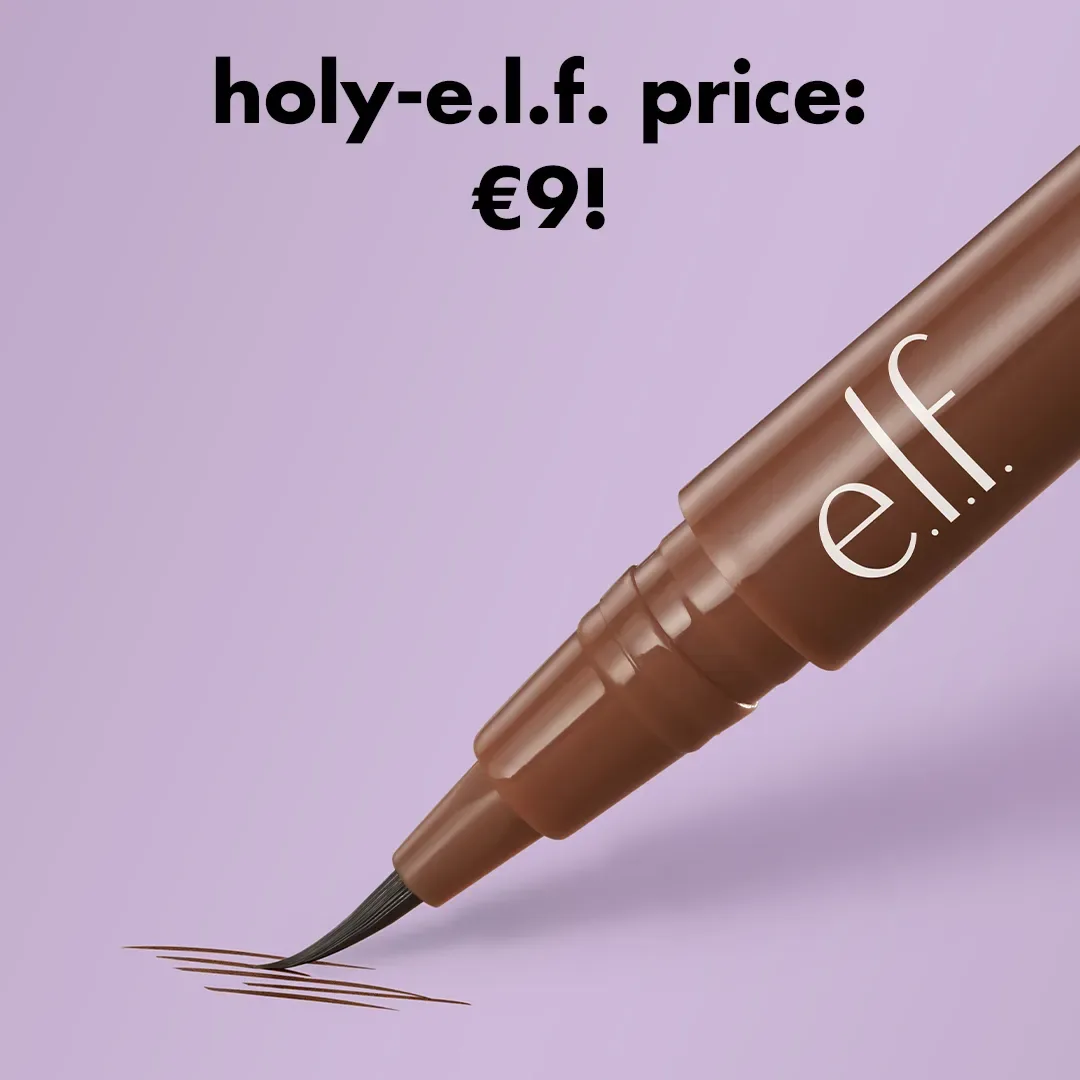
One brown brow pen lies across a flat lilac frame, three drawn strokes under its tip. "holy-e.l.f. price: €9!" in heavy black at the top. 358 days. It's the ad from the first paragraph.
Why it works: It states e.l.f.'s position, prestige quality at drugstore price, without naming a rival. A pun makes the price a brand asset rather than a discount, so it never needed an end date.
Clone it: Only if your price is the story. Product on a flat color, price in the headline, no strike-through.
16. Dr. Brandt — "Heavy coverage? Hard pass."
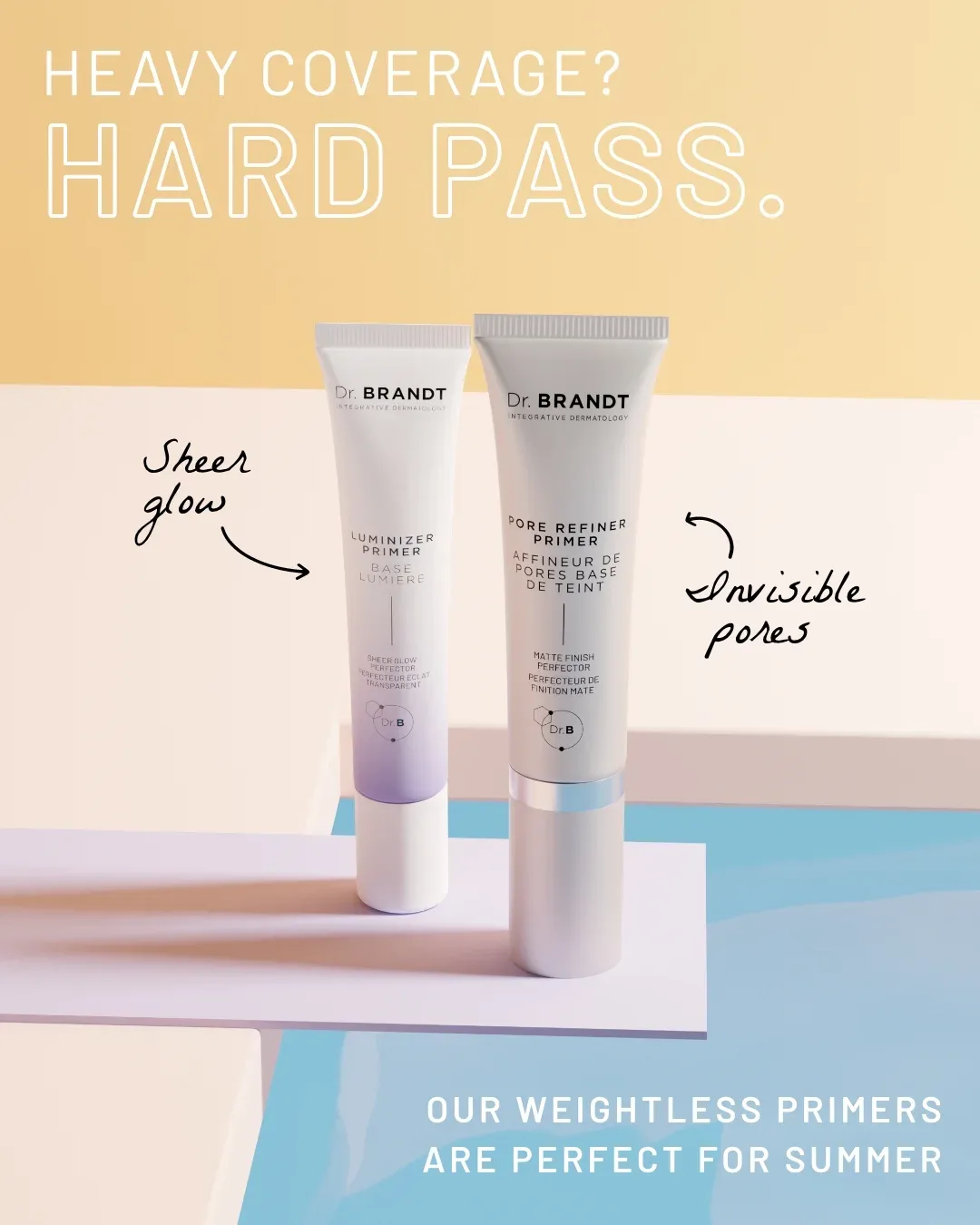
Two white primer tubes, Luminizer and Pore Refiner, on a pale plinth against a butter-yellow and sky-blue set. Handwritten arrows: "Sheer glow" to one, "Invisible pores" to the other. "HEAVY COVERAGE? HARD PASS." in outlined caps at the top, "OUR WEIGHTLESS PRIMERS ARE PERFECT FOR SUMMER" at the bottom. 182 days.
Why it works: It names the habit it replaces, heavy foundation, not a competitor. Handwritten notes turn two near-identical tubes into a choice.
Clone it: Any product positioned against a habit. Ask the habit as a question, answer it in two words, label each SKU by hand.
Review and proof. Four ways to borrow somebody else's voice, from a single customer line to a sales ranking.
17. IL MAKIAGE — one quote, 12 bottles
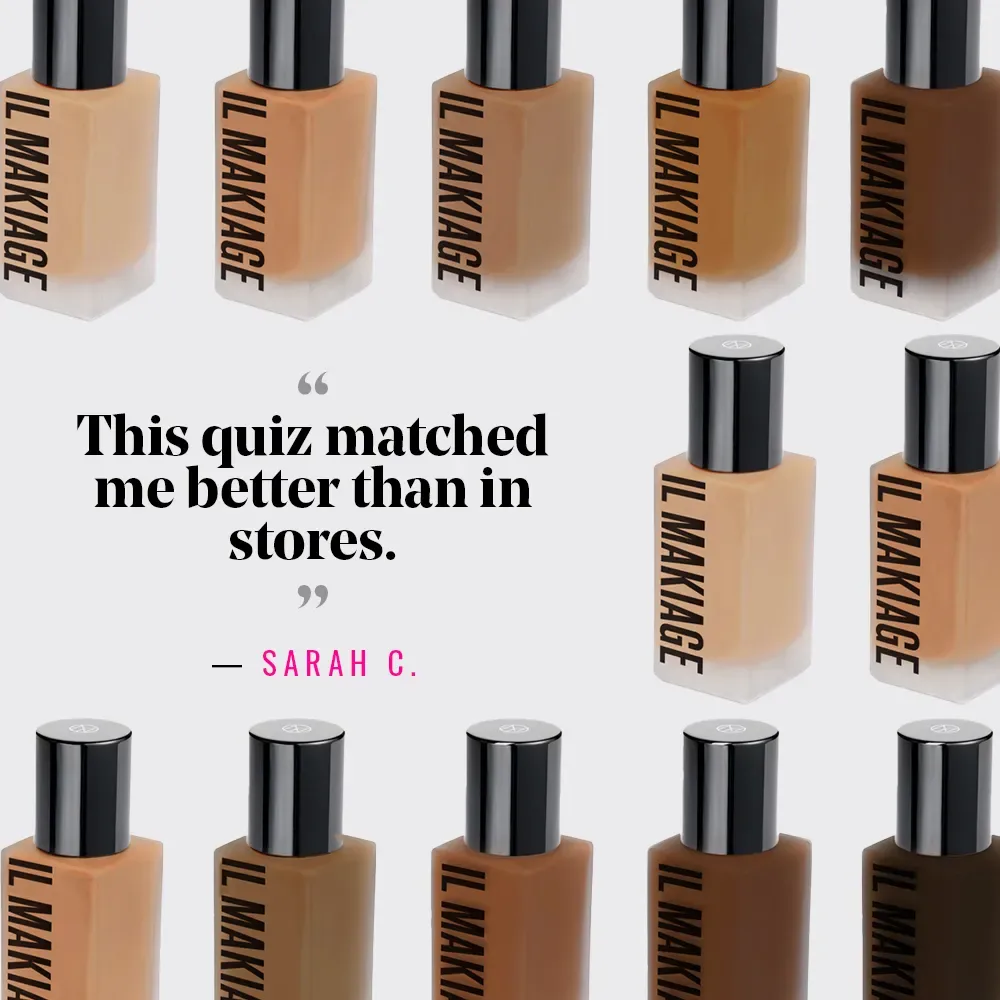
Rows of square foundation bottles, light shades top-left to deep shades bottom-right, frame a single serif quote: "This quiz matched me better than in stores." Attributed "— SARAH C." in pink caps. 65 days, newer.
Why it works: One quote answers the online shade-buyer's objection, "I need to try it in a store," in a customer's words. One review chosen for the objection beats a row of badges.
Clone it: Find the review that answers your biggest objection. Set it alone, in a serif, inside your range.
18. MoxieLash — eight eyes, eight star rows
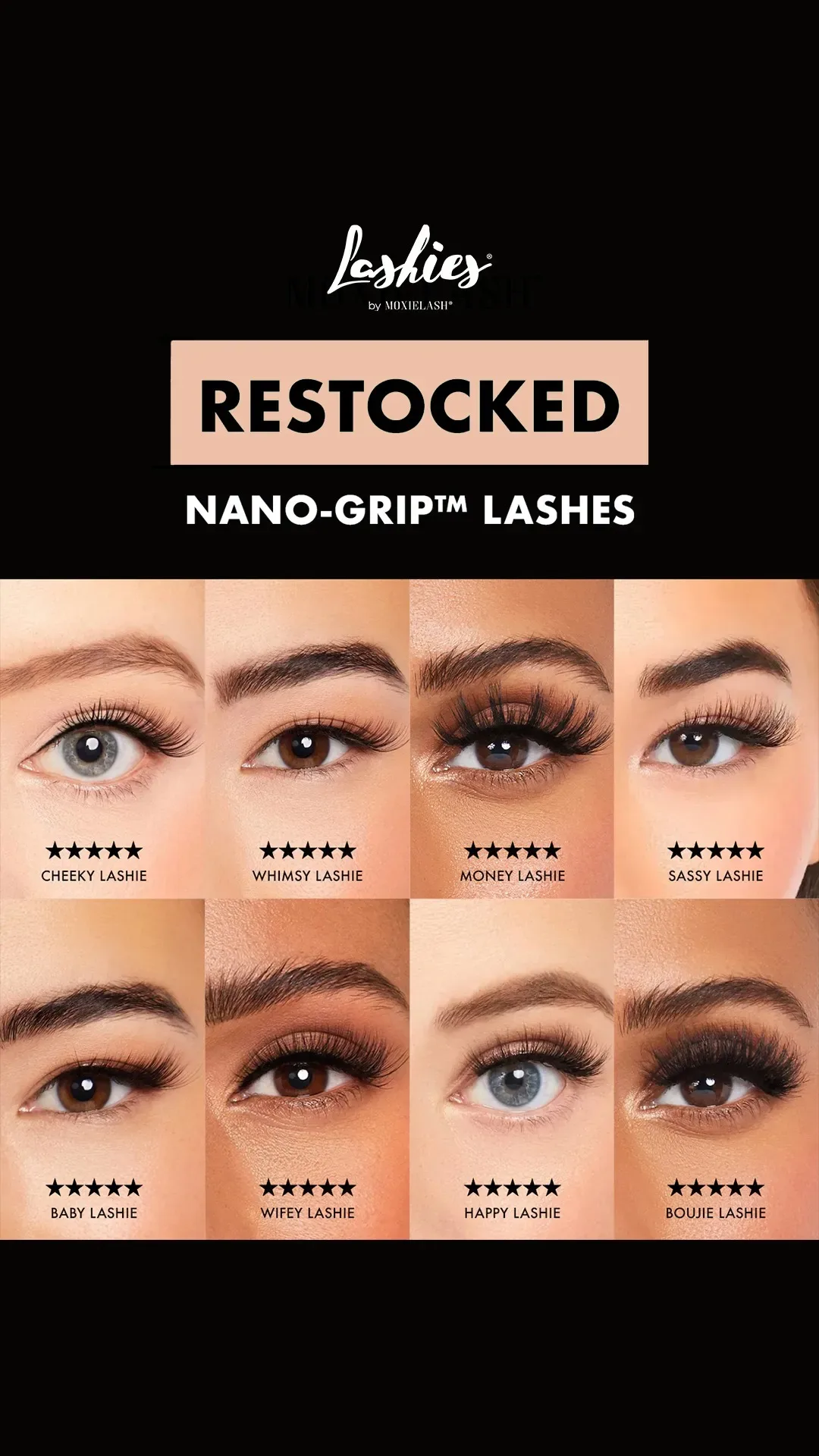
A black top third with the Lashies script logo, "RESTOCKED" in a peach box, and "NANO-GRIP™ LASHES." Below, a two-by-four grid of eyes on different skin tones, each wearing a different style with five stars and a name underneath: Cheeky, Whimsy, Money, Sassy, Baby, Wifey, Happy, Boujie. 310 days.
Why it works: A catalog page that reads as social proof: the stars sit under each style, so the rating attaches to the exact product, and "restocked" adds scarcity without a deadline.
Clone it: Any range with styles or shades. One crop per variant, a star row and a name under each, one word of urgency on top.
19. Trinny London — "I didn't know makeup could do this"
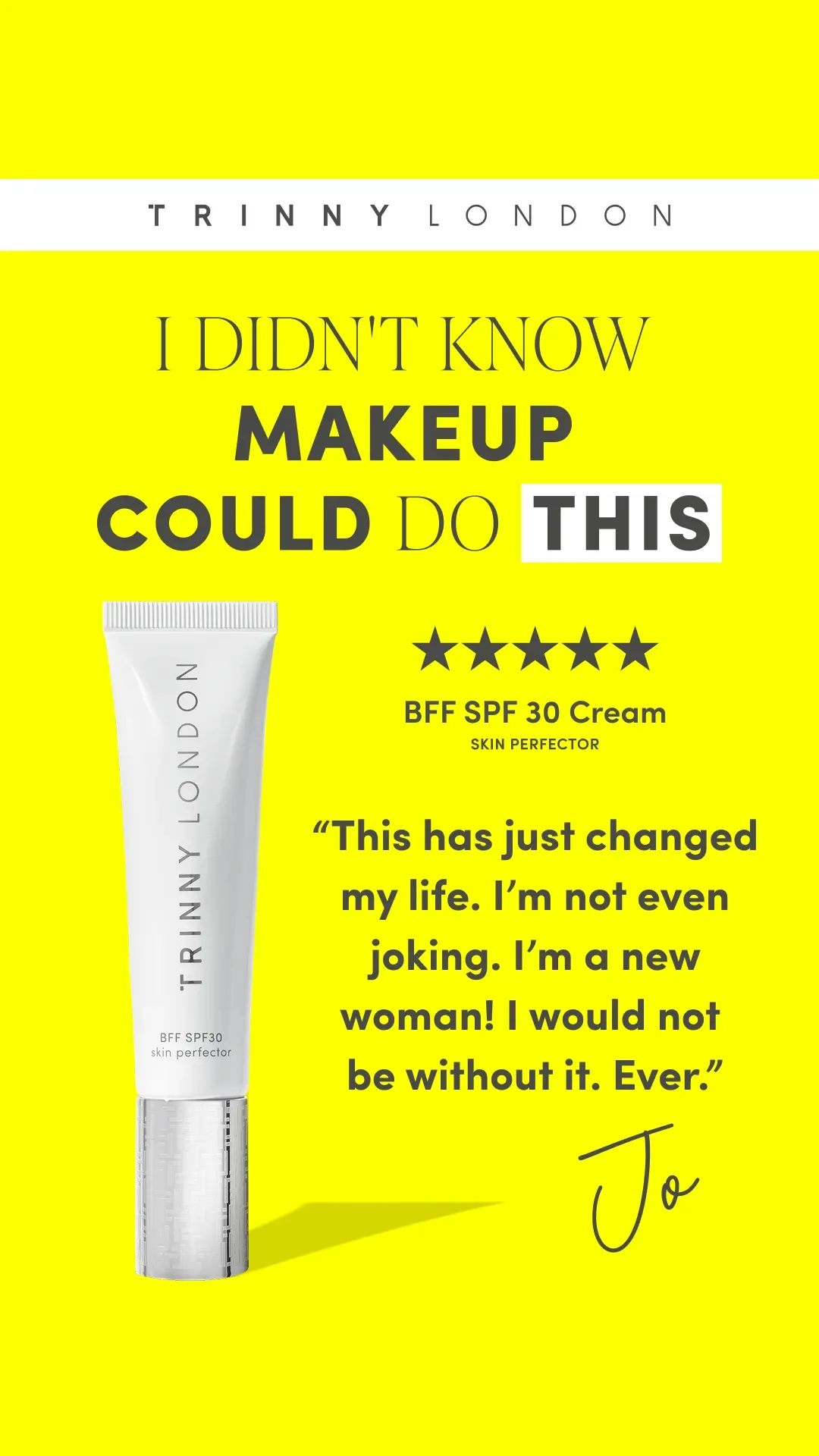
Acid yellow, the Trinny London wordmark, and "I DIDN'T KNOW MAKEUP COULD DO THIS" in mixed light and heavy caps. A white tube of BFF SPF 30 skin perfector on the left; on the right, five stars and a quote: "This has just changed my life. I'm not even joking. I'm a new woman! I would not be without it. Ever." Signed "Jo." 171 days.
Why it works: Its headline is the customer's surprise and its quote is the evidence, in a template that changes only its color per product. Two compliance notes: "changed my life" is the kind of exceptional result the FTC wants put in context, and "SPF 30" makes the product a drug as well as a cosmetic in the US.
Clone it: A testimonial card system. Brand color, the customer's surprise as headline, one quote, a signature.
20. ILIA — "#1 Mascara at Sephora*", with the asterisk
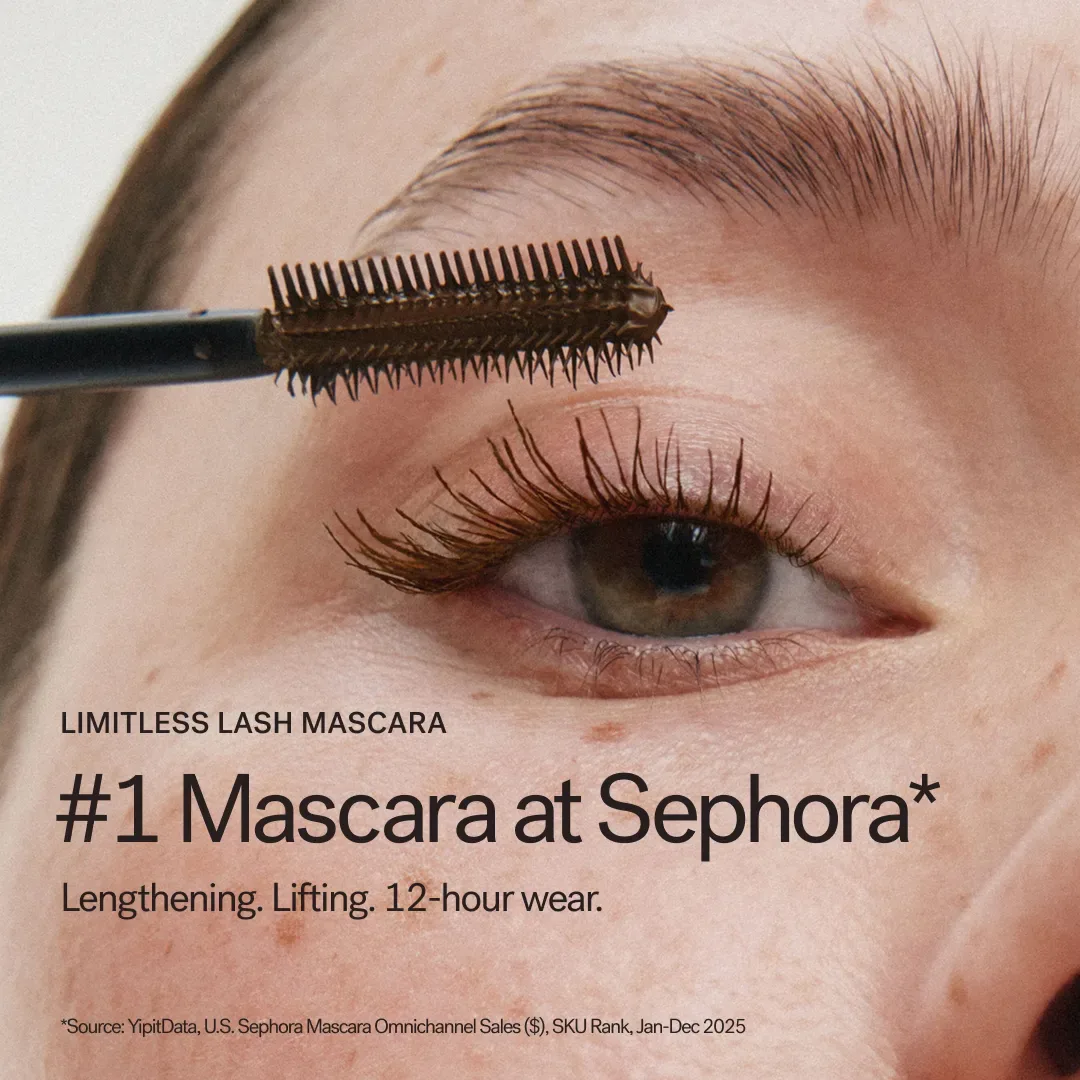
A macro of one eye, a brown mascara wand loaded and lifting the lashes. Bottom-left: "LIMITLESS LASH MASCARA," then "#1 Mascara at Sephora*" in large type, then "Lengthening. Lifting. 12-hour wear." The footnote reads: "*Source: YipitData, U.S. Sephora Mascara Omnichannel Sales ($), SKU Rank, Jan-Dec 2025." 16 days, newer.
Why it works: ILIA prints its substantiation in the frame: who measured, what, where, and when. That footnote is the difference between a claim and a liability (see the L'Oréal case below).
Clone it: Only with a ranking you can source. Put the claim large and the source small, on the same image.
Routine and how-to. Two ways to teach in a static: a choice to make, or steps to follow.
21. IL MAKIAGE — three coverages and a quiz
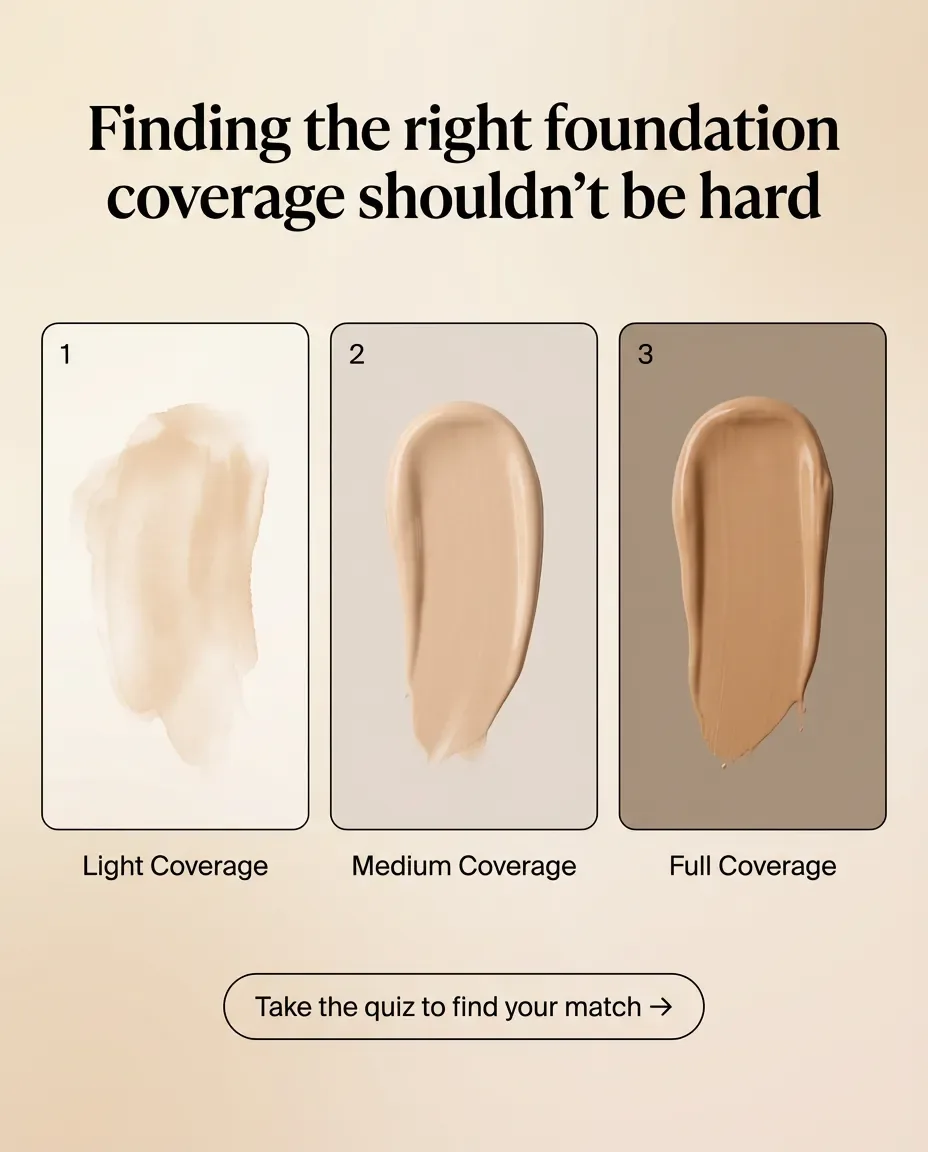
A warm beige frame with three rounded panels, each holding one foundation swatch: sheer and streaky for "Light Coverage," smooth for "Medium Coverage," opaque for "Full Coverage." "Finding the right foundation coverage shouldn't be hard" in a serif at the top; an outlined "Take the quiz to find your match →" at the bottom. 20 days, newer.
Why it works: It turns confusion into a three-way choice and sends the shopper to the quiz. Swatches define "coverage" better than words.
Clone it: Any product with a spec the buyer doesn't understand: coverage, finish, hold. Three swatches, three labels, one next step.
22. Fièra — three steps around a tube
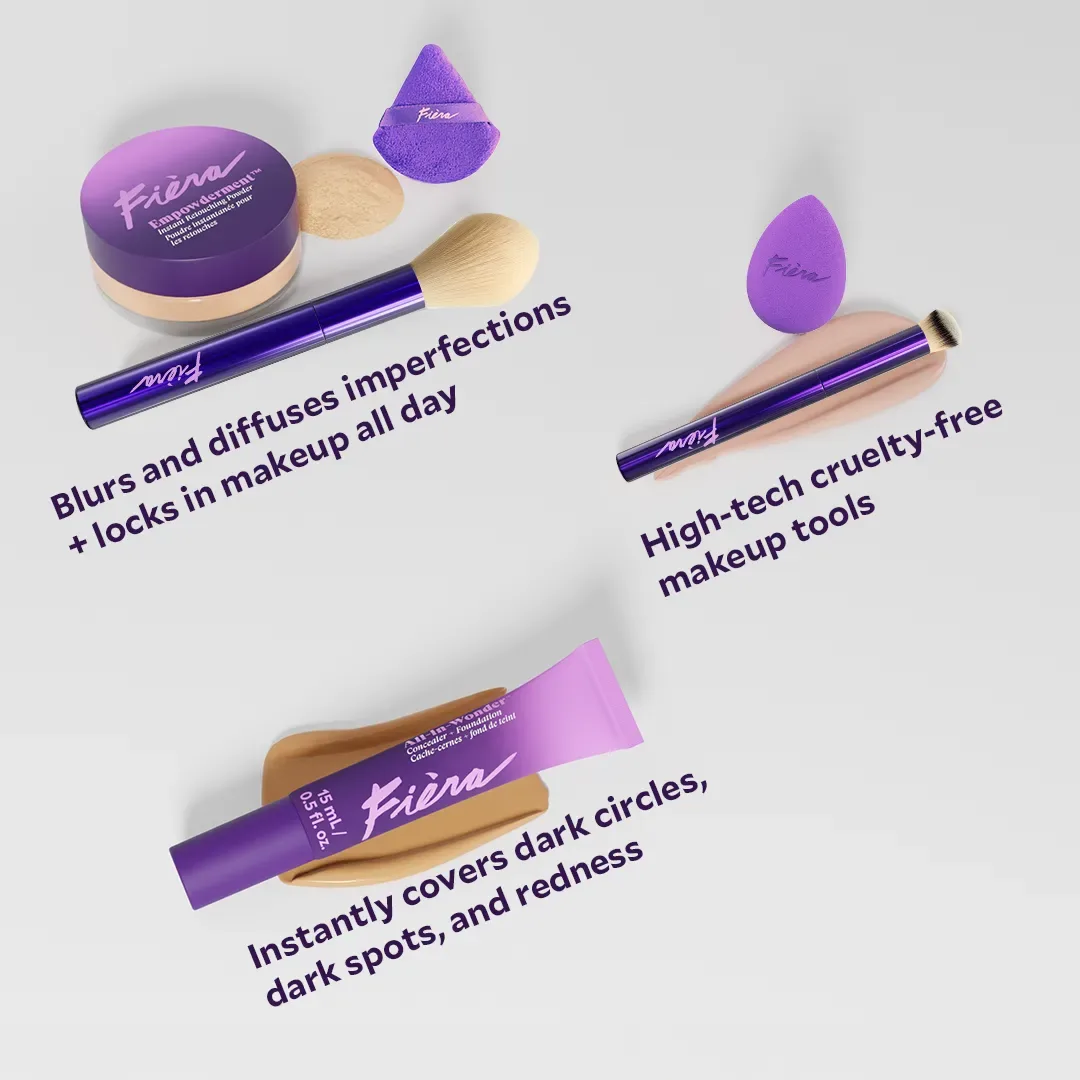
A light-gray flat lay in three clusters, every item purple: a setting powder with a puff and fluffy brush ("Blurs and diffuses imperfections + locks in makeup all day"), a sponge and a buffing brush ("High-tech cruelty-free makeup tools"), and an All-in-Wonder concealer and foundation tube on a beige swatch ("Instantly covers dark circles, dark spots, and redness"). Each line is set at an angle along its cluster. 253 days.
Why it works: A routine without numbers: base, tools, set. Angled copy leads the eye in order, and one brand color makes three product types read as a system.
Clone it: A bundle or a routine. Group by step, one benefit line per group, angled to lead the eye.
Offer and gift. Five of the 26 put money in the frame. Makeup brands discount less than you'd guess, and when they do, a gift often replaces the percentage.
23. MoxieLash — a Black Friday ad that ran 321 days
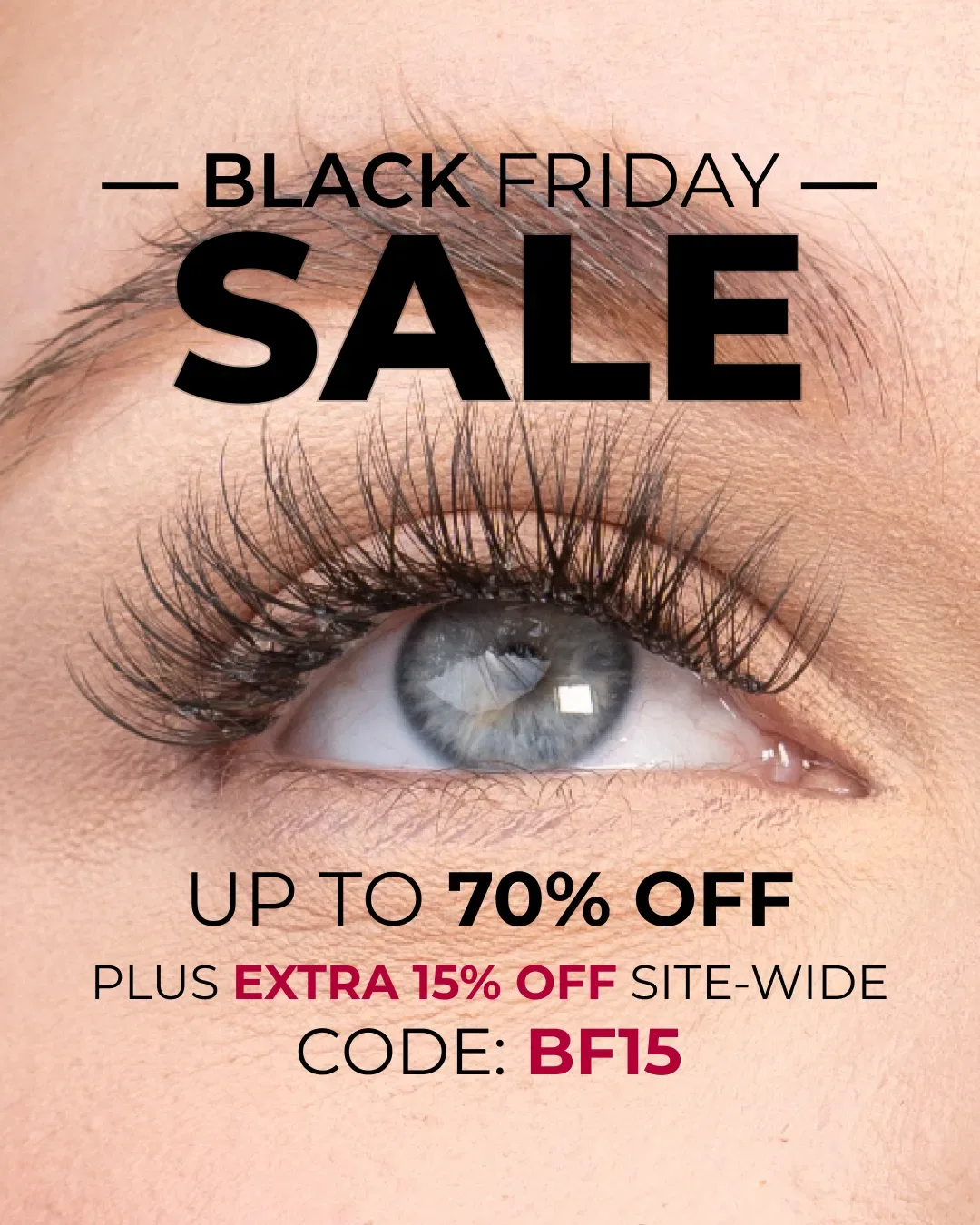
A macro of one blue-gray eye in full false lashes fills the middle of a peach frame. "— BLACK FRIDAY — / SALE" in heavy black at the top; "UP TO 70% OFF / PLUS EXTRA 15% OFF SITE-WIDE / CODE: BF15" at the bottom, the extra discount and code in red. 321 days at the October 9, 2026 check.
Why it works: An eye is the demo and the offer is stacked. Its run-length is the honest lesson: a "Black Friday" ad still live in October either became evergreen or nobody turned it off. More seasonal examples sit in the sale and promo ad examples in the library.
Clone it: Product macro plus a stacked offer. Then put an end date in your calendar.
24. Milk Makeup — the duo at 20% off
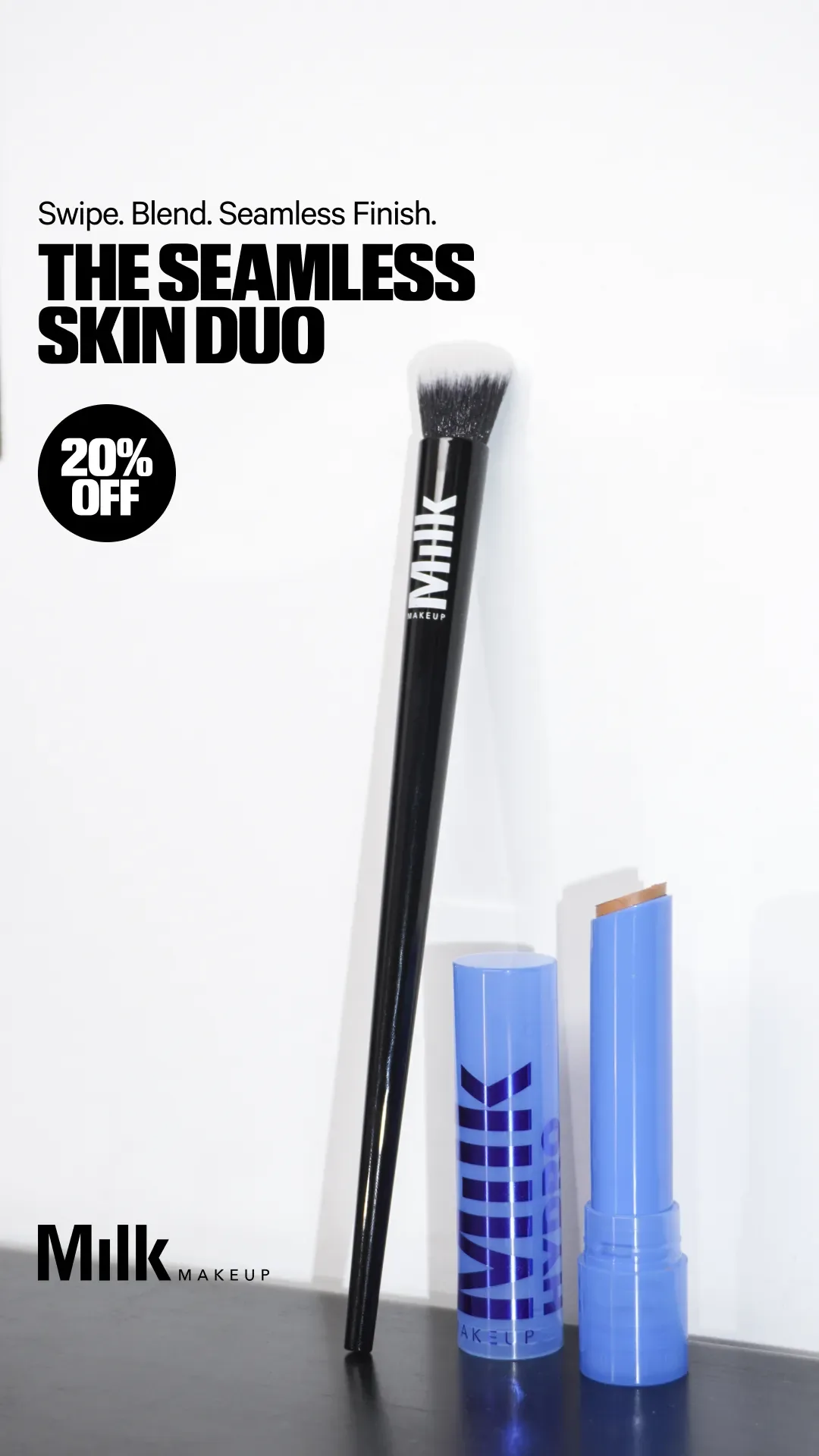
A black brush and two cobalt Hydro Grip concealer sticks, one uncapped, stand on a dark shelf against white. "Swipe. Blend. Seamless Finish." as a kicker, "THE SEAMLESS SKIN DUO" in heavy condensed caps, and a black "20% OFF" roundel. 107 days.
Why it works: Its kicker is a routine in three words, and the discount applies to a pairing, which raises order value instead of cutting it.
Clone it: Pair a product with its tool. Three-word routine, one roundel.
25. Charlotte Tilbury — "worth £325, yours for £170"
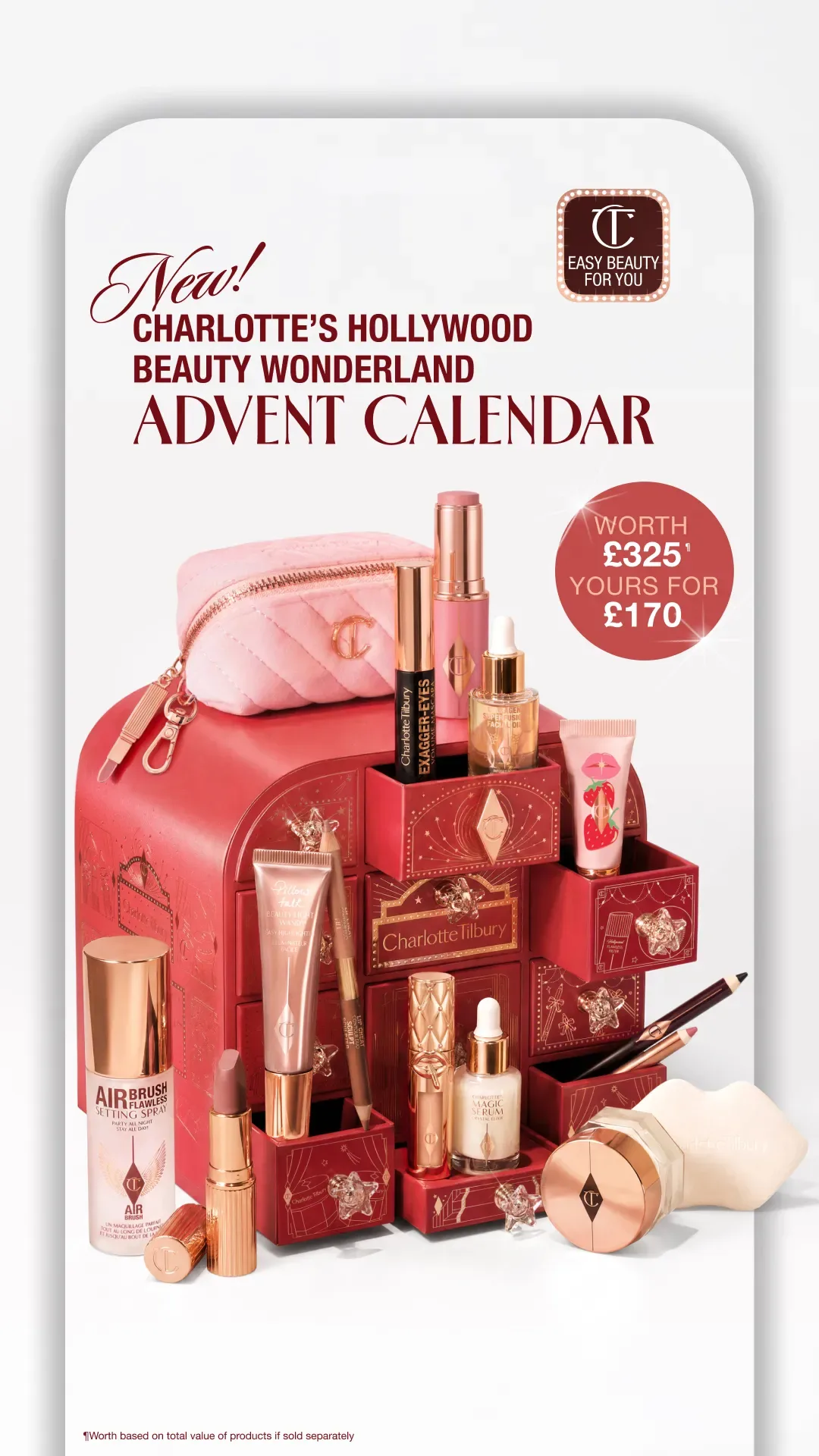
A red-and-gold advent cabinet with its drawers open, spilling a lipstick, mascara, setting spray, highlighter wand, serum, and a quilted pink bag, all inside a rounded phone-shaped frame. "New! CHARLOTTE'S HOLLYWOOD BEAUTY WONDERLAND ADVENT CALENDAR" at the top, a red roundel reading "WORTH £325¹ YOURS FOR £170," a "CT EASY BEAUTY FOR YOU" badge, and a footnote: "¶Worth based on total value of products if sold separately." 31 days, newer, seasonal.
Why it works: A "worth" figure anchors a high price against a higher one, and the footnote says how the "worth" was calculated. Every product is visible, so the value claim is checkable.
Clone it: Gift sets and bundles. Show every item, state the sum, footnote the math.
26. Rare Beauty — a gift instead of a discount
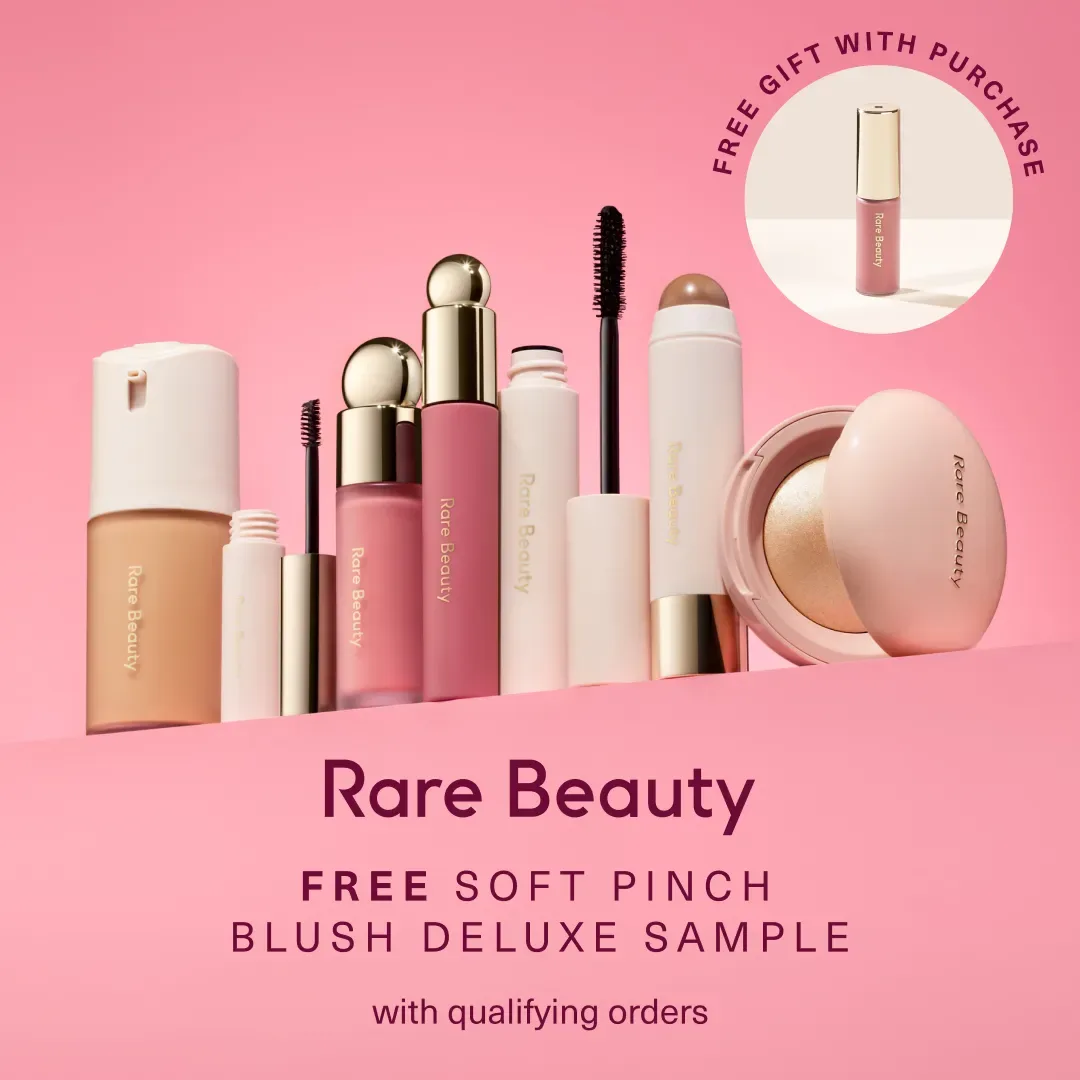
Nine products in a row on a pink set: foundation, two mascaras, liquid blushes, a contour stick, and a highlighter compact. A circular inset top-right, ringed with "FREE GIFT WITH PURCHASE," shows a mini Soft Pinch blush. Below: "Rare Beauty / FREE SOFT PINCH BLUSH DELUXE SAMPLE / with qualifying orders." 65 days, newer.
Why it works: Its gift is the hero product in miniature, so the promotion doubles as sampling, and no percentage touches the price of the lineup.
Clone it: Gift-with-purchase on your bestseller's mini. Lineup below, gift in a roundel, "qualifying orders" stated plainly.

Create your own beauty product ads
Create your ad
What the long runners share
All three ads that ran past a year are a shade grid (Jones Road, 390 days), a one-feature before-and-after (Jones Road, 390), and a close-up mid-application (Sephora Collection, 412). All three answer "will it work on me?" before the viewer reads a word. And the claims that ran long are metaphors ("5 extra hours of sleep"), counts ("15 shades"), or rankings with a printed source. Broad promises turn up in regulators' files, not in long-running ads. More transformations sit in the library's before and after ad examples, and review formats get their own post, testimonial ad examples.
Makeup ad rules: FTC, FDA, and Meta
Three rulebooks shape what beauty ads like the 26 above can show and say. What follows summarizes official sources. It isn't legal advice.
The FDA decides by what the ad claims. Under the Food, Drug, and Cosmetic Act, a cosmetic is for "cleansing, beautifying" and similar purposes, a product intended "to affect the structure or any function of the body" is a drug, and intended use can be set by "claims stated on the product labeling, in advertising, on the Internet, or in other promotional materials" (FDA, "Is It a Cosmetic, a Drug, or Both?"). Three consequences for makeup ads:
- SPF in makeup makes it a drug too. The FDA states that "moisturizers and makeup marketed with sun-protection claims are cosmetic/drug products." M·A·C's Studio Fix Fluid SPF 15 and Trinny London's BFF SPF 30 sit in that category.
- Anti-aging wording decides the category. A product meant "to make lines and wrinkles less noticeable, simply by moisturizing the skin" is a cosmetic, while one claiming "to remove wrinkles or increase the skin's production of collagen" is a drug (FDA on anti-aging products). Jones Road's "for women over 40" names an audience, not an effect.
- Lash and brow growth is a drug claim. The FDA lists claims to restore hair growth among the claims that make a product a drug. A mascara can say "lengthening" (a look, ILIA) or name a "peptide lash serum" (an ingredient, Kosas); "grows your lashes" moves it to the drug column.
The FTC wants proof for every objective claim. In 2014 the FTC approved a final order against L'Oréal USA over Lancôme Génifique and L'Oréal Paris Youth Code ads that claimed the products were "clinically proven" to boost genes' activity and produced "visibly younger skin in just 7 days." The order bars unsupported claims of that kind and misrepresenting test results (FTC). That principle covers "#1 at Sephora," "24HR," and "after 1 application," and ILIA's footnote shows what substantiation looks like in a frame. For testimonials, the FTC says that when an endorser's results are exceptional, the ad "must make clear to the audience what the generally expected results" are, and unexpected connections such as free product must be disclosed (Endorsement Guides FAQ). Its 2024 rule also bans fake and AI-generated reviews and testimonials (FTC).
Meta polices appearance, not makeup. Meta's Health and Wellness ad standard bars "statements of inferiority about physical appearance," meaning "terms, descriptions, or questions that are negative and attack an individual's appearance, specific body parts, or hygiene." It lists "general cosmetic products, procedures, surgeries depicting before and after transformation" among ads allowed only for people 18 and over, yet exempts "non-permanent cosmetic and beauty products such as creams, makeup, hair products" from that age rule (Meta Transparency Center). Those two lines overlap for a makeup before-and-after and Meta doesn't say which wins, so the cautious setting is 18+ for any ad built as a transformation. Jones Road's "5 extra hours of sleep" frames the result positively. "Embarrassed by your dark circles?" is the kind of question the standard describes.
The UK goes further on retouching. In February 2021 the UK Advertising Standards Authority ruled against two tanning brands, Skinny Tan and We Are Luxe, for filtered influencer Stories, and told advertisers to "avoid applying filters to photos or videos which are directly relevant to the product being advertised" (ASA). Its production-techniques guidance says lash inserts "should not be used to do more than replace damaged or missing lashes," cites a 2012 ruling against a Dior mascara ad over retouched lashes, and says a disclaimer doesn't rescue an inherently misleading ad (ASA). Glossier's visible freckles and pores in ad 11 are a style choice that also happens to be the safe one.
How to make a makeup ad that converts
- Pick the move from the product, not the trend. Foundation and concealer: shade range (ad 1) or a one-feature before-and-after (ad 6). Lip and cheek: swatches or smears (ads 4 and 5). Mascara, liner, brow: a close-up mid-application (ads 10 and 14). Primers: a bracketed before-and-after (ad 7) or a "versus the habit" headline (ad 16).
- Put one number in the frame and make it true. Hours of wear, shade count, price, or a sourced ranking.
- Shoot real skin. No filters on anything the product touches, and lash inserts only to fill gaps.
- Leave the price out unless it's the argument. Twenty-one of 26 did.
- Build a template, not an ad. Trinny London's card, Jones Road's before-and-after, and MoxieLash's grid swap the product and keep the frame. Then test three to five variants against each other. Placements are covered in Instagram ad formats for beauty products.
Every ad above sits in the AdDogs library, and AdDogs can clone any of them with your product: upload your product photo, pick the reference, and it rebuilds the layout with your brand colors. One credit is one ad in the dimension you pick. Basic is $12/mo for 30 credits with 1:1, 9:16, and 16:9, and Pro and Ultimate include all 14 aspect-ratio options. The legal line for cloning an ad covers what you can borrow.
Methodology
On October 25, 2026 we searched the AdDogs library for public ads mentioning makeup products (mascara, lipstick, foundation, concealer, blush, liner, bronzer, brow, primer, gloss), plus beauty-category ads from makeup brands. We kept only run-lengths measured in the Meta Ad Library or by Foreplay, which excluded many gallery-imported ILIA, Alleyoop, Glossier, and Jones Road ads, then dropped skincare, fragrance, SPF-only, and accessory ads, anything in our skincare post, and low-resolution or duplicate images. We chose 26 by creative move, at most two per brand. Foreplay checked five ads on April 8, 2026 (both Fenty Beauty, the primer before-and-after, Sephora Collection, Dr. Brandt), and Meta data covers the rest between August 11 and October 12, 2026. Copy was transcribed from the images. Our rules summary reflects the linked FDA, FTC, Meta, and ASA pages as of October 25, 2026.
FAQ
How do you advertise makeup on Facebook and Instagram?
Answer "will this work on me" in the image. In this set, the longest-running makeup ads show a shade range (Jones Road's 16-jar grid, 390 days), a one-feature before-and-after (Jones Road's concealer, 390 days), or a close-up mid-application (Sephora Collection's mascara, 412 days). Twenty-one of the 26 show no price.
Can you show before and after photos in makeup ads on Facebook?
Yes, with care. Meta allows cosmetic before-and-after transformations for audiences 18 and over but exempts non-permanent makeup from its age rule, so 18+ targeting is the cautious setting. Meta rejects copy that attacks appearance. Crop to one feature, keep the lighting identical, and describe the result positively.
Can makeup ads use filters or retouching?
Not on the part of the face the product changes. The UK ASA ruled against two tanning brands in 2021 for filtered Stories, limits lash inserts to replacing missing lashes, and says a disclaimer doesn't fix a misleading image. In the US, the FTC treats an exaggerated result like any other unsubstantiated claim.
Is makeup with SPF a cosmetic or a drug?
Both, in the US. The FDA says makeup marketed with sun-protection claims is a cosmetic/drug product, so a foundation with an SPF number must meet drug requirements too. Claims to grow lashes or remove wrinkles also make a product a drug.
What claims can a beauty ad make?
Any objective claim it can prove. The FTC's 2014 order against L'Oréal over "clinically proven" Génifique and Youth Code ads is the standard warning. Rankings, hours of wear, and percentages need substantiation before the ad runs, as ILIA's sourced "#1 Mascara at Sephora*" shows. Testimonials must reflect expected results, and fake or AI-generated reviews are banned.
How much do makeup brands spend on advertising?
e.l.f. Beauty reported $399.8 million in marketing and digital expenses for its fiscal year ended March 31, 2026, about 24% of net sales. Its brow-pen ad with one line and a €9 price still ran 358 days on Meta.